Screen Stories – March 1968

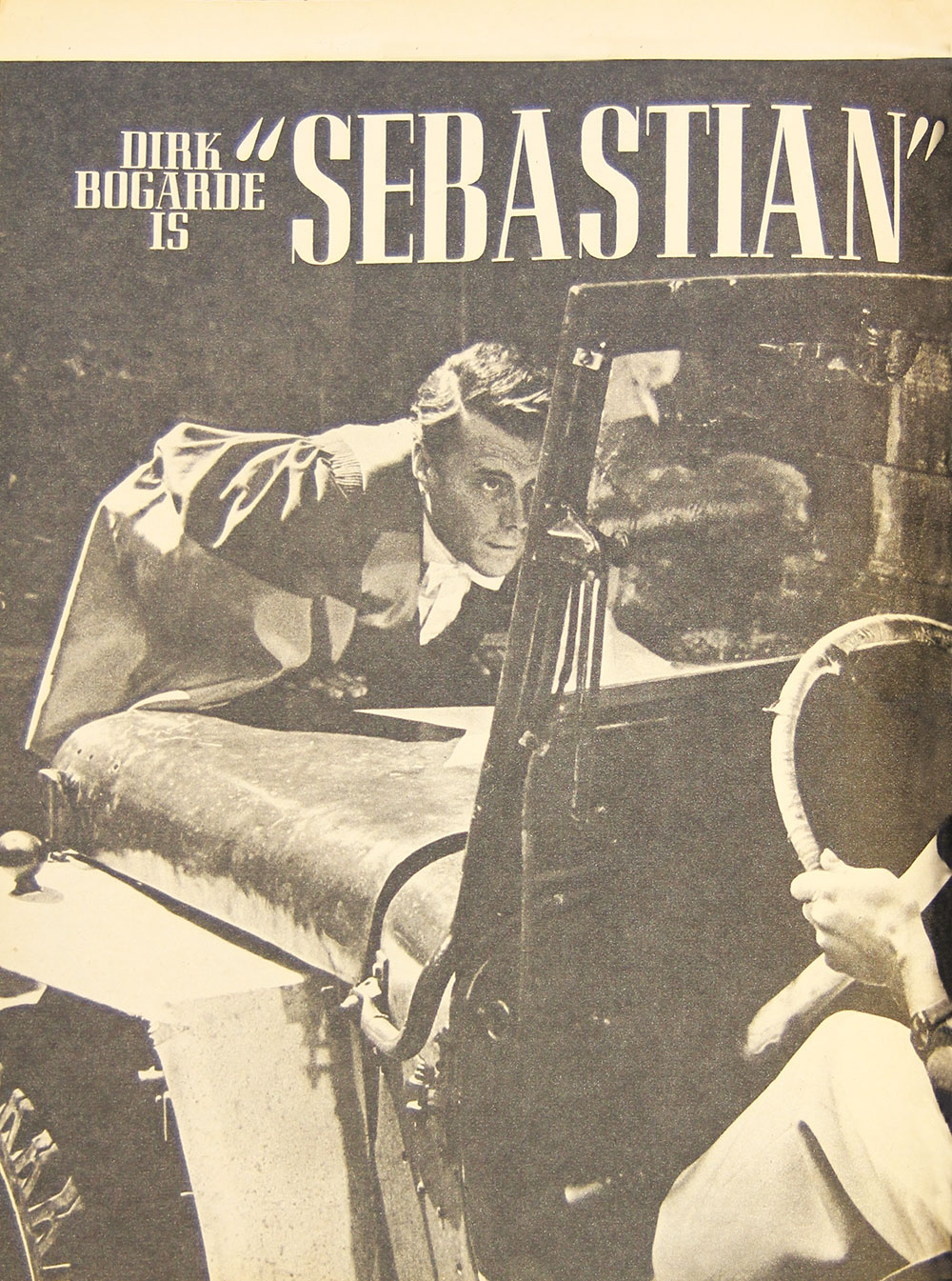

Dirk Bogarde is “Sebastian”
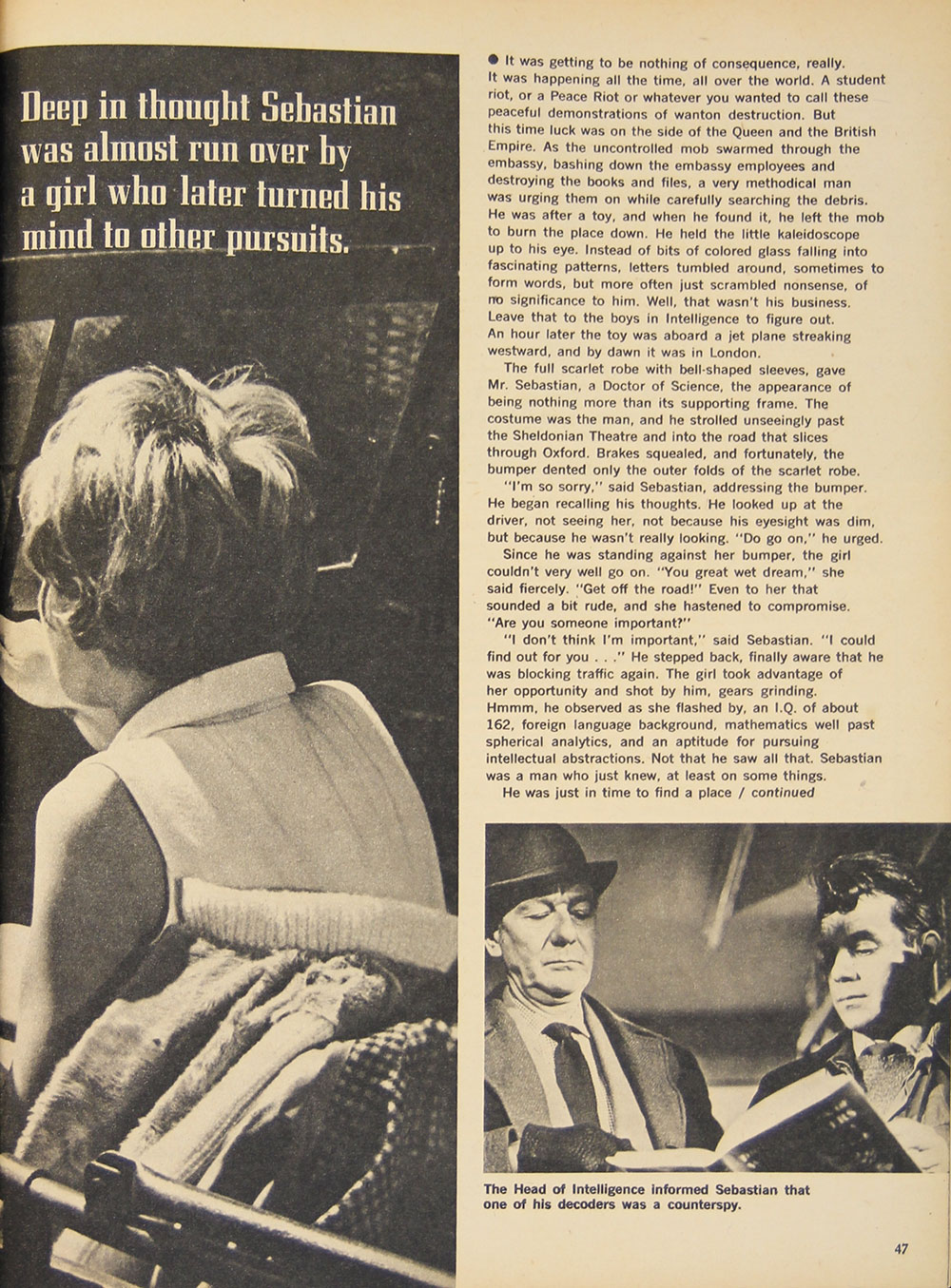
Deep in thought Sebastian was almost run over by a girl who later turned his mind to other pursuits.
It was getting to be nothing of consequence, really. It was happening all the time, all over the world. A student riot, or a Peace Riot or whatever you wanted to call these peaceful demonstrations of wanton destruction. But this time luck was on the side of the Queen and the British Empire. As the uncontrolled mob swarmed through the embassy, bashing down the embassy employees and destroying the books and files, a very methodical man was urging them on while carefully searching the debris. He was after a toy, and when he found it, he left the mob to burn the place down. He held the little kaleidoscope up to his eye. Instead of bits of colored glass falling into fascinating patterns, letters tumbled around, sometimes to form words, but more often just scrambled nonsense, of no significance to him. Well, that wasn’t his business. Leave that to the boys in Intelligence to figure out. An hour later the toy was aboard a jet plane streaking westward, and by dawn it was in London.
The full scarlet robe with bell-shaped sleeves, gave Mr. Sebastian, a Doctor of Science, the appearance of being nothing more than its supporting frame. The costume was the man, and he strolled unseeingly past the Sheldonian Theatre and into the road that slices through Oxford. Brakes squealed, and fortunately, the bumper dented only the outer folds of the scarlet robe.
“I’m so sorry,” said Sebastian, addressing the bumper. He began recalling his thoughts. He looked up at the driver, not seeing her, not because his eyesight was dim, but because he wasn’t really looking. “Do go on,” he urged.
Since he was standing against her bumper, the girl couldn’t very well go on. “You great wet dream,” she said fiercely. “Get off the road!” Even to her that sounded a bit rude, and she hastened to compromise.
“Are you someone important?”
“I don’t think I’m important,” said Sebastian. “I could find out for you…” He stepped back, finally aware that he was blocking traffic again. The girl took advantage of her opportunity and shot by him, gears grinding. Hmmm, he observed as she flashed by, an I.Q. of about 162, foreign language background, mathematics well past spherical analytics, and an aptitude for pursuing intellectual abstractions. Not that he saw all that. Sebastian was a man who just knew, at least on some things.
He was just in time to find a place in the Encaenia Procession. There were two thousand people in the auditorium to watch the annual spectacle. Solemn organ music, speeches in Latin-it was all very impressive and incredibly dull.
“Sebastian, isn’t?” asked the robed figure next to him. “I’m Riley … of Brasenose.”
“Yes, of course,” said Sebastian, courteous but vague.
“Topography was your subject … “
“Topology,” corrected Sebastian.
“Of course. I remember. I read a paper of yours on the Topology of Synclastic Forms. We expected great things of you. Great things.”
“I’m sorry you’ve been disappointed.” There were times he was disappointed himself. “I lead a frivolous life, I’m afraid.”
The Chancellor intoned the benediction in Latin, and the ceremony was over. The robed figures filed into the ancient courtyard and broke into small groups, suddenly talkative. A Doctor of Letters cornered Sebastian.
“Congratulations,” said Sebastian. It wasn’t every Doctor who got to sit at the right of the Chancellor.
“Well, it makes a placid, toddling sort of day.” The Doctor paused as though trying to remember something. “Oh … Jamie’s boys sent a present.” He pulled a toy from the folds of his robe and handed it over. “Did you hear about that? It’s for you.”
Sebastian pocketed the kaleidoscope, his smile turning rueful. That the Head of Intelligence could also be a Doctor of Letters at Oxford was not too impossible, but for a Doctor of Science who was also the Head of Cryptology it was damned inconvenient. Now he would have to work again.
But first, his robe folded and tucked under his arm, he had to go to Blackwell’s Bookshop. The girl inspecting the mathematics bookrack looked up at him in astonishment. “Did I conjure you up? I was just thinking about you.”
Sebastian recognized her as the girl in the car. “What were you thinking?”
“I was thinking you are a very mysterious character. Say something mysterious.”
“Spell your name backwards.”
“Y-K-C-E-B D-R-A-W-O-H.”
“Becky Howard. Very good.” He brought out his everpresent memo pad and scrawled down a number. “If you ever find yourself in need of a job, ring that number. I’m in the spelling business.”
“What’s your name?” Her curiosity was real, almost pressing.
“Naitsabes. Ring me. NAITSABES.”
Becky returned to her flat, annoyed but intrigued. It was a nice little flat though a bit of a mess. No piece of furniture without its drapery of panties, bras, and nylons. She picked her way over a few ash trays and phonograph records strewn about the floor and removed with distaste an orange rind that had dried hard on the juice squeezer. With more distaste she looked at the sign scrawled in lipstick over her bed: “Get Organized.”
She lifted a pair of slacks and found the phone.
“Let me smother you in jewels,” was Sebastian’s greeting. “Let me whisk you to the Monte in my Mercedes. Let me teach you the meaning of desire.”
“What?” said Becky, but she recovered fast. “It sounds a bit old-fashioned to me.”
Miss Elliott snatched the phone from Sebastian. “This is Mister Sebastian’s personal assistant. We are a more or less sane and respectable department of Civil Service, appearances notwithstanding…”
“Civil Service… Good God!” Becky hung up in dismay.
“Well, you’ve lost her,” said Miss Elliott, looking accusingly at her boss.
“You’ve been doing a lot of this stuff recently. This gaily irresponsible stuff. This fart-arsing about. It’s time you took a proper holiday.”
“Was I unkind to the poor girl?” Sebastian rubbed his forehead. “I get tired, I get bored, I get angry.”
He applied the kaleidoscope to his eye and turned it slowly. The letters clung together until he had made nearly a quarter-turn. Then they spilled into a new formation. It made his eye ache, and his head ache, but he was finding words. It was like a dozen monkeys pounding type-writers -they were bound to spell out words now and then, but never would they write whole messages. But the word “now” or “won” kept repeating itself about every fourth turn.
The phone again. “What department of Civil Service?” Becky demanded.
“I think you might find it interesting,” said Miss Elliott. “How many words can you make out of ‘thorough’?”
“Is that a serious question?” asked Becky suspiciously.
“Yes, it is.”
Becky rattled off about twenty, ending with, “Rut, rout, hut, and out.”
“Not bad,” approved Miss Elliott. “Do you like music?”
It went on, Becky finding herself enjoying it even as her annoyance increased. “Would I see much of Mister Sebastian?” she demanded at last.
“Yes and no.” was Miss Elliott’s guarded answer. “You’ll find him, more whimsical than predatory, if thats any comfort to you.”
“Well, I like them more predatory than whimsical…if that’s any comfort to you,” retorted Becky.
Miss Elliott smiled, satisfied. “Yes, I would say you were aggressive, temperamental, quick-witted. I think you’ll probably do.”
“Do what?”
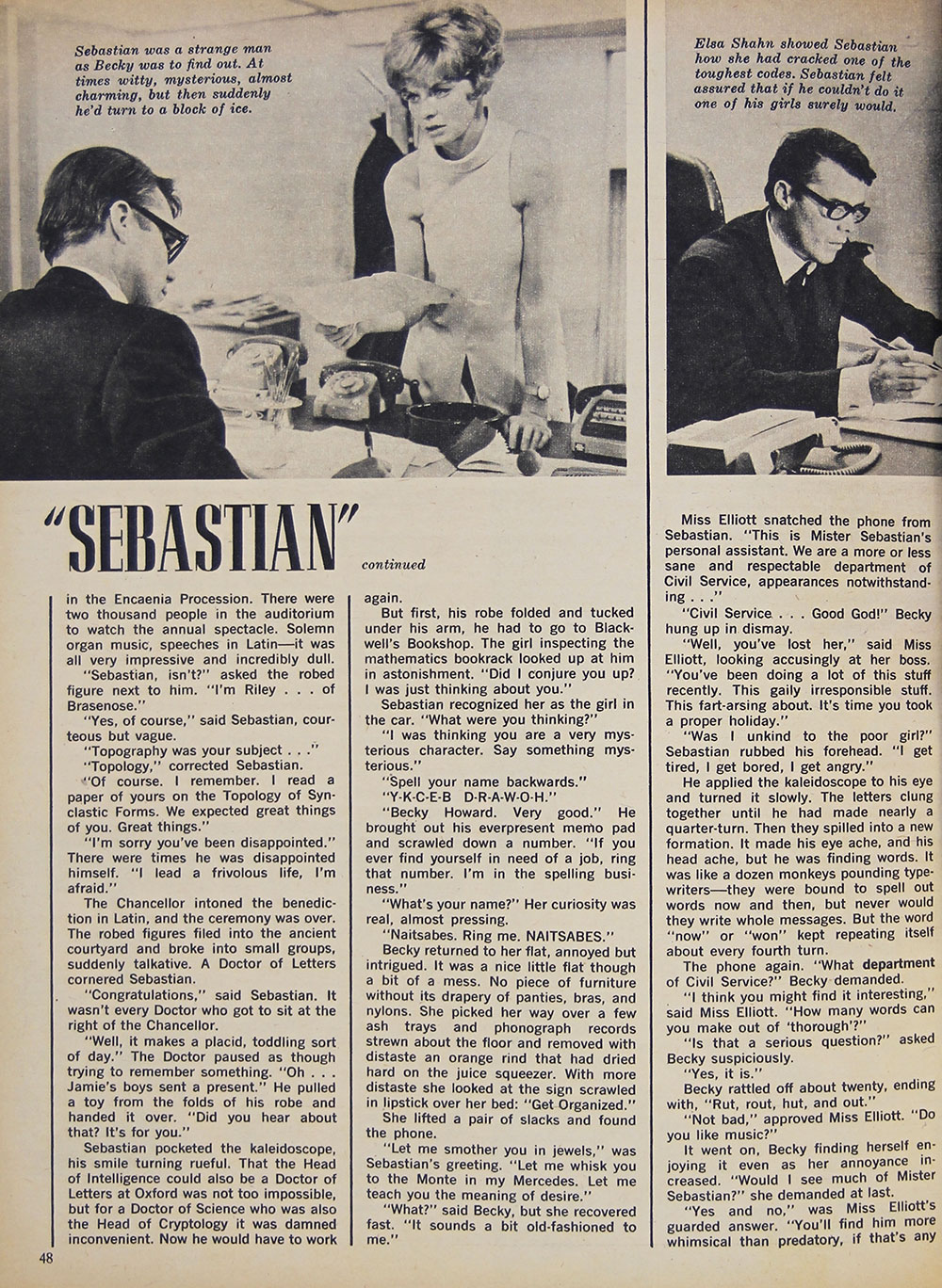
It took three months of intensive training to tell her that. A rose is a sore, is Eros, is oser-a Yiddish word meaning doubt or skepticism. Hour after hour and day after day, and there was even a room supplied with crockery to be thrown and furniture to break, and bags to punch when the strain got too great. There were a dozen girls in training, and maybe a dozen more in the code room of which six were the elite. The elite were no more intelligent than the rest, nor no more logical. But like Sebastian they had the strange gift of being able to leap logical barriers to arrive at illogical conclusions that were often right. Like Elsa Shahn, a German Jewess with a face lined by bitter experience but still possessed of an attractiveness too powerful for experience to destroy. It was Elsa who had broken the kaleidoscope code when she began turning the kaleidoscope back and forth like a safecracker seeking the combination, they clicked right into place. Why had she found it and not Sebastian? Neither knew, but Sebastian did know that what he couldn’t find, one of his girls could and would.
Of the dozen girls in training when Becky entered the class, only she graduated to the Main Decoding Room, and then only after going through a long interrogation by agents who already knew more about herself than she did. Finger-printing, mug shots, an examination on the Official Secrets Act, and finally a Security Pass admitting her to the holy of holies.
After all her expectations, the room was a great disappointment. It looked like a classroom in some reform school for delinquent women. Ten girls slouched behind their battered desks smoking cigarettes and grumbling to each other. Sebastian sat on a raised platform in an armchair rescued from a junk pile, smoking a peeling cigar. Then the wall behind him became a wide movie screen upon which were projected hundreds of letters in groups and columns. No electronic calculators, no code-unscrambling machines. Here was where human minds took over after the machines had failed. Here was where problems were solved by the plain, old-fashioned method of thinking about them.
Sebastian turned to study the top row of words, apparently finding them fascinating. “XOTRG UETOI EXUCZ OETRU PLQTN.” “I’m forever blowing bubbles,” he said. “Right, my lovely children?”
The girls chorused that he was right. “This was intercepted an hour ago. It’s a very crafty little number indeed. It may well give us the low-down on Herr Ulbright’s visit to Moscow which is a juicy bit of gossip. Just about juicy enough for a million attempts.” He began to sing. “Happy days are here again.” He took his pointer and indicated a scattering of letters he seemed to find significant. “Watch the progress of those T’s. Try to align them in columns. Take a bigram test. Look out for dummy groups. This is really… quite…important. When we finish…” he paused expectantly.
The girls were ready on cue. “WE ALL GO HOME.”
“When do we finish?”
“NEVER!”
“Right, my lovely children. Get on with it.”
Sebastian strolled down the aisle. “Hullo. Miss Howard.” He strolled out the door.
Becky should have appreciated the fact that he had recognized her at all. But after three months of training, and that was all the greeting she got, and she the only one in her class to pass. . . . She looked at the progression of the T’s on the screen, not liking them at all. She began to think. She was in business.
Sebastian had a call to make. General Phillips, head of Security, had been putting his agents on the trail of Elsa Shahn, and she was all upset. Something about her being a member of the Hampstead Action Group for Peace in Vietnam.
General Phillips voice was icy cold when he came on the phone. “I take it you want to speak to me about Elsa Shahn? I’m concerned about the state of security in your department. I tell you that directly.”
Sebastian squeezed a rubber ball until his knuckles were white, but his voice was languid. “Much as your concern distresses me, General. I must ask you to leave my people alone. If you please.”
“We’d better meet. In your office. Four-thirty on Friday.”
“By all means. Goodbye, General.” Sebastian hung up and hurled the ball across the room with full force. He caught it on the rebound, its speed making his hand sting, and he felt better.
He felt so good on Friday that he was practically debonair. Maybe too much so. General Phillips was a very practical man.
“All your girls know too much, and some of them know much too much,” accused the general.
Mildly Sebastian pointed out that if they didn’t know anything, they would be of no use in the decoding room. “I need girls who possess a highly specialized intellectual gift. When I find them. I keep them . . . and they stay. The Intelligence Service can thank God that they do.”
General Phillips was not impressed. In his opinion, Sebastian was the weakest link in the Intelligencc system. Through his hands those of his girls passed all the international messages of gravest importance. They knew all the secrets of the world, even before the Head of Intelligence was given the decoded messages, sometimes after weeks of work. What this department needed was someone like himself to run it, and not a nut like Sebastian.”
“Elsa Shahn should be dismissed. She’s a bad security risk,” he said flatly.
“Elsa has worked here since 1942, bless her burning little Jewish heart,” said Sebastian. “Let’s avoid wasting each other’s time. I answer for the conduct of my office to the foreign Secretary direct. I’ve seen three Heads of Security come and go, and I’ve never taken their orders to sack my staff. As for Elsa Shahn, she’s one of the best decoders I have, I know she is loyal.”
That ended the conversation, but started the battle. General Phillips went directly to the Head of Intelligence.
“You think he ought to go!” asked the Head of Intelligence.
“Yes I do.”
“He was running the department ten years before I got here. At the moment he is irreplaceable. No, John, he won’t be going for a while yet.”
“He’s becoming jungly. He plays about with a rubber ball. It won’t be long before he’s wearing spurs and giving away coding manuals to little girls in Hyde Park.”
The Head of Intelligence laughed, a little ruefully. “Sebastian is a romantic. He needs a little extra something…like a rubber ball. Keep an eye on him, though, and that Shahn woman. For the present we’ll leave it at that.”
General Phillips began keeping an eye on everyone. Quite interesting, these private lives. Sebastian was given to visiting the flat of a buxom, cheerful girl in a sad sort of way who fried sausages for him-that was all the sniffing agent could detect. Her name was Carol, and she did a little modelling and TV work with no great success. He also favoured a small pub frequented by artists and writers of the kind who, if not Reds were certainly Bohemians. And at least once a week he visited a gambling casino where he played of all things, chess. But early every night he was in his rather barren flat, playing records to relieve the solitude. All night long, at any hour, his light would go on, and his shadow would be seen pacing back and forth while he scribbled on his memo pad. Clearly he was going around the bend.
Elsa just went to meetings. Ban The Bomb meetings, Disarmament meetings, Peace in Vietnam meetings, and Civil Rights meetings. Lots of good people did. But what a lot of nuts most of them were. Clearly she was going round the bend.
Becky Howard was so far behaving normally with a perfectly normal if-this could be bad-intellectual boyfriend. But if the agent could have got close enough to hear their conversation, his suspicion would have been reawakened.
“Whom, above all others, do you reverence. cherish, and adore?” asked Gavin.
“Naitsabes. Naitsabes,” she cried adoringly.
“You know. these days I quite often fear for the balance of your mind,” said Gavin.
“You mustn’t worry, darling,” Becky assured him. “We’re both madly in love, and that’s all that matters. Me with Naitsabes . . . and you with you.” And she kissed him a fond farewell.
It was a Saturday noon, and Sebastian went to call on Carol. She was still in bed, and grateful that she had made it that far.
“Hail, Persephone. Goddess of Spring,” hailed Sebastian from the doorway, and then recoiled at the rumpled sight. “Anguish, remorse, despair … Got any salts?”
“Cupboard in the kitchen,” groaned Carol. “I was so pissed last night.”
Sebastian returned with a fizzing glass of salts. “I have to go see someone I’m afraid.”
“Uh-huh,” said Carol, taking the glass and moving over on the bed. “Want your oats first?” He was unmoving. “Well, boyo, this is the day you get ’em somewhere else. You can knock it off the bill.”
His face expressionless, Sebastian moved without haste to the door. Carol saw the finality of his move. “Hey, no. . .it’s all right. Stay with me. . .where are you going?”
He went to Maggie’s Club. No artists and writers there at this unaccustomedly early hour, but Becky was there.
“Miss Howard,” Very formal.
“Mister Sebastian! What a nice surprise! And on a Saturday, too!” Becky’s surprise was not too convincing.
“You shouldn’t be here,” he said. “Girls who drink in the afternoon become fat and nasty. I see you in a punt with some young man, trailing your hand in the water. . .”
“I don’t know people who go about in punts.” said Becky primly.
The bartender brought Sebastian his usual and replenished Becky’s glass in well-trained silence.
“Furthermore,” continued Sebastian. “I think there was a man following both of us. I should imagine he came from Security Branch, which will now be trying to dope out what the hell we are up to.”
“Well, I’ll tell you,” said Becky, jarred by the news that they were being followed, but not dismayed. Elsa had told her about Security. “Six months ago you spoke to me on the telephone. You said, ‘Let me smother you in jewels; let me whisk you to Monte in my Mercedes; let me teach you the meaning of desire.'”
Sebastian had the courtesy to wince. “I’m sorry. It was a joke in bad taste. It must have annoyed you.”
“Oh, it didn’t annoy me,” denied Becky with wicked malice. “I just decided you were rather fascinating … so I thought I’d give you a whirl.”
“Did you?” Sebastian was very cold. In his years of dedicated service cryptology and the British Empire, he had found his solace in his own way when he had time to find it. But just by tagging along uninvited from one of his haunts to the next, she wore him down, and when she won five hundred pounds at the gambling casino while he played chess, he had to agree she could afford to take him to his flat in a taxi. She scrambled out first, handed the driver a five pound note, and dismissed him with a wave of the hand.
Sebastian stared sourly after the departing cab. “Now we’ll have to find another one. I don’t take women up to my room.”
“Well, isn’t it time you made a start?” She suddenly became serious. “Look, I’m not that much of a tart, really. Come on. . . be a devil.”
“You’re not going to like my room,” said Sebastian, dreading that anyone should see it but finding no escape.
“I’ll bet it’s foul.” But when he switched on the lights and she saw it in all its monastic drabness, she could only exclaim, “Oh. dear. Oh, dear.”
“Just so,” said Sebastian in a forlorn voice.
Moved to overwhelming compassion for this lonesome man, she said, “I could ever so easily love you like anything. . .absolutely anything.”
She moved in on him. Sebastian backed away. She followed him up. “And I hate your bloody wallpaper,” she cried, pouncing.
He felt himself being swept backward on the bed. “I haven’t been raped for years,” he said, struggling.
“Well, that’s a crying shame.” She found the switch at the head of the bed and the lights went out.
A sleepy voice. “Are you going to sack me?”
“I don’t see why I should.”
“Neither do I. I shall behave with sickening discretion.”
“I can imagine it.” Suddenly, as though impelled by an electric shock, Sebastian sat upright in the bed, the lights went on, and he began scribbling furiously on his memo pad.
“You are really in a bad way.” said Becky and as an act of mercy turned off the light again.
If Sebastian’s memory had failed him he would have heard all about it from the Head of Intellgence.
“Word reaches me that you are altering your style of life. Said the Head of Intelligence over the phone. He did not sound as friendly as usual. “I understand you are escorting one of your own decoders.”
“In general, I would say that my private life is my own,” said Sebastian.
“Well, yes, and then again, of course it isn’t. However, we’ll let that go by.” The Head of Intellgence changed the subject. “I really wanted to talk to you about Elsa Shahn. John Phillips wants her out. He’s prepared to make an issue of it.”
Sebastian found some hard words that, decoded, meant he would make an issue of it, too.
“That’s a crass response,” said the Head of Intelligence. “Remember, Sebastian, no one is a safe king of his castle. Dirty rascals surrounded us all.”
Sebastian went back to the decoding room. It was a bad one from one of their own agents who had fouled up his own code, and the girls were working late on it. “I’ve known him a long time,” Sebastian told the girls. “A very steady, very reliable man. But here he’s made a pig’s breakfast of his coding. When a clever, careful agent makes a really dismal mess of his coding, it’s a fair guess he was in a great hurry. Or very scared. Or both. So there you are, my loves. Just slam into it with those ravishing intellects for an hour or two. I’ll be in my office.”
Becky was the one who got it an hour later. “Look here. Suppose that G he sent in code was really an L. That would make sense of the idea that he’s capped Column Three . . . wouldn’t it?”
Elsa began scribbling furiously, the lines in her face growing deeper as she progressed. “Yes, well, that’s it,” she said bleakly. “I’ll take it to Sebastian.”
“That young Howard girl broke it,” said Elsa to Sebastian. “She’s very bright indeed.”
“Too late. I’m afraid,” said Sebastian. He held out a cable from Cairo. “I’ve just heard that Jimmy’s dead.”
Elsa had feared as much. “Poor old Jimmy.
“He was run down by a lorry in a back street. Killed outright.” Sebastian studied jis associate of many years. “Elsa, we’ve both been in this crumby business much too long.”
“Go ahead. Say it.” She knew what was coming.
“I’ll see you get a Senior Supervisor’s pension and a decent job.”
“How about you? Haven’t you had enough?”
“I just don’t know the answer,” said Sebastian honestly. Elsa shrugged. Neither did she.
He did no better trying to explain to Becky. “I’ve worked there for twenty-five years. The trouble with a habit is that it becomes habit forming.” He nodded to himself, grimly. “Im a kind of septic tank for the world’s ugly secrets. All the news that’s unfit to print.”
“Why don’t you give up?” She sounded eager.
“Because it’s the only thing I know how to do, and I’m bloody good at it.” Another pause of self-analysis. “And this late in the game, I doubt if I’d be much good at anything else.”
But things were getting out of hand. Elsa broke some of it to him when she came in after decoding a message intercepted by a listening post in Central America. “It’s a message from the rightwing military command, listing its requirements in the way of arms and arranging a rendezvous with Cuban mercenaries. Are you sleeping with that Howard girl?”
For once Sebastian was taken completely off balance. That information could only come from Security, and that would be Jameson, the Security guard at their door. Now why would he be spreading gossip like that through the staff? “Elsa,” he said. “Peace be with us.”
“Peace is for precious few people in this world,” said Elsa, speaking with the wisdom of too much bitter experience. “Why should it be with us?”
Becky was the next to discover that all was not secure with the decoding department’s castle. Busily trying to do what she could to improve the austerity of Sebastian’s quarters, she was washing down the hideous wallpaper when she came across a trace of a patch.
“My, you really did love this paper, didn’t you?” she exclaimed. “You’ve had it invisibly mended.”
What do you mean?” Sebastian was up on the stepladder with her in a flash. “Give me that scraper.” As cute a wide-angle listening device planted in the wall as anyone ever did see.
“Who put it there?” asked the shocked Becky, thinking of the things she had said meant for Sebastian’s ears alone.
Sebastian was thinking of other things, namely his habit of talking aloud to himself as he jotted down notes. “Tomorrow I shall enquire amongst my dearest friends,” he said bitterly.
But it was already too late. Moved to direct action at last. Elsa had taken her message on the right-wing military movement and the aid of Cuban mercenaries to a certain embassy in London, and the whole plot had been foiled overnight.
“And who do you think told Casselman?” asked General Phillips of sebastian. Sebastian, which his own fierce questions choking in his throat, knew the answer.
“Did she confess?”
General Phillips nodded smugly. “I think she was a little bit alarmed. We usually manage to alarm them a little bit.”
“Can I see her?”
“She’s back at the coding office. Jameson is handling the technicalities of he dismissal.” He was vastly proud of himself.
“Tell the Chief he’ll have my written resignation inside twenty-four hours,” said Sebastian, his face grim.
“I’ll think about it,” said the general, and now in his total triumph he was really beaming.
“Would you now?” Sebastian turned back. “Did you bug my room?”
“It’s an amateur question.” His contempt was deep. The great Sebastian, too dumb to know his room was bugged. Time, and long overdue, that he went.
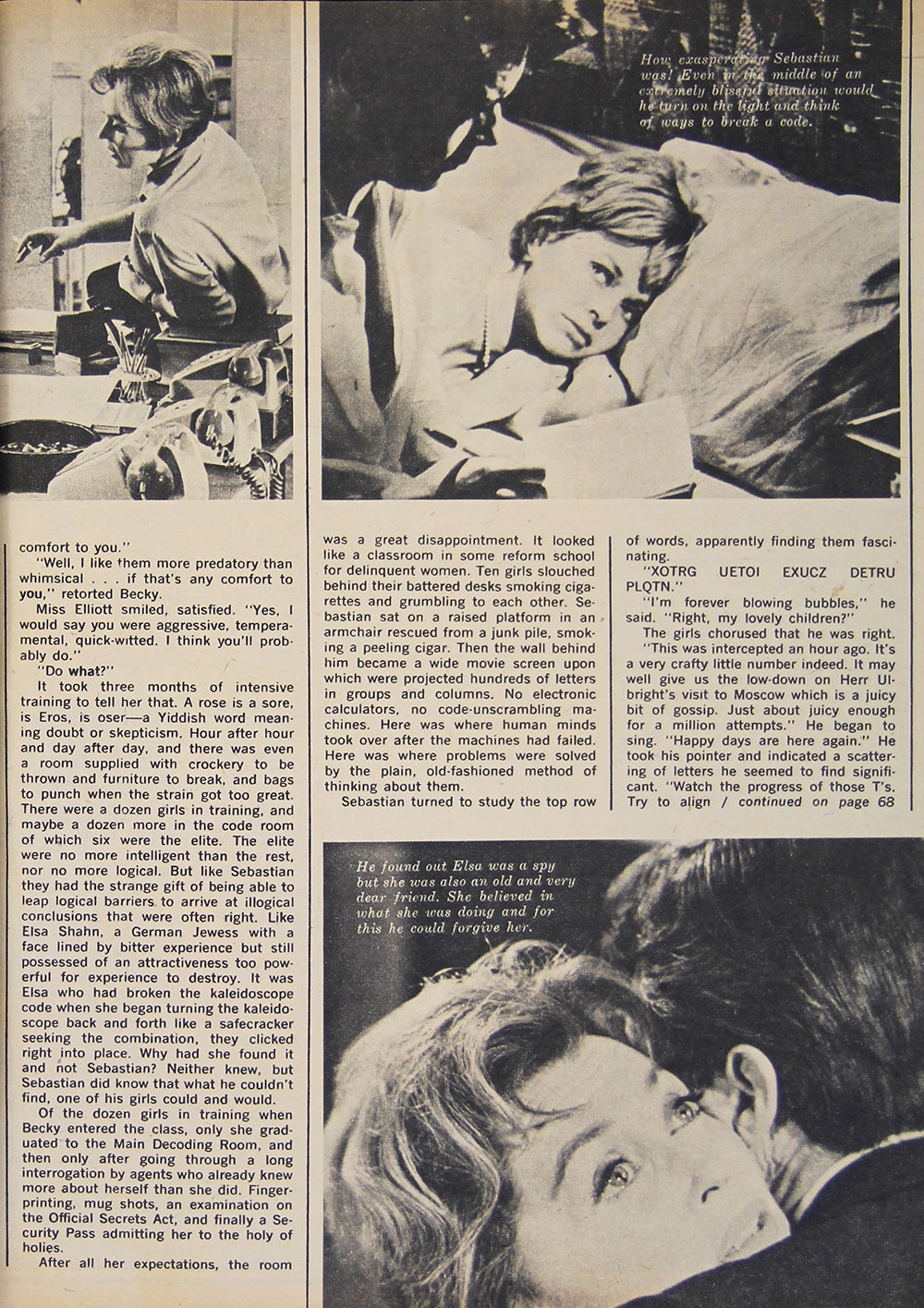
Sebastian found Elsa regretting that she had got him into trouble but not regretting her sell-out. “I saw both of us as a pair of grizzled veterans . . . weary, cynical, holding the fort to the end. It’s amazing how one floats through life on tides of sickening slop like that.”
Sebastian only nodded his understanding and she went on. “Now perhaps, I’ll be able to do something useful. I don’t think they’ll send me to prison. Of course I’ll lose my pension.”
Sebastian nodded sadly. “I never heard of a martyr with a pension.”
“Poor Sebastian . . . I’m sorry if I’ve messed it all up for you.” Her eyes filled with tears and she flung her arms around his neck. “Give us a bit of cuddle.”
He did so. “Elsa, Elsa . . . keep the pink flag flying.”
“You should get married or something,” said Elsa, and she was her battered self again.
For Sebastian it was not to be that easy. The Decoding Room had been his life, in it or out of it, awake or asleep, for twenty-five years, and for days he wandered around like a lost soul, avoiding everyone. When Becky did find him, he was curt and irritable. She left, crushed. When a few days later he sought her out to make amends, she had moved, leaving no forward address. Then for a few weeks he sort of drew a blank, finding himself one day far from London in a field with flowers. But no pasque flowers. That was odd. There should be some about. Suddenly his old interest in topology revived, and once more his mind had something to work on. Oxford was glad to welcome him back as a research topologist, and so passed a year.
The Head of Intelligence found Sebastian on the South Downs, tracing the colour eccentricities of the pasque flowers in the chalky soil. In the distance could be heard the sound of surf pounding at the foot of the white cliffs.
“Sebastian! What a happy coincidence!” said the Head of Intelligence. “I have a job for you, Sebastian.”
“I suggest you dispose of it elsewhere,” said Sebastian. “I’m searching for a pasque flower.”
“Really? you just walked by a pasque flower.”
“How did you know?”
“I used to be a botanist in my reckless youth. If we don’t beat this one, we’re in bad trouble. You’ve always been a bloody nuisance, Sebastian.” The Head of Intelligence decided that was not a mollifying approach. “We’re going into it with the Americans, but they want you.” His shrug indicated the Americans had scant confidence in general Phillips’ Decoding Room. “You can name your own terms.”
“I’ll settle for a silver salver with your head on it,” said Sebastian. But the prospect was too enticing. “One condition . . . Elsa Shahn shall receive full pension of a senior supervisor, backdated to last October.”
“Certainly. Ah . . .Another happy coincidence.” A military Landrover had appeared as if by magic from behind a nearby ridge. Three hours later they were in his office, or rather, General Phillips’ office.
“Welcome back,” he said with honest insincerity. I want you to take care of yourself. At the moment, the opposition is very sensitive to our decoding capacity. They won’t be at all pleased to see you.”
Sebastian managed to conceal his satisfaction in the implied compliment, and the general continued, “You used to complain that this was a dirty business. Now is the time to bear that in mind.”
Rapidly Sebastian collected the material he needed, and then he and the Head of Intelligence were off again, this time by helicopter to the great listening station at Jodrell Bank, home to the largest radio-telescope in the world.
Rosenau, the best communications man Sebastian had ever had before going into television, was there to greet him.
“Sweetie doll, how are you?” asked Rosenau.
Sebastian recoiled. “What was that gruesome mode of address?”
“Think nothing of it, lover,” said Rosenau. “We all talk like advertising men in television.” He made the introductions tot he other officials while Sebastian stared around him in awe at the giant equipment.
“What lovely toys you have here,” he said.
Sir Bernard Lovell, the director, beamed with pride. “I started this meadow with an army surplus radar truck. Then we grew.”
They got down to business. The Russians had launched a new breed of sophisticated satellites that were sending back messages from space in a code no one had been able to break.
“The politicians are scared, and the soldiers are angry,” said the Head of INtelligence. “Thats the worst possible combination.”
“The boys in the back room are dusting of the panic button,” added Rosenau.
They went into the recording room, and Rosenau put on a tape recording-the best he had been able to capture. It was just a wild scream.
“Very pretty,” said Sebastian, but he was listening intently.
“We catcher . . . you break,” said Rosenau.
“Compressed time,” said Sebastian.
“Correct,” said Rosenau. “Played at a thousand times the speed of sound. We’ve slowed it up.” He played the next tape, and now the wild scream was slowed down to be heard as a violin sonata. But not even a devotee of music like Sebastian could place it. As in breaking a Chinese code, they needed an interpreter. Yehudi Menuhin was in Manchester. They flew over.
Menuhin identified the music as Liszt’s Fantasia and Fugue for organ, and then played it on his violin. “Notice that quote,” he said.
“What quote?” Sebastian looked blank.
Menuhin repeated the notes slowly. “B- A- C- B flat,” he said. “B flat in German is H. The Fugue is on Bach.”
“B- A- C- H,” repeated Sebastian. “Thank you, that’s a start.”
Back to the Decoding Room in London. Only a few of the girls from his staff were still there, but they caught fire when he returned, and the rest responded. But oh, if he could only get Elsa and Becky and Thelma . . .
“Right, my lovely children,” he said, “today we start deciphering the music of the spheres. It’s a very sticky little number indeed . . .” He gave them the leads he had figured out. “Break your hearts with that one.” And he went back to his office to throw the rubber ball at the wall. It went through the window.
Two days and two nights, and the music from outer space had driven three girls into hysterics, but nothing was coming through. Sebastian, haggard from lack of sleep, went out for a breath of air. If only he could find . . .
What he found was Carol, or more correctly, she found him. And he was in one of those depressed moods that she knew so well how to cure. For how many years had he sought her out in times like this . . .
“. . . go to a lovely party?” she was prattling as she took his unresisting arm possessively. “And help me get a lovely modelling job, and keep me off the streets, and make my poor old Mum proud of me?” Sebastian had been to one of those parties with Carol. Models, advertising art directors, a few creeps and pansies, but always plenty of booze. Maybe a change of pace and a drink would help.
“You don’t think we’ll regret it?” he asked, and was immediately assured it would be wonderful.
It was the usual thing, except the host-an advertising man named Toby-seemed a little out of place at his own party. Sebastian sipped his drink, and made agreeable small talk, and looked around him. A curious effect, like being in a fishbowl looking out. He got up, and promptly fell over a very pretty boy stretched out on the floor.
“Well! Really!” trilled the pretty boy, not displeased.
Sebastian tried to roll off the giggling figure, but his arms wouldn’t work. There was a sudden hush in the room, as though this was the moment all had been waiting for. Then the door was crashed open in splinters. General Phillips and his wrecking crew.
Sebastian’s thoughts, before he came to in a steam bath, were concerned with infinite stupidity of the Sebastian brain, and the incalculable value of his grossly underestimated Captain Phillips.
“take this pig sty apart,” said General Phillips to his men. Maybe they couldn’t break a code, but they could shatter an apartment, and a few foreign agents like Toby who tried to resist.
Two messages awaited Sebastian when he reached his office. “Plod on quietly,” was the advice from the Head of Intelligence. The second was Becky Howard’s address. Sebastian felt restored enough to call that night.
It was quite a greeting he got. From tremulous, to hostile, to combative. In his shaken condition, Sebastian’s resistance was feeble, and he landed on his back on the bed.
“Where the bloody hell have you been?” cried the furious Becky.
“We’ll come to that, where have you been?” said the defensive Sebastian.
“I’ve been here!”
“Well, all right! I’ve found you here.” And since they were indeed there, and everything all convenient . . .
The wail was like that from outer space, but closer. But it was not the music of the spheres. Becky roused herself.
“Now you’ve woken the baby,” she said, and got up to rush into the other room. What she returned with was a baby, all right.
“Is that mine?” asked Sebastian in a strained voice.
“He’s mine,” said Becky fiercely. “He had the windies, poor little sausage.”
Sebastian’s mind was whirling, and not with code words or even topology. “Did you manage all by yourself?”
“Well I didn’t find him under a hedge,” said Becky, burping the baby with maternal solicitude.
“Why didn’t you tell me?” He paused, lost in admiration of the scene. “You’re very good. I love you. What’s his name?”
“Jason.”
“That’s a dog’s name.”
“It’s a hero’s name,” defended Becky. “Anyway, he has a dog’s life.” She thrust the boy into Sebastian’s arms, and he caught the squirming bundle awkwardly.
“Isn’t he a bit wet?”
“Yes. Well, it does happen.”
Jason burped contentedly all over Sebastian’s shoulder and went back to sleep. They put him back in his crib, and absently Sebastian began to toy with the beads, strung as a sort of colorful abacus at the foot of the crib. Click … click … click click. He did it again. Suddenly he began clicking the beads in wild fury. That was it. He rushed for the phone and called the office.
An hour later the girls were in Becky’s flat, sprawled on the floor and arranging their counters. Click . . click . . clickclock . . . Click . . . They had brought all the tapes Rosenau had shipped on as soon as received at Jodrell Banks, and Sebastian was playing them over and over.
It was morning. Jason woke up howling. Becky brought him out. “What a beautiful baby,” said one of the new girls. “I didn’t know you were married.”
“Work,” snarled Sebastian, taking the baby himself and sending Becky into the fray.
“I’ve got it. I’ve got it,” cried a coder. She had it.
Sebastian sent the girls home, and raced over to deliver the decoded message to General Phillips. Just a weather report from space, but it would relieve a lot of minds. Miss Elliott met him as he left the general’s office and handed him his rubber ball.
“It hit a man on a bicycle. We had a terrible time covering up for you.” She looked at his beaming face curiously. “Whatever were you doing?”
“Fart-arsing about,” he said. He kissed her soundly and raced out, leaving her considerably shaken.
“Back again,” he said, moving fast before Becky could get up from the couch.
“Conquering hero?”
“A touch of that.”
“Would you care to lay your head in my lap?”
“Be quite acceptable.” He settled himself comfortably. “Marry me?”
“No.”
“Want your son to grow up to be a great big bastard?”
“Like his Dad?” Becky hesitated. “Well, I’ll think about it.”
“You think about it,” said Sebastian, in no hurry at all.
THE END
A PARAMOUNT PICTURES release
Produced by
HERBERT BRODKIN-MICHAEL POWELL
Directed by DAVID GREEN
–Screen story by LEO MARKS
Screenplay by GEROLD VAUGHN-HUGHS
Adapted for SCREEN STORIES by GEORGE SCULLIN.

