Films and Filming – Apr 1966
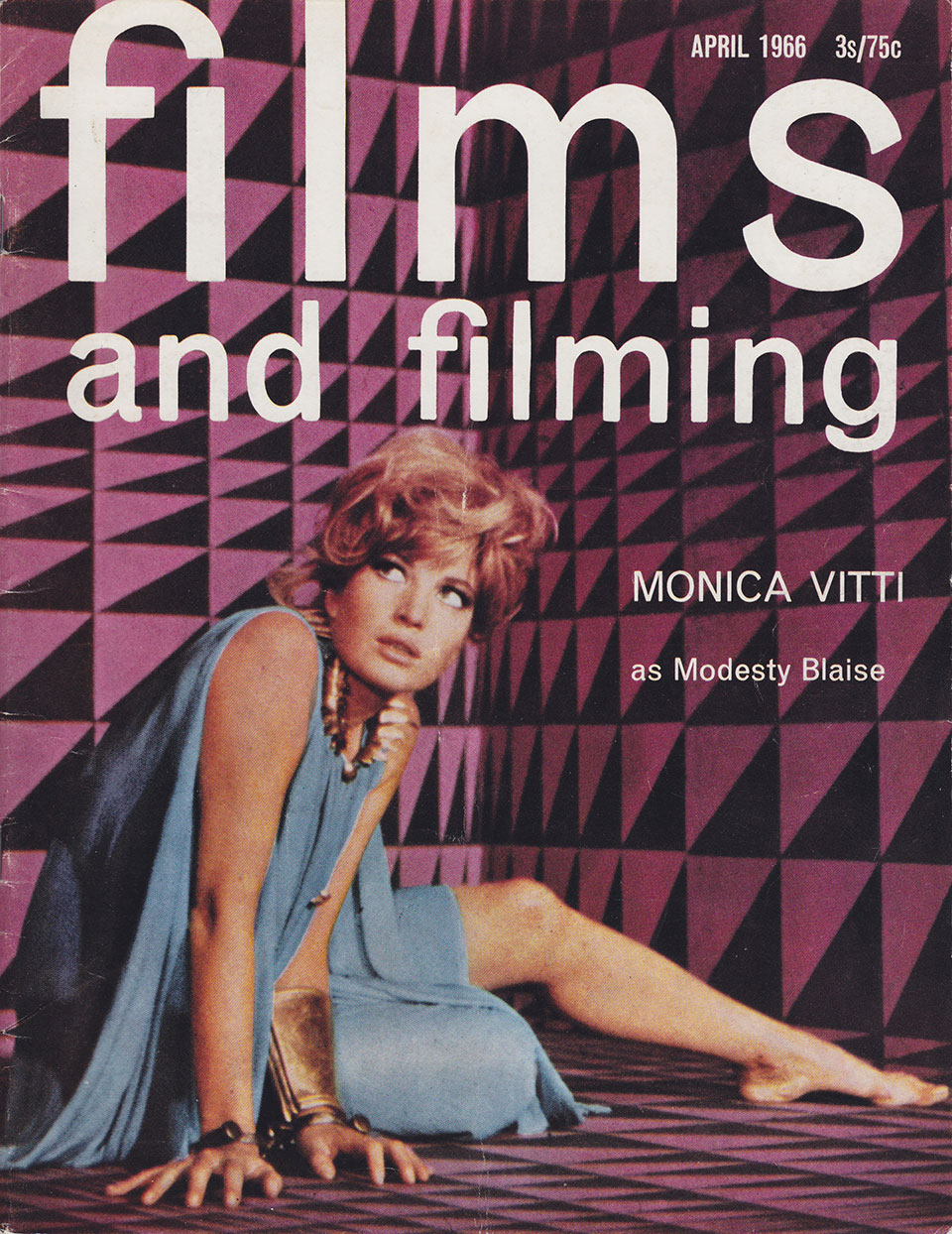

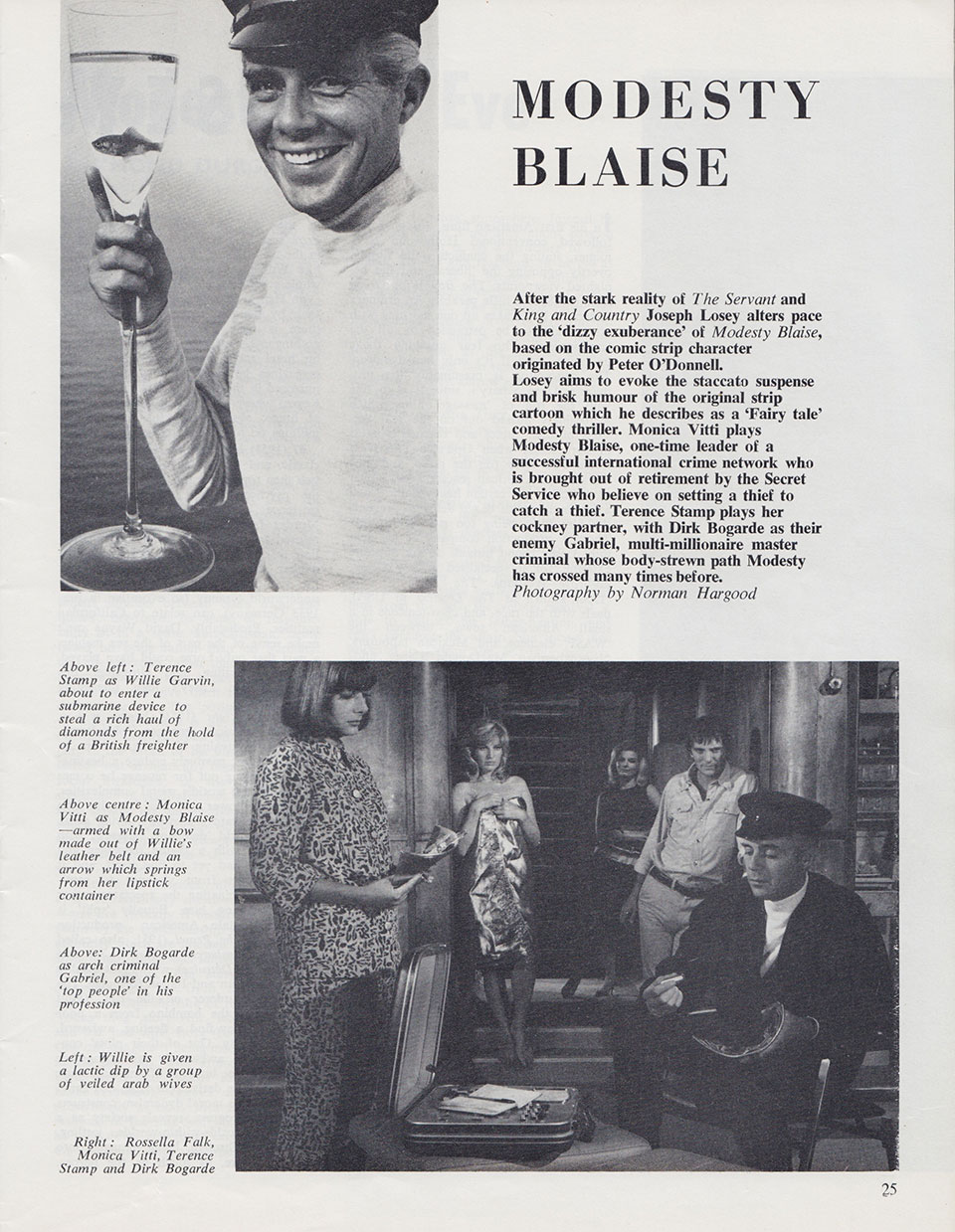
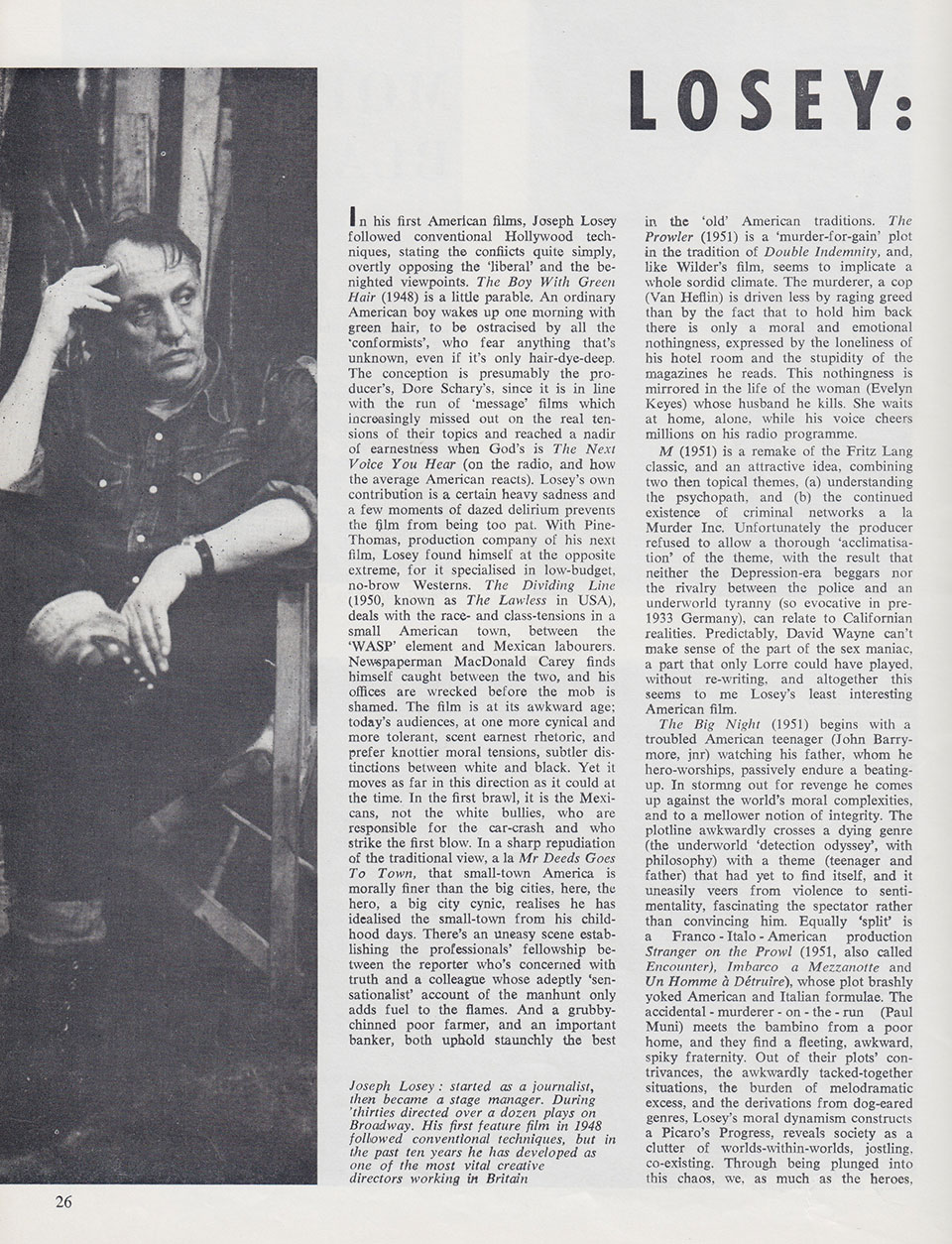

MODESTY BLAISE
After the stark reality of The Servant and King and Country Joseph Losey alters pace to the ‘dizzy exuberance’ of Modesty Blaise, based on the comic strip character originated by Peter O’Donnell.
Losey aims to evoke the staccato suspense and brisk humour of the original strip cartoon which he describes as a ‘Fairy tale’ comedy thriller. Monica Vitti plays Modesty Blaise, one-time leader of a successful international crime network who is brought out of retirement by the Secret Service who believe on setting a thief to catch a thief. Terence Stamp plays her cockney partner, with Dirk Bogarde as their enemy Gabriel, multi-millionaire master criminal whose body-strewn path Modesty has crossed many times before.
Photography by Norman Hargood
LOSEY: Modesty and Eve
RAYMOND DURGNAT
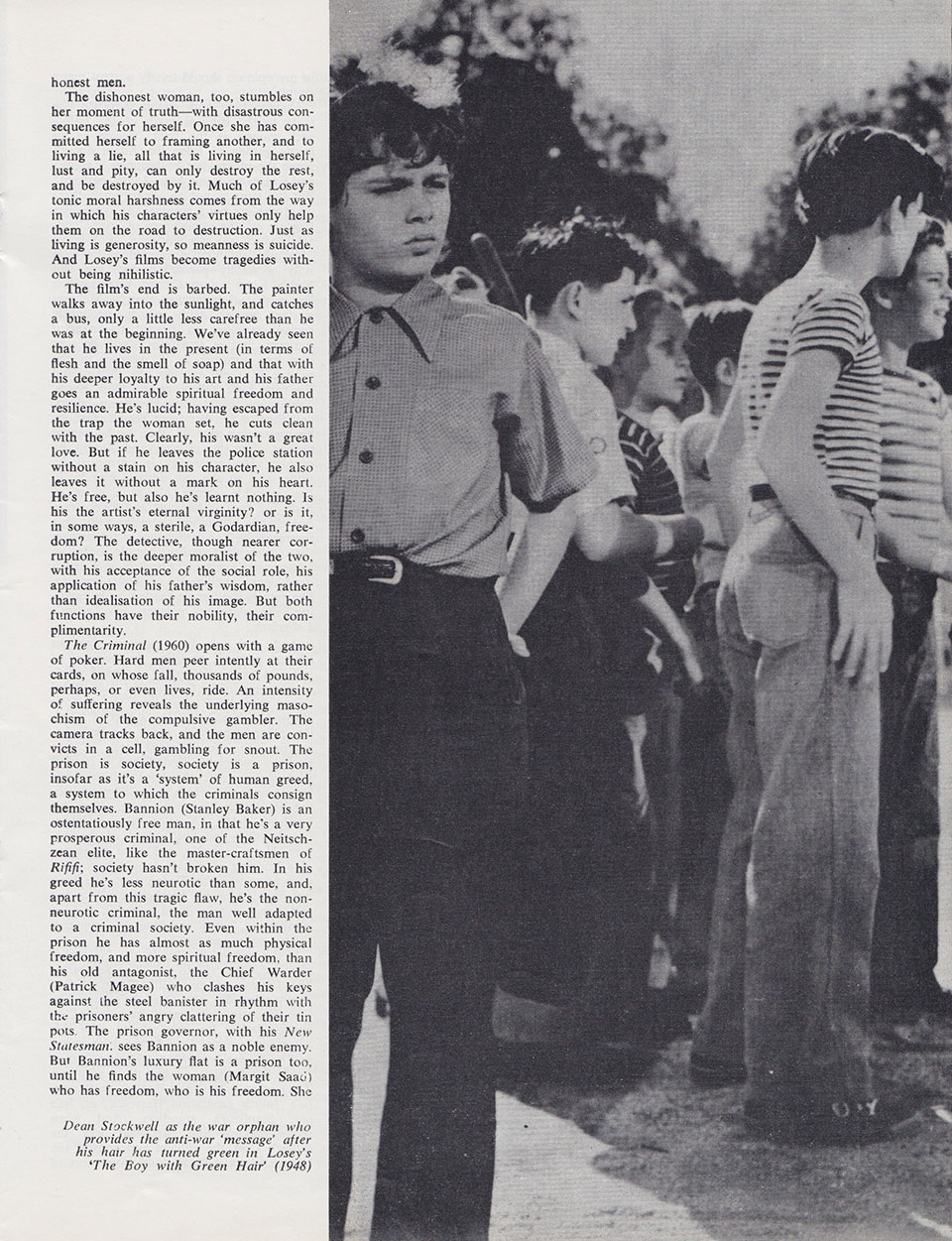
In his first American films, Joseph Losey followed conventional Hollywood techniques, stating the conflicts quite simply, overtly opposing the ‘liberal’ and the benighted viewpoints. The Boy With Green Hair (1948) is a little parable. An ordinary American boy wakes up one morning with green hair, to be ostracised by all the ‘conformists’, who fear anything that’s unknown, even if it’s only hair-dye-deep. The conception is presumably the producer’s, Dore Schary’s, since it is in line with the run of ‘message’ films which increasingly missed out on the real tensions of their topics and reached a nadir of earnestness when God’s is The Next Voice You Hear (on the radio, and how the average American reacts). Losey’s own contribution is a certain heavy sadness and a few moments of dazed delirium prevents the film from being too pat. With Pine Thomas, production company of his next film, Losey found himself at the opposite extreme, for it specialised in low-budget, no-brow Westerns. The Dividing Line (1950, known as The Lawless in USA), deals with the race- and class-tensions in a small American town, between the ‘WASP’ element and Mexican labourers. Newspaperman MacDonald Carey finds himself caught between the two, and his offices are wrecked before the mob is shamed. The film is at its awkward age; today’s audiences, at one more cynical and more tolerant, scent earnest rhetoric, and prefer knottier moral tensions, subtler distinctions between white and black. Yet it moves as far in this direction as it could at the time. In the first brawl, it is the Mexicans, not the white bullies, who are responsible for the car-crash and who strike the first blow. In a sharp repudiation of the traditional view, a la Mr Deeds Goes To Town, that small-town America is morally finer than the big cities, here, the hero, a big city cynic, realises he has idealised the small-town from his childhood days. There’s an uneasy scene establishing the professionals’ fellowship between the reporter who’s concerned with truth and a colleague whose adeptly ‘sensationalist’ account of the manhunt only adds fuel to the flames. And a grubby-chinned poor farmer, and an important banker, both uphold staunchly the best
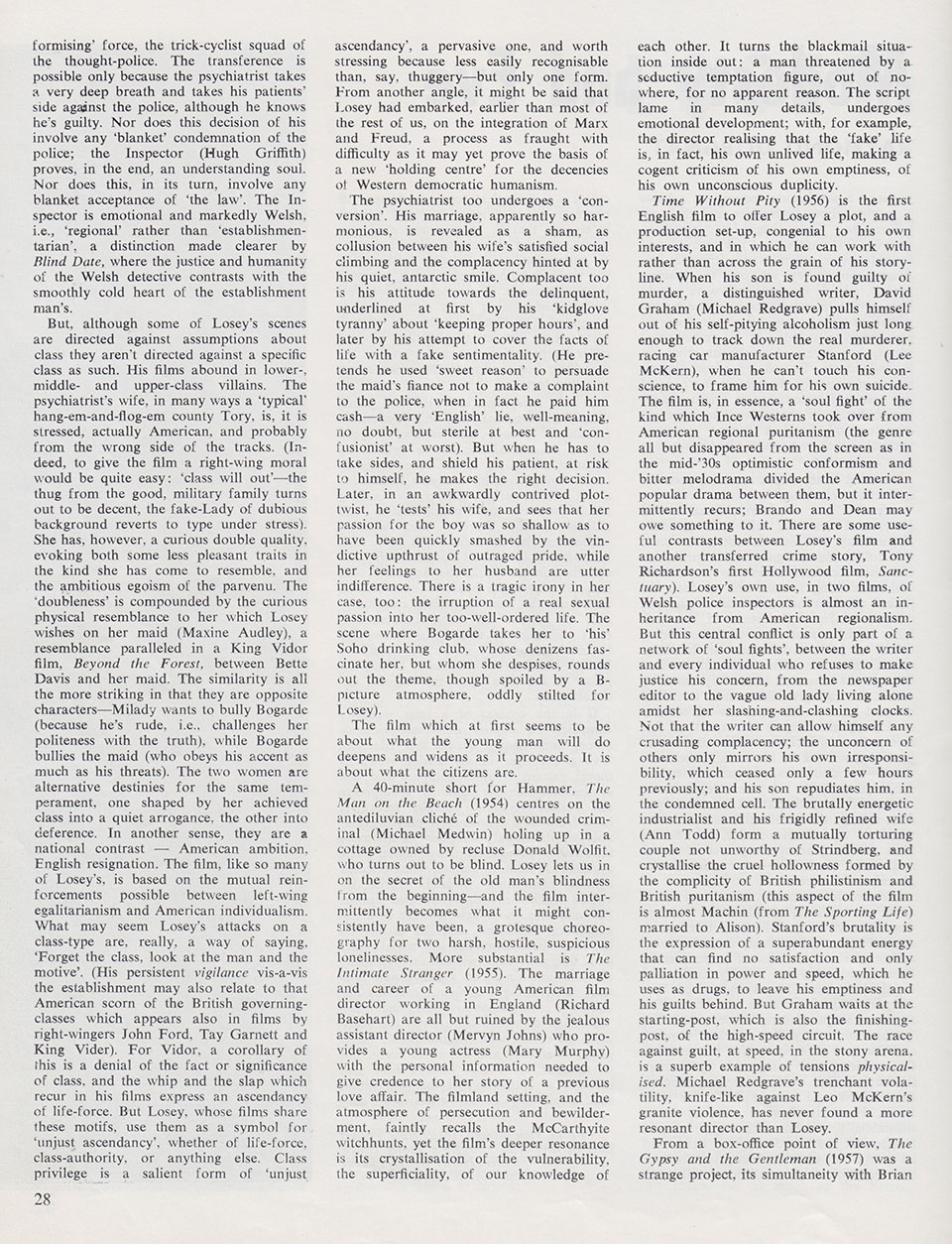
Joseph Losey: started as a journalist, then became a stage manager. During ‘thirties directed over a dozen plays on Broadway. His first feature film in 1948 followed conventional techniques, but in the past ten years he has developed as one of the most vital creative directors working in Britain
in the ‘old’ American traditions. The Prowler (1951) is a ‘murder-for-gain’ plot in the tradition of Double Indemnity, and, like Wilder’s film, seems to implicate a whole sordid climate. The murderer, a cop (Van Heflin) is driven less by raging greed than by the fact that to hold him back there is only a moral and emotional nothingness, expressed by the loneliness of his hotel room and the stupidity of the magazines he reads. This nothingness is mirrored in the life of the woman (Evelyn Keyes) whose husband he kills. She waits at home, alone, while his voice cheers millions on his radio programme.
M (1951) is a remake of the Fritz Lang classic, and an attractive idea, combining two then topical themes, (a) understanding the psychopath, and (b) the continued existence of criminal networks a Ia Murder Inc. Unfortunately the producer refused to allow a thorough ‘acclimatisation’ of the theme, with the result that neither the Depression-era beggars nor the rivalry between the police and an underworld tyranny (so evocative in pre- 1933 Germany), can relate to Californian realities. Predictably, David Wayne can’t make sense of the part of the sex maniac, a part that only Lorre could have played, without re-writing, and altogether this seems to me Losey’s least interesting American film.
The Big Night (1951) begins with a troubled American teenager (John Barrymore, jnr) watching his father, whom he hero-worships, passively endure a beating-up. In storming out for revenge he comes up against the world’s moral complexities, and to a mellower notion of integrity. The plotline awkwardly crosses a dying genre (the underworld ‘detection odyssey’, with philosophy) with a theme (teenager and father) that had yet to find itself, and it uneasily veers from violence to sentimentality, fascinating the spectator rather than convincing him. Equally ‘split’ is a Franco – Italo – American production Stranger on the Prowl (1951, also called Encounter), Imbarco a Mezzanotte and Un Homme à Détruire), whose plot brashly yoked American and Italian formulae. The accidental-murderer-on-the-run (Paul Muni) meets the bambino from a poor home, and they find a fleeting, awkward, spiky fraternity. Out of their plots’ contrivances, the awkwardly tacked-together situations, the burden of melodramatic excess, and the derivations from dog-eared genres, Losey’s moral dynamism constructs a Picaro’s Progress, reveals society as a clutter of worlds-within-worlds, jostling. co-existing. Through being plunged into this chaos, we, as much as the heroes, undergo a sentimental education, achieve a lucidity about themselves and their relationships. They begin as reporters, prowlers, strangers on the prowl, and stumble, often too late, upon the fact that those whom they set out to observe, exploit, punish or shrug off, were a possible end to their isolation. Yet the overall moral pattern is not the classic form of error-remorse-tragedy. It is, rather, that society is a dazzle of neighbours, that we, as individuals, limited by some egoistic aim, complacently obedient to the code of our own little microclimate, frightened by the challenge of the unfamiliar, have cut ourselves off from a human openness without which we must also reject our own authenticity.
Not that Losey, for a moment, preaches an undiscriminating, impartial love for ‘everyone’, nor a sacrificial-sentimental piety, and least of all a do-gooder’s charitability. But one cannot attain one’s own full strength, dignity and warmth, nor end one’s loneliness in as powerful a love, without corning to see, and to feel, the potent affinities between one’s own, and others’, life-force. Its sense of responsibility is, in a sense, anti-Christian, being based on pride rather than on humility, on self- assertion rather than self -sacrifice. Because the true man is not frightened by others, he can give them their due, and demand his own. The ‘puritanical’ severity of Losey’s morality is an aspect of this essentially Neithschzean affirmation. And part of the shock of his films is their unstated- but dramatically organic-blend of social awareness, of the Neithschzean strain, and of egalitarianism. His American films arraign the unreflective individualism which is an American vice, his British films the complacent acceptance of moral and social hierarchies-unconscious arrogance, and deference.
Most of his American films were made at an extraordinary speed-under 21 days -and are virtually B features lifted to A status by the craftsmanship and emotional authority which are injected en passant. In Britain too, Losey was initially condemned to tired genres. The storyline of The Sleeping Tiger is, from the box-office angle, an adept mixture of two genres, the ‘young thug’ story (for ‘thickear’ lovers) and the ‘bad wife’ story (for housewives). One can imagine it being made by Warners the late ’30s, with Humphrey Bogart, Bette Davis and Claude Rains (or even Leslie Howard). Losey’s treatment was substantially at odds with British critical fashions of the mid-50s, which demanded he tone down emotional excesses, ‘ballast’ the storyline with realistic detail, and create a ‘location’ atmosphere. Instead he concentrates on a morality about passion in society, that is, on a structure of passionate actions and reactions, in excess as in frustration. If it became ‘realistic’ in the timid, ‘common-sense’, sense, it would be platitudinous. The spectator must feel maladjusted passion in its excess and inadequacy. The film is a series of ‘temps-forts’ (and just as the nihilist Godard styles temps-forts into temps-morts, so the moralistic Losey affirms even temps-morts as temps-forts!).
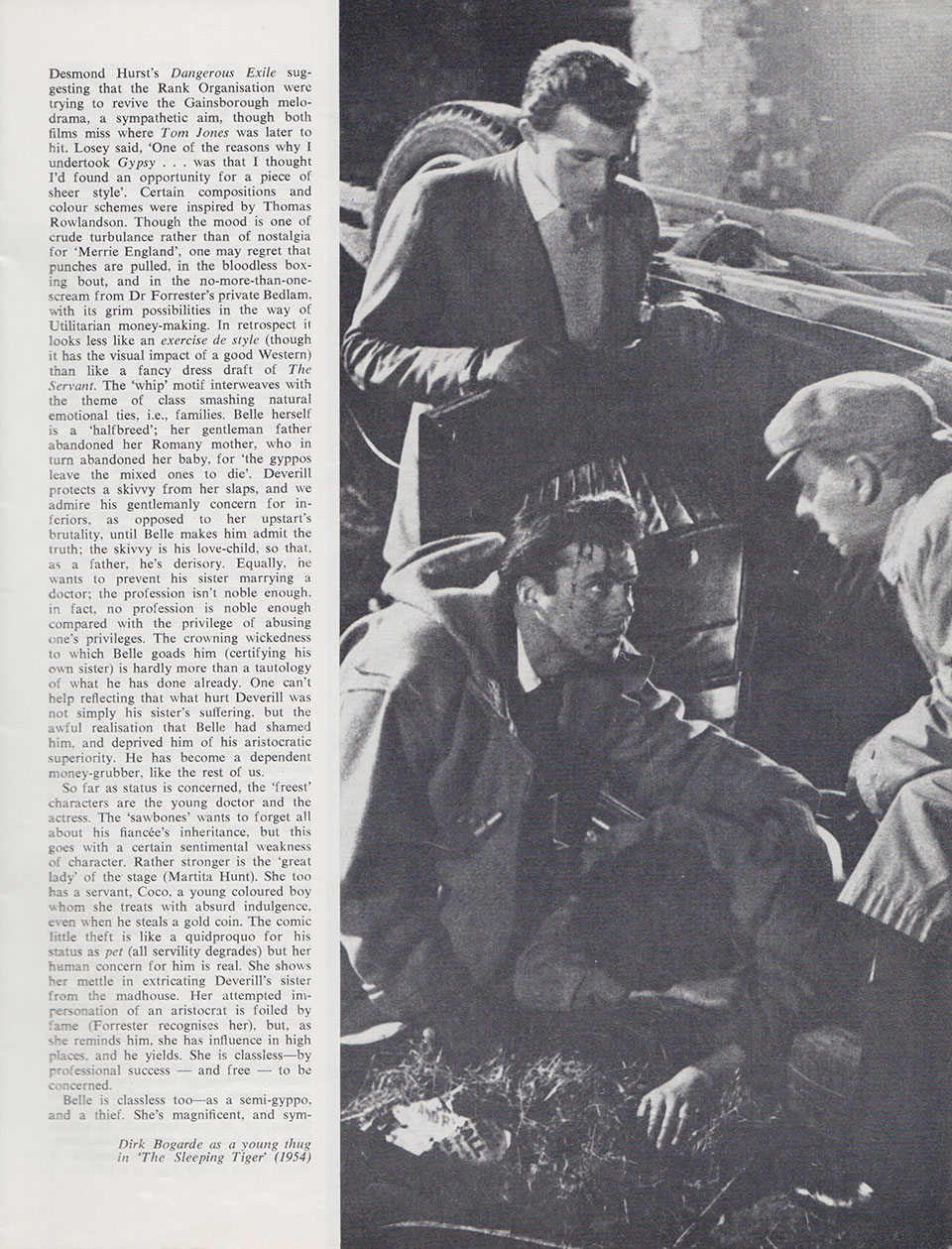
In The Sleeping Tiger (1954) a young thug (Dirk Bogarde) picks on a psychiatrist (Alexander Knox) who is also a judo expert. As an alternative to prison, he becomes guinea-pig in the latter’s experiment- living with his analyst’s family for a six-month period. Under an initially polite veneer, the psychiatrist’s wife (Alexis Smith) despises him with a vehemence that isn’t far from love, and, her rather cold, correct husband being too absorbed in his work, has an affair with him. But after the husband has shielded him from the law, the young criminal is able to kathart his father-fixation, and can’t continue the affair. She incites her husband to destroy him, but only destroys herself–driving to her death through a poster of the Esso tiger-the original, unamiable one.
If in the context of a later publicity campaign its expose of latent violence among suburbanites evokes the reflection, ‘I’ve got a tiger in my Tudor villa’, its moral pattern is more complex and less sentimental than the perennial ‘Well you’re not perfect yourself’ whereby reformers have from time immemorial played (valuably) on the moral masochism of the more sensitively puritanical bourgeoisie. The argument is relevant enough when directed against pharasaism (indeed, Christ invented it), but invariably buckles against the rejoinder. ‘So maybe I don’t love my neighbour as myself, but the distinction between the observance of social rules and thuggery isn’t without significance’. But the film hinges on a conversion. The thug is freed, by treatment, from his unconscious compulsions, so that the film’s ‘reformist’ overtones arise from the argument, so cogent with the reasonable bourgeois, to efficacy and minimum force, not to squeamishness. But Losey’s film also involves a repudiation of the proposition that psychiatry is an effectively ‘conformising’ force, the trick-cyclist squad of the thought-police. The transference is possible only because the psychiatrist takes a very deep breath and takes his patients’ side against the police, although he knows he’s guilty. Nor does this decision of his involve any ‘blanket’ condemnation of the police; the Inspector (Hugh Griffith) proves, in the end, an understanding soul. Nor does this, in its turn, involve any blanket acceptance of ‘the law’. The Inspector is emotional and markedly Welsh, i.e., ‘regional’ rather than ‘establishmentarian’, a distinction made clearer by Blind Date, where the justice and humanity of the Welsh detective contrasts with the smoothly cold heart of the establishment man’s.
But, although some of Losey’s scenes are directed against assumptions about class they aren’t directed against a specific class as such. His films abound in lower-, middle- and upper-class villains. The psychiatrist’s wife, in many ways a ‘typical’ hang-em-and-flog-em county Tory, is, it is stressed, actually American, and probably from the wrong side of the tracks. (Indeed, to give the film a right-wing moral would be quite easy: ‘class will out’-the thug from the good, military family turns out to be decent, the fake-Lady of dubious background reverts to type under stress). She has, however, a curious double quality, evoking both some less pleasant traits in the kind she has come to resemble, and the ambitious egoism of the parvenu. The ‘doubleness’ is compounded by the curious physical resemblance to her which Losey wishes on her maid (Maxine Audley), a resemblance paralleled in a King Vidor film, Beyond the Forest, between Bette Davis and her maid. The similarity is all the more striking in that they are opposite characters-Milady wants to bully Bogarde (because he’s rude, i.e., challenges her politeness with the truth), while Bogarde bullies the maid (who obeys his accent as much as his threats). The two women are alternative destinies for the same temperament, one shaped by her achieved class into a quiet arrogance, the other into deference. In another sense, they are a national contrast – American ambition, English resignation. The film, like so many of Losey’s, is based on the mutual reinforcements possible between left-wing egalitarianism and American individualism. What may seem Losey’s attacks on a class-type are, really, a way of saying, ‘Forget the class, look at the man and the motive’. (His persistent vigilance vis-a-vis the establishment may also relate to that American scorn of the British governing classes which appears also in films by right-wingers John Ford. Tay Garnett and King Vidor). For Vidor, a corollary of this is a denial of the fact or significance of class, and the whip and the slap which recur in his films express an ascendancy of life-force. But Losey, whose films share these motifs, use them as a symbol for ‘unjust ascendancy’, whether of life-force, class-authority. or anything else. Class privilege is a salient form of ‘unjust ascendancy’, a pervasive one, and worth stressing because less easily recognisable than, say, thuggery-but only one form. From another angle, it might be said that Losey had embarked, earlier than most of the rest of us, on the integration of Marx and Freud, a process as fraught with difficulty as it may yet prove the basis of a new ‘holding centre’ for the decencies of Western democratic humanism.
The psychiatrist too undergoes a ‘conversion’. His marriage, apparently so harmonious. is revealed as a sham, as collusion between his wife’s satisfied social climbing and the complacency hinted at by his quiet, antarctic smile. Complacent too is his attitude towards the delinquent, underlined at first by his ‘kid-glove tyranny’ about ‘keeping proper hours’, and later by his attempt to cover the facts of life with a fake sentimentality. (He pretends he used ‘sweet reason’ to persuade the maid’s fiance not to make a complaint to the police, when in fact he paid him cash- a very ‘English’ lie, well-meaning, no doubt, but sterile at best and ‘confusionist’ at worst). But when he has to take sides, and shield his patient, at risk to himself, he makes the right decision. Later, in an awkwardly contrived plot-twist, he ‘tests’ his wife, and sees that her passion for the boy was so shallow as to have been quickly smashed by the vindictive upthrust of outraged pride, while her feelings to her husband are utter indifference. There is a tragic irony in her case, too: the irruption of a real sexual passion into her too-well-ordered life. The scene where Bogarde takes her to ‘his’ Soho drinking club, whose denizens fascinate her, but whom she despises, rounds out the theme, though spoiled by a B-picture atmosphere, oddly stilted for Losey).
The film which at first seems to be about what the young man will do deepens and widens as it proceeds. It is about what the citizens are.
A 40-minute short for Hammer. The Man on the Beach (1954) centres on the antediluvian cliche of the wounded criminal (Michael Medwin) holing up in a cottage owned by recluse Donald Wolfit, who turns out to be blind. Losey lets us in on the secret of the old man’s blindness from the beginning-and the film intermittently becomes what it might consistently have been, a grotesque choreography for two harsh, hostile, suspicious lonelinesses. More substantial is The Intimate Stranger (1955). The marriage and career of a young American film director working in England (Richard Basehart) are all but ruined by the jealous assistant director (Mervyn Johns) who provides a young actress (Mary Murphy) with the personal information needed to give credence to her story of a previous love affair. The filmland setting, and the atmosphere of persecution and bewilderment, faintly recalls the McCarthyite witchhunts, yet the film’s deeper resonance is its crystallisation of the vulnerability, the superficiality, of our knowledge of each other. It turns the blackmail situation inside out: a man threatened by a seductive temptation figure, out of nowhere, for no apparent reason. The script lame in many details, undergoes emotional development; with, for example, the director realising that the ‘fake’ life is, in fact, his own unlived life, making a cogent criticism of his own emptiness, of his own unconscious duplicity.
Time Without Pity (1956) is the first English film to offer Losey a plot, and a production set-up, congenial to his own interests, and in which he can work with rather than across the grain of his storyline. When his son is found guilty of murder, a distinguished writer, David Graham (Michael Redgrave) pulls himself out of his self-pitying alcoholism just long enough to track down the real murderer, racing car manufacturer Stanford (Lee McKern), when he can’t touch his conscience, to frame him for his own suicide.
The film is, in essence, a ‘soul fight’ of the kind which Ince Westerns took over from American regional puritanism (the genre all but disappeared from the screen as in the mid-’30s optimistic conformism and bitter melodrama divided the American popular drama between them, but it intermittently recurs; Brando and Dean may owe something to it. There are some useful contrasts between Losey’s film and another transferred crime story, Tony Richardson’s first Hollywood film, Sanctuary). Losey’s own use, in two films, of Welsh police inspectors is almost an inheritance from American regionalism. But this central conflict is only part of a network of ‘soul fights ‘, between the writer and every individual who refuses to make justice his concern, from the newspaper editor to the vague old lady living alone amidst her slashing-and-clashing clocks. Not that the writer can allow himself any crusading complacency; the unconcern of others only mirrors his own irresponsibility, which ceased only a few hours previously; and his son repudiates him, in the condemned cell. The brutally energetic industrialist and his frigidly refined wife (Ann Todd) form a mutually torturing couple not unworthy of Strindberg, and crystallise the cruel hollowness formed by the complicity of British philistinism and British puritanism (this aspect of the film is almost Machin (from The Sporting Life) married to Alison). Stanford’s brutality is the expression of a superabundant energy that can find no satisfaction and only palliation in power and speed, which he uses as drugs, to leave his emptiness and his guilts behind. But Graham waits at the starting-post, which is also the finishing-post, of the high-speed circuit. The race against guilt, at speed, in the stony arena, is a superb example of tensions physicalised, Michael Redgrave’s trenchant volatility, knife-like against Leo McKern’s granite violence, has never found a more resonant director than Losey.
From a box-office point of view, The Gypsy and the Gentleman (1957) was a strange project, its simultaneity with Brian Desmond Hurst’s Dangerous Exile suggesting that the Rank Organisation were trying to revive the Gainsborough melodrama, a sympathetic aim, though both films miss where Tom Jones was later to hit. Losey said, ‘One of the reasons why I undertook Gypsy … was that I thought I’d found an opportunity for a piece of sheer style’. Certain compositions and colour schemes were inspired by Thomas Rowlandson. Though the mood is one of crude turbulence rather than of nostalgia for ‘Merrie England’, one may regret that punches are pulled, in the bloodless boxing bout, and in the no-more-than-one scream from Dr Forrester’s private Bedlam, with its grim possibilities in the way of Utilitarian money-making. In retrospect it looks less like an exercise de style (though it has the visual impact of a good Western) than like a fancy dress draft of The Servant. The ‘whip’ motif interweaves with the theme of class smashing natural emotional ties, i.e., families. Belle herself is a ‘halfbreed’; her gentleman father abandoned her Romany mother, who in turn abandoned her baby, for ‘the gyppos leave the mixed ones to die’. Deverill protects a skivvy from her slaps, and we admire his gentlemanly concern for inferiors, as opposed to her upstart’s brutality, until Belle makes him admit the truth: the skivvy is his love-child, so that, as a father, he’s derisory. Equally, he wants to prevent his sister marrying a doctor; the profession isn’t noble enough, in fact, no profession is noble enough compared with the privilege of abusing one’s privileges. The crowning wickedness to which Belle goads him (certifying his own sister) is hardly more than a tautology of what he has done already. One can’t help reflecting that what hurt Deverill was not simply his sister’s suffering, but the awful realisation that Belle had shamed him, and deprived him of his aristocratic superiority. He has become a dependent money-grubber, like the rest of us.
So far as status is concerned, the ‘freest’ characters are the young doctor and the actress . The ‘sawbones’ wants to forget all about his fiancee’s inheritance, but this goes with a certain sentimental weakness of character. Rather stronger is the ‘great lady of the stage (Martita Hunt). She too has a servant, Coco, a young coloured boy she treats with absurd indulgence, even when he steals a gold coin. The comic little theft is like a quid-pro-quo for his status as pet (all servility degrades) but her human concern for him is real. She shows her mettle in extricating Deverill’s sister from the madhouse. Her attempted impersonation of an aristocrat is foiled by fame (Forrester recognises her), but, as she reminds him, she has influence in high places, and he yields. She is classless- by Professional success – and free – to be concerned.
Belle is classless too – as a semi-gyppo, and a thief. She’s magnificent, and sympathetic, in her ‘gold-digging’, insofar as (a) sexual privileges are no less sympathetic than hereditary ones, (b) she’s the ‘underdog’, and (c) she’s trying to get money for the man she loves, horse-trader Patrick McGoohan, whom she loves more generously than Deverill loves her. Love is all her existence; marriage she hardly understands. But when her lover uses the money she gives him to start bargaining for a pretty young gypsy-girl as concubine, she turns them away, crying, ‘Get off my land! ‘ like a Deverill herself. In their turn, the gypsies are quite ready to sell their daughter, as she to be sold – a mirror of the ‘heiress’ theme. And Belle, who sells her body to Deverill, contrasts with another person who sells his body to Deverill – the blacksmith – prizefighter (Nigel Green) whose purse Belle steals and who refuses Deverill’s tactful compensation as implying the loss of his good name. He understands order, and he has self-respect, perhaps because, fighting apart, he has a modest status and trade. The gipsies are thieves and nomads. When Belle orders them off her land, they retaliate by slashing whatever hasn’t been sold or possessed in the Deverill mansion – and by so doing, bring to light the faked will. Disorder remedies disorder, but haphazardly. For in a disorderly order, the forcefulness of Deverill and Belle, in itself a glorious explosion of life-force, becomes irresponsible and predatory, and concludes in masochism (for as Deverill is exploited by Belle, so is she by the man she loves).
In a sense, this is a film noir in Technicolor, but in another sense it negates the underlying negation of the film noir, which is that fate or the system will cross us whatever we do. Here, we see, or we feel, the characters’ mistakes, they themselves sense them. Deverill might have taken his uncle’s advice and learned to be something as egalitarian as the system allowed, that is, a ‘good master’. The phrase jars on our modern minds, and sets us in a mood to think in social terms when Belle is insulted for her race, or menaced with a summary beating, or when we compare, in our minds, the Deverill mansion with her tent in the forest (a subsequent cut from the stately home to a forest downpour hints at the utter vileness of her life). Deverill finds in his cellar a bottle of wine brought from France ‘when they still had a king’. Someone, somewhere, had the idea of a revolution, involving principles, not the horse-trader’s ‘blind kickbacks.
But though Losey ties in social and personal relationships – more concretely than bien-pensants find comfortable- he isn’t saying that decent personal relationships are possible only in an egalitarian democracy. After all, the gypsy and the gentleman are matched by the turtledoves, Belle by the actress, the horse-trader by the blacksmith. Being set in a period where class counted, class counts, but it’s primarily a personal morality, criticising both Deverill’s aristocratic irresponsibility and Belle’s random individualism. Melina Mercouri’s performance is almost embarrassing to the English spectator, for the best of reasons, its uncouthness, shot through, particularly in the film’s second half, with the deepening sadness of a lucidity never quite attained, and, in extremes, denied.
In one of his finer moments, Deverill lucidly and honestly admits to his fiancee that he doesn’t love her, and her quiet affirmation of friendship establishes what his life could have been, bad the social framework been such as to engage his sense of responsibility on a broader front). Dreamgirl Margit Saad’s sexual gift of herself to Johnny in The Criminal has a cool, sharp, reserved incisiveness, implying a classical, rather than a romantic, attitude to love, as ‘une passion disciplinée’. Losey’s films often centre on sexual passion as infatuation, i.e., a subtle but no less pernicious form of egoism, which is what it is for Deverill, Tyvian and Tony. And for Losey, as for Freud, sexual love is only one passion among many- Graham in Time Without Pity is, almost, kept alive, by the sheer frenzy of his love for his son and of his guilt. If Losey is an admirable portraitist of passion (with its battle for ascendancies, its perverse egoisms) it is because it has, for him, no moral privileges. Paradoxically (given its ‘Neitschean’ energy) there is no indulgence of amorality of any sort in Losey’s work, less than in that of Huston and Becker (with their sympathy for rascals) and even of Bunuel (with his earlier weakness for Sade and, later, his quieter moral tone). There is a streak in Losey’s work of a (highly sublimated) moral sadism; just as his sense of interpersonal asoendencies is healthily disturbing; both are American traits, the first, puritan, the second, not. In more ways than one, he is, as an American, as a Freudian and as a Democrat, the ‘anti-Dostoievski’, a position almost too easy for a modern artist to adopt in his work, and all the more difficult to adopt validly, whence Losey’s stress on conflict and paradoxes, and the reversibility of some of his morals. He can count on the audience thinking one way rather than another; while making liberal morality relevant to those who, like many in the younger generation, often find its affirmations earnest rather than serious. Losey’s films are, in a sense, for those who, accepting liberal principles, are uninterested in pious reassertions, and fascinated by the subsequent problem, of balancing and managing the egoistic and the reactionary impulses which spring, not simply from the traditions and assumptions around us, but also from the fact of being alive. All of which entails something much more cynical and near the knuckle than obvious liberalism, a new kind of moral tone, both puritan and Neitschzean, rationalist, yet not unemotional.
Blind Date (1959: in the USA, Chance Meeting), a detective story, reverts to the scale and style of Time Without Pity. A struggling young Dutch painter (Hardy Kruger) in London gives a few lessons to a proud rich woman (Micheline Presle). They fall in love. After several meetings in his white, bare studio, he, for the first time, goes to her home, where she is found murdered. The police describe her as the mistress of an important Foreign Office personage, Sir Howard Fenton, and a bureaucrat hints to the Inspector in charge of the case (Stanley Baker) that his career will be advanced if charges are successfully pressed against the boy. But Inspector Morgan credits his story, and the boy’s mistress is finally revealed as the murderess. Dropping her guard for a split second, she inculpates herself, and the boy goes free.
Artist and detective are both hunters after truth, each in his own limited, slightly oblique way. The painter, arrogant and innocent, seems to hover on the edge of life’s complexity, resenting it a little. In London he paints pictures of Dutch miners, honouring his father. Truth, for him, is the truth of form, physical enough, but also something of an abstraction. He scolds his none-too-serious pupil for drawing a shoulder lifelessly, and bares his own: ‘This is a shoulder, it’s flesh and blood, scratch it, it bleeds.’ She is able to add: ‘Kiss it, it trembles. . . .’ As we first see him, before his disillusionment, hop-skip- and-jumping along the pavements, he seems enviably free, but half a child. Outside his art, there are things he can’t, or won’t, see, like the heavy opulence of his mistress’s apartment, with dolphin and putti-taps, a nouveau-riche love-nest if ever there was one, as the detective spots at first glance. The detective has an eye for life, an eye that’s hardly artistic, but just as incisive and just as salutary. ‘That woman isn’t a giver, she’s a taker. My father was a chauffeur, so I know all about that’. There is a minor early exchange, typical, in little, of the drastically self-effacing quality of much good scriptwriting. The painter, under suspicion, says, ‘I washed my hands. . . .’ The detective: ‘Why, were they dirty?’ The painter: ‘I liked the scent of her soap … .’ The conflict between the smooth ‘establishment’ view of the system, and Morgan’s intuitive belief in the boy’s honesty, an intuition born of the experience which is his equivalent of an artist’s ‘vision’, gives a special depth to his ‘Racinian’ choice between justice and career. How kind fate is to him we don’t know- for now Sir Howard’s name will be dragged into courtroom scandal- but he has made the right choice.
But his intuition can only be touched because the boy persists, is active, questions, probes. From the beginning he’s ready to stand on his rights. Though friendly, he’s not afraid to challenge the ‘fatherly wisdom’ of the police. He never resigns himself into anyone else’s hands. Truth is not the monopoly of one profession, or of one approach. It springs from a dialectic, the reciprocal challenge-and- respect of the diverse insights of honest men.
The dishonest woman, too, stumbles on her moment of truth- with disastrous consequences for herself. Once she has committed herself to framing another, and to living a lie, all that is living in herself, lust and pity, can only destroy the rest, and be destroyed by it. Much of Losey’s tonic moral harshness comes from the way in which his characters’ virtues only help them on the road to destruction. Just as living is generosity, so meanness is suicide. And Losey’s films become tragedies without being nihilistic.
The film’s end is barbed. The painter walks away into the sunlight, and catches a bus, only a little less carefree than he was at the beginning. We’ve already seen that he lives in the present (in terms of flesh and the smell of soap) and that with his deeper loyalty to his art and his father goes an admirable spiritual freedom and resilience. He’s lucid; having escaped from the trap the woman set, he cuts clean with the past. Clearly, his wasn’t a great love. But if he leaves the police station without a stain on his character, he also leaves it without a mark on his heart. He’s free, but also he’s learnt nothing. Is his the artist’s eternal virginity? or is it, in some ways, a sterile, a Godardian, freedom? The detective, though nearer corruption, is the deeper moralist of the two, with his acceptance of the social role, his application of his father’s wisdom, rather than idealisation of his image. But both functions have their nobility, their complimentarily.
The Criminal (1960) opens with a game of poker. Hard men peer intently at their cards, on whose fall, thousands of pounds, perhaps, or even lives, ride. An intensity of suffering reveals the underlying masochism of the compulsive gambler. The camera tracks back, and the men are convicts in a cell, gambling for snout. The prison is society, society is a prison, insofar as it’s a ‘system’ of human greed, a system to which the criminals consign themselves. Bannion (Stanley Baker) is an ostentatiously free man, in that he’s a very prosperous criminal, one of the Neitschzean elite, like the master-craftsmen of Rififi; society hasn’t broken him. In his greed he’s less neurotic than some, and, apart from this tragic flaw, he’s the non-neurotic criminal, the man well adapted to a criminal society. Even within the prison he has almost as much physical freedom, and more spiritual freedom, than his old antagonist, the Chief Warder (Patrick Magee) who clashes his keys against the steel banister in rhythm with the prisoners’ angry clattering of their tin pots. The prison governor, with his New Statesman, sees Bannion as a noble enemy. But Bannion’s luxury flat is a prison too, until he finds the woman (Margit Saati) who has freedom, who is his freedom. She materialises, in his bed, after a party, like a gift from the Gods. But the gift to her of a too-ostentatious ring becomes his downfall – because he can never quite break free from his inner prison- and he does, with inner squalidity, grubbing at the snow-covered earth beneath which his useless treasure lies, screaming in dying terror of Hell.
‘The system’ finds another image in The Damned (1961). Sheltering from a gang of teds in a seaside town, American playboy Macdonald Carey and pick-up Shirley Ann Field stumble into a secret bunker where civil servant Alexander Knox is rearing a weird breed of ice-cold, radioactivity- proof children in preparation for the day after The Bomb. (And if there’s no bomb, what life will theirs have been …. ?).
But this coldly convulsive ethos is only the last term of the dialectic o[ British sang-froid and British cold-bloodedness. Around a seafront statue of King George III cluster the Teddy Boys. Their leader, King (Oliver Reed) sarcastically sports a Guards brolly and accent, asserting, not only the contrast, but the continuity, of militarism and hooliganism. (Losey’s approach to phenomena, like Marx’s and Freud’s, is dialectical, rendering him keenly conscious of the identities bred by opposition and inspiring his pairs of antagonist accomplices: Tony / Barratt, Hannion / Warder, Tyvian /Eva, King / ‘King’). The Teds think sex is filthy- so King uses his pretty sister as ‘ bait’; and his genuine protectiveness has its incestuous tinge. They seem to represent puritanism’s rearguard; Shirley Ann Field escapes from them to the American’s motor launch, called, pointedly, the ‘dolee vita’. There is a passionate nostalgia of opposites between the cold, reasoning bureaucrat and the forcefully passionate artist- thus sculptress Viveca Lindfors sports black leather trousers and with a facetious femme fatale festure resembles her own statue of a ‘graveyard bird’. Her violence though is personal, emotional, protective, a revelation of, and therefore a counter to, society’s. When a philistine Ted takes an axe to her work she closes with him without a second’s hesitation. The bureaucrat’s ‘violence’, constructive in intent, is impersonal, rational , merciless. He shoots the sculptress he once loved, to keep his secret. Watched by a helicopter, the Dolce Vita drifts out beyond territorial waters, the lovers, believing themselves free at last, contaminated, and doomed to a hideous, lingering death. The black leather boys have an almost touchingly old-fashioned warmth, their brutality a certain personal decency, in contrast to the most dangerous ‘anti-violence’ of all, the calm expectation of the Day of the Megadeaths. Yet the bureaucrat’s concern for his ward’s mental health is like kindness, compared with the military’s old-fashioned, no-nonsense demands for even stricter surveillance. As it is, the children’s brave but losing battle against their ‘Big Brother’ TV-surveillance, their foredoomed attempts to escape from their sterilised universe, the poetic myths through which they endeavour to explain their own origins and existence, has the chilly tragedy of L’ Année Dernière A Marienbad. Only this is this year at Weymouth ….
In its details, the film’s view of the English is a schematised one. The teddy boys are a very phoney lot; and although Viveca Lindfors triumphantly displays the warmth and attack worthy of Losey at his best, he seems, otherwise, more distant from his players than usual. Like Blind Date, it is a ‘cool’ film, a certain passivity and distance attaches to its central characters. But, for all its defects, it remains exciting for its structure of ideas, for its use of landscape, and for its images- King clambering over moonlit tombs like a third ‘graveyard bird’- a guard’s rubber gloved hand sending the children’s toy globe spinning while they sleep ….
Two films about concrete prisons are followed by two on the prisons of pleasure, the tragedies of affluence, Eva (1962) and The Servant (1963). Eva was mutilated by its French producers, the brothers Hakim, even more brutally than The Damned by Hammer, and reduced from 155 to (in its British version) 100 minutes, so that, in Losey’s words, the picture ‘has lost almost all of its emotional content….’ Hence it was plausible for critics to fear that Losey was in danger of the fate threatening so many promising American artists when they cut free of the system, of revealing a lack of self-discipline, an emptiness along with the earnestness. Eva was criticised for its ‘Antonioni-ism’, because of its ‘indecisive’ dramaturgy, its non-analytical psychology, its visual style. In fact, the film is, in all these respects, nearer Ophuls’ Lola Montes than anything of Antonioni’s, and the style seems appropriate for the sumptuousness whose hollowness it exposes. One might call it Venice Observ’d. The ornateness of Venetian architecture, the pearly-greys of its winter sky and sea, the role of a film festival as an arcanum of modern hedonism, establish a romanticism against which the story’s squalidity becomes almost bearable and most cutting. The story might be called This Writing Life. Its hero, Tyvian (Stanley Baker), like Storey’s Machin, is a self-made man, a virile proletarian. But this time, instead of turning back from highlife to his landlady’s drab kitchen, he has tried the other alternative, only to be, again , checkmated, by, this time, the incarnation of the bitch-goddess Success (Jeanne Moreau). And these two freebooters, whose energies are so superbly matched, torture each other into a stalemate that each accepts as, somehow, a conclusion, all that life can offer them, the ghost of a marriage. She’s a courtesan, he, ruined and magnetised by her, has become a guide, but we sense, as Losey comments, ‘a situation which is probably the equivalent of marriage, or of a comparable compromise. In a sense I suppose the film is the story of a great many marriages. …. That’s the story, a story which in my opinion should terrify a great many people’.
Commentary and statutary relate the story to the Biblical myth of the Fall- with money as the fruit, Venice as an ironic garden of Eden (its Adam doesn’t name the plants, but he becomes a guide), and Eva as an ironic Eve- Lilith, perhaps? But the story is not an allegory and these overtones are not a schema; the symbolism triggers off the atmosphere of ironic contrast, which one can render in ‘as if’ terms of symbolism. Venice, offered as Eden, is only a stately pleasure dome, less like Kubla Khan’s than Citizen Kane’s. It is less a primal innocence than a Mohammedan heaven with which hedonistic society promises to reward its inverted puritans, but it frustrates itself because they use pleasure as a weapon in the service of their egoisms. Its Adam and Eve are both takers rather than givers. Tyvian sets out to win Eva from others, and then to win her from herself, first, by his aggressive panache, then by his sexual virility, then by money, and finally by murder. His generosity is corrupted by pride, and so she can destroy him by it. Eva is fickle, sterile, almost a ghost of flesh, her face as haggard and lovely as a fine drizzle of sadness, a melancholy rage impregnating her, giving her a restlessness that resembles vitality but is only an exasperated apathy, the twitch of a frog’s dead legs, intelligence without concern. She recalls the female-headed birds haunting the desolate palaces of Lenica’s Labyrinth.
And each of these partners has an ‘absent partner’, recalling the honesty of toil. Eva has an (invented?) husband who’s an engineer in the Congo, and does useful things there, and who alone, she says, is allowed to beat her. (He’s a sort of ‘God-the-father-figure’ with which she beats her lovers into the defeated role of the Oedipus complex). Tyvian had a brother who really wrote the book which made him famous and which he stole by publishing it under his own name after his brother’s death. (A rather clumsy image for the Cain-and-Abel aspect of the rat-race. More probable, and more suggestive of a bridging of worlds, would have been a situation whereby Tyvian wrote the book but based it on his brother’s coalface toil and sweat, wrote it, in a spirit, not of compassion, but of ambition, i.e., contempt for his mates and family.)
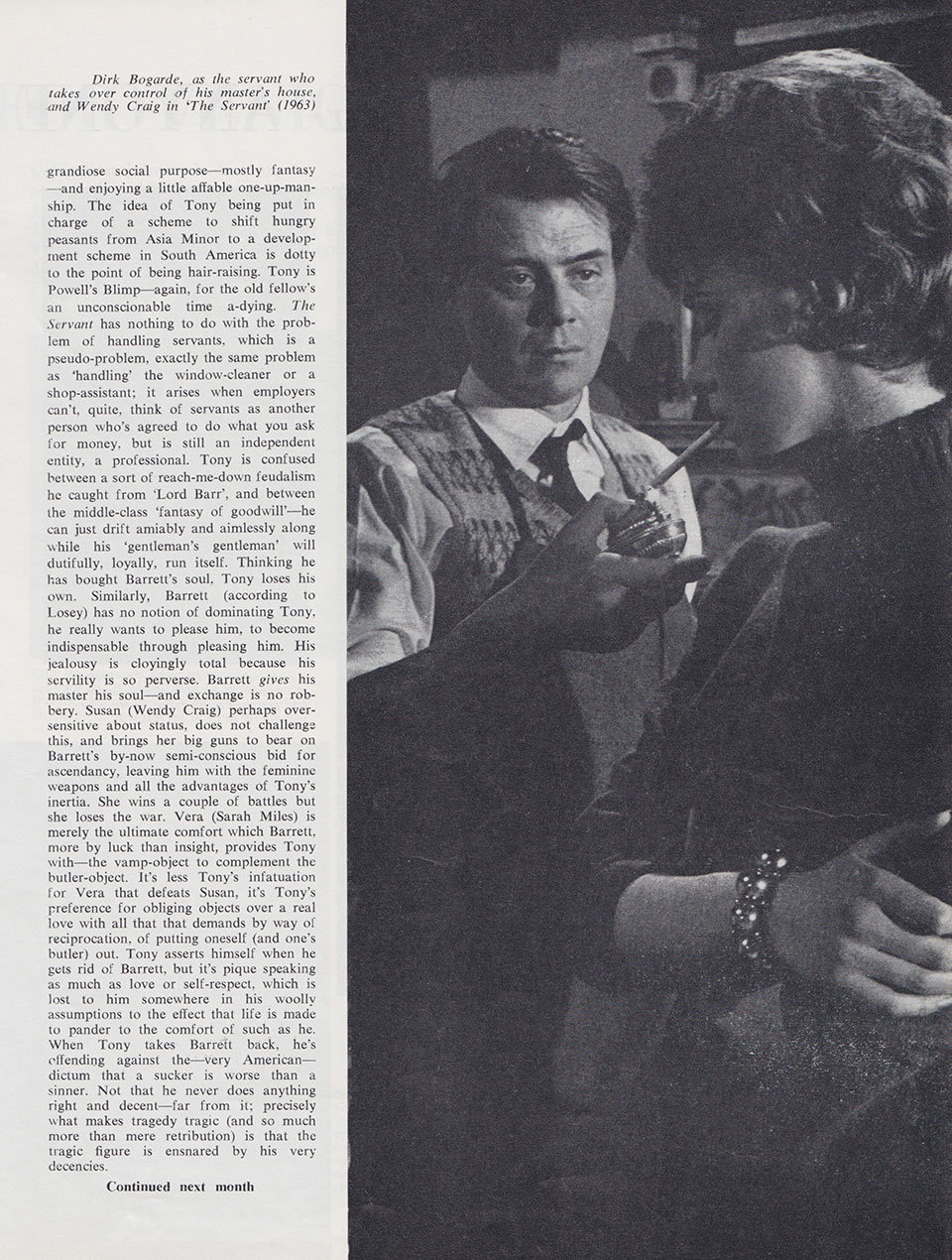
The ‘villain’ in Eva is ‘the fantasy of pleasure’, the ‘villain’ of The Servant is ‘the fantasy of goodwill’. Tony is nice, absent-mindedly nice, and he’s nice like that because he’s never been equal to anyone below his own, closed class. He corresponds to the June Laverick character in The Gypsy and the Gentleman. Yet as Losey has insisted, against those who saw Tony as an aristocratic English gentleman, he’s ‘fourth generation Harrod’s’, or, let’s say, Stanford’s grandson. And when money-making and ‘arriving’ was the father’s God, the affluent and arrived son has no aim but flirting with some sort of grandiose social purpose-mostly fantasy – and enjoying a little affable one-up-manship. The idea of Tony being put in charge of a scheme to shift hungry peasants from Asia Minor to a development scheme in South America is dotty to the point of being hair-raising. Tony is Powell’s Blimp-again, for the old fellow’s an unconscionable time a-dying. The Servant has nothing to do with the problem of handling servants, which is a pseudo-problem, exactly the same problem as ‘handling’ the window-cleaner or a shop-assistant; it arises when employers can’t, quite, think of servants as another person who’s agreed to do what you ask for money, but is still an independent entity, a professional. Tony is confused between a sort of reach-me-down feudalism he caught from ‘Lord Barr’, and between the middle-class ‘fantasy of goodwill’- he can just drift amiably and aimlessly along while his ‘gentleman’s gentleman’ will dutifully, loyally, run itself. Thinking he has bought Barrett’s soul, Tony loses his own. Similarly, Barrett (according to Losey) has no notion of dominating Tony, he really wants to please him, to become indispensable through pleasing him. His jealousy is cloyingly total because his servility is so perverse. Barrett gives his master his soul- and exchange is no robbery. Susan (Wendy Craig) perhaps oversensitive about status, does not challenge this, and brings her big guns to bear on Barrett’s by-now semi-conscious bid for ascendancy, leaving him with the feminine weapons and all the advantages of Tony’s inertia. She wins a couple of battles but she loses the war. Vera (Sarah Miles) is merely the ultimate comfort which Barrett, more by luck than insight, provides Tony with-the vamp-object to complement the butler-object. It’s less Tony’s infatuation for Vera that defeats Susan, it’s Tony’s preference for obliging objects over a real love with all that that demands by way of reciprocation, of putting oneself (and one’s butler) out. Tony asserts himself when he gets rid of Barrett, but it’s pique speaking as much as love or self-respect, which is lost to him somewhere in his woolly assumptions to the effect that life is made to pander to the comfort of such as he. When Tony takes Barrett back, he’s offending against the – very American – dictum that a sucker is worse than a sinner. Not that he never does anything right and decent- far from it; precisely what makes tragedy tragic (and so much more than mere retribution) is that the tragic figure is ensnared by his very decencies.

