Photoplay – Oct 1977

BOGARDE’S ‘DESPAIR’
by Ian F. McAsh
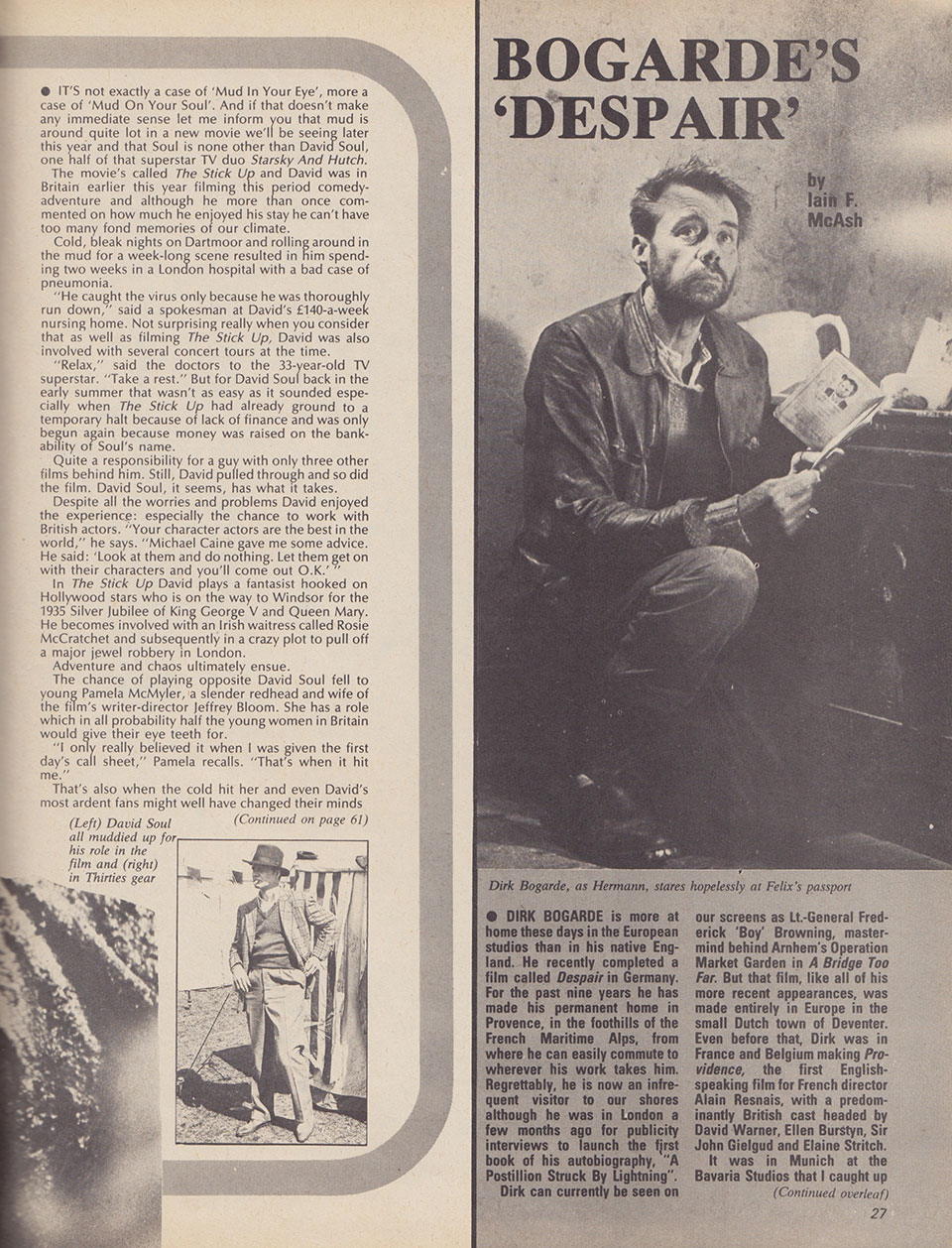
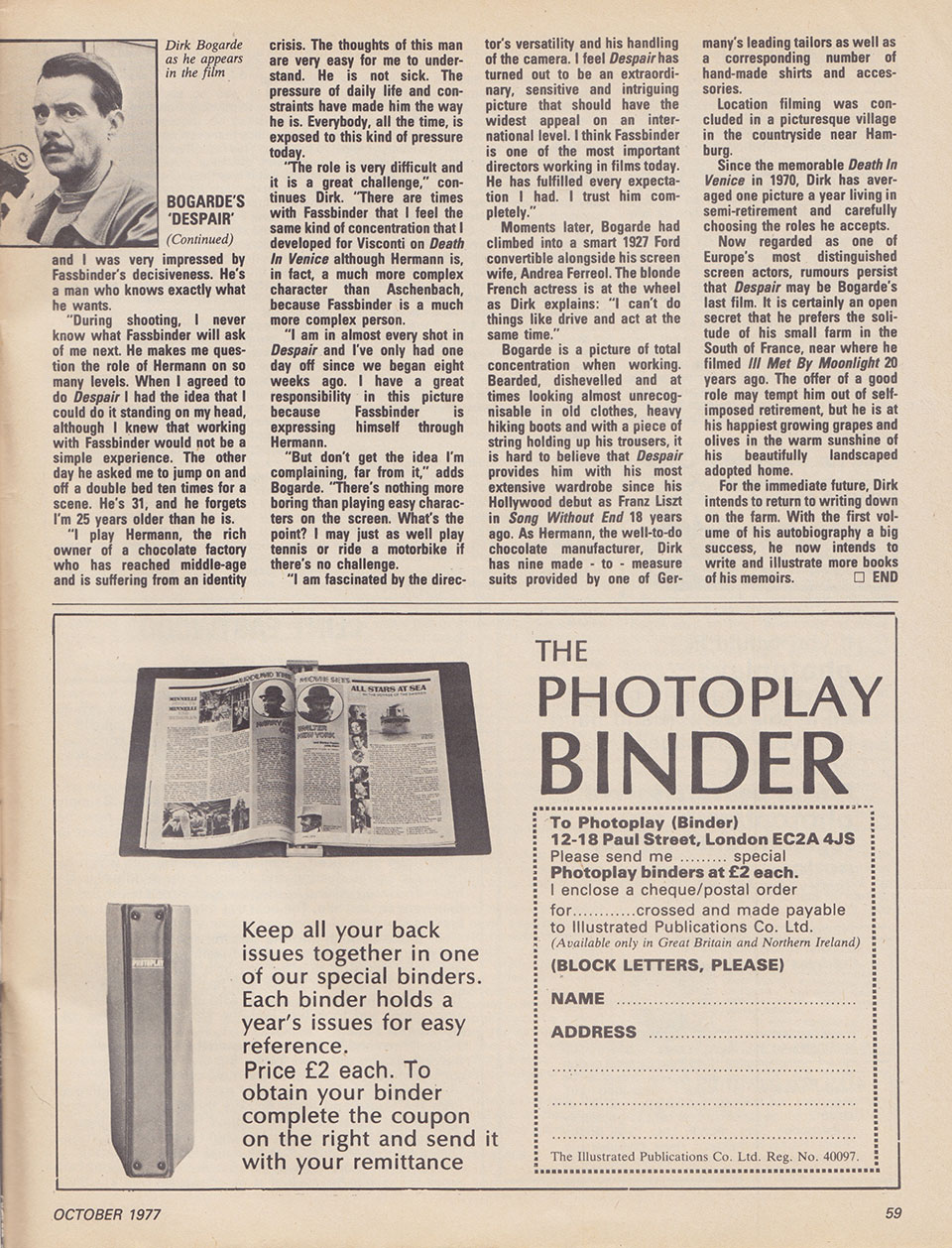
DIRK BOGARDE is more at home these days in the European studios than in his native England. He recently completed a film called Despair in Germany. For the past nine years he has made his permanent home in Provence, in the foothills of the French Maritime Alps, from where he can easily commute to wherever his work takes him. Regrettably, he is now an infrequent visitor to our shores although he was in London a few months ago for publicity interviews to launch the first book of his autobiography, “A Postillion Struck By Lightning”.
Dirk can currently be seen on our screens as Lt.-General Frederick ‘Boy’ Browning, mastermind behind Arnhem’s Operation Market Garden in A Bridge Too Far. But that film, like all of his more recent appearances, was made entirely in Europe in the small Dutch town of Deventer. Even before that, Dirk was in France and Belgium making Providence, the first English speaking film for French director Alain Resnais, with a predominantly British cast headed by David Warner, Ellen Burstyn, Sir John Gielgud and Elaine Stritch.
It was in Munich at the Bavaria Studios that I caught up with him. He was then making Despair. Dirk was the only British member of the large cast engaged by director Rainer Werner Fassbinder,the ‘enfant terrible‘ of the contemporary German cinema. Of course, portraying German characters on the screen is nothing new for Bogarde, who had two of his biggest successes in The Damned and The Night Porter.
Perhaps there is nothing strange about Dirk turning to European cinema for, although he first made his mark in British films almost thirty years ago, he is of half-Dutch parentage. His real surname is van den Bogaerde and his family can trace their ancestry back to Anne of Cleves, originating from the fruit-growing region on the Dutch-Belgian frontier. During the last ten years, Dirk has worked for many of the top European directors including Visconti, Resnais and Liliana Cavani.
Despair is based on a novel by the late Vladimir Nabokov, author of “Lolita”. Thinking himself too Teutonic for the task Fassbinder, who usually writes the scripts for his own films. engaged brilliant British playwright Tom Stoppard to pen the screenplay.
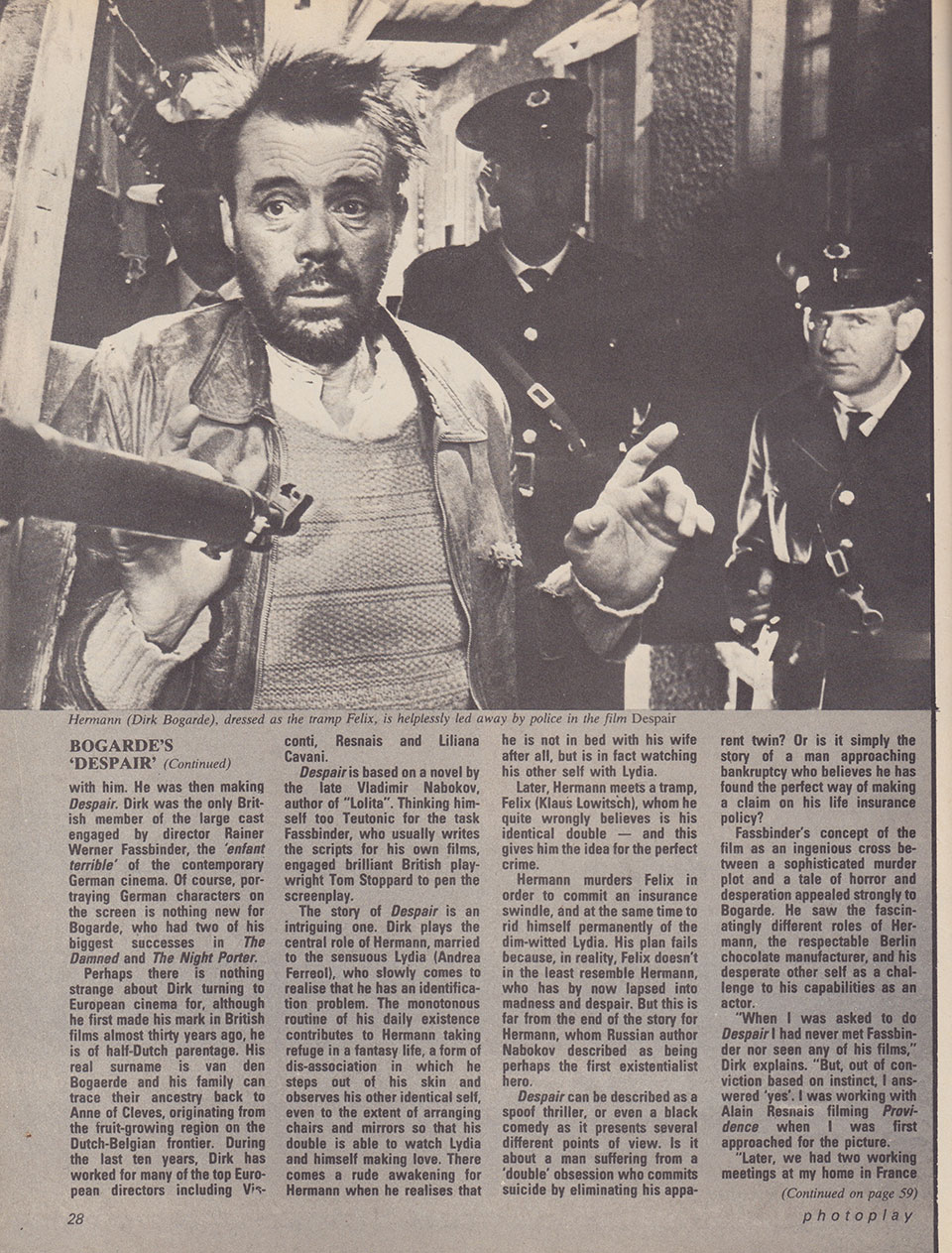
The story of Despair is an intriguing one. Dirk plays the central role of Hermann, married to the sensuous Lydia (Andrea Ferreol), who slowly comes to realise that he has an identification problem. The monotonous routine of his daily existence contributes to Hermann taking refuge in a fantasy life, a form of dis-association in which he steps out of his skin and observes his other identical self, even to the extant of arranging chairs and mirrors so that his double is able to watch Lydia and himself making love. There comes a rude awakening for Hermann when he realises that he is not in bed with his wife after all, but is in fact watching his other self with Lydia. Later, Hermann meets a tramp, Felix (Klaus Lowitsch), whom he quite wrongly believes is his identical double – and this gives him the idea for the perfect crime.
Hermann murders Felix in order to commit an insurance swindle, and at the same time to rid himself permanently of the dim-witted Lydia. His plan fails because, in reality, Felix doesn’t in the least resemble Hermann, who has by now lapsed into madness and despair. But this is far from the end of the story for Hermann, whom Russian author Nabokov described as being perhaps the first existentialist hero.
Despair can be described as a spoof thriller, or evan a black comedy as it presents several different points of view. Is it about a man suffering from a ‘double’ obsession who commits suicide by eliminating his apparent twin? Or is it simply the story of a man approaching bankruptcy who believes he has found the perfect way of making a claim on his life insurance policy?
Fassbinder’s concept of the film as an ingenious cross between a sophisticated murder plot and a tale of horror and desperation appealed strongly to Bogarde. He saw the fascinatingly different roles of Hermann, the respectable Berlin chocolate manufacturer, and his desperate other self as a challenge to his capabilities as an actor.
“When I was asked to do Despair I had never met Fassbinder nor seen any of his films,” Dirk explains. “But, out of conviction based on instinct. I answered ‘yes’. I was working with Alain Resnais filming Providence when I was first approached for the picture. “Later, we had two working meetings at my home in France and I was very impressed by Fassbinder’s decisiveness. He’s a man who knows exactly what he wants.
“During shooting, I never know what Fassbinder will ask of me next. He makes me question the role of Hermann on so many levels. When I agreed to do Despair I had the idea that I could do it standing on my head, although I knew that working with Fassbinder would not be a simple experience. The other day he asked me to jump on and off a double bed ten times for a scene. He’s 31, and he forgets I’m 25 years older than he is.
“I play Hermann, the rich owner of a chocolate factory who has reached middle-age and is suffering from an identity crisis. The thoughts of this man are very easy for me to understand. He is not sick. The pressure of daily life and constraints have made him the way he is. Everybody, all the time, is exposed to this kind of pressure today.
‘The role is very difficult and it is a great challenge,” continues Dirk. “There are times with Fassbinder that I feel the same kind of concentration that I developed for Visconti on Death In Venice although Hermann is, in fact, a much more complex character than Aschenbach, because Fassbinder is a much more complex person.
“I am in almost every shot in Despair and I’ve only had one day off since we began eight weeks ago. I have a great responsibility in this picture because Fassbinder is expressing himself through Hermann.
“But don’t get the idea I’m complaining, far from it,” adds Bogarde. ‘There’s nothing more boring than playing easy characters on the screen. What’s the point? I may just as well play tennis or ride a motorbike if there’s no challenge.
“I am fascinated by the director’s versatility and his handling of the camera. I feel Despair has turned out to be an extraordinary, sensitive and intriguing picture that should have the widest appeal on an international level. I think Fassbinder is one of the most important directors working in films today. He has fulfilled every expectation I had. I trust him completely.”
Moments later, Bogarde had climbed into a smart 1927 Ford convertible alongside his screen wife, Andrea Ferreol. The blonde French actress is at the wheel as Dirk explains: “I can’t do things like drive and act at the same time.”
Bogarde is a picture of total concentration when working. Bearded, dishevelled and at times looking almost unrecognisable in old clothes, heavy hiking boots and with a piece of string holding up his trousers, it is hard to believe that Despair provides him with his most extensive wardrobe since his Hollywood debut as Franz Liszt in Song Without End 18 years ago. As Hermann, the well-to-do chocolate manufacturer, Dirk has nine made-to-measure suits provided by one of Germany’s leading tailors as well as a corresponding number of hand-made shirts and accessories.
Location filming was concluded in a picturesque village in the countryside near Hamburg.
Since the memorable Death In Venice in 1970, Dirk has averaged one picture a year living in semi-retirement and carefully choosing the roles he accepts. Now regarded as one of Europe’s most distinguished screen actors, rumours persist that Despair may be Bogarde’s last film. It is certainly an open secret that he prefers the solitude of his small farm in the South of France, near where he filmed Ill Met By Moonlight 20 years ago. The offer of a good role may tempt him out of self-imposed retirement, but he is at his happiest growing grapes and olives in the warm sunshine of his beautifully landscaped adopted home.
For the immediate future, Dirk intends to return to writing down on the farm. With the first volume of his autobiography a big success, he now intends to write and illustrate more books of his memoirs.
END

