Film In Review – Nov 1980
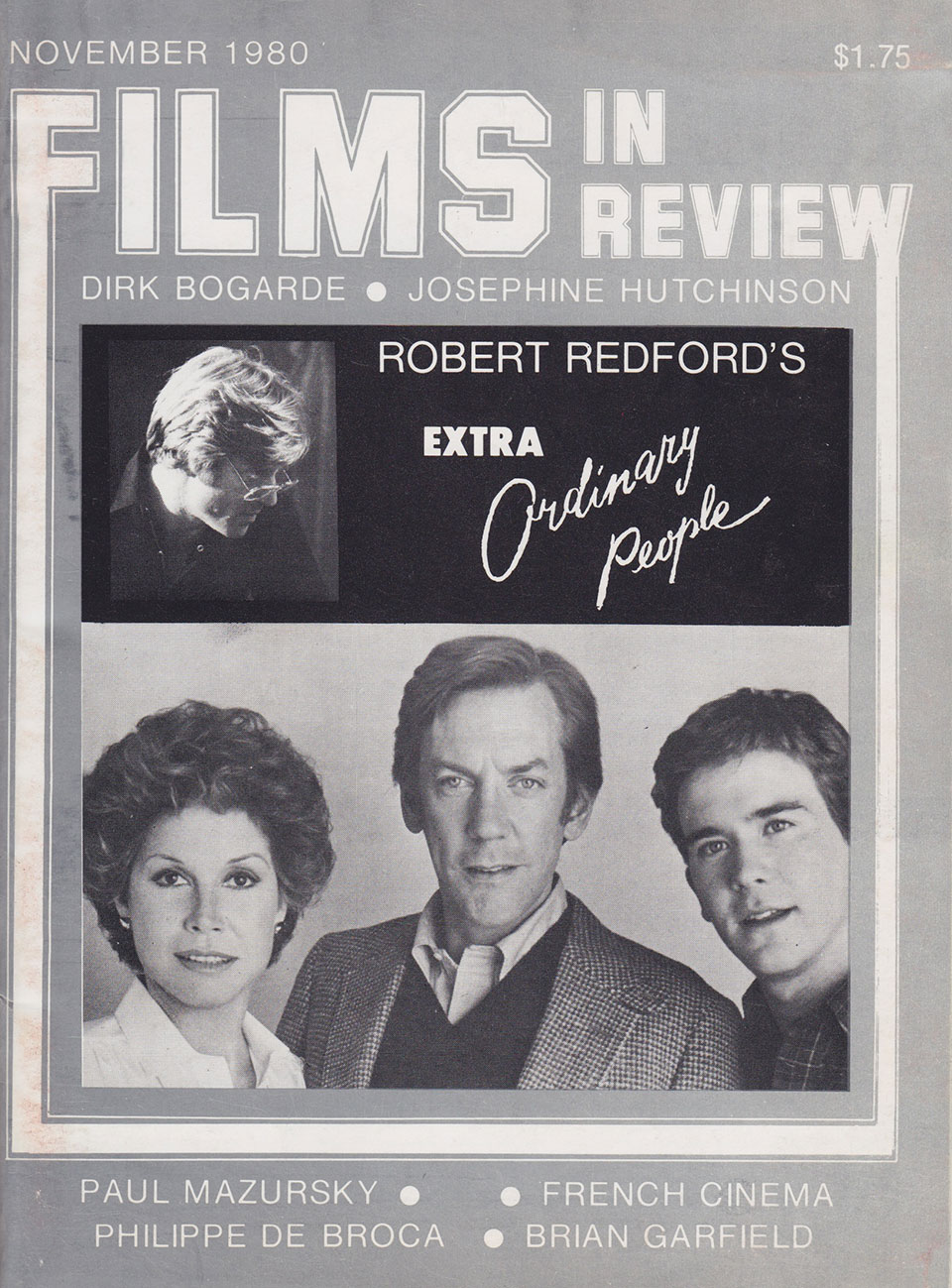
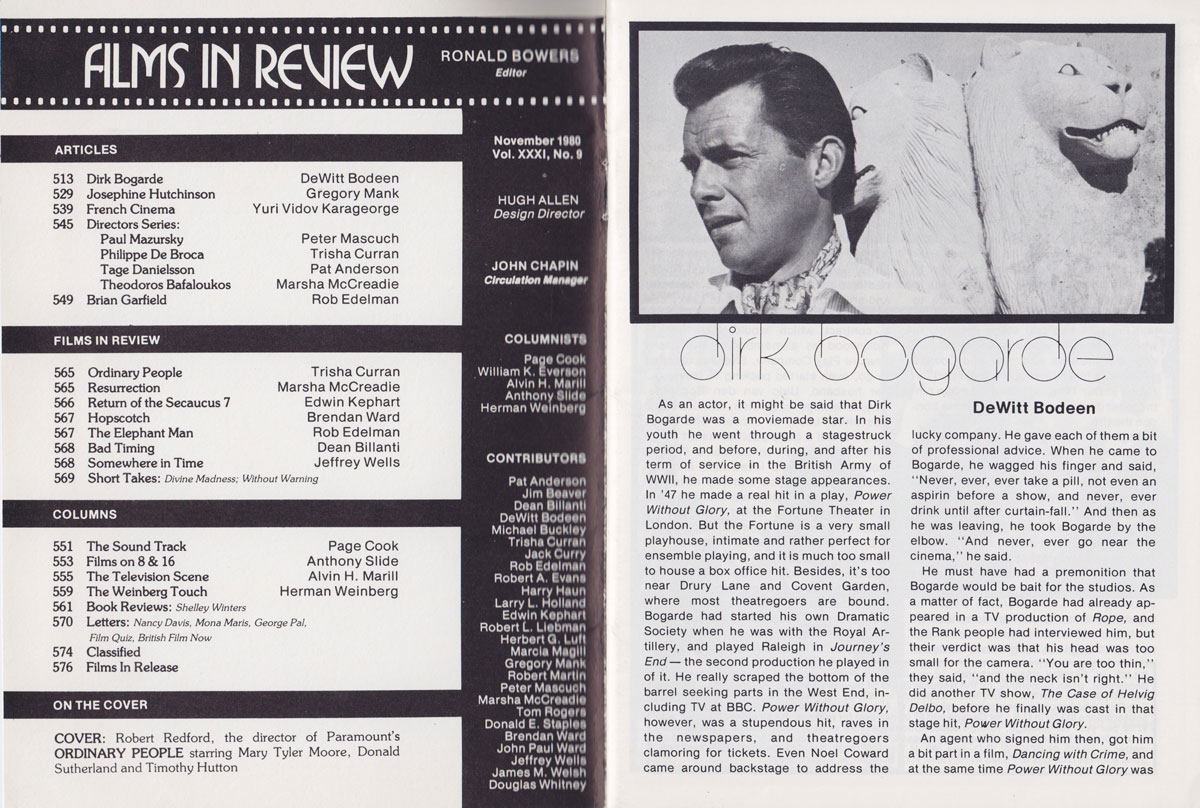
Dirk Bogarde
DeWitt Bodeen
As an actor, it might be said that Dirk Bogarde was a movie-made star. In his youth he went through a stagestruck period , and before, during , and after his term of service in the British Army of WWII , he made some stage appearances. In ’47 he made a real hit in a play, Power Without Glory, at the Fortune Theater in London. But the Fortune is a very small playhouse, intimate and rather perfect for ensemble playing , and it is much too small to house a box office hit. Besides, it’s too near Drury Lane and Covent Garden, where most theatregoers are bound. Bogarde had started his own Dramatic Society when he was with the Royal Artillery, and played Raleigh in Journey’s End – the second production he played in of it. He really scraped the bottom of the barrel seeking parts in the West End , including TV at BBC. Power Without Glory, however, was a stupendous hit, raves in the newspapers, and theatregoers clamouring for tickets. Even Noel Coward came around backstage to address the lucky company. He gave each of them a bit of professional advice. When he came to Bogarde, he wagged his finger and said, “Never, ever, ever take a pill, not even an aspirin before a show, and never, ever drink until after curtain-fall.” And then as he was leaving , he took Bogarde by the elbow. “And never, ever go near the cinema, “he said.
He must have had a premonition that Bogarde would be bait for the studios. As a matter of fact, Bogarde had already appeared in a TV production of Rope, and the Rank people had interviewed him, but their verdict was that his head was too small for the camera. “You are too thin,” they said, “and the neck isn’t right.”He did another TV show, The Case of Helvig Delbo, before he finally was cast in that stage hit, Power Without Glory. An agent who signed him then, got him a bit part in a film, Dancing with Crime, and at the same time Power Without Glory was transferred to a larger theatre in the West End. Producer Ian Dalrymple, from the Rank organization, signed Bogarde up almost at once for the role of William Latch in a movie to be made of George Moore’s novel, Esther Waters.
And then Noel Coward, still pleased as punch with the company he had “discovered,” came backstage to tell them that he had written them all into perfectly wonderful parts for his new play, Peace in Our Time. Bogarde shamefacedly confessed that he’d ignored Coward’s advice and signed up for a seven-year contract with Rank. Coward took him to dinner at the Savoy Grill, and then back to his house, hoping to persuade him to break his film contract. Coward believed that Bogarde had real stage potential; a whole new world would open up for him now that the War was over and Coward had written him a “walloping great part” in Peace in Our Time, which could make him the most desirable young actor in the London theatre.
Bogarde, however, could not be dissuaded. He had made a bargain with Ian Dalrymple, and his contract with Rank would permit him doing a play for six months every second year; Bogarde argued that he was just postponing his attempt to become a stage success in order to make some quick money in the movies. Coward was very unhappy.
Dirk Bogarde has written all this just as it happened in his two volumes of autobiography – A Postillion Struck by Lightning, which takes him up to the age of 18, and Snakes & Ladders, which brings him up through his long movie career to ’78. They are two of the best books to be written by a theatre and film personality. Bogarde is honest; he is sensitive; he has a delightful, even wicked, sense of humour; and he has proved that he can write with all the skill of a professional writer.
He had been born Derek Jules Gaspard Ulric Niven van den Bogaerde in Hampstead, London, on March 28, ’21. His mother, Margaret Niven, a Scotswoman, had been a very promising actress in the theatre, scoring a great hit during ’11 in the Scottish comedy at the Haymarket, Bunty Pulls the Strings, which ran for 617 performances. Her father, Forrest Niven, had also been a well-known stage actor and artist of his time. Jesse L. Lasky saw her at the Haymarket, and later offered her a contract which would take her to Hollywood as a member of the Lasky Feature Play Company. She was tempted to go, even started packing to leave, but her husband , Ulric van den Bogaerde, whose heritage was Dutch ,told her that it was either Lasky or himself. She chose him. He had a good position as art editor with “The Times” in London’s Printing House Square; she loved him, although she always regretted that she never got any further west than Manhattan, and was confident that she would have been a much-loved silent screen star.
Dirk Bogarde has written of his childhood and youth as a time of a kind of pastoral loveliness; he had a sister named Elizabeth and a younger brother Gareth, and although their father worked in London, the family lived and was brought up in a cottage outside the city in a district known as “The Great Meadow.” Yvonne Arnaud was Bogarde’s godmother, and he has said of her kindliness, “Yvonne adopted godchildren as some women adopt habits. Unthinkingly, wholeheartedly and devotedly.”
He attended University College School and Allan Glen’s School in Scotland. Young Dirk had a real talent for drawing and scenic design; his sketches illustrate his books charmingly. He loved to paint scenery at the nearby Uckfield Theatre, and it wasn’t long before he was drafted there as an actor. He had a natural, winning way onstage, and caught the audience’s fancy . He went on to “Q” Theatre, where he become friendly with another actor named William Wrightman, who later attained no little success as Peter Ustinov. Bogarde won audiences with his performances in several J. B. Priestley plays, When We Are Married and Cornelius; a Shaw comedy, You Never Can Tell; and a revue, Diversion.
He fell in love with a young actress, a Scots girl, Anne Deans, but they never married. He was in the midst of a successful engagement in the mystery thriller, The Ghost Train, when war with Germany was declared, and he was soon off to York and then sent to Richmond for his training.
An attempt was made to train him to be a signaller in the Royal Corps of Signals, but, as he has confessed, he “had the coordination of a bursting dam and the technical intelligence of an eft.” He excelled in the precision of drilling, even if he couldn’t even send out an S.O.S. He volunteered for the cookhouse, and it seemed as if he might fight the war peeling potatoes and scrubbing down tables and benches. Nothing went right until he was promoted to be Lance Corporal, and his company formed a Dramatic Society and staged Patrick Hamilton’s Rope, which had a lovely part for him. The Society also staged Elmer Rice’s Judgement Day with even greater success, and he got to be an Officer’s Cadet by persuading his father to send some large photos of nude women to hang in the Officer’s Mess.
He was in service for five and a half years, even got to Calcutta, Java, Malaya -one of “the Forgotten Army,” as they were called. The important thing was that he survived the whole bloody mess, in spite of never being able to do the Morse or ride a motorcycle. He came out, instead, a full Lieutenant, and finally got mustered out and went home to “The Great Meadow.” He was then 26 years old, and he was lucky, for he still looked like a juvenile, rather well tanned because of all the time he’d spent under the Malayan sun.
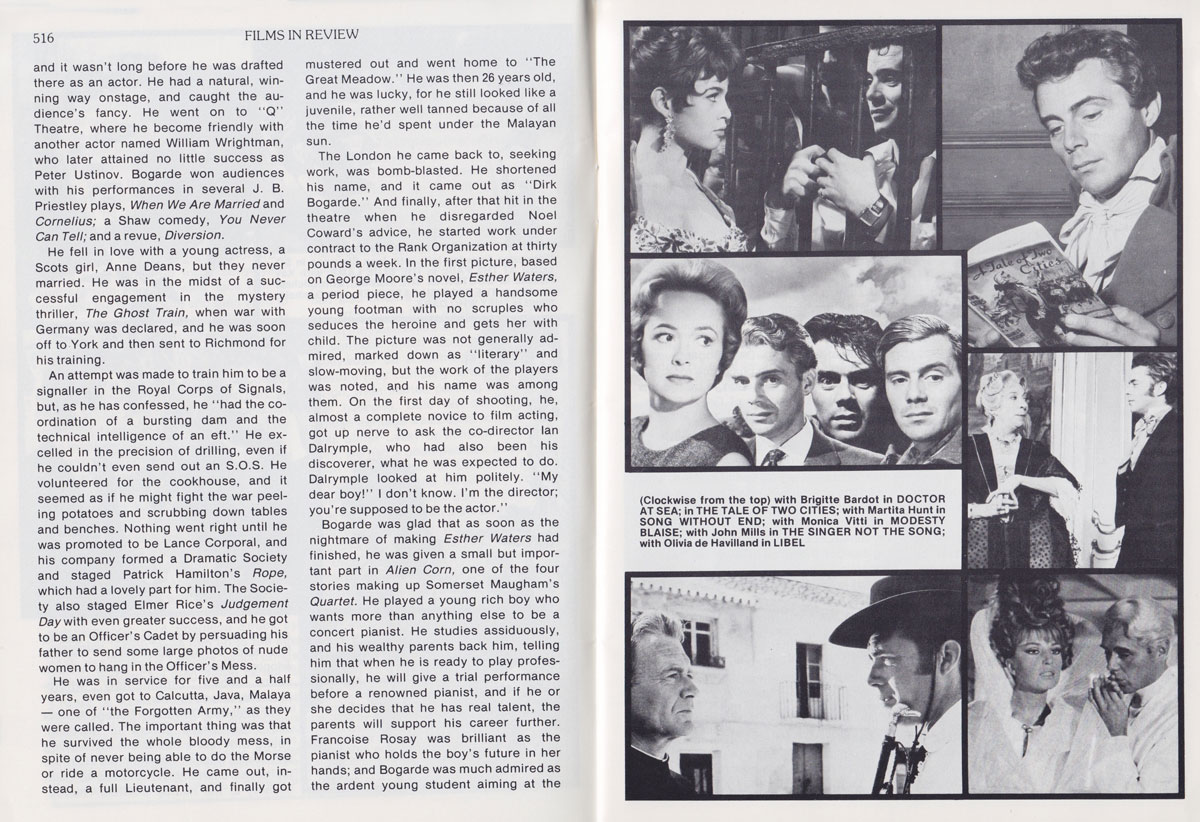
The London he came back to, seeking work, was bomb-blasted. He shortened his name, and it came out as “Dirk Bogarde. “And finally, after that hit in the theatre when he disregarded Noel Coward ‘s advice, he started work under contract to the Rank Organization at thirty pounds a week. In the first picture, based on George Moore’s novel, Esther Waters, a period piece, he played a handsome young footman with no scruples who seduces the heroine and gets her with child. The picture was not generally admired, marked down as “literary” and slow-moving, but the work of the players was noted, and his name was among them. On the first day of shooting, he, almost a complete novice to film acting, got up nerve to ask the co-director Ian Dalrymple, who had also been his discoverer, what he was expected to do. Dalrymple looked at him politely. “My dear boy!” I don’t know. I’m the director; you’re supposed to be the actor.”
Bogarde was glad that as soon as the nightmare of making Esther Waters had finished, he was given a small but important part in Alien Corn, one of the four stories making up Somerset Maugham’s Quartet. He played a young rich boy who wants more than anything else to be a concert pianist. He studies assiduously, and his wealthy parents back him, telling him that when he is ready to play professionally, he will give a trial performance before a renowned pianist, and if he or she decides that he has real talent, the parents will support his career further. Francoise Rosay was brilliant as the pianist who holds the boy’s future in her hands; and Bogarde was much admired as the ardent young student aiming at the stars.
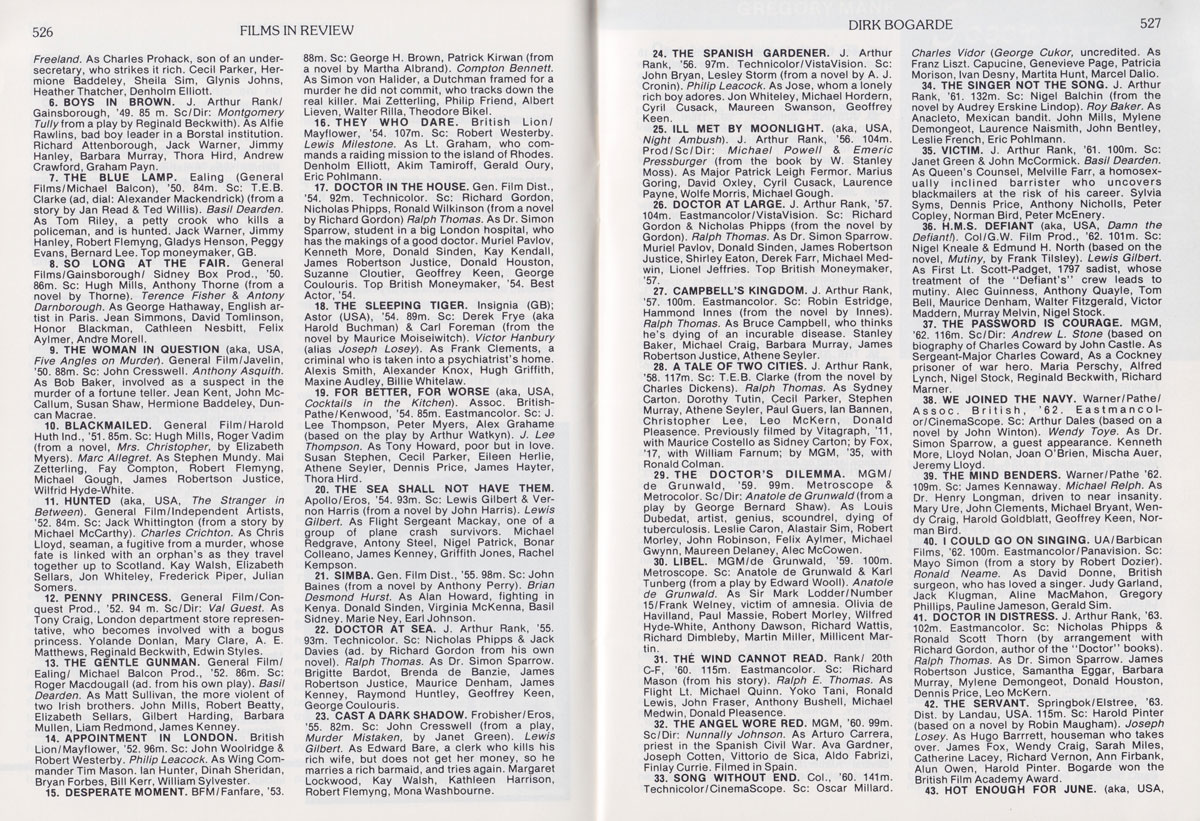
The Rank people kept him busy as a cyclist (believe it or not) in Once a Jolly Swagman; as an under-secretary’s son in Arnold Bennett’s Dear Mr.Prohack; and as a belligerent Borstal boy lionizing a reformatory of bad youths in Boys in Brown.
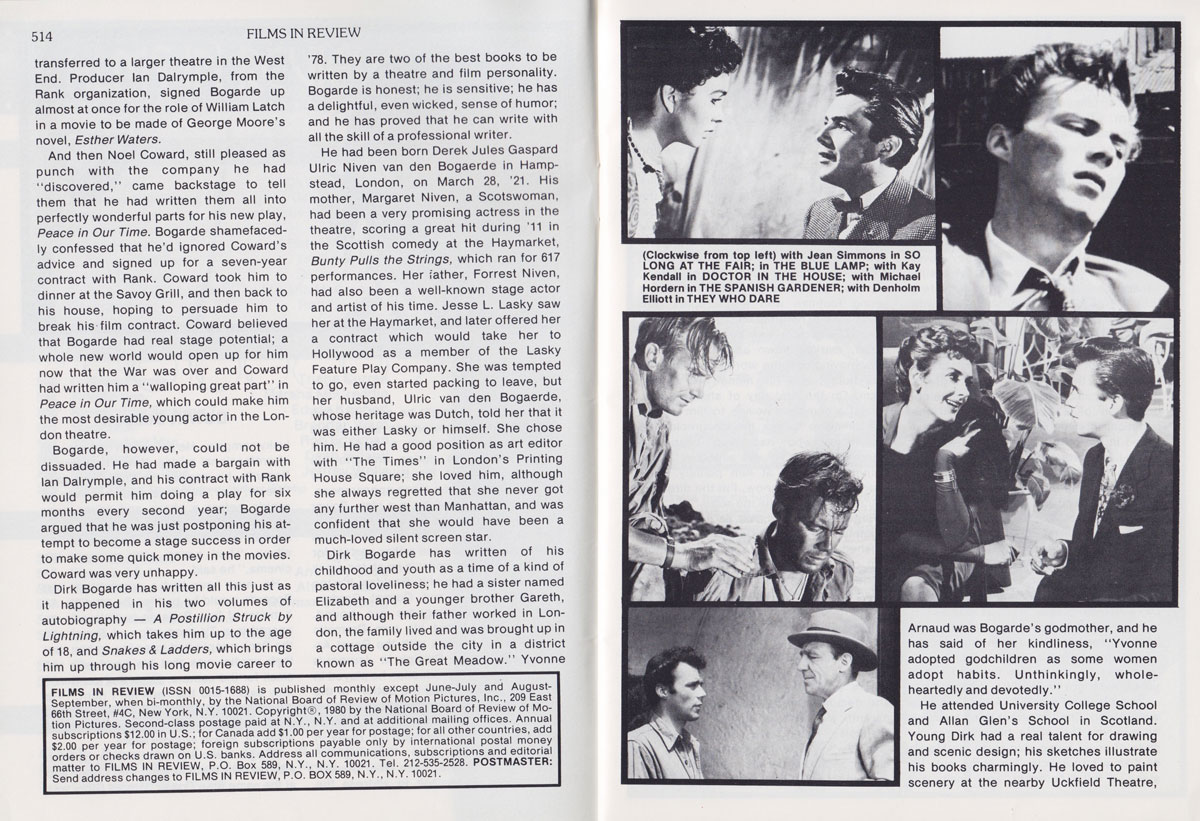
With his seventh picture, Bogarde hit the jackpot. It was an intense and ingelligent melodrama about the London police, The Blue Lamp, splendidly directed by Basil Dearden, and in it Bogarde played a youthful crook who kills a policeman and tries to escape being captured by the entire London police force , determined to bring in the killer of one of their own. Bogarde not only got astonishingly good notices, but he won the favor of movie viewers, much as young James Cagney had done in Hollywood Warner Bros. gangster films, and he took a giant step towards the film stardom that was shortly to be his.
I remember how arresting he was also in his very next picture, So Long at the Fair, an absorbing and very believable mystery story set in Paris at the time of the Exposition, which he did with Jean Simmons. He then did two murder mysteries, The Woman in Question and afterwards Blackmailed, the latter directed by Marc Allegret from a spellbinding novel by Elizabeth Myers called Mrs. Christopher. It has a unique beginning : a handful of well-dressed people unknown to one another gathers by appointment in a cottage parlor. They are all victims of a blackmailer, who now politely but firmly tells them that he is being forced to raise the amount of the money each is paying him every month for crimes only he knows of their having committed. A middle-aged lady quietly withdraws a revolver from her purse, takes careful aim , and with one bullet kills the blackmailer dead. The victims then make an agreement among themselves; they will leave the house separately and go to their various homes, and none of them will ever reveal the identity of Mrs. Christopher, who has freed them . All goes well until a reward is offered and one by one those who had sworn to keep the identity of Mrs. Christopher secret sell their knowledge to the police. There is a catch , however, even though Mrs. Christopher, in spite of high connections, admits to her guilt, and is executed . The money each of those has gained for betraying her brings to each of them nothing but misery and complete disaster. This story calls for a re-make, because, as Blackmailed, it did not have the superb irony of the novel, although Bogarde, Fay Compton, Robert Flemyng, and Mai Zetterling lent it believability and class.
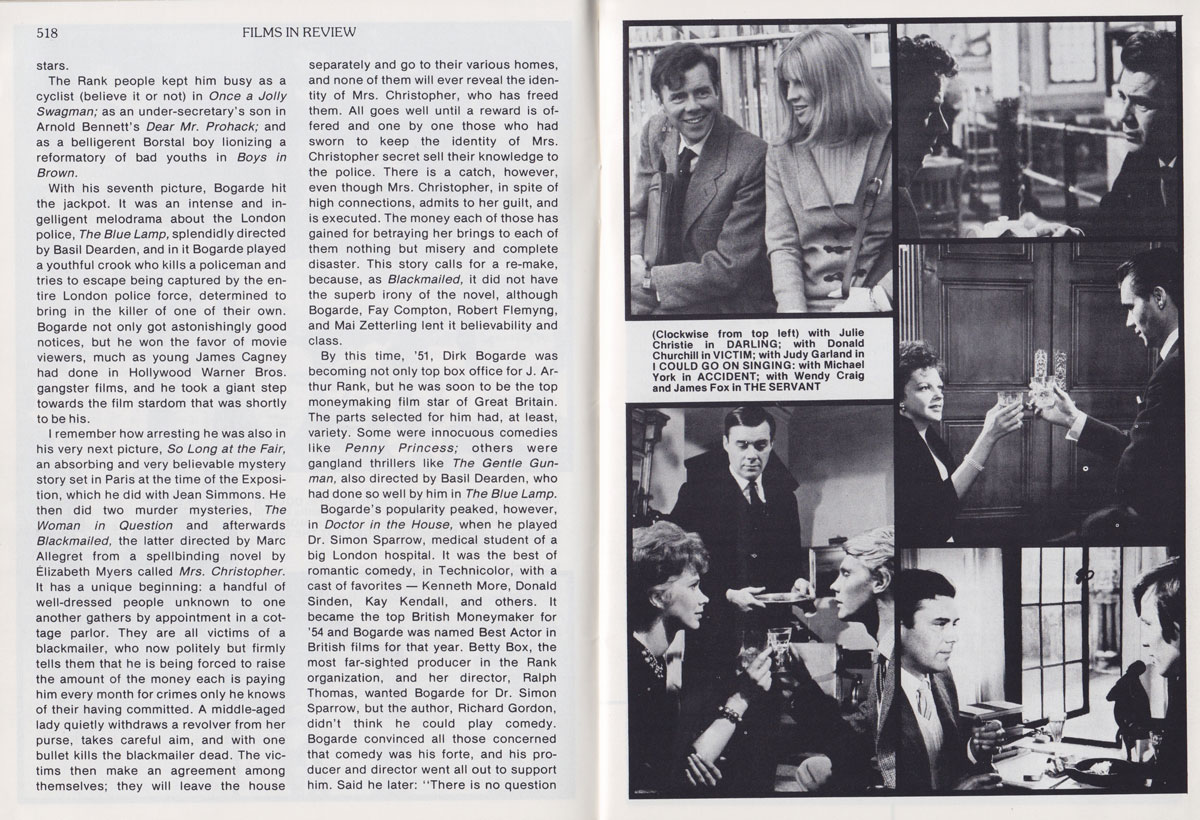
By this time, ’51 , Dirk Bogarde was becoming not only top box office for J. Arthur Rank, but he was soon to be the top moneymaking film star of Great Britain. The parts selected for him had, at least, variety. Some were innocuous comedies like Penny Princess; others were gangland thrillers like The Gentle Gunman, also directed by Basil Dearden, who had done so well by him in The Blue Lamp. Bogarde’s popularity peaked, however, in Doctor in the House, when he played Dr. Simon Sparrow, medical student of a big London hospital. It was the best of romantic comedy, in Technicolor, with a cast of favorites – Kenneth More, Donald Sinden , Kay Kendall, and others. It became the top British Moneymaker for ’54 and Bogarde was named Best Actor in British films for that year. Betty Box, the most far-sighted producer in the Rank organization, and her director, Ralph Thomas, wanted Bogarde for Dr. Simon Sparrow, but the author, Richard Gordon, didn’t think he could play comedy. Bogarde convinced all those concerned that comedy was his forte, and his producer and director went all out to support him. Said he later: “There is no question in my mind whatsoever that if they (Box and Thomas) had not taken this courageous stand I should never have had a career in the cinema at all; it was the absolute turning point, and by their action they secured me in my profession. A debt it is impossible to repay.”
He was to play Dr, Simon Sparrow in three additional sequels: Doctor at Sea (’55); Doctor at Large (top British moneymaker for ’57)’ Doctor in Distress (’63); and he made a guest appearance as Dr. Sparrow in We Joined the Navy (’62). The “Doctor” films were also wellreceived in the US. Dirk Bogarde’s name was one every moviegoer anywhere came to know and remember.
One of my own favorite films of his was called Hunted (’52), known in the US as The Stranger in Between. In it he played a seaman running away from a murder, who is aided by a runaway orphan, and the two manage to get up to Scotland together. Bogarde has been rather non-committal about most of his early pictures, but he has admitted that he enjoyed doing Hunted and thought it came off well.
In ’54 he had one of his earliest associations with director Joseph Losey, who had escaped from McCarthy persecution in the US and under the pseudonym of “Victor Hanbury” directed a British film called The Sleeping Tiger. Both men realized at once that they worked well together, and in later years, after Bogarde finished his long association with Rank, they made four pictures together, each in its way a gem.
Bogarde starred in a good murder mystery, Cast a Dark Shadow, in which he played an unscrupulous villain who marries a woman for her money and kills her, but he cannot claim her wealth without exposing himself; he tries again, with another rich widow, and she proves too smart for him.
An A. J. Cronin novel, The Spanish Gardener, had Bogarde as a lonely Spanish gardener who is adored by an equally lonely child. It was well-liked, and had much of the sensitiveness of Hunted.
In ’58 Rank’s version of Dickens ‘A Tale of Two Cities was released, in which Bogarde gave one of his best performances as the gallant Sydney Carton. The lavish ’35 MGM version remains definitive, but Rank’s version, by necessity less expensive, was tremendously moving, and although Ronald Colman had made Carton particularly his own, Bogarde brought the role some subtle nuances of grim humor, lost youth , and a resignation to the hopelessness of his romance.
Bogarde was lent for a sumptuous production of Shaw’s The Doctor’s Dilemma, made by MGM and Anatole de Grunwald. It had a beautiful cast of real artistes, and Bogarde was at his best as a dying artist, who in spite of his genius, is something of a genuine scoundrel. I have always thought, even with the Broadway Katharine Cornell stage production, that The Doctor’s Dilemma was a play that provides fascinating reading, but simply does not play. The film did not change my opinion.
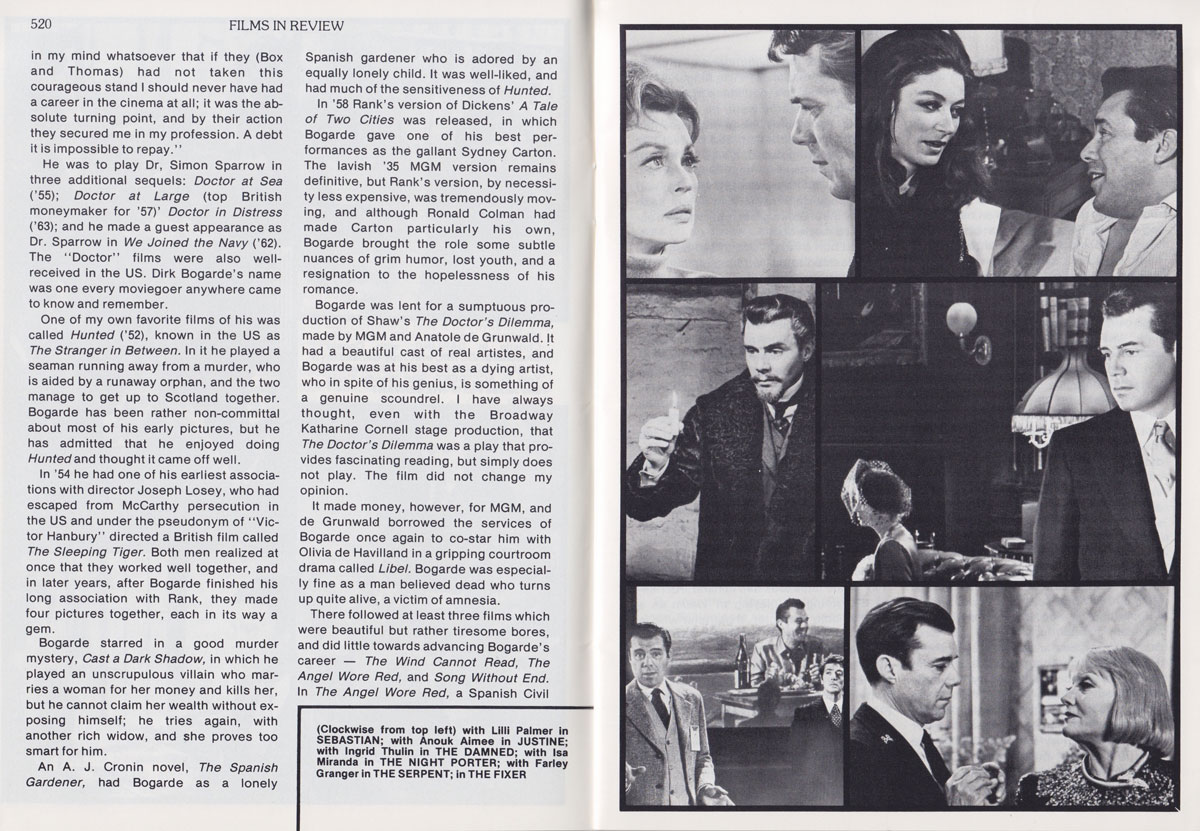
It made money, however, for MGM, and de Grunwald borrowed the services of Bogarde once again to co-star him with Olivia de Havilland in a gripping courtroom drama called Libel. Bogarde was especially fine as a man believed dead who turns up quite alive, a victim of amnesia. There followed at least three films which were beautiful but rather tiresome bores, and did little towards advancing Bogarde’s career – The Wind Cannot Read, The Angel Wore Red, and Song Without End. In The Angel Wore Red, a Spanish Civil War drama, Bogarde took over a part Monty Clift was supposed to have played.
Neither he nor his co-star, Ava Gardner, was very happy about the script. One day Miss Gardner asked him frankly, “What do you get paid for this load of crap?” “A fortune,” he admitted . “So am I,” she granted, “but it’s not worth it.” In Song Without End Bogarde played Franz Liszt, although he was no pianist himself and was nearly driven mad learning how to fake playing as Liszt would have, even though he knew the playing itself would be dubbed by a virtuoso. Charles Vidor, director, died suddenly in the midst of production , and Columbia was lucky enough to get George Cukor· to take over. To quote Bogarde on the subject: “In the end everything is a matter of taste – that’s what George taught me. Ever since then I’ve always asked myself, ‘Would George approve?’
“George taught me everything, and I’d already been in films for years when I met him. George will never believe that, but it’s true. When he took over for Vidor, he didn’t like me one bit. I can still see him pacing up and down that hotel corridor in Vienna, eating apples. I asked him if there was anything remotely salvageable from what we’d done. He said, ‘No, nothing whatsoever.'”
“After three weeks, however, he learned I wasn’t just a pretty boy in tights.” In ’61 Bogarde co-starred with John Mills in The Singer Not the Song, a stunning “camp” melodrama of the love of a Mexican bandit for a man of God. Bogarde’s appearance was eye-taking; dressed in form-fitting black leather, he played this unbelievable story the only way it would work, and when he and the young priest are lying on the sand at the end, dying from gun wounds like Jennifer Jones and Gregory Peck in Duel in the Sun, their hands outstretched to touch one another, the priest, who has tried to convert him, asks “Is it the singer or the song?” And the dying bandit, with an ironic smile, responds, “The Singer.” It was elegant trash; it made money, and everywhere Bogarde went, he was mobbed like a celebrity, requiring mounted policemen to attend him and protect him from his adoring public. It was the kind of popularity, however, that would boomerang. David Lean was casting a film and when Bogarde’s name came up, Lean said , “I think Dirk’s great, but I want an actor, not a movie star.”
“That hurt a little,” confessed Bogarde, “so I decided to hell with the glamour” – and he gradually eased into character acting. Most of what he played was no longer what he called “romantic schlock,” and gradually magazine writers stopped calling him “the English Rock Hudson.”
Although his contract permitted him to do theatre on occasion, the plays he performed pleased him as little as the movies he was doing. They were too esoteric; he was no longer stagestruck; and in ’56 he knew that he was going to abandon the theatre for good. By ’61 , after a successful holiday in the theatre, when Laurence Olivier asked Bogarde to join him in the opening season at Chichester Theatre, suggesting that he might “do Hamlet or some such thing,” Bogarde reneged, aware that he was going on as a screen player, high at least on the yearly lists of the Top Ten in England.
In ’61 the fates took him in hand. He risked everything on playing in Victim as a questionable character, a barrister who is a secret homosexual and risks his position as Queen’s Counsel in exposing a blackmailing ring , even though it means victimizing himself and endangering his own happiness and successful career. Playing Victim meant, of course, that the screen image he had built up and sustained for fourteen years quickly disintegrated. His fans didn’t like his playing such a part, and deserted him without a backward glance. But Basil Dearden was again his director, and Dearden had brought his career, beginning with The Blue Lamp nothing but blessings and honors.
The following year Bogarde played a sadistic first lieutenant in a late 18th century melodrama about a ship’s mutiny, H.M.S. Defiant. As a screen subject, mutiny was definitely in that year, for it was also the theme of Billy Budd and Mutiny on the Bounty. Bogarde decidedly was off on a new bent. His public changed. No longer were they idol-worshippers. The critics began to regard him with admiration, and his fans became those who responded to his talents as an actor rather than as a sex symbol.
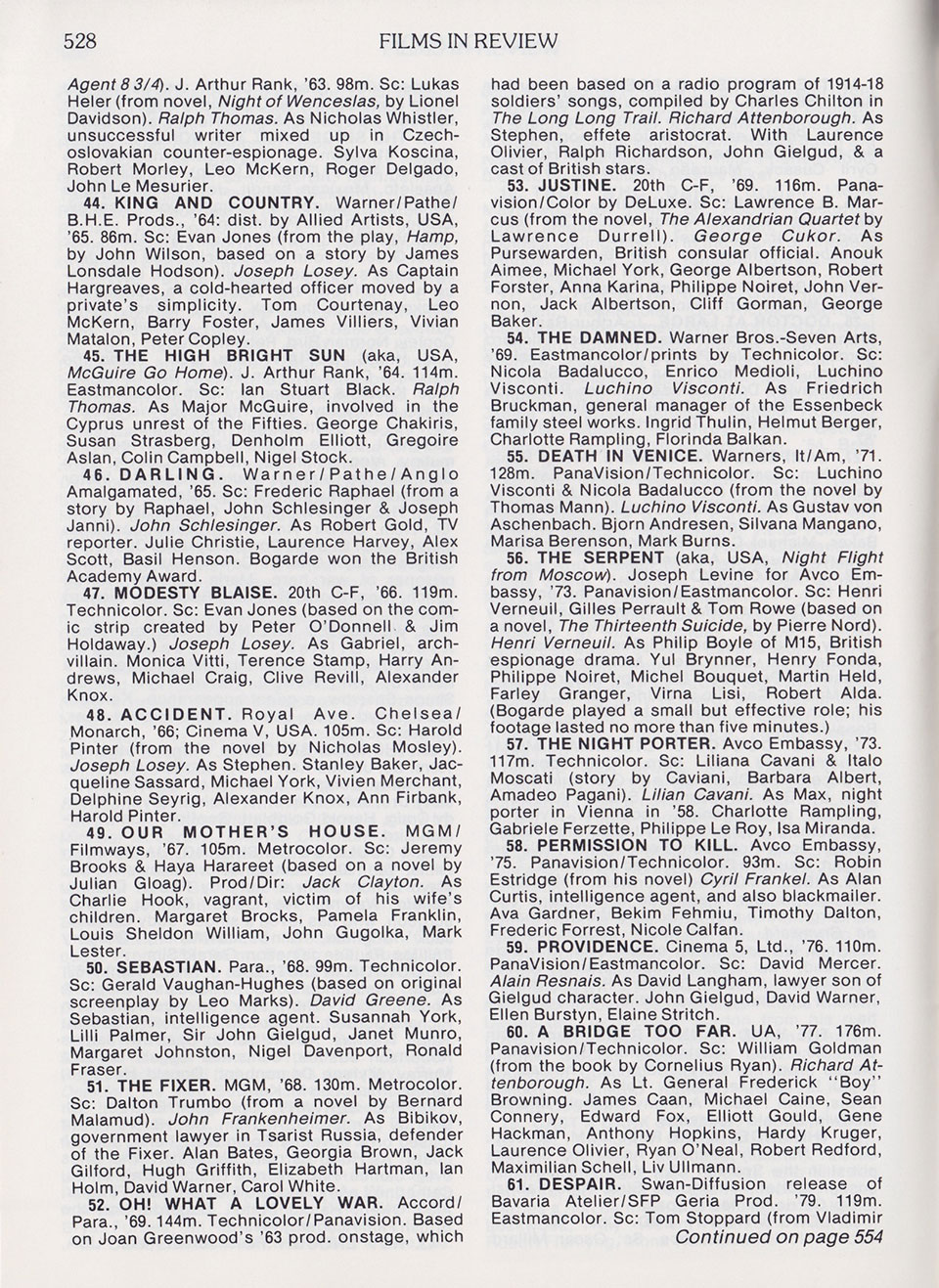
In ’63 he made The Servant, from a Harold Pinter screenplay, directed by Joseph Losey, playing a venal houseman who cleverly and completely corrupts his weak master, taking his house and position away from him. It brought Bogarde the British Film Academy Award as Best Actor. Two years later Losey directed him again in King and Country, a war story in which he played a cold-hearted captain who, although moved by a private’s honest simplicity, allows him to be executed as a deserter. It was a dramatic and disturbing film and brought honors to both Bogarde and a newcomer, Tom Courtenay, who was superbly touching as the simple-minded private.
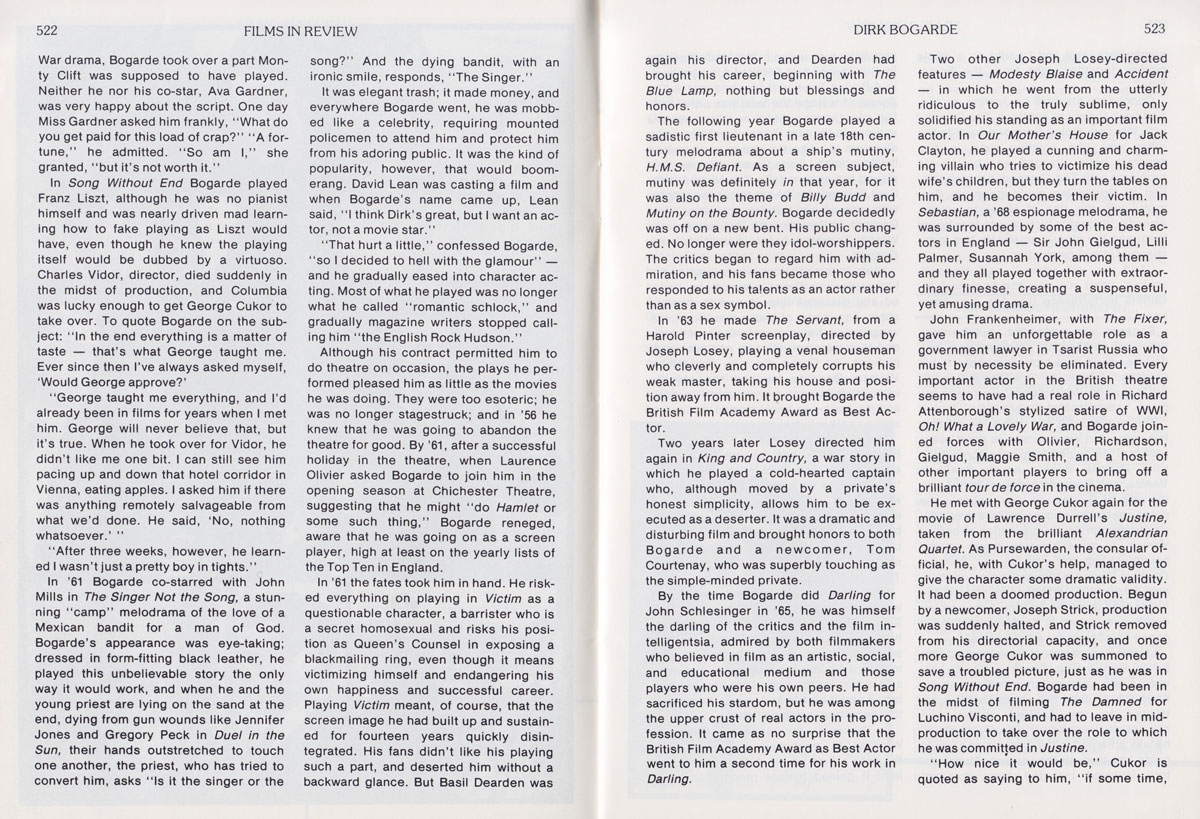
By the time Bogarde did Darling for John Schlesinger in ’65, he was himself the darling of the critics and the film intelligentsia, admired by both filmmakers who believed in film as an artistic, social, and educational medium and those players who were his own peers. He had sacrificed his stardom , but he was among the upper crust of real actors in the profession. It came as no surprise that the British Film Academy Award as Best Actor went to him a second time for his work in Darling. Two other Joseph Losey-directed features – Modesty Blaise and Accident – in which he went from the utterly ridiculous to the truly sublime, only solidified his standing as an important film actor. In Our Mother’s House for Jack Clayton, he played a cunning and charming villain who tries to victimize his dead wife’s children, but they turn the tables on him, and he becomes their victim . In Sebastian, a ’68 espionage melodrama, he was surrounded by some of the best actors in England – Sir John Gielgud, Lilli Palmer, Susannah York, among them – and they all played together with extraordinary finesse , creating a suspenseful, yet amusing drama.
John Frankenheimer, with The Fixer, gave him an unforgettable role as a government lawyer in Tsarist Russia who must by necessity be eliminated. Every important actor in the British theatre seems to have had a real role in Richard Attenborough’s stylized satire of WWI, Oh! What a Lovely War, and Bogarde joined forces with Olivier, Richardson , Gielgud, Maggie Smith, and a host of other important players to bring off a brilliant tour de force in the cinema. He met with George Cukor again for the movie of Lawrence Durrell’s Justine, taken from the brilliant Alexandrian Quartet. As Pursewarden, the consular official, he, with Cukor’s help, managed to give the character some dramatic validity. It had been a doomed production . Begun by a newcomer, Joseph Strick, production was suddenly halted, and Strick removed from his directorial capacity, and once more George Cukor was summoned to save a troubled picture, just as he was in Song Without End. Bogarde had been in the midst of filming The Damned for Luchino Visconti , and had to leave in midproduction to take over the role to which he was committed in Justine.
“How nice it would be,” Cukor is quoted as saying to him, “if some time, somewhere, you and I could do a whole picture together right from the beginning!” Concluding his work on Justine, he hurried back to Italy to continue The Damned with Visconti. Going from one back to the other was like splitting time in two separate hells. Visconti was having his problems with The Damned, his picturization of Borgia-like skulduggery in Germany with the rise of Hitler to power. Already, Visconti’s picture was four hours long, and the story’s emphasis had to be changed in mid-production.
“And you will agree,” said Visconti, smiling, “that you give the best back-tocamera performance that has ever been seen!”
Bogarde was saddened , but he took heart, when Visconti promised that one day he would give him a present. “I will not forget,” he said; “it will be a present, not a reward . Remember.” He raised his glass. “I drink to that, Bogarde.”
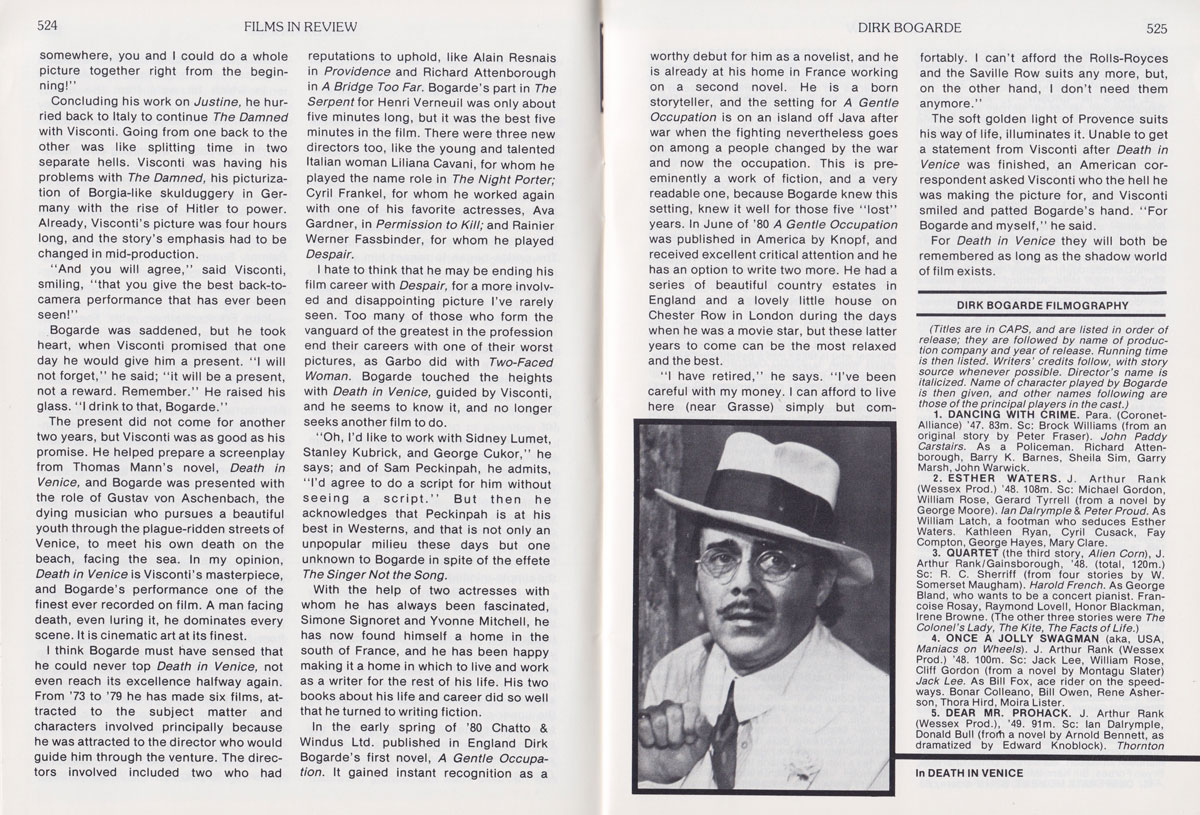
The present did not come for another two years, but Visconti was as good as his promise. He helped prepare a screenplay from Thomas Mann’s novel, Death in Venice, and Bogarde was presented with the role of Gustav von Aschenbach, the dying musician who pursues a beautiful youth through the plague-ridden streets of Venice, to meet his own death on the beach, facing the sea. In my opinion, Death in Venice is Visconti’s masterpiece, and Bogarde’s performance one of the finest ever recorded on film. A man facing death, even luring it, he dominates every scene. It is cinematic art at its finest.
I think Bogarde must have sensed that he could never top Death in Venice, not even reach its excellence halfway again. From ’73 to ’79 he has made six films, attracted to the subject matter and characters involved principally because he was attracted to the director who would guide him through the venture. The directors involved included two who had reputations to uphold, like Alain Resnais in Providence and Richard Attenborough in A Bridge Too Far. Bogarde’s part in The Serpent for Henri Verneuil was only about five minutes long, but it was the best five minutes in the film. There were three new directors too, like the young and talented Italian woman Liliana Cavani, for whom he played the name role in The Night Porter; Cyril Frankel, for whom he worked again with one of his favorite actresses, Ava Gardner, in Permission to Kill; and Rainier Werner Fassbinder, for whom he played Despair.
I hate to think that he may be ending his film career with Despair, for a more involved and disappointing picture I’ve rarely seen. Too many of those who form the vanguard of the greatest in the profession end their careers with one of their worst pictures, as Garbo did with Two-Faced Woman. Bogarde touched the heights with Death in Venice, guided by Visconti, and he seems to know it, and no longer seeks another film to do.
“Oh, I’d like to work with Sidney Lumet, Stanley Kubrick, and George Cukor,” he says; and of Sam Peckinpah, he admits, “I’d agree to do a script for him without seeing a script. “But then he acknowledges that Peckinpah is at his best in Westerns, and that is not only an unpopular milieu these days but one unknown to Bogarde in spite of the effete The Singer Not the Song.
With the help of two actresses with whom he has always been fascinated, Simone Signore and Yvonne Mitchell, he has now found himself a home in the south of France, and he has been happy making it a home in which to live and work as a writer for the rest of his life. His two books about his life and career did so well that he turned to writing fiction.
In the early spring of ’80 Chatto & Windus Ltd. published in England Dirk Bogarde’s first novel, A Gentle Occupation. It gained instant recognition as a worthy debut for him as a novelist, and he is already at his home in France working on a second novel. He is a born storyteller, and the setting for A Gentle Occupation is on an island off Java after war when the fighting nevertheless goes on among a people changed by the war and now the occupation. This is preeminently a work of fiction , and a very readable one, because Bogarde knew this setting, knew it well for those five “lost” years. In June of ’80 A Gentle Occupation was published in America by Knopf, and received excellent critical attention and he has an option to write two more. He had a series of beautiful country estates in England and a lovely little house on Chester Row in London during the days when he was a movie star, but these latter years to come can be the most relaxed and the best.
“I have retired,” he says. “I’ve been careful with my money. I can afford to live here (near Grasse) simply but comfortably. I can’t afford the Rolls-Royces and the Saville Row suits any more, but, on the other hand, I don’t need them anymore.”
The soft golden light of Provence suits his way of life, illuminates it. Unable to get a statement from Visconti after Death in Venice was finished, an American correspondent asked Visconti who the hell he was making the picture for, and Visconti smiled and patted Bogarde’s hand. “For Bogarde and myself,” he said. For Death in Venice they will both be remembered as long as the shadow world of film exists.
November 1980

