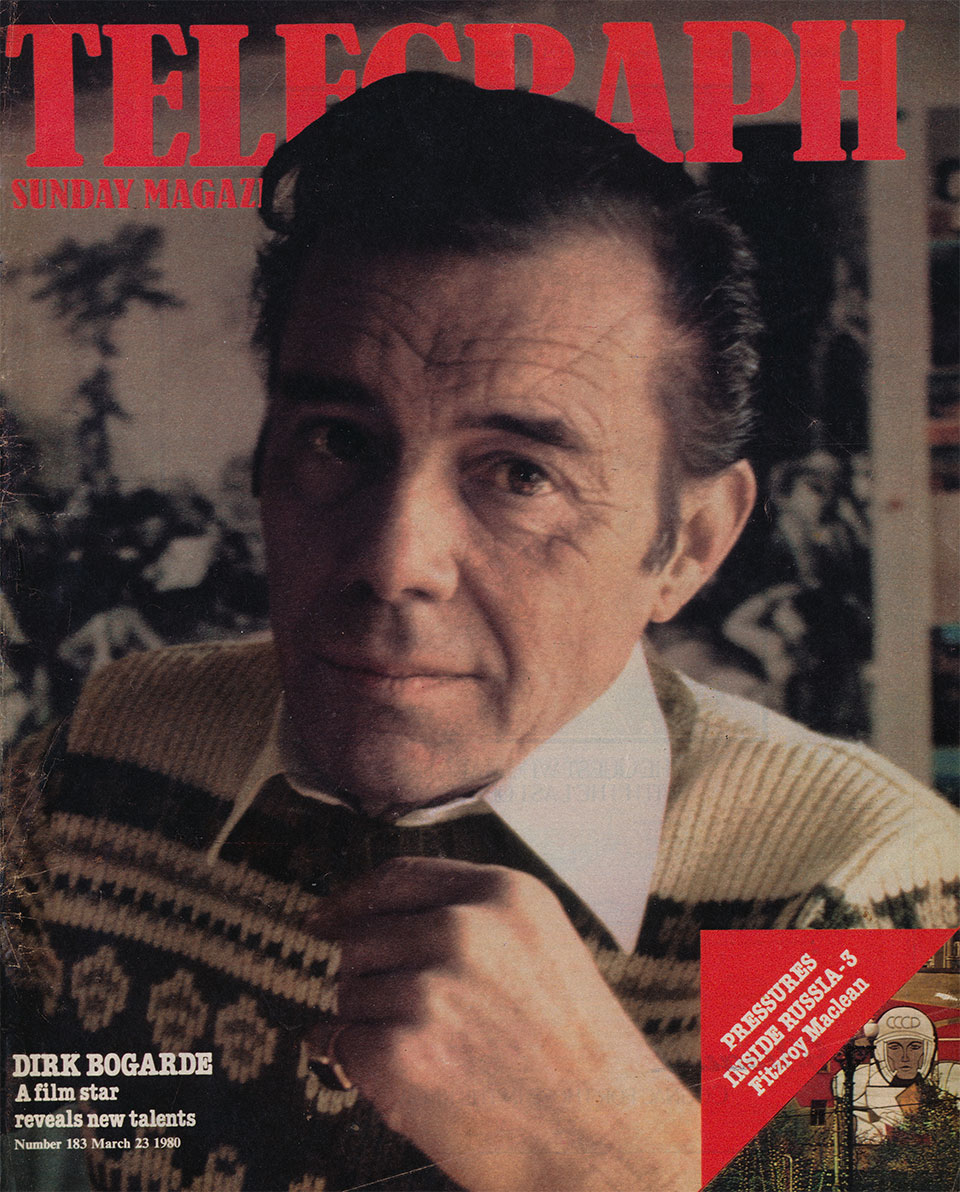
Telegraph Sunday Magazine – Mar 23rd 1980
WRITER WAITING IN THE WINGS
By William Green
Dirk Bogarde made his name as an actor, but a literary career has blossomed since he moved to Provence ten years ago
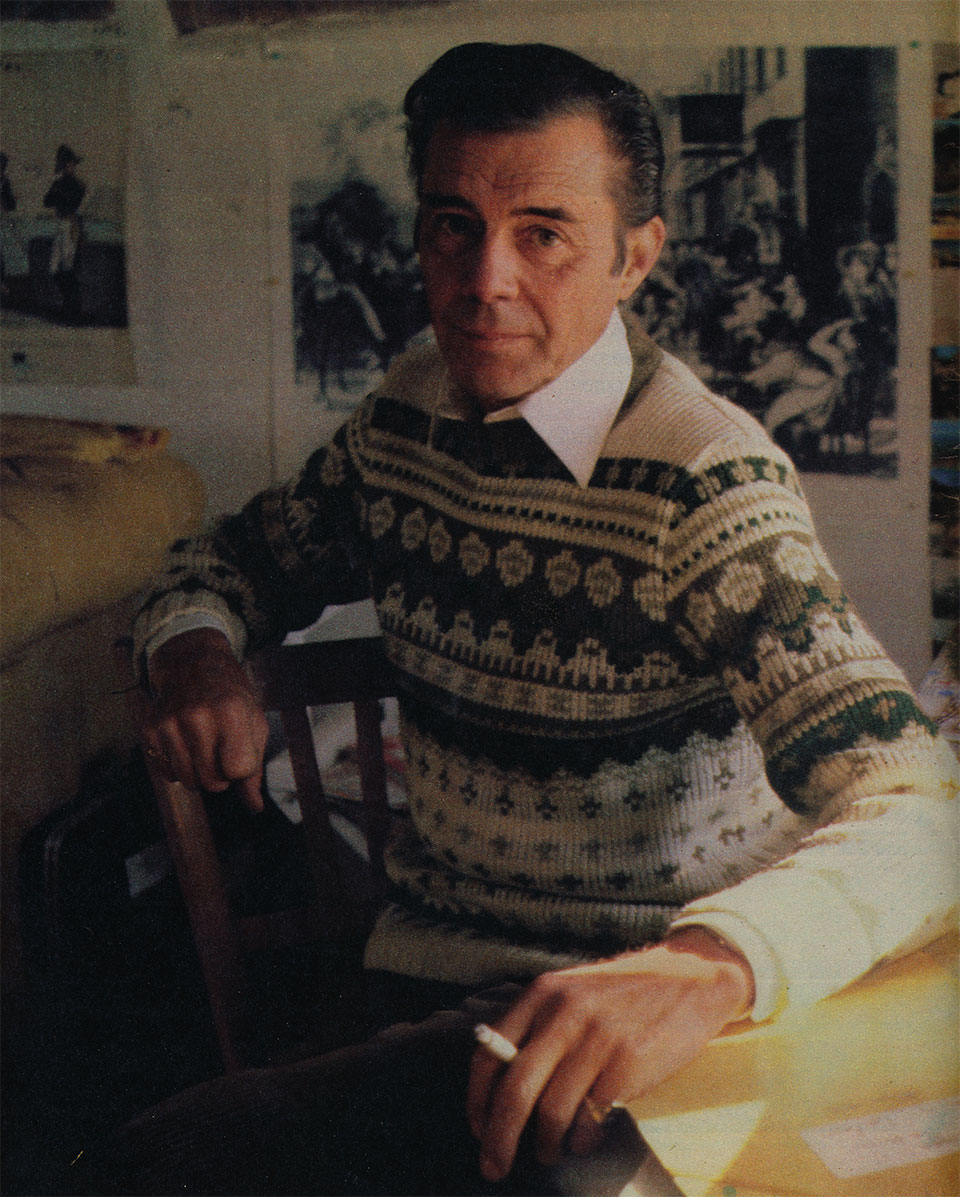
Dirk Bogarde has still got a lot to learn: or so he says. For a man who bas collected enough laurels in his career for a regiment to rest on, this is a startling claim. Is it enough to be an internationally applauded film actor, a writer of poems and best-selling autobiographies, and a very fair artist (he draws his own book-covers)? Apparently not. This week he is taking another leap in the dark with the appearance of his first novel, A Gentle Occupation, published by Chatto and Windus.
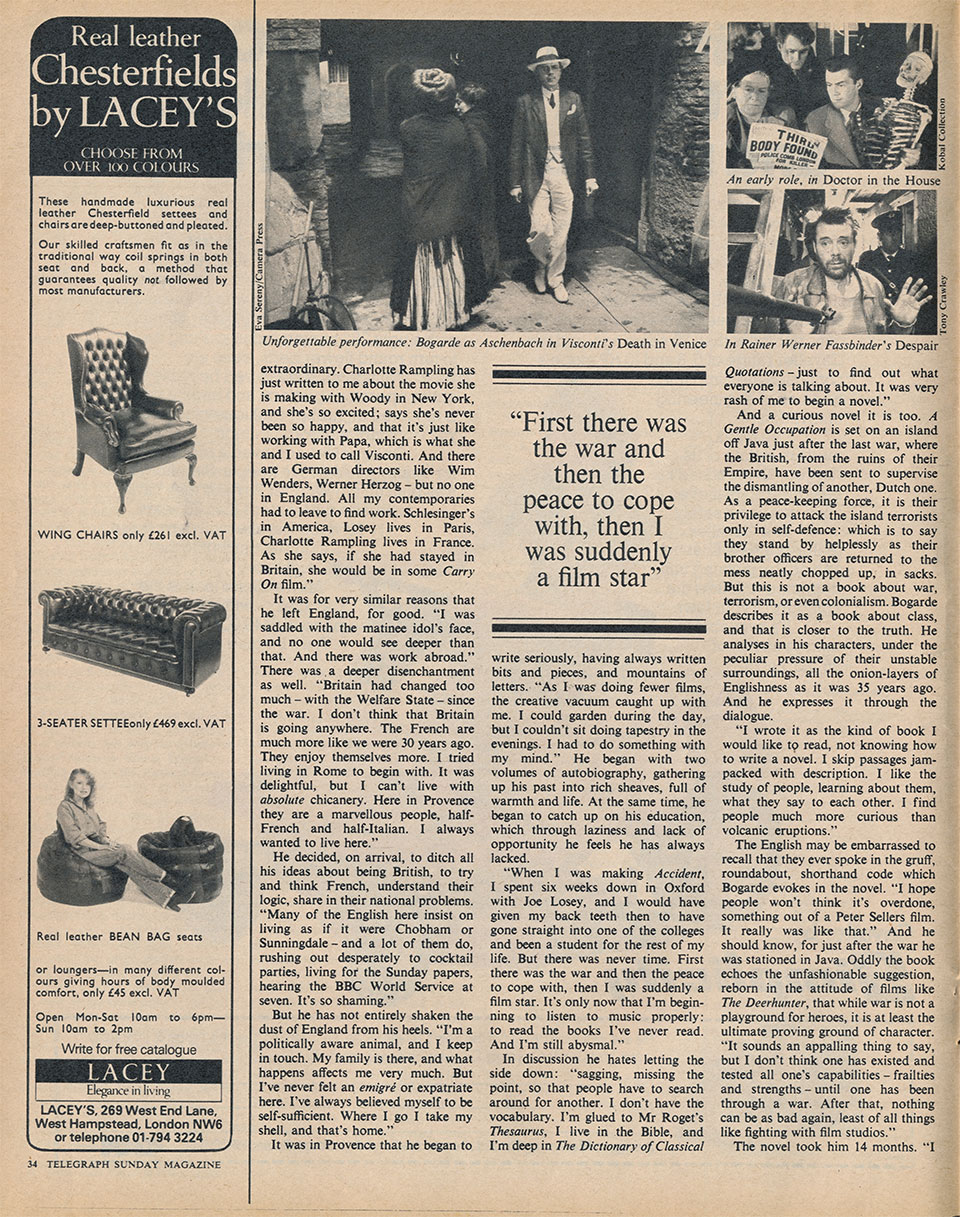
The veteran of over 60 films, with leading roles all the way from The Blue Lamp to Death in Venice, he is one of the very few English actors who have been able to earn inter- national distinction without the help of Hollywood. His memorable performances have not been as an aggressive, dominating hero in the star-system tradition, but in quieter, more ambiguous roles. And as director Visconti – who spotted his talent for playing irresolute unheroic characters – used to insist, it takes the strongest actors to play the weakest men.
For a film star, Dirk Bogarde has always led a very private life, particularly since his retreat ten years ago to a “little Provençal shepherd’s house”, near Grasse in the South of France. His is a writer’s life now, and his solitary existence is disturbed only when publishers drag him out to help promote his latest book.
“I had no idea that you had to to flog a book like a packet of soap flakes,” he says. “But you do nowadays.” He is used to the public eye, of course, and to the hard work behind the hard sell. “In America, as an actor, I used to do ‘total immersion’ programmes, which lasted from seven in the morning until eight at night: journalists would arrive in hourly or half-hourly relays.” Now, although he clings to his privacy, “I’ve come to the world of publishing, parallel but very different, and I have to do as I’m told”. This time around, however, he will only undertake mammoth flyleaf signing operations at places he enjoys, like Hatchards in Piccadilly, or the university towns, where the students come to talk and discuss rather than giggle and gawp. “They sometimes turn up in sailor boy suits, dressed as Tadzio from Death in Venice, or as the mother, in flowing drag and strings of pearls, with copies of Mahler under their arms for me to sign.”
Will those students meet the actor or the writer now? In conversation he is voluble, but with the expressiveness of someone who is interested in much more than the sound of his own voice; he can come to points of unforced intensity worlds away from an actor’s affectation. Nor does he belabour the listener with assumed voices and traffic-signal arm movements. In fact he seems downright untheatrical. It is not until he gets up in front or a camera, with every expression pitched a notch higher and every gesture a fraction stronger, that one sees how convincingly he has put himself across, and how deliberate has been his quiet performance all along. As he says himself, he is an actor and a writer, and he can easily be both at the same time.
The camera, usually of the moving variety, has been his “one great love affair”, and has treated him kindly – even during his early days as a heart- throb in dozens of post-war British films for Rank from Doctor in the House to A Tail of Two Cities.
He was asked to play the Shah of Persia, but he rejected the offer
As he recounts in his book A Postillion Struck by Lightning, he became an actor, as many do, by a combination of unshakable ambition and sheer luck. His father, the Art Editor of The Times, had been anxious to help him into a “more respectable” career in journalism. And, indeed, in spite of his enormous popular success as a J. Arthur Rank leading man, it was a long while before he got around to doing any respectable acting. “The climate wasn’t right. The films we made then were just fodder, pulp. You get the same kind of thing on British television now.”
In the early sixties the wind changed. and so did Bogarde, who blossomed out as a serious, sensitive actor, first in the controversial Victim, then in five films with director Joseph Losey. Among them were The Servant and Accident, both scripted by Harold Pinter, which still turn up every so often in the art cinemas of London.
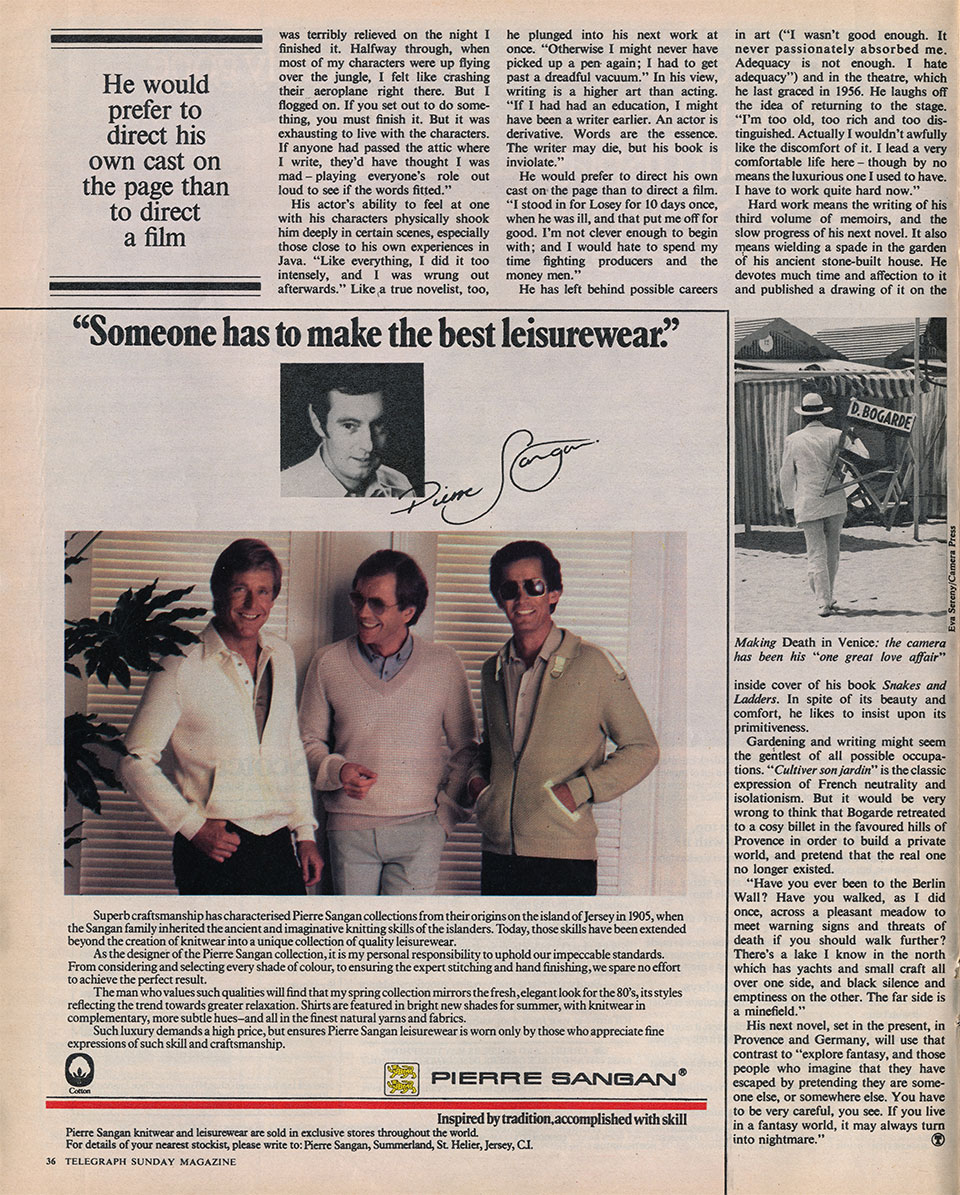
In the late sixties, when the English studios folded, he left for the Continent, and there he has added to his reputation, Death in Venice, the second film he made with the incomparable Luchino Visconti, has been screened in Paris almost every day since its release ten years ago. and is a constant visitor to London. “With Visconti, I knew I was in the hands of a master. I give directors what I have. I’m a ball of clay in their hands – but I like to try things my way as well as theirs. With Visconti you did what he said, and that was it. He was a giant in everything.”
After working with such a master, Bogarde felt that he had graduated in film acting, proved himself in the medium. Since then he has only worked on films which interest him personally, with directors like Alain Resnais and the angry young German Rainer Werner Fassbinder. “He’s hardly 30, but we’re total contemporaries. There’s no age difference. I believe very firmly in youth, and the awful thing about getting older – I’m S8 now – is that only your face and body get older. The mind stays, alas, the same. Anyway, if you’re always the student, which I am, then you must have a master, a teacher. Fassbinder is one of those.”
He will not make films just for the money now. Of course he is fortunate that be does not have to. He was asked to play the Shah of Persia, but he rejected the offer. If he does accept another part, it will have to be one which stretches his abilities, with an adventurous director to coax him along. He is an emotional actor who needs to go beyond the safety of technique and try to become, as nearly as possible, the character he is playing. In his last film, Despair, made three years ago with Fassbinder, he identified so closely with the role of Hermann Hermann that “I honestly believe that to be my best screen performance”. The film, unfortunately, was marred by problems at the editing stage, and the final version allowed a dense, complex script to fall into confusion. But there is a good chance that Bogarde will work with Fassbinder again, perhaps for a film built round an idea which be himself put forward a couple of years ago. There are also hopes of a new collaboration with Joseph Losey; but both these projects are still under wraps.
There are others he would love to work for, “Woody Allen. Now he wouldn’t even have to ask me. I go to very few films these days, but I saw Manhattan, which was quite extraordinary. Charlotte Rampling has just written to me about the movie she is making with Woody in New York, and she’s so excited; says she’s never been so happy, and that it’s just like working with Papa, which is what she and I used to cali Visconti. And there are German directors like Wim Wenders, Werner Herzog – but no one in England. All my contemporaries had to leave to find work. Schlesinger’s in America. Losey lives in Paris, Charlotte Rampling lives in France. As she says, if she had stayed in Britain, she would be in some Carry On film.”
It was for very similar reasons that he left England, for good. “I was saddled with the matinee idol’s face, and no one would see deeper than that. And there was work abroad.” There was a deeper disenchantment as well. “Britain had changed too much – with the Welfare State – since the war. I don’t think that Britain is going anywhere. The French are much more like we were 30 years ago. They enjoy themselves more. I tried living in Rome to begin with. It was delightful, but I can’t live with absolute chicanery. Here in Provence they are a marvellous people, half – French and half-Italian. I always wanted to live here.”
He decided, on arrival, to ditch all his ideas about being British, to try and think French, understand their logic, share in their national problems. “Many of the English here insist on living as if it were Chobham or Sunningdale – and a lot of them do, rushing out desperately to cocktail parties, living for the Sunday papers, hearing the BBC World Service at seven. It’s so shaming.”
But he has not entirely shaken the dust of England from his heels. “I’m a politically aware animal, and I keep in touch. My family is there, and what happens affects me very much. But I’ve never felt an emigre or expatriate here. l’ve always believed myself to be self-sufficient. Where I go I take my shell, and that’s home.”
“First there was the war and then the peace to cope with, then I was suddenly a film star”
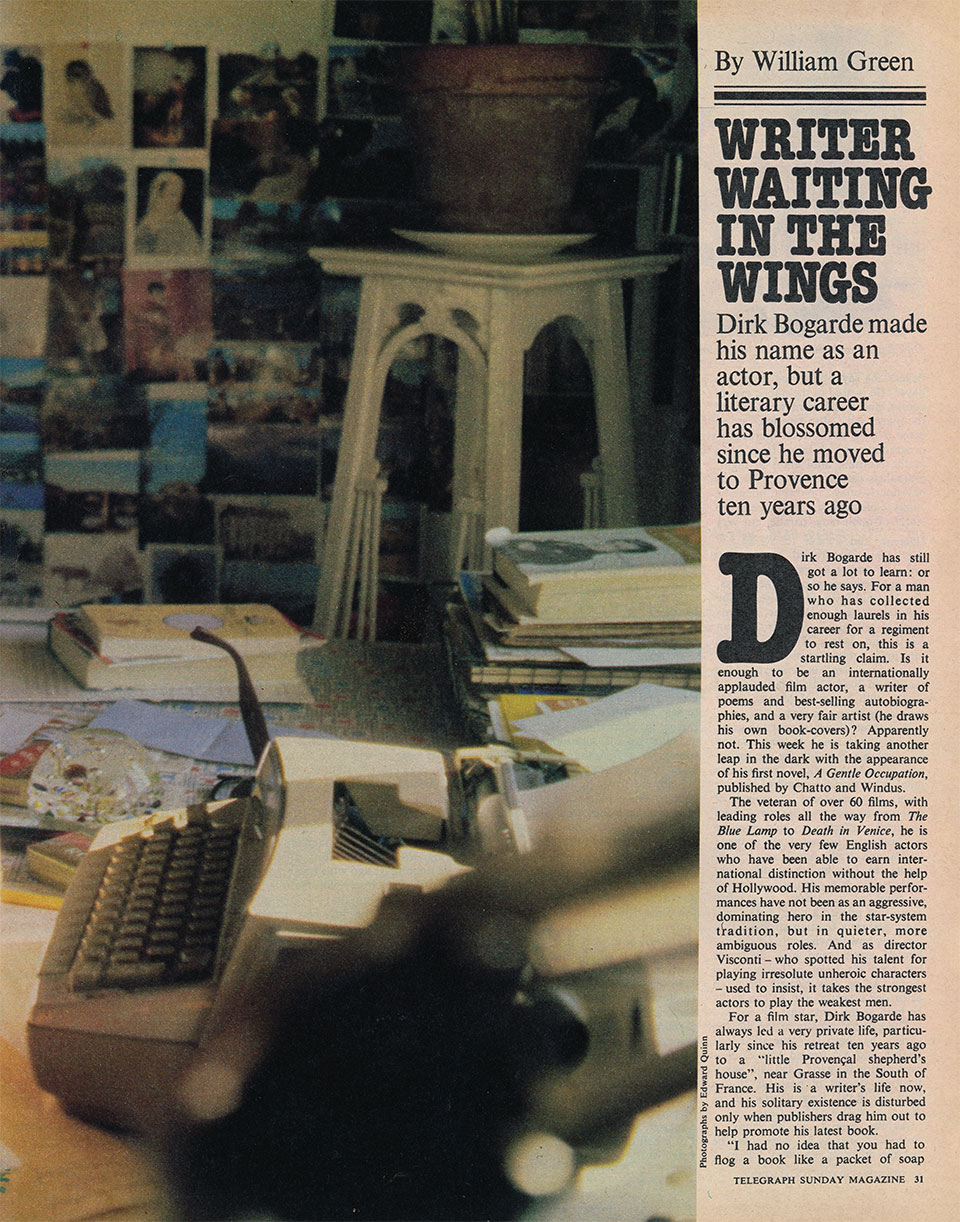
It was in Provence that he began to write seriously, having always written bits and pieces, and mountains of letters. “As I was doing fewer films, the creative vacuum caught up with me. I could garden during the day, but I couldn’t sit doing tapestry in the evenings. I had to do something with my mind.” He began with two volumes of autobiography, gathering up his past into rich sheaves, full of warmth and life. At the same time, he began to catch up on his education, which through laziness and lack of opportunity he feels he has always lacked.
“When I was making Accident, I spent six weeks down in Oxford with Joe Losey, and I would have given my back teeth then to have gone straight into one of the colleges and been a student for the rest of my life. But there was never time. First there was the war and then the peace to cope with, then I was suddenly a film star. It’s only now that I’m beginning to listen to music properly: to read the books I’ve never read. And I’m still abysmal.”
In discussion he hates letting the side down: “sagging, missing the point, so that people have to search around for another. I don’t have the vocabulary. I’m glued to Mr Roget’s Thesaurus, 1 live in the Bible, and I’m deep in The Dictionary of Classical Quotations – just to find out what everyone is talking about. It was very rash of me to begin a novel.”
And a curious novel it is too. A Gentle Occupation is set on an island off Java just after the last war, where the British, from the ruins of their Empire, have been sent to supervise the dismantling of another, Dutch one. As a peace-keeping force, it is their privilege to attack the island terrorists only in self-defence: which is to say they stand by helplessly as their brother officers are returned to the mess neatly chopped up, in sacks. But this is not a book about war. terrorism, or even colonialism. Bogarde describes it as a book about class, and that is closer to the truth. He analyses in his characters, under the peculiar pressure of their unstable surroundings, all the onion-layers of Englishness as it was 35 years ago. And he expresses it through the dialogue.
“I wrote it as the kind of book I would like to read, not knowing how to write a novel. I skip passages jam- packed with description. I like the study of people, learning about them, what they say to each other. I find people much more curious than volcanic eruptions.”
The English may be embarrassed to recall that they ever spoke in the gruff, roundabout, shorthand code which Bogarde evokes in the novel. “I hope people won’t think it’s overdone, something out of a Peter Sellers film. It really was like that.” And he should know, for just after the war he was stationed in Java. Oddly the book echoes the unfashionable suggestion, reborn in the attitude of films like The Deerhunter, that while war is not a playground for heroes, it is at least the ultimate proving ground of character. “It sounds an appalling thing to say, but I don’t think one has existed and tested all one’s capabilities – frailties and strengths – until one has been through a war. After that nothing can be as bad again, least of all things like fighting with film studios.”
He would prefer to direct his own cast on the page than to direct a film
The novel took him 14 months. “I was terribly relieved on the night I finished it. Halfway through, when most of my characters were up flying over the jungle, I felt like crashing their aeroplane right there. But I flogged on. If you set out to do something, you must finish it. But it was exhausting to live with the characters. If anyone has passed the attic where I write, they’d have thought I was mad – playing everyone’s role out loud to see if the words fitted.”
His actor’s ability to feel at one with his characters physically shook him deeply in certain scenes, especially those close to his own experiences in Java. “Like everything, I did it too intensely, and I was wrung out afterwards . ., Like a true novelist, too, be plunged into his next work at once. “Otherwise I might never have picked up a pen again; I had to get past a dreadful vacuum.” In his view, writing is a higher art than acting. “If I had had an education, I might have been a writer earlier. An actor is derivative. Words are the essence. The writer may die, but his book is inviolate.”
He would prefer to direct his own cast on the page than to direct a film. “I stood in for Losey for 10 days once, when he was ill, and that put me off for good. I’m not clever enough to begin with; and I would hate to spend my time fighting producers and the money men.”
He has left behind possible careers in art (“I wasn’t good enough. It never passionately absorbed me. Adequacy is not enough. I hate adequacy”) and in the theatre, which he last graced in 1956. He laughs off the idea of returning to the stage. “I’m too old, too rich and too distinguished. Actually I wouldn’t awfully like the discomfort of it. I lead a very comfortable life here- though by no means the luxurious one I used to have. I have to work quite hard now.”
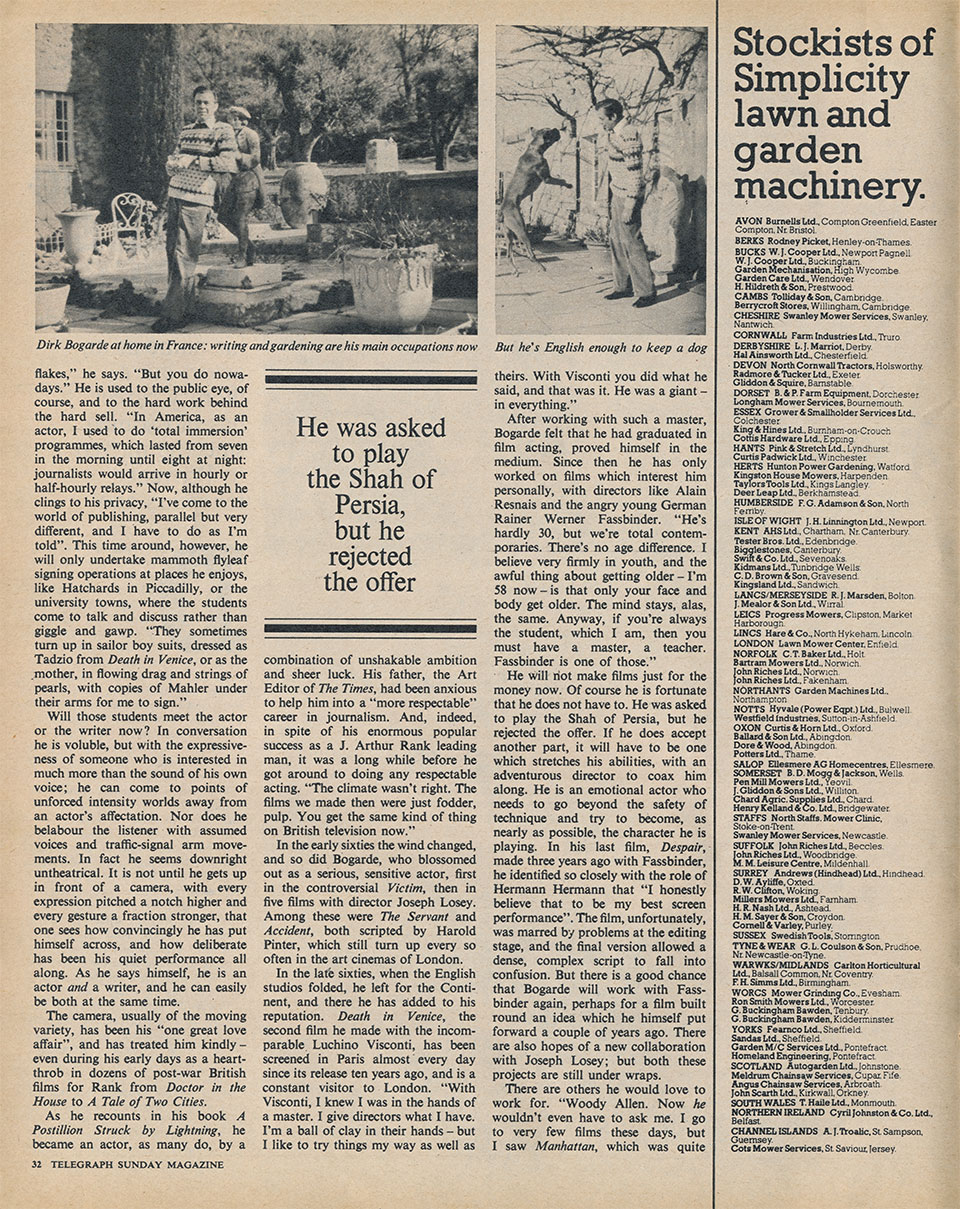
Hard work means the writing of his third volume of memoirs, and the slow progress of his next novel. It also means wielding a spade in the garden at his ancient stone-built house. He devotes much time and affection to it and published a drawing of it on the inside cover of his book Snakes and Ladders. In spite of its beauty and comfort, he likes to insist upon its primitiveness.
Gardening and writing might seem the gentlest of all possible occupations. “Cultiver son jardin” is the classic expression of French neutrality and isolationism. But it would be very wrong to think that Bogarde retreated to a cosy billet in the favoured hills of Provence in order to build a private world, and pretend that the real one no longer existed.
“Have you ever been to the Berlin Wall? Have you walked, as I did once, across a pleasant meadow to meet warning signs and threats of death if you should walk further? There’s a lake I know in the north which has yachts and small craft all over one side, and black silence and emptiness on the other. The far side is a minefield.”
His next novel, set in the present, in Provence and Germany, will use that contrast to “explore fantasy, and those people who imagine that they have escaped by pretending they are someone else, or somewhere else. You have to be very careful, you see. If you live in a fantasy world, it may always turn into nightmare.”

