ABC Film Review – Apr 1963


What next for Dirk Bogarde?
By Elizabeth Hardie
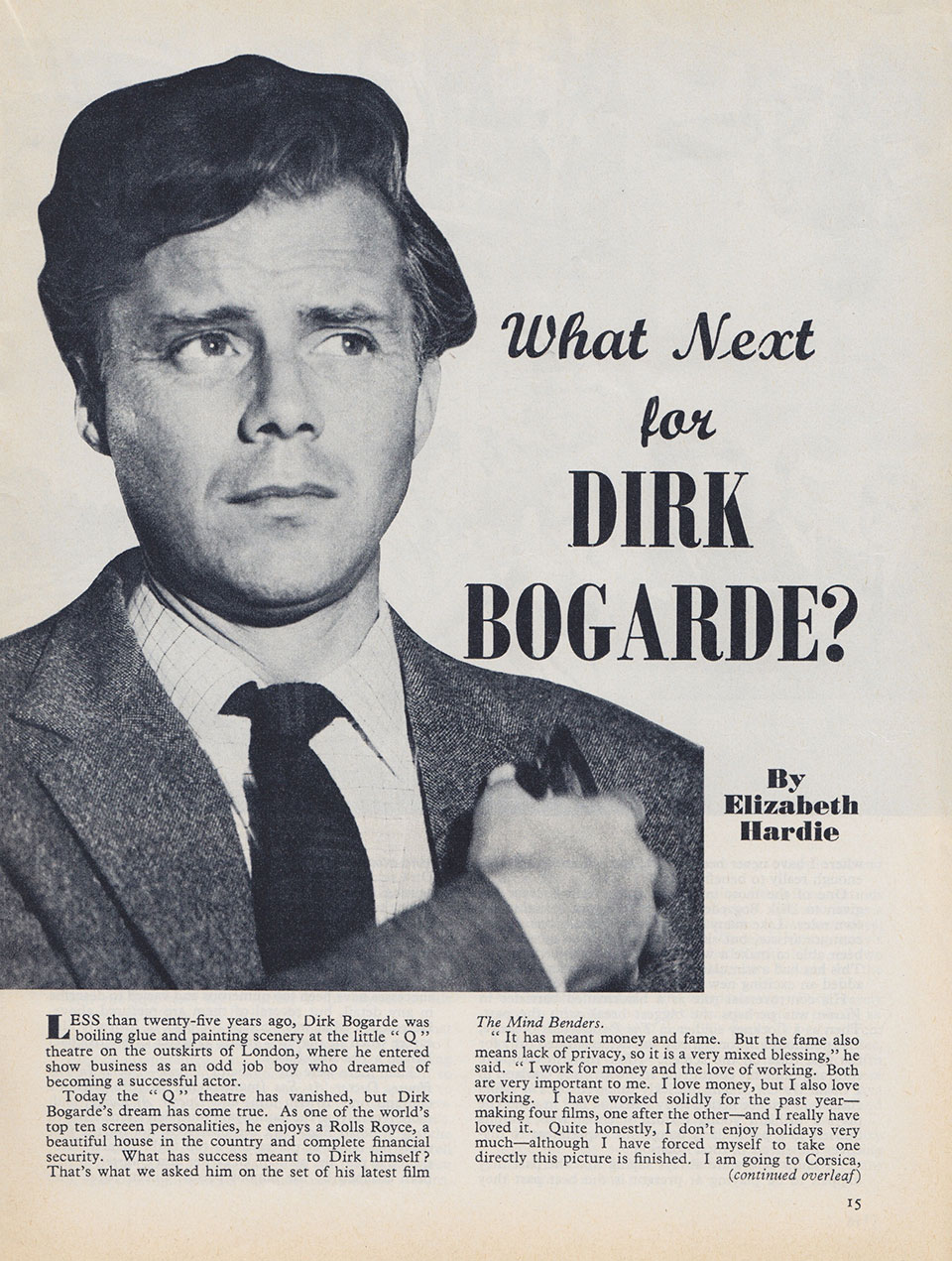
LESS than twenty-five years ago, Dirk Bogarde was boiling glue and painting scenery at the little “Q” theatre on the outskirts of London, where he entered show business as an odd job boy who dreamed of becoming a successful actor.
Today the “Q” theatre has vanished, but Dirk Bogarde’s dream has come true. As one of the world’s top ten screen personalities, he enjoys a Rolls Royce, a beautiful house in the country and complete financial security. What has success meant to Dirk himself? That’s what we asked him on the set of his latest film The Mind Benders.
“It has meant money and fame. But the fame also means lack of privacy, so it is a very mixed blessing,” he said. “I work for money and the love of working. Both are very important to me. I love money, but I also love working. I have worked solidly for the past year – making four films, one after the other – and I really have loved it. Quite honestly, I don’t enjoy holidays very much – although I have forced myself to take one directly this picture is finished. I am going to Corsica, where I have never been before, and I hope I can relax enough really to benefit by it.”
One of the most important things that success has given to Dirk Bogarde is the privilege of selecting his own roles. Like many stars he established his name as a contract artiste, but since becoming a freelance he has been able to make a wider and bolder choice of parts. This has had a stimulating effect on him as an actor and added an exciting new dimension to his performances.
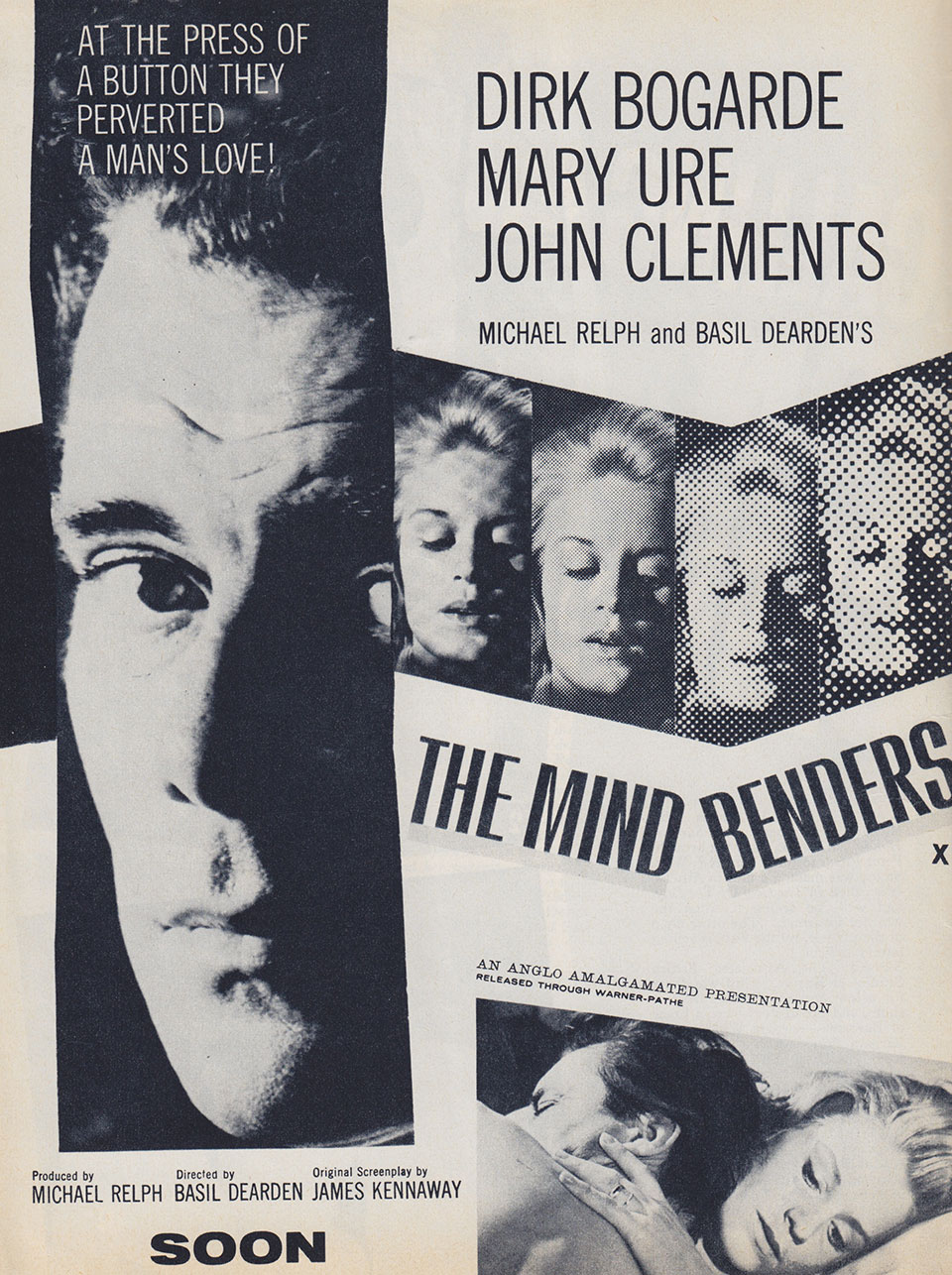
His controversial role as a blackmailed barrister in Victim was perhaps the biggest break with the past. Then as a Cockney soldier in The Password Is Courage, his enormous gift for comedy was demonstrated fully for the first time on the screen. After that, in complete contrast, came his co-starring role with Judy Garland in I Could Go On Singing, quickly followed by The Mind Benders, a science fiction story based on fact in which he plays a brilliant young Oxford scientist who submits himself to a particularly dangerous experiment to discover the effects of total isolation.
“I know actors are always saying that the part they happen to be playing at present is the best part they have ever had, but in my case it’s unquestionably true,” Dirk said of his role in The Mind Benders. ” I’ve been waiting over two years for this part, and I was never more thrilled than when Relph and Dearden cast me in it. It’s a part that has everything.”
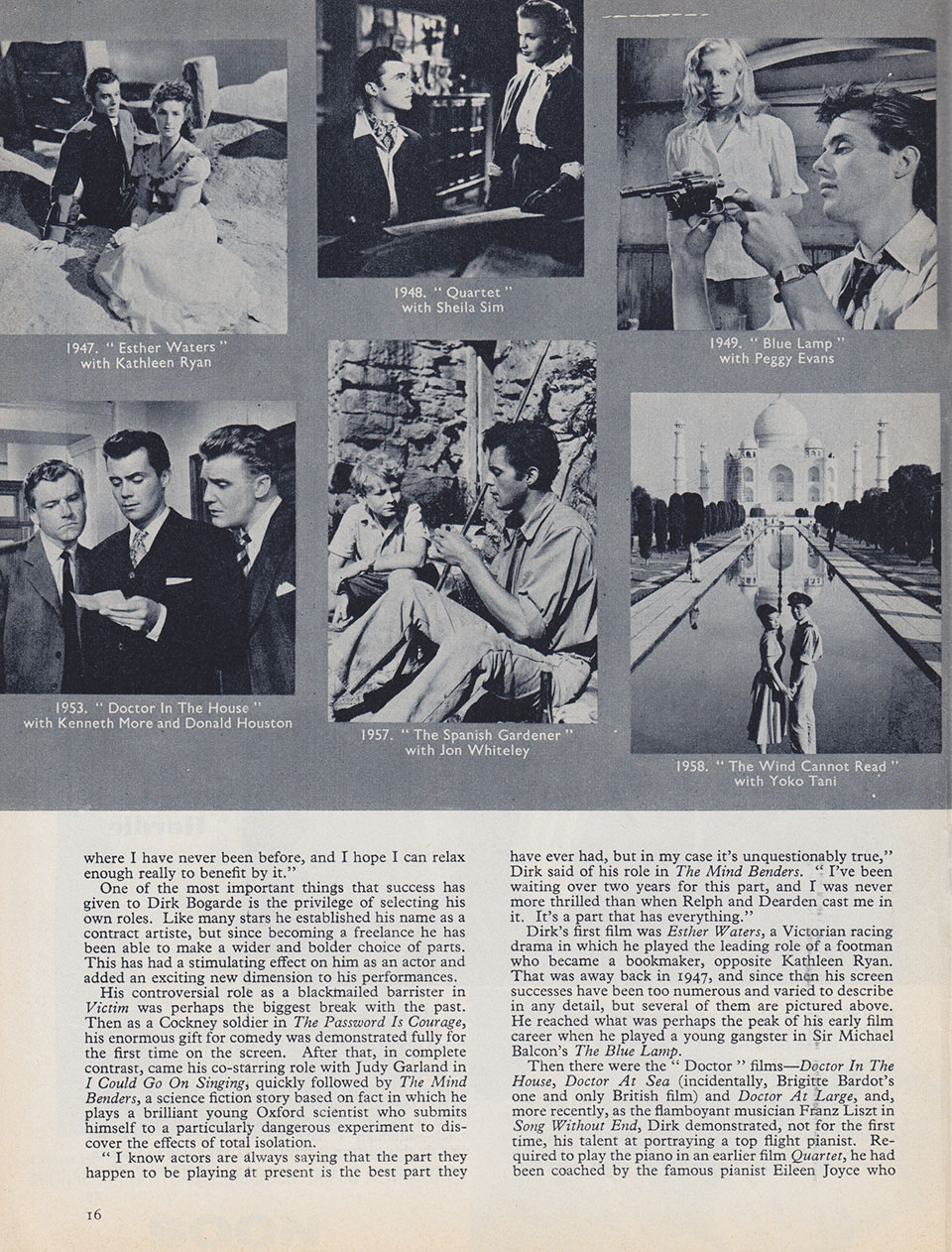
Dirk’s first film was Esther Waters, a Victorian racing drama in which he played the leading role of a footman who became a bookmaker, opposite Kathleen Ryan. That was away back in 1947, and since then his screen successes have been too numerous and varied to describe in any detail, but several of them are pictured above. He reached what was perhaps the peak of his early film career when he played a young gangster in Sir Michael Balcon’s The Blue Lamp.
Then there were the “Doctor” films – Doctor In The House, Doctor At Sea (incidentally, Brigitte Bardot’s one and only British film) and Doctor At Large, and, more recently, as the flamboyant musician Franz Liszt in Song Without End, Dirk demonstrated, not for the first time, his talent at portraying a top flight pianist. Required to play the piano in an earlier film Quartet, he had been coached by the famous pianist Eileen Joyce who expressed great admiration for his aptitude in mastering the technique of fingering the keyboard.
In the past year we have seen him as a black-hearted naval officer in H.M.S. Defiant and a hero of the Second World War in The Password Is Courage as well as the disorientated scientist in The Mind Benders. Of his next role in The Servant, a contemporary drama with a script by Harold Pinter for Elstree Distributors, it’s still too early to speak; for, until you see a Dirk Bogarde film you just can’t tell. Variety is the keynote of his career, and that is how he likes it.
“I sincerely hope people won’t be able to guess what Dirk Bogarde’s going to do next,” he said. “If they do I shall be disappointed. But I can assure you of one thing – each character will be someone I personally want to portray. Every role will have something that appeals to me strongly. This may sound like a very simple professional ambition. You may take it from me that it isn’t. The main difficulty facing any star is in finding the right parts. It’s a terrible gamble, and you can never tell when the public is going to tire of you. It can happen almost overnight and for the most inexplicable reasons.
“Success is a tightrope. It’s so easy to topple off, and there isn’t any net.”
Dirk Bogarde, who is unmarried, lists his recreations as walking, riding and playing squash. He also keeps a sketch book which he finds little time to use these days, but when he was serving on General Montgomery’s staff during the war he always had it with him, and two sketches that he did on D-Day were bought by the British War Museum.
Naturally reserved in temperament, Dirk rarely attends premieres or night clubs, and regards privacy as one of the essentials of life. His desire to be free from prying eyes has forced him from one home to another, and he recently moved to a lovely rambling twelfth century house deep in the Surrey countryside. There his weekend guests include such celebrities as Ava Gardner, Rex Harrison, Laurence Harvey, Capucine and Alan Jay Lerner, the composer of “My Fair Lady.”
Fame and fortune combined with a simple country home life may seem a tall order, but it is something that Dirk Bogarde has successfully achieved and means to maintain at any price.

