Book and Magazine Collector – Sept 1989
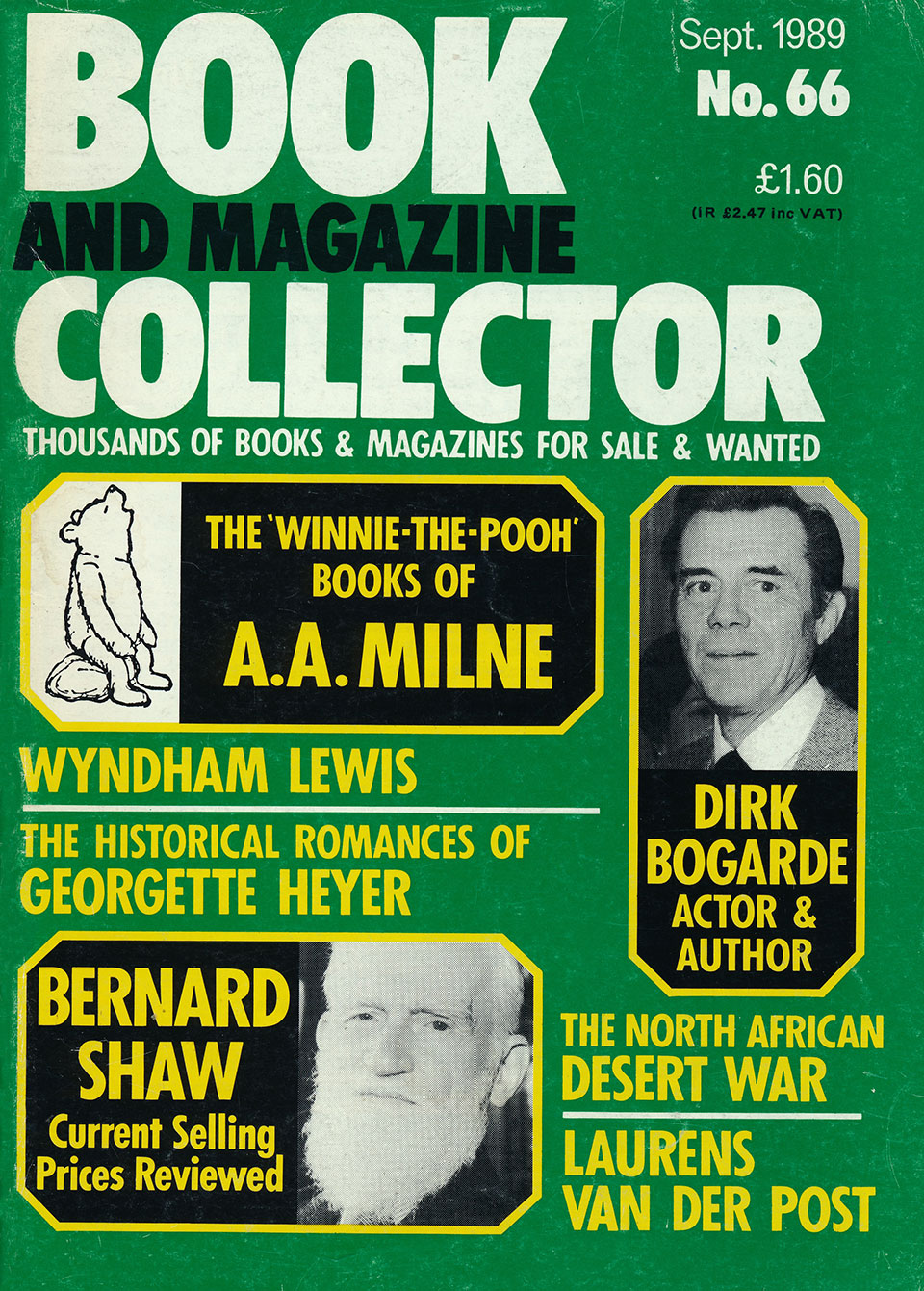


DIRK BOGARDE – ACTOR & AUTHOR
KENNETH FIELDS EXAMINES HOW A TOP ACTOR BECAME ONE OF BRITAIN’S MOST POPULAR AUTHORS
In the early 1970s, a ten-line letter from publishers Chatto & Windus to Dirk Bogarde put forward a suggestion that was to change his career. “Have you ever considered writing about your life?”, they asked. At first he was so amazed that anyone would be interested in his memoirs that he dismissed the idea, but the publishers persisted and they eventually persuaded him to attempt the first three chapters.
Dirk Bogarde was well aware that the transition from acting to writing would be one fraught with many pitfalls. Even a famous name on the title page cannot save a boring volume from inevitable oblivion, so he was determined that his book wouldn’t be yet another hackneyed expose of the thespian world. Instead, he would attempt to write about his happy childhood memories, his family, and the rolling English countryside which he loved so much.
REFRESHING
It was a rare and refreshing event when a film star, who had enjoyed four decades of leading roles, emerged as a sensitive and talented author. Dirk Bogarde, the handsome and talented actor of the Fifties and Sixties, is now the mature best-selling author of the Eighties. His four volumes of autobiography and three novels have all received impressive reviews and book collectors are already beginning to acknowledge his literary talent – the demand for his first editions is rising steadily.
Derek Niven van den Bogaerde was born on 28 March 1921 in Hampstead, North London. Nevertheless, his mother later said that he ought to have been born in France as his conception had taken place in the Hotel Crillon, in Paris!
The van den Bogaerdes were an ancient Catholic family who settled in Iseghem in Belgium during the 16th century. Although their fortunes faded over successive generations, Dirk’s grandfather, Aime, ended his Grand Tour (as customary for Belgian nobility as it was for the English) by marrying an Englishwoman, Grace Clark, and settling near Birmingham. His father was born in 1892 and, showing outstanding artistic talent, became one of the ‘golden boys’ on the ‘Times’ newspapers , eventually rising to become one of their best-ever Art Editors.
His mother was one of eleven children born to proud Scottish parents in Ayrshire. Her father was also a fine painter who contributed cartoons to a Glasgow newspaper as well as an ‘indifferent actor’. He introduced his beautiful daughter into the acting world, taking her on a tour of the provinces and eventually reaching the heights of London’s Haymarket Theatre. However, she gave up her acting ambitions in order to marry, but not without some regrets in later life.
Dirk Bogarde’s first volume of autobiography, “A Postillion Struck By Lightning”, was published in 1977, and, true to his word, it records the early years of his life. The book is illustrated with seventeen of his own pen and ink drawings together with black and white photographs from his family album. It owes its strange title to a boyhood incident that took place while he was on holiday in France.
DETAILED
His colourful and detailed narrative flows with nostalgia, recording his happy childhood memories. Much of the volume is devoted to the halcyon days between the two wars when his family took a cottage on the Sussex Downs. With his younger sister, Elizabeth, he made excursions into the rolling countryside, discovering its secrets and meeting the local eccentrics. A vivid picture emerges of a shy, sensitive boy, devoted to his nanny, Lally, and oblivious to the fame which was his destiny.
However, his carefree days came to an abrupt end when, following the birth of his brother, he was sent to live with Scottish relatives to attend school. Here he endured the strait-laced atmosphere of his aunt’s household, as well as the aggressive suspicion of his schoolmates. He was a Sassenach with a posh accent – a combination that was not well-received in Glasgow.
But his tenacity and stamina won through. He endured three years of upheaval and he later regarded these years as the most important part of his early life. Returning south at the age of sixteen, he became an art student at the Chelsea Polytechnic, where he studied under such celebrated masters as Graham Sutherland and Henry Moore.
His father hoped this training would lead to a career in the printed media, but the urge to act, probably inherited from his mother, began to pursue young Dirk with a vengeance. He joined the local amateur dramatic group in his village, then moved on to the Uckfield Theatre and eventually caught the eye of Anthony Forwood, a notable London agent. His acting career really began to take off but, unfortunately, the war brought his new-found success to an abrupt end.
Following the. outstanding success of the first volume· of his autobiography, he continued the story in “Snakes and Ladders”, Which was published in 197 8. It related the ups and downs of his life through the war years, and his success in films· in the years that followed. The rear of the dust-wrapper is illustrated with a fine photograph of the author taken by E.L.L. Forwood in Provence. Inside are many unique photos of the famous stars that eventually he was to call his friends, including Kay Kendall, Jean Simmons and Elizabeth Taylor.
At the age of eighteen, Bogarde found himself facing a dismal train journey to the austere army training camp at Catterick in North Yorkshire. Using his notebooks and diaries as source material, and aided by an almost photographic memory, he paints a marvellous picture of those grim days.
It was a period of learning to cope with army life with all its toughness, boredom and insecurity, made bearable only by his tenacious character and the courageous humour of his fellow sufferers. The one incident that is forever etched in his memory is the suicide of one of his young colleagues, who was unable to cope with the gruelling training course.
SURVIVAL
To his great astonishment, for his survival strategy was to keep a low profile, Bogarde found himself promoted to Lance Corporal. His immediate reward was a ‘real’ bed at the end of the hut. Life was also made more bearable by his association with the Dramatic Society that had been formed within the camp.
His modest part in this society was regarded as ‘jolly good show, boosting morale’ by the officers, which led to him facing an officer selection committee. He had doubts that a civilian occupation of “Chorus Boy” would enhance his chances of selection, but when he promised to acquire a series of pin-up photos from ‘Men Only’ for the officers’ mess, it seemed to make all the difference – he was chosen as an Officer Cadet.
In April 1943, he found himself leaving the parade ground at Sand hurt a fully commissioned Lieutenant of the Queen’s Royal Regiment. His path now led, via the Holding Battalion in Lancashire, to Cornwall, and then as a member of the Air Photographic Interpretation Section in Europe and the Far East. His most frightening recollection of the whole war was when he had to climb a mill chimney in Blackburn as part of a street fighting course!
Returning to a bomb-blasted London after the war, Bogarde began to try and pick up the threads of an acting career that had hardly begun. With a rapidly dwindling gratuity, he rented a dingy room and began to contact acting friends from the past. One colleague, Peter Ustinov, could offer little help as he too was desperately seeking work.
His fortunes, however, showed a modest improvement when he was chosen to play Jesus at an audition for the Actors Reunion Theatre. Success followed when he acquired his first real part as Granillo the killer in a television version of Alfred Hitchcock’s “Rope”. Tony Forwood, his agent and friend, advised him to change his name to one more acceptable to the general public. After rejecting Simon Garde and following much deliberation, Dirk Bogarde was reluctantly chosen.
HUMILIATING
After he had attended a humiliating interview at the Rank Organisation at which he was told his head was too small and he was too thin, television once again came to the rescue, when he was given a part in a war story, “The Case of Helvig Delbo”.
But it was his appearance in “Power Without Glory” at the New Lindsey Theatre in 194 7 which was to really propel him towards stardom. Also starring Beatrice Varley and Kenneth More, the play received rave reviews from the critics. Noel Coward came to meet the cast, and advised Bogarde “never, ever, go near the cinema!”.
However, in the great tradition of the acting world, . he completely ignored the advice. His first film role was in “Dancing With Crime” in 194 7. Although he had just one line to speak, Rank (who had earlier given him such a disastrous interview) decided to offer him a seven-year contract.
To begin with, his roles were undemanding: he appeared in “Esther Waters” and “Quartet” in 1948, then over the next few years he gradually climbed the ladder to stardom. The parts became more interesting, and by 1950 he had appeared in several good films including “The Blue Lamp” and “So Long at the Fair”.
Bogarde’s boyish good looks and his great interpretive ability helped to keep him in demand for romantic parts. His war service also made him a natural for the many parts available in the films being churned out of the studios at the time. These included “Ill Met By Moonlight”, “The Sea Shall Not Have Them” and, later, “A Bridge Too Far”. His lighter roles included the part of Dr Simon Sparrow in the highly successful ‘Doctor’ series of comedy films. It was reported in the Fifties that, along with Gary Cooper and Laurence Olivier, he was the Queen’s favourite film star.
By 1970, Bogarde had appeared in over fifty films, including several very demanding parts. “Victim” in 1961, for example, was the first British film to tackle the then controversial subject of homosexuality in public life. In “The Servant” he created a classic interpretation of the manservant who gradually secures an evil hold over his master. This won him a British Academy Award in 1963, but he regarded his role in Visconti’s “Death in Venice” as the most difficult part he-had ever attempted. It was the culmination of all his years of work and training.
PROVING
Now that he had completed two volumes of his autobiography, proving to both himself and the world that he could write as well as he could act, Dirk Bogarde decided to attempt a novel. “A Gentle Occupation” was published in 1980 with a dust-wrapper designed by himself. It was appropriately dedicated to Norah Smallwood of publishers Chatto & Windus, who had inspired him so successfully.
Based on his own wartime experiences in South East Asia, the story, although a work of fiction, does have a background of fact. It concerns the colourful lives of a mixed bunch of people caught up in the aftermath of the last war on a small island near Java. Through his powerful narrative he marvellously portrays the urge to survive that is within us all. It is a highly readable book, both witty and sad, which successfully explores the subtleties of the human spirit beneath the veneer of civilisation.
His second novel, “Voices in the Garden”, again displays his ability to blend together entirely different characters. Again the dust-wrapper is his own design. This time the setting varies from cosmopolitan London, to Cap Ferrat and Germany. The characters range from an ambitious Italian film director, of whom the author must have known many, to two young people in love. The absorbing story concerns the interaction of the characters and how their brief encounter has lasting effects.
CHEVALIER
In 1982, Bogarde’s accomplishments were acknowledged by the French government when they made him a Chevalier de l’Ordre des Arts et Lettres. The following year, the third volume of his autobiography, “An Orderly Man”, was published. The title relates to his inborn obsession with tidiness – he confesses to an instinct which makes him live a “precise and correct” life. Among the many fascinating photographs in this volume is a marvellous portrait of his mother taken in 1923. The book covers the period when he was ending his demanding role in “Death in Venice” and made the decision to leave England to live abroad. At first, he was unsure of where he wanted to go, but the lure of France, a country he had loved since childhood, eventually proved too much.
Bogarde bought a former shepherd’s house on a high terrace of twelve acres in Provence and began the arduous task of making it habitable. Joined by his friend, Tony Forwood, who had guided his career since pre-war days, they were confronted by a host of unforeseen problems. The land needed draining, the olive trees which seemed to the layman to be fit and healthy were, in fact, dying, and they had to contend with the violent ‘Mistral’ wind.
The expense of all these unforeseen difficulties forced him to return to the cinema after a two year lay off. In 1973, he starred in the highly controversial “The Night Porter”, and then came the opportunity to join Sir John Gielgud in Alain Resnais’s “Providence”. But the role he believes his best-ever screen performance was his portrayal of a Jewish survivor in Fassbinder’s “Despair”.
In one – volume of his autobiography, Bogarde relates a fascinating episode in. his chequered life that began in England in 1967_ when he received a letter from a Mrs X who lived in a small American town. By chance, she had seen a photograph of him in a magazine and recognised the house in which he was living as her former home. This began a regular secret correspondence that was to continue unbroken for five years until she died in 1972.
The letters were quite formal at first , but quickly became personal essays. She wrote every single day, often correcting his punctuation and spelling, beginning an extraordinary friendship that had a profound effect on his life and his future literary career.
It was in France, though, that his writing really began, following a chance visit by John Charlton from Chatto. He was persuaded by the publishing director to pursue his idea of a rural ride through the Sussex of his childhood. Rather reluctantly, Bogarde agreed, beginning what was eventually to be acknowledged as one of the most impressive autobiographies of the decade.
TALENT
1984 brought the publication of his third successful novel, “West of Sunset”, which further developed his talent for characterisation. This time the setting is Los Angeles, and the story-line follows the tangled web of intrigue of a group of exiles caught up in the ‘great American dream’. The front of the colourful dust-wrapper, painted by the author, shows the city outline, while the rear has his portrait photographed by Rosalind Bowlby.
In July 1985, Bogarde’s literary accomplishments were again acknowledged, this time by the University of St Andrews who awarded him the honorary degree of Doctor of Letters. The following year brought the publication of the final part of his autobiography, “Backcloth”. In this volume he endeavours to explore the entire composition of his life from early childhood through to his new career as a writer. He looks at the many close relationships he has cherished with both family and friends, and at those people who have had a profound effect in shaping his life. The volume contains several of his sketches, including many done during the war years.
An omnibus edition of the complete four volumes of his autobiography, entitled simply “Dirk Bogarde”, was published by Methuen in 1988, and a complete catalogue of all his film roles up to 1974 can be found in “The Films of Dirk Bogarde” by Margaret Hinxman and Susan d’Arcy. He has also written a small number of haunting poems which have appeared in a variety of magazines and in the Faber anthology, “The Terrible Rain”.
Dirk Bogarde is now regarded on both sides of the Atlantic as a man of unique creative talent. As an actor he has distinguished himself in many of the most demanding roles; as an artist his brush has successfully captured the flavour of the past; and, finally, as a writer his work has that rare essence of delightful sincerity that pushes each successive volume into the best-seller lists. His first editions are. highly collectable, having wide appeal – and at the moment they can be acquired quite easily and cheaply.

