Cosmopolitan – April 1960
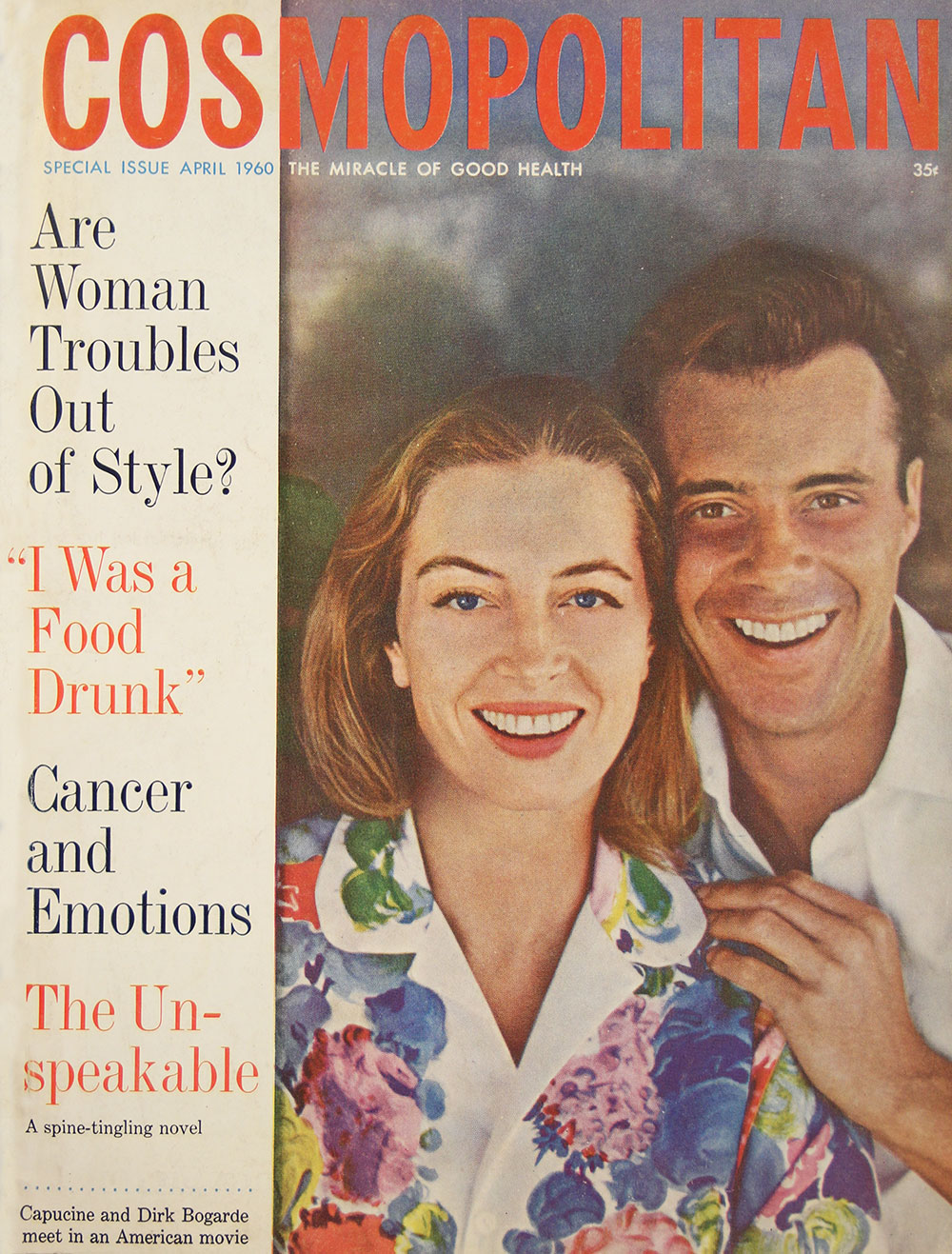
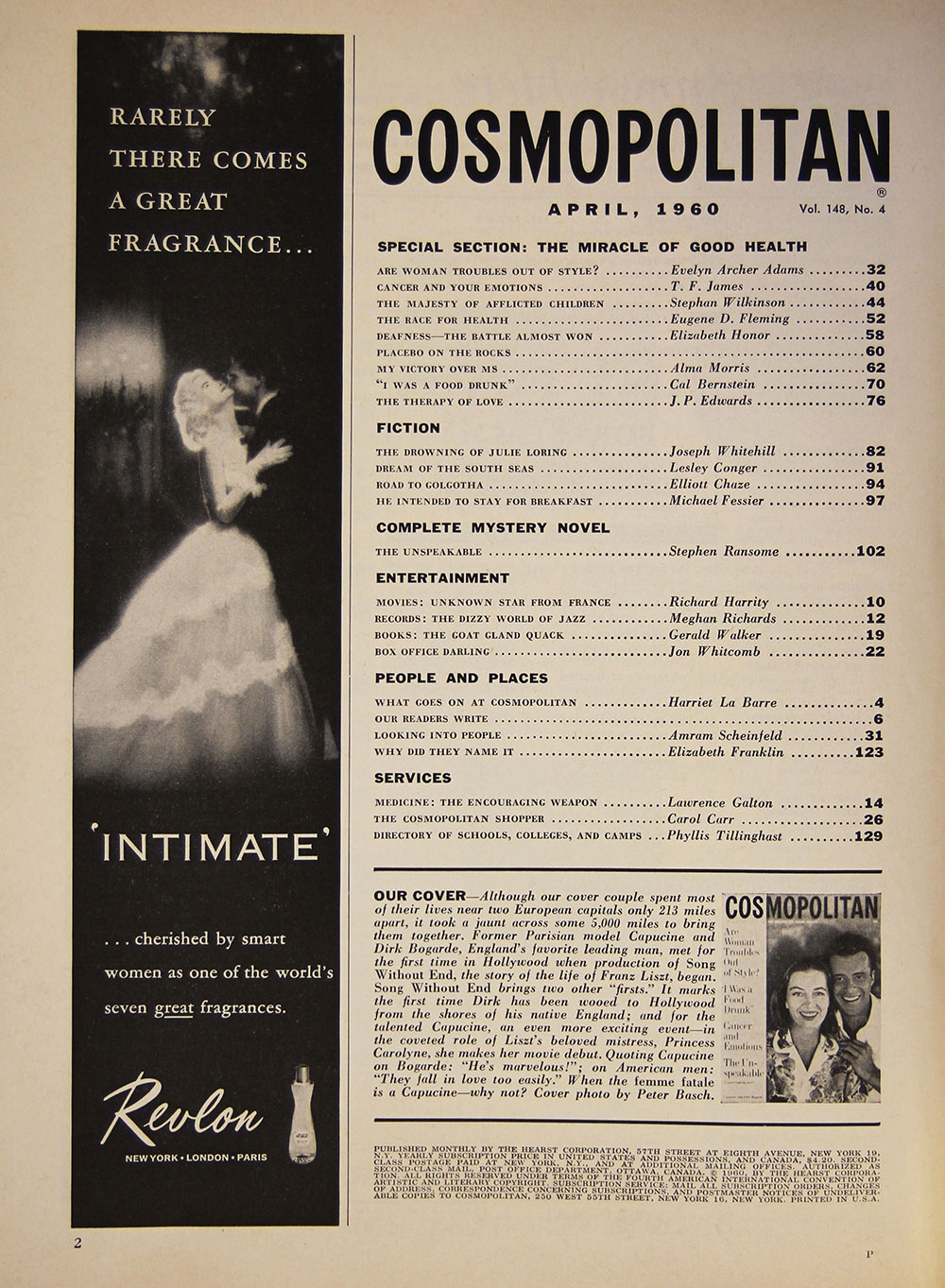
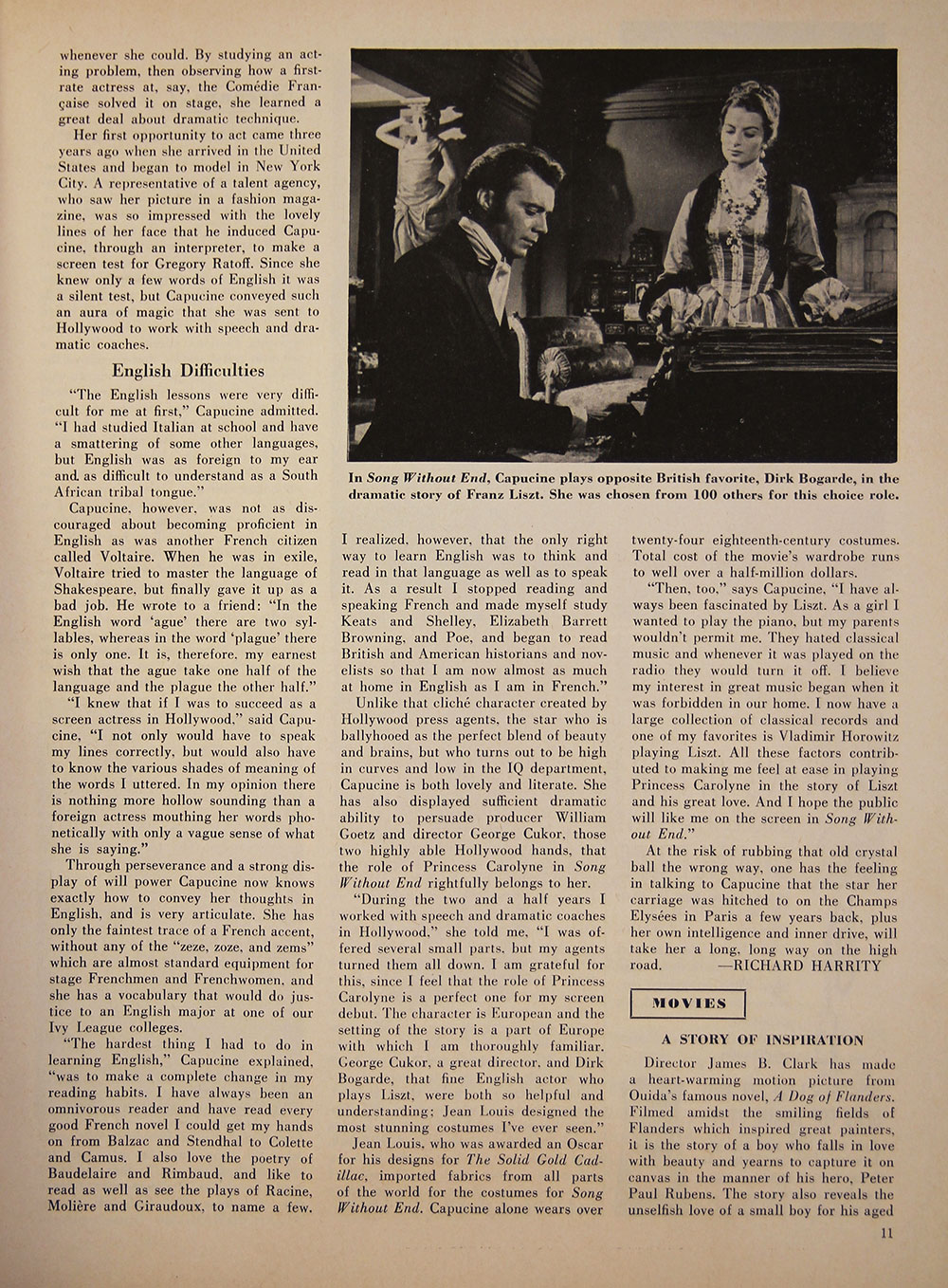
OUR COVER – Although our cover couple spent most of their lives near two European Capitals only 213 miles apart, it took a jaunt across some 5,000 miles to bring them together. Former Parisian model Capucine and Dirk Bogarde, England’s favorite leading man, met for the first time in Hollywood when production of Song Without End, the story of the life of Franz Liszt, began. Song Without End brings two other “firsts”. It marks the first time Dirk has been wooed to Hollywood from the shores of his native England; and for the talented Capucine, an even more exciting event-in the coveted role of Liszt’s beloved mistress, Princess Carolyne, she makes her movie debut. Quoting Capucine on Bogarde: “He’s marvellous!”; on American men; “They fall in love too easily.” When the femme fatale is a Capucine-why not?
Cover photo by Peter Basch.
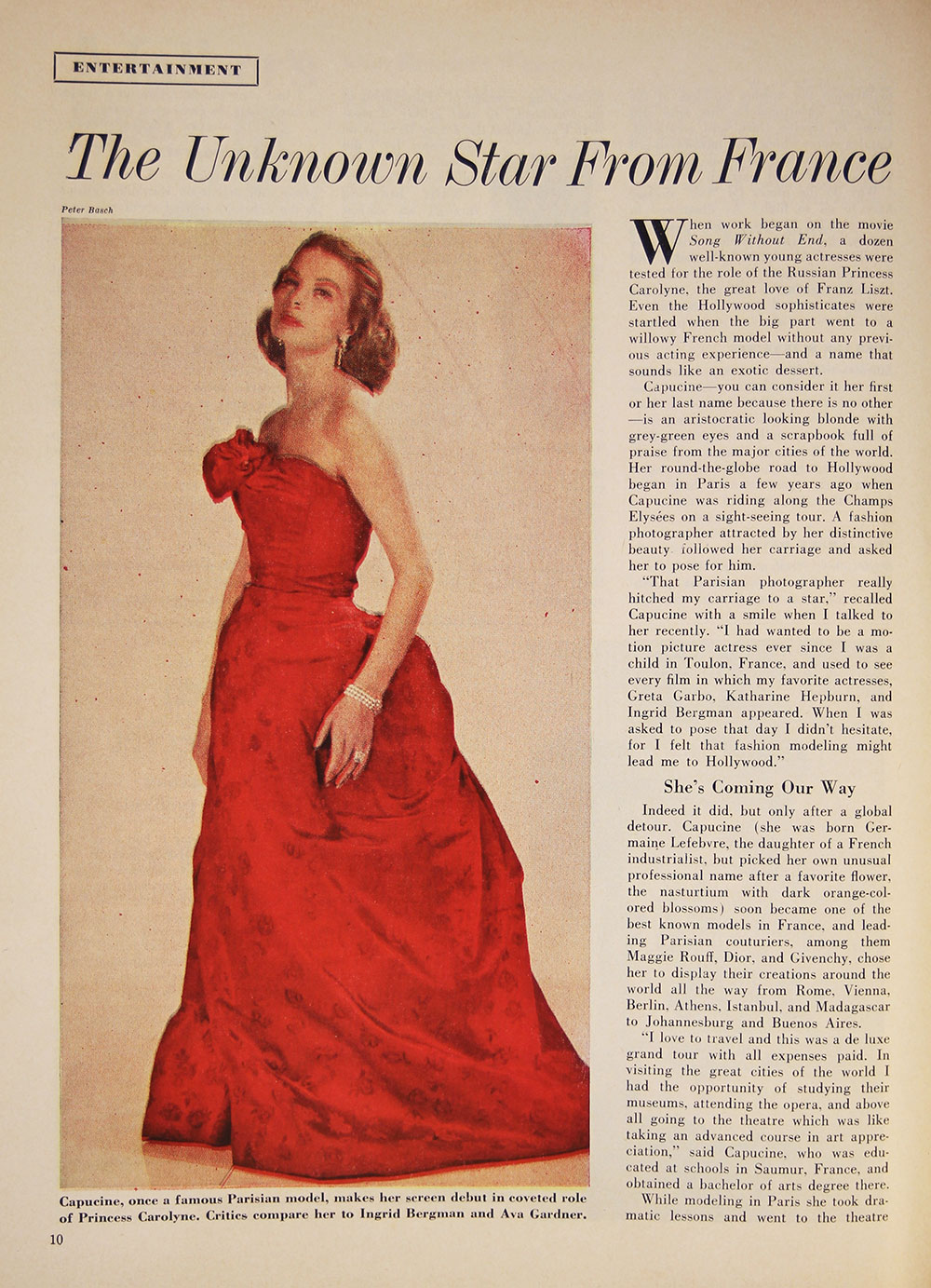
The Unknown Star From France
When work began on the movie Song Without End, a dozen well-known young actresses were tested for the role of the Russian Princess Carolyne, the great love of Franz Liszt. Even the Hollywood sophisticates were startled when the big part went to a willowy French model without any previous acting experience and a name that sounds like an exotic desert.
Capucine-you can consider it her first or her last name because there is no other- is an aristocratic looking blonde with grey-green eyes and a scrapbook full of praise from the major cities of the world. Her round-the-globe road to Hollywood began in Paris a few years ago when Capucine was riding along the Champs Elysées on a sight-seeing tour. A fashion photographer attracted by her distinctive beauty followed her carriage and asked her to pose for him.
“That Parisian photographer really hitched my carriage to a star.” recalled Capucine with a smile when l talked to her recently. “I had wanted to be a motion picture actress ever since I was a child in Toulon, France, and used to see every film in which my favorite actresses, Greta Garbo, Katharine Hepburn, and Ingrid Bergman appeared. When I was asked to pose that day I didn’t hesitate, for I felt that fashion modelling might lead me to Hollywood.”
She’s Coming Our Way
Indeed it did, but only after a global detour. Capucine (she was born Germaine Lefebvre, the daughter of a French industrialist, but picked her own unusual professional name after a favorite flower, the nasturtium with dark orange-coloured blossoms) soon became one of the best known models in France, and lead- ing Parisian couturiers, among them Maggie Rouff, Dior, and Givenchy, chose her to display their creations, around the world all the way from Rome, Vienna, Berlin, Athens, Istanbul, and Madagascar, to Johannesburg and Buenos Aires.
“I love to travel and this was a de luxe grand tour with all expenses paid. In visiting the great cities of the world I had the opportunity of studying their museums, attending the opera, and above all going to the theatre which was like taking an advanced course in art appreciation” said Capucine, who was educated at schools in Saumur, France, and obtained a bachelor of arts degree there. While modeling in Paris, she took dramatic lessons and went to the theatre whenever she could. By studying an acting problem, then observing how a first rate actress at, say, the Comédie Française solved it on stage, she learned a great deal about dramatic technique.
Her first opportunity to act came three years ago when she arrived in the United States and began to model in New York City. A representative of a talent agency, who saw her picture in a fashion magazine, was so impressed with the lovely lines of her face that he induced Capucine, through an interpreter, to make a screen test for Gregory Ratoff. Since she knew only a few words of English it was a silent test, but Capucine conveyed such an aura of magic that she was sent to Hollywood to work with speech and dramatic coaches.
English Difficulties
“The English lessons were very difficult for me at first,” Capucine admitted. “I had studied Italian at school and have a smattering of some other languages, but English was as foreign to my ear and as difficult to understand as a South African tribal tongue.”
Capucine, however, was not discouraged about becoming proficient in English as was another French citizen called Voltaire. When he was in exile, Voltaire tried to master the language of Shakespeare, but finally gave it up as a bad job. He wrote to a friend: “In the English word ‘ague’ there are two syllables, whereas in the word ‘plague’ there is only one. It is, therefore, my earnest wish that the ague take one half of the language and the plague the other half.”
“I knew that if I was to succeed as a screen actress in Hollywood,” said Capucine, “I not only would have to speak my lines correctly, but would also have to know the various shades of meaning of the words I uttered. In my opinion there is nothing more hollow sounding than a foreign actress mouthing her words phonetically with only a vague sense of what she is saying.”
Through perseverance and a strong display of will power Capucine now knows exactly how to convey her thoughts in English, and is very articulate. She has only the faintest trace of a French accent, without any of the “zeze, zoze, and zems” which are almost standard equipment for stage Frenchmen and Frenchwomen, and she has a vocabulary that would do justice to an English major at one of our Ivy League colleges.
“The hardest thing I had to do in learning English,” Capucine explained, “was to make a complete change in my reading habits. I have always been an omnivorous reader and have read every good French novel I could get my hands on from Balzac and Stendhal to Colette and Camus. I also love the poetry of Baudelaire and Rimbaud, and like to read as well as see the plays of Racine, Moliére and Giraudoux, to name a few.
I realised, however, that the only right way to learn English was to think and read in that language as well as to speak it. As a result I stopped reading and speaking French and made myself study Keats and Shelley, Elizabeth Barrett Browning, and Poe, and began to read British and American historians and novelists so that I am now almost as much at home in English as I am in French.”
Unlike that cliché character created by Hollywood press agents, the star who is ballyhooed as the perfect blend of beauty and brains, but who turns out to be high in curves and low in the IQ department, Capucine is both lovely and literate. She has also displayed sufficient dramatic ability to persuade producer William Goetz and director George Cukor, those two highly able Hollywood hands, that the role of Princess Carolyne in Song Without End rightfully belongs to her.
“During the two and a half years I worked with speech and dramatic coaches in Hollywood,” she told me. “I was offered several small parts, but my agents turned them all down. I am grateful for this, since I feel that the role of Princess Carolyne is a perfect one for my screen debut. The character is European and the setting of the story is a part of Europe with which I am thoroughly familiar. George Cukor, a great director and Dirk Bogarde, that fine English actor who plays Liszt, were both so helpful and understanding; Jean Louis designed the most stunning costumes I’ve ever seen.”
Jean Louis, who was awarded an Oscar for his designs for The Solid Gold Cadillac. imported fabrics from all parts of the world for the costumes for Song Without End. Capucine alone wears over twenty-four eighteenth-century costumes. Total cost of the movie’s wardrobe runs to well over a half-million dollars.
“Then, too.” says Capucine, “I have always been fascinated by Liszt. As a girl I wanted to play the piano, but my parents wouldn’t permit me. They hated classical music and whenever it was played on the radio they would turn it off. I believe my interest in great music began when it was forbidden in our home. I now have a large collection of classical records and one of my favorites is Vladimir Horowitz playing Liszt. All these factors contributed to making me feel at ease in playing Princess Carolyne in the story of Liszt and his great love. And I hope the public will like me on the screen in Song Without End.”
At the risk of rubbing that old crystal ball the wrong way, one has the feeling in talking to Capucine that the star her carriage was hitched to on the Champs Elysées in Paris a few years back, plus her own intelligence and inner drive, will take her a long, long way on the high road. – RICHARD HARRITY

