Everybody’s – July 9th 1955
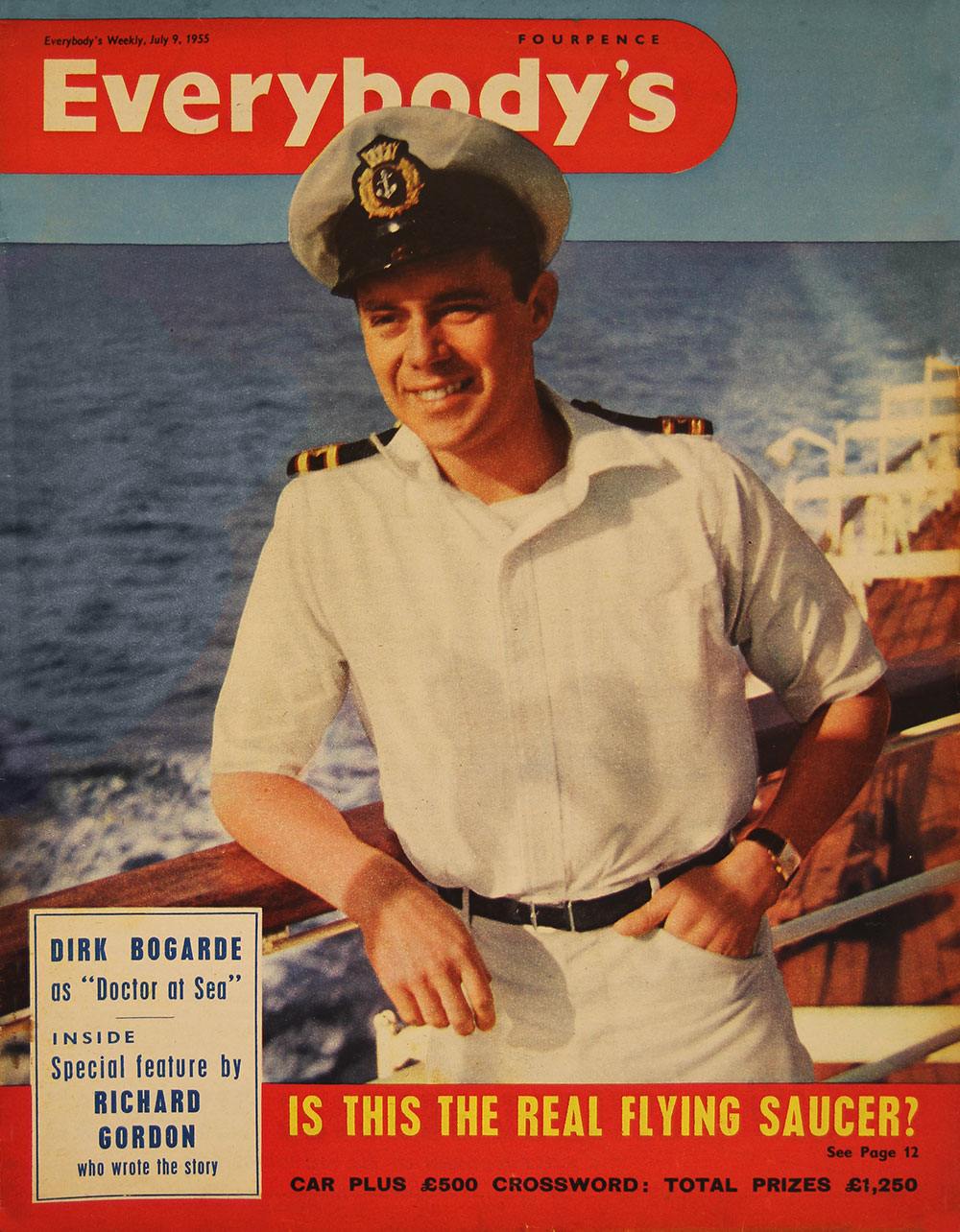


The film version of this hilarious novel has its world premiere in the West End next week
Richard Gordon tells the story behind Doctor At Sea
In the film of Doctor at Sea, Dirk Bogarde is greeted on joining the S.S.Lotus with the question: “What sent you to sea, Doc? Drink, women, or the police?” I must insist that I became a ship’s doctor myself without compulsion from any of these. I was driven to sea by St. Pancras Station.
A few years after qualifying I gave up clinical doctoring to become a medical journalist in London, sitting in an office that looked over the roofs of Bloomsbury at St. Pancras. I enjoyed the job, but at the end of a year it became obvious that either the station had to move or I did.
As St. Pancras showed no signs of shifting, I cleared my desk, put on my best suit, and tried my luck with the shipping offices in Leadenhall Street.
The first shipowners said that they could fix me up as a bathroom steward. The second seemed more interested in my alcoholic career than my academic one. The third was a haughty company who took only retired surgeon-captains from the Royal Navy (referred to as the Old Grey Funnel Line). The fourth had just heard that one of their surgeons had broken his leg in Victoria Docks, twenty-four hours before sailing.
As no British ship with over ninety-nine souls aboard is allowed to leave without a doctor, this company almost Shanghaied me on sight.
For a doctor, joining the Merchant Navy is almost as simple as joining a tennis club. But I had two essential visits to make before boarding the ship.
I was brought before the official Shipping Master, who cheerfully looked me up in the Medical Register to see if I were bogus, took my fingerprints, and gave me the ship’s articles to sign. This made me officially a sailor, bound to obey my Captain’s lawful commands on pain of imprisonment, liable to be sent anywhere in the world bar the North and South Poles, and entitled to double pay on Sundays, green vegetables twice a week at sea, and a bed in the Sailor’s Home if I felt like it.
The next visit was more exciting. I found a small nautical tailor’s in Aldgate, where I was fitted out with a uniform loaded with gold and scarlet rings. I caught sight of myself in the mirror, and immediately felt like a combination of Horatio Hornblower and Blackbeard the Pirate.
Pulling my brand new cap sharply over one eye I left the shop with a devilish swagger, wholly forgetting that my only seafaring experience was riding the Isle of Wight ferry, when I was sick both ways.
My ship was a cargo vessel, bound for the Far East with a lascar crew . I arrived just as the officers were sitting down to lunch, which was curry. I later found that there was curry for every meal, including breakfast. If you felt hungry in the middle of the morning – or the middle of the night – you could always ring for a dish of curry.
The only curries I had eaten before were served by my landlady on Tuesdays, when the remains of the joint were a bit off. These had the same relationship to my new, diet as grapefruit juice to hydrochloric acid, and after a week I felt like a sword swallower in need of a holiday.
Life in this ship was like India in the nineteen-thirties. We drank chota pegs and ate tiffin, and all the officers were sahibs. My official title was ‘Hakim Sahib,’ which I resented until someone explained that it was Hindustani for ‘The Wise One.’
My job was mainly drinking gin with the Radio Officer (or Marconi Sahib), listening to the Chief Engineer’s reminiscences of Glasgow, and looking after the Captain’s stomach. This was an organ of far-reaching clinical effects.
If he was digesting his curry comfortably, the ship’s company went about their work as blithely as the chorus in H.M.S. Pinafore. If he woke up with dyspepsia, I could make the diagnosis by hearing him kick the steward bringing his breakfast, down the ladder.
The Captain had strong views on medicine, which he practised himself for many years when sailing as Mate in small tramp ships with no doctor aboard. He had one cure for everything – castor oil, in large doses.
Fortunately, no one-was seriously ill on the voyage, though every morning a dozen or so men queued outside the ship’s hospital hopeful of a day off work. But as the captain refused to accept any medical certificate unless accompanied by a corpse, I soon stopped signing them. He was a just man, but he could see no difference between giving orders to me about treating the patients and giving orders to the Purser about treating the soup.
When the ship reached London again I felt that I would suffer irreversible psychological changes if I stayed in her any longer, so I signed-off and looked for another berth.
Life aboard cargo ships is informal – the boots may be unlaced during dinner, the washing hung on the wireless aerials, and tropical uniform reduced to a regulation cap with a white cover and a pair of sandals; bowler hats have been said to appear on the bridge, and captains to give their helm orders by calling “Shift her round a bit to the left, Charlie.”
My next ship was a liner, where I had to dress for dinner and supplement my medical duties with a string of social ones, extending from being chucked into the swimming pool fully dressed at the Equator to showing pretty girls the boat deck in the moonlight.
This charming life had one disadvantage. The G.P. in England isn’t served a seven-course dinner every night, but he doesn’t have to eat it with his patients.
The Purser arranges the saloon seating, and tries to keep everyone happy by gathering together people with identical interests. For instance, at his own table, he puts all the prettiest girls aboard; at the Chief Engineer’s, all the Scotsmen; and at the doctor’s, all the people travelling for their health.
I was prepared to give Mrs. Smith’s kidney my deepest attention in the consulting room each morning, but having it served every day for dinner with Mr. Jones’ stomach, Mrs. Jones’ thyroid, and Mr. Smith’s poor feet, brought on a strained and shifty look attributed by the passengers either to over-work or taking drugs.
I spent two years at sea, in ships sailing from Newfoundland to Tasmania – it hadn’t occurred to me the day my qualifying diploma arrived that I’d got a ticket for a world cruise.
Meanwhile I’d learned more about people, as distinct from patients, than in five years at medical school; and half a dozen captains had taught me an even more valuable lesson – that doctors aren’t really such ruddy important people after all.
When I left my last ship, I had the manuscript of Doctor At Sea in my baggage. Every voyage brought its emergencies, but I had time for writing as well because I was usually occupied with nothing more serious than sunburn or seasickness – though even these simple complaints have their pitfalls.
I was proud of a secret mixture I had concocted for seasickness, which failed in only one case, a pretty young woman emigrating with her husband to Australia.
I felt mildly annoyed at this, and opened the ship’s pharmacy book to try some of the official drugs. Still I had no success. I even contemplated using old sailors’ cures like bandaging up an eye or drinking a glassful of seawater. Finally I decided that only psychiatry could cure her, particularly as the sea had been flat for several days. That evening I tried hypnosis.
“It’s no good, doctor,” she admitted the next day. “I was seasick before breakfast again this morning, just like yesterday and the day before.”
“You mean you’re only seasick before breakfast?”
She looked surprised. “Why, yes, doctor.”
“In the name of Heaven,” I said, “where’s your husband? Now he’s got to stand me and the whole ship’s company a free gin. Congratulations!”
I was careful the Captain didn’t hear about that one.

