Film – Jan 1963


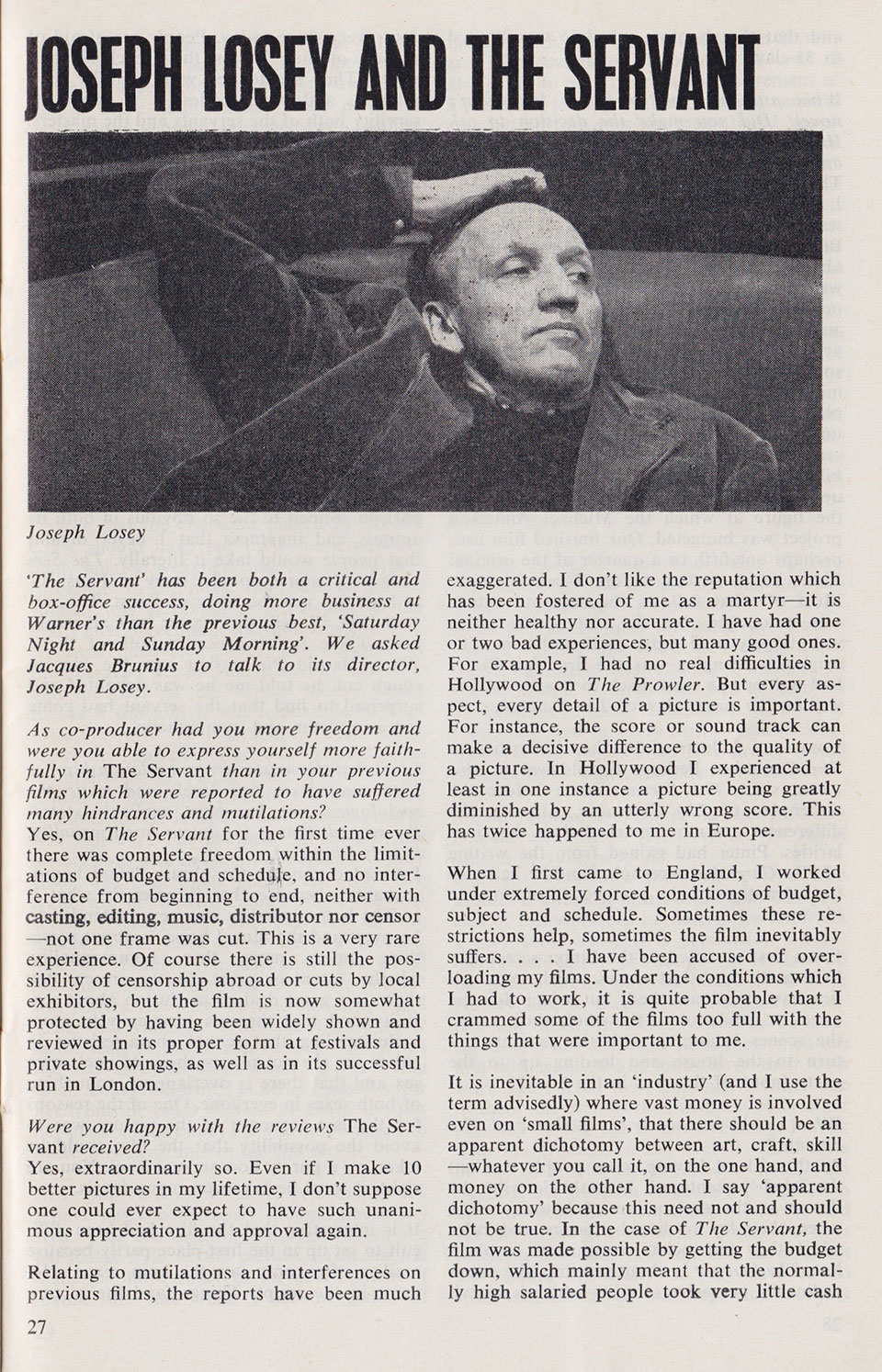

JOSEPH LOSEY AND THE SERVANT
‘The Servant’ has been both a critical and box-office success, doing more business at Warner’s than the previous best, ‘Saturday Night and Sunday Morning’. We asked Jacques Brunius to talk to its director, Joseph Losey.
As co-producer had you more freedom and were you able to express yourself more faithfully in The Servant than in your previous films which were reported to have suffered many hindrances and mutilations?
Yes, on The Servant for the first time ever there was complete freedom within the limitations of budget and schedule, and no interference from beginning to end, neither with casting, editing, music, distributor nor censor – not one frame was cut. This is a very rare experience. Of course there is still the possibility of censorship abroad or cuts by local exhibitors, but the film is now somewhat protected by having been widely shown and reviewed in its proper form at festivals and private showings, as well as in its successful run in London.
Were you happy with the reviews The Servant received?
Yes, extraordinarily so. Even if I make 10 better pictures in my lifetime, I don’t suppose one could ever expect to have such unanimous appreciation and approval again.
Relating to mutilations and interferences on previous films, the reports have been much exaggerated. I don’t like the reputation which has been fostered of me as a martyr – it is neither healthy nor accurate. I have had one or two bad experiences, but many good ones. For example, I had no real difficulties in Hollywood on The Prowler. But every aspect, every detail of a picture is important. For instance, the score or sound track can make a decisive difference to the quality of a picture. In Hollywood I experienced at least in one instance a picture being greatly diminished by an utterly wrong score. This has twice happened to me in Europe.
When I first came to England, I worked under extremely forced conditions of budget, subject and schedule. Sometimes these restrictions help, sometimes the film inevitably suffers… I have been accused of overloading my films. Under the conditions which I had to work, it is quite probable that I crammed some of the films too full with the things that were important to me.
It is inevitable in an ‘industry’ (and I use the term advisedly) where vast money is involved even on ‘small films’, that there should be an apparent dichotomy between art, craft, skill – whatever you call it, on the one hand, and money on the other hand. I say ‘apparent dichotomy’ because this need not and should not be true. In the case of The Servant, the film was made possible by getting the budget down, which mainly meant that the normally high salaried people took very little cash and that the shooting schedule was limited to 35 days.
What attracted you to Robin Maugham’s novel? Did you make the decision to ask Harold Pinter to write the screen adaptation, and were you influenced by similarities with The Caretaker?
I read the novel when it first appeared and was interested in it. I took it to Dirk Bogarde, but he at that time was uneasy about it, so I put it away and forgot it. This was probably a good thing then, because neither Dirk nor I was ready for it, nor were audiences. Also at that time Pinter had not yet been heard from. Later Michael Anderson bought the rights of the novel and commissioned Harold Pinter to write a screenplay, but Anderson for various reasons was unable to set up the picture. I heard of this script, read it and was excited by its possibilities. I found that I would be able to set it up if the budget was kept considerably under the figure at which the Michael Anderson project was budgeted. Our finished film uses perhaps one-fifth or a quarter of the original Pinter script written before I came into it. Most of what follows the servant’s return was untouched, but the rest of the script was largely rethought and rewritten. The original screenplay was the first that Pinter had written; he came back to it after having written the screenplay of The Caretaker.
I was not influenced by the similarities to The Caretaker. Perhaps Harold was or vice versa, since The Servant came before the screenplay of The Caretaker. Anyway, the differences are more marked than the similarities. Pinter had gained from the writing of The Caretaker screenplay and he had also the advantage of the perspective of time on his work.
I was first attracted to the Pinter screenplay by exactly those last scenes which some critics have most attacked, but which for me were the validation of the whole project: i.e. the scenes beginning with the servant’s return to the house and leading up to the party (none of this was in the book).
What would you say was the theme of The Servant?
At the risk of having some people trot out the label ‘pretentious’, I would describe the theme as the destruction of human beings when they try to live by codes and rules which they and society recognise to be obsolete. The Servant is about servility, the extraordinarily pervasive servility which is so evident everywhere today. People are afraid of money, of their bosses, their teachers, their wives. They are loaded with guilt by their religious and social codes – it is about the servility both of the servants and the masters. It is a product of the general corruption amidst which we live, the kind of hypocrisy common to all of us… I don’t think of the servant as evil, but as a man who was living according to the rules of our society as he understood their operation. In this connection of ‘the sinister servant who is the embodiment of evil’, I was perhaps responsible for some misconceptions: a synopsis of the film was requested. I have a terror of synopses and didn’t feel that this particular film could be synopsised. I wrote rather considerable notes about the film and ended somewhat facetiously saying, ‘if you still want to know the story, it is – ‘ and I first left what it was blank. Challenged by a friend, I added, ‘if you still want to know what The Servant is about, it is the story of Faust’. The comparison seemed to me so obvious in both its aptness and inaptness that I never dreamt that people would take it literally. The Servant is of course not the story of Faust, or at least not just the story of Faust. The servant isn’t all evil, the master isn’t all weakness. There is innocence in both of them. When Harold Pinter first saw the film in rough cut, he told me he was delighted and surprised to find that the servant had come out as a victim and ‘sympathetic’.
I feel that the master-servant relationship has been treated on two levels and while the sociological one has been explicitly stated, the second, that is the latent homosexuality, is only hinted at.
I am glad you use the phrase ‘latent homosexuality’, because that is precisely what it is. The homosexuality was never intended to be overt and the film, I hope, is about something much more than homosexuality, whether latent or overt. In our present day there is a great deal of confusion about sex. It is good that there is progressively more understanding that sexual characteristics in either sex are not purely those of one’s own sex and that there is overlapping, something of both sexes in everyone. One of the reasons for the last sequence of the picture was to avoid the possibility that the film could be taken on a purely homosexual level. You are right, it must be taken on many levels.
It is interesting that the film had been difficult to set up in the first place partly because readers often only saw the homosexual element in the script. Things (and the picture itself) have so changed matters that I have more than once had serious proposals to cut the last sequence in order to make the picture ‘more homosexual’. These pressures come from people concerned with selling the picture. If the picture is taken purely as a homosexual study it makes it much easier for most elements of the audience to reject those other aspects of the picture that might apply to them. Many people will sense the element of homosexuality or see it only later after some thought. Others will never see it at all. This is the way I intended it and this way I think it means much more. One of the things which the film may affect is to give sexual attitudes a larger scope and minimise their simplification of the sexual problems of the picture.
Do you accept my criticism that of the four principals the character of the master’s fiancée was under-developed and that she gave in too easily?
I agree that the character played by Wendy Craig should have put up a more effective fight, but the weakness was not in the performance. In the novel the character of the woman was sickening and her part in the first Pinter screenplay was non-existent. Pinter wasn’t interested in her. The weakness of the character in the film is also to some extent the fault of the British theatre which makes it difficult, if not impossible, to find someone who is inescapably upper-class. However, I can’t emphasise too strongly that the character of young Tony was never intended to be upper-class in the pure sense of the term. He is what I call ‘fourth generation Harrods’. The character of the girl, the fiancée, was also never intended, once Wendy Craig was cast, to be played as ‘posh’. We made use of Wendy Craig’s slight regional accent (Derbyshire). The character of the fiancée could have come from a recently moneyed family. Her education was good, her mind better than that of Tony, but she still suffers from the terrible handicaps and social disadvantages of anyone slightly lower in the scale of the British class system. When she acts as upper-class ‘bitch’, she is trying to do something which is neither possible for her from the point of view of character, nor her class background. I am afraid I failed to make this clear and so did the script.
Have you consciously developed your style?
I have never consciously thought about my style. I of course always thought about the particular style of the picture. Criticism has made me more aware of the development of mannerisms and when I become aware of them I try to stay away from them. Details are of tremendous importance to me: I always try to plan the rhythms, movement of a picture in terms of subject, cutting, camera, etc., but all this does not mean that I necessarily have a particular style. As I have often said, I believe that any picture worth serious attention must be signed by its director, but if I may presume that my pictures have a signature that doesn’t necessarily mean that I always work in the same style. Painters like Picasso, Braque, Cézanne as well as the old masters sign their paintings in the sense that their work is almost always immediately recognisable by anyone who loves painting, but individual paintings may be executed in different styles. It is an easy way out for critics to label directors and to fit them neatly into different movements. Some of the labels for me have been ‘baroque’, ‘self-indulgent’, ‘self-conscious symbolism’, ‘ambiguous’. These labels are really terrible even if there may be, as of course there is, some truth in them.
Was the master-servant relationship the central theme for you or did you find the corruption theme more important?
I am not particularly interested in servant-master relationships. Someone recently asked me in all seriousness whether I thought all master-servant relationships had an element of sexuality in them. The answer is, no. But I do think that in every intense relationship, whatever the sexes, there is a strong sexual element from which the intensity derives.
Would you like to speak about Richard MacDonald with whom you work on the visual aspects of your pictures?
I always work with some one person who usually is an artist in his own right. The process of this work has no descriptive name. In a very loose sense it is production design; the French call it ‘pre-design’. In Hollywood the person on all but two pictures was John Hubley and in England it is Richard MacDonald. Their function is not to be confused with art direction. Both these men are first-rate painters and both have their own work apart from their painting. Neither one of them has ever worked with anybody other than me on this job of pre-designing. I work with MacDonald on the overall visual style of the film. The work concerns itself with lighting, composition of groups, composition in movement. Sometimes MacDonald sketches in very great detail. Sometimes it is merely a hasty line-drawing. It is never direct story-board continuity. It may have to do with sets, costumes, make-up, etc. Working with one single man a common language is created which greatly enlarges and simplifies work.
The work of the lighting cameraman is also extremely important to me. Douglas Slocombe’s contribution to The Servant is inestimable, as great or greater than that of Gianni di Venanzo’s photography in Eve. Both men are capable of many styles and both contributed to a picture through the framework of what the director wants.
One final word about The Servant: on this picture more than any other which I have ever made, I found out where I was going in the process of going there. At the commencement of shooting I was still not aware of what the stylistic solution would be. I had no similar experience before. By the time the film was finished everything had fully crystallised.
Pinter says that he doesn’t know where his characters are going, that he merely follows them.
If you ask Harold what a piece of work of his is about, he can never answer you. He will tell you that he doesn’t know. I think he does. On this picture I didn’t know at the beginning, but I know now.
What pictures and directors have particularly impressed you?
Among the recent pictures particularly Resnais’ Muriel and Kubrick’s Dr. Strangelove.

