Films and Filming – Apr 1959

The Doctor’s Dilemma
By ROGER MANVELL
BERNARD SHAW’S The Doctor’s Dilemma is an actor’s play, full of good but verbal parts in which artists who specialise in the eccentricities of character can shine. It is a delight on the stage where in scene after scene a group of eminent, opinionated and socially successful specialists, dress in their best Edwardian clothes, debunk each other to our heart’s content, and point Shaw’s moral for him – the fallibility of medicine and the vanity of men of science who command the life and death of those patients who can afford the remedies they have made fashionable. Shaw shot this bolt again in a Preface almost as long as the play itself, but left the other argument, the dilemma stated in the title, to a little essay (one of his best) that he wrote soon afterwards. This he called “The Sanity of Art.”
For the doctors have to legislate whether the latest treatment for tuberculosis (which has just brought Sir Colenso Ridgeon his knighthood, but is still in short supply) should be conferred on a worthy but utterly undistinguished colleague working for pence in a slum practice or upon an unworthy man who happens to be a painter of genius. They argue the toss in their various inimitable ways and finally choose the doctor. The immoral artist is left with a fine death scene to play on the stage and his heart-broken mistress puts on a posthumous exhibition of his work, which the whole of London society acclaims. This play – a comedy of life and death – was put on at the Royal Court Theatre in 1906, the year in which it was written. Whatever the merits of the play – and they are considerable – it must be confessed that it has no action at all, and needs none to make its point.
One of Anthony Asquith’s particular skills lies in the meticulous and elegant transfer of highly theatrical plays to the screen. Since the essence of such plays as The Importance of Being Earnest and The Doctor’s Dilemma lies in the verbal exchanges of unusually articulate characters whose personalities depend upon their tongues, it is no good expecting in the films derived from them the conventions of mobility, suspense and the active pursuit of actuality that are regarded as normal for the screen. These become films of people talking, and the utmost movement possible is usually the perambulation of a handsome cab, the ceremonious opening of front doors, or the momentary crossing of a room. The director and screen-writer, having devised the succession of the film’s scenes, must then let the camera and microphone serve the actors to the best advantage against the decorative elegance of their surroundings. As on the stage, the continuity of what happens follows entirely the flow of speech, because speech is the predominant feature of both Shaw and Wilde as dramatists. All movement is dictated by the actor’s need to point and emphasise the rhythm or rhetoric of what he has to say.
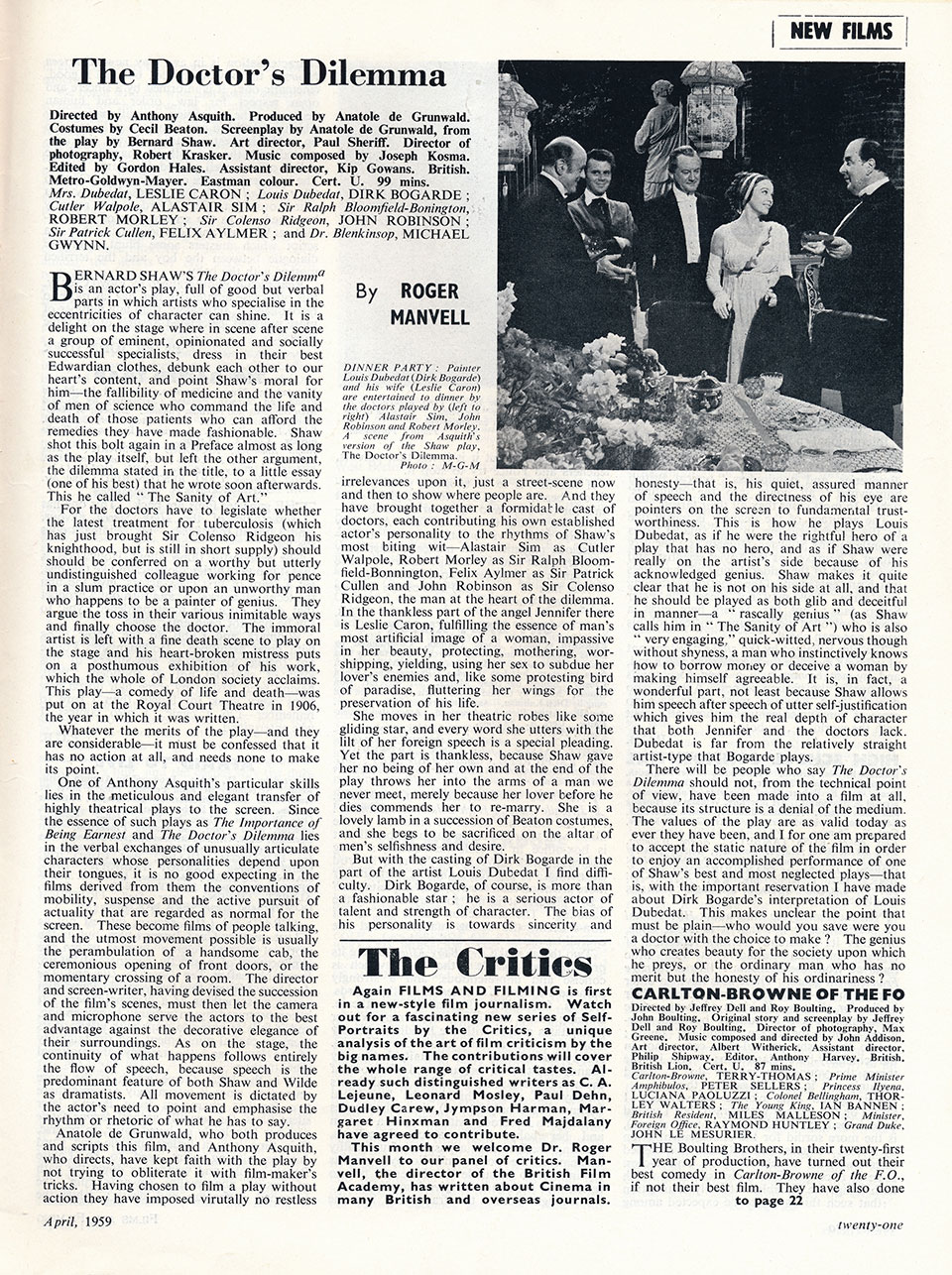
Anatole de Grunwald, who both produces and scripts this film, and Anthony Asquith, who directs, have kept faith with the play by not trying to obliterate it with film-maker’s tricks. Having chosen to film a play without action they have imposed virtually no restless irrelevances upon it, just a street-scene now and then to show where people are. And they have brought together a formidable cast of doctors, each contributing his own established actor’s personality to the rhythms of Shaw’s most biting wit – Alastair Sim as Cutler Walpole, Robert Morley as Sir Ralph Bloomfield- Bennington, Felix Aylmer as Sir Patrick Cullen and John Robinson as Sir Colenso Ridgeon, the man at the heart of the dilemma. In the thankless part of the angel Jennifer there is Leslie Caron, fulfilling the essence of man’s most artificial image of a woman, impassive in her beauty, protecting, mothering, worshipping, yielding, using her sex to subdue her lover’s enemies and, like some protesting bird of paradise, fluttering her wings for the preservation of his life.
She moves in her theatric robes like some gliding star, and every word she utters with the lilt of her foreign speech is a special pleading. Yet the part is thankless, because Shaw gave her no being of her own and at the end of the play throws her into the arms of a man we never meet, merely because her lover before he dies commends her to re-marry. She is a lovely lamb in a succession of Beaton costumes, and she begs to be sacrificed on the altar of men’s selfishness and desire.
But with the casting of Dirk Bogarde in the part of the artist Louis Dubedat I find difficulty. Dirk Bogarde, of course, is more than a fashionable star; he is a serious actor of talent and strength of character. The bias of his personality is towards sincerity and honesty – that is, his quiet, assured manner of speech and the directness of his eye are pointers on the screen to fundamental trustworthiness. This is how he plays Louis Dubedat, as if he were the rightful hero of a play that has no hero, and as if Shaw were really on the artist’s side because of his acknowledged genius. Shaw makes it quite clear that he is not on his side at all, and that he should be played as both glib and deceitful in manner – a “rascally genius” (as Shaw calls him in “The Sanity of Art”) who is also “very engaging,” quick-witted, nervous though without shyness, a man who instinctively knows how to borrow money or deceive a woman by making himself agreeable. It is, in fact, a wonderful part, not least because Shaw allows him speech after speech of utter self-justification which gives him the real depth of character that both Jennifer and the doctors lack. Dubedat is far from the relatively straight artist-type that Bogarde plays.
There will be people who say The Doctor’s Dilemma should not, from the technical point of view, have been made into a film at all, because its structure is a denial of the medium. The values of the play are as valid today as ever they have been, and I for one am prepared to accept the static nature of the film in order to enjoy an accomplished performance of one of Shaw’s best and most neglected plays – that is, with the important reservation I have made about Dirk Bogarde’s interpretation of Louis Dubedat. This makes unclear the point that must be plain – who would you save were you a doctor with the choice to make? The genius who creates beauty for the society upon which he preys, or the ordinary man who has no merit but the honesty of his ordinariness ?
Directed by Anthony Asquith.
Produced by Anatole de Grunwald.
Costumes by Cecil Beaton.
Screenplay by Anatole de Grunwald, from the play by Bernard Shaw.
Art director, Paul Sheriff.
Director of photography, Robert Krasker.
Music composed by Joseph Kosma.
Edited by Gordon Hales.
Assistant director, Kip Gowans.
British. Metro-Goldwyn-Mayer. Eastman colour. Cert. U. 99 mins.
Mrs. Dubedat, LESLIE CARON;
Louis Dubedat, DIRK BOGARDE;
Cutler Walpole, ALASTAIR SIM;
Sir Ralph Bloomfield-Bonington, ROBERT MORLEY;
Sir Colenso Ridgeon, JOHN ROBINSON;
Sir Patrick Cullen, FELIX AYLMER;
and Dr. Blenkinsop, MICHAEL GWYNN.

