Films and Filming – Feb 1975
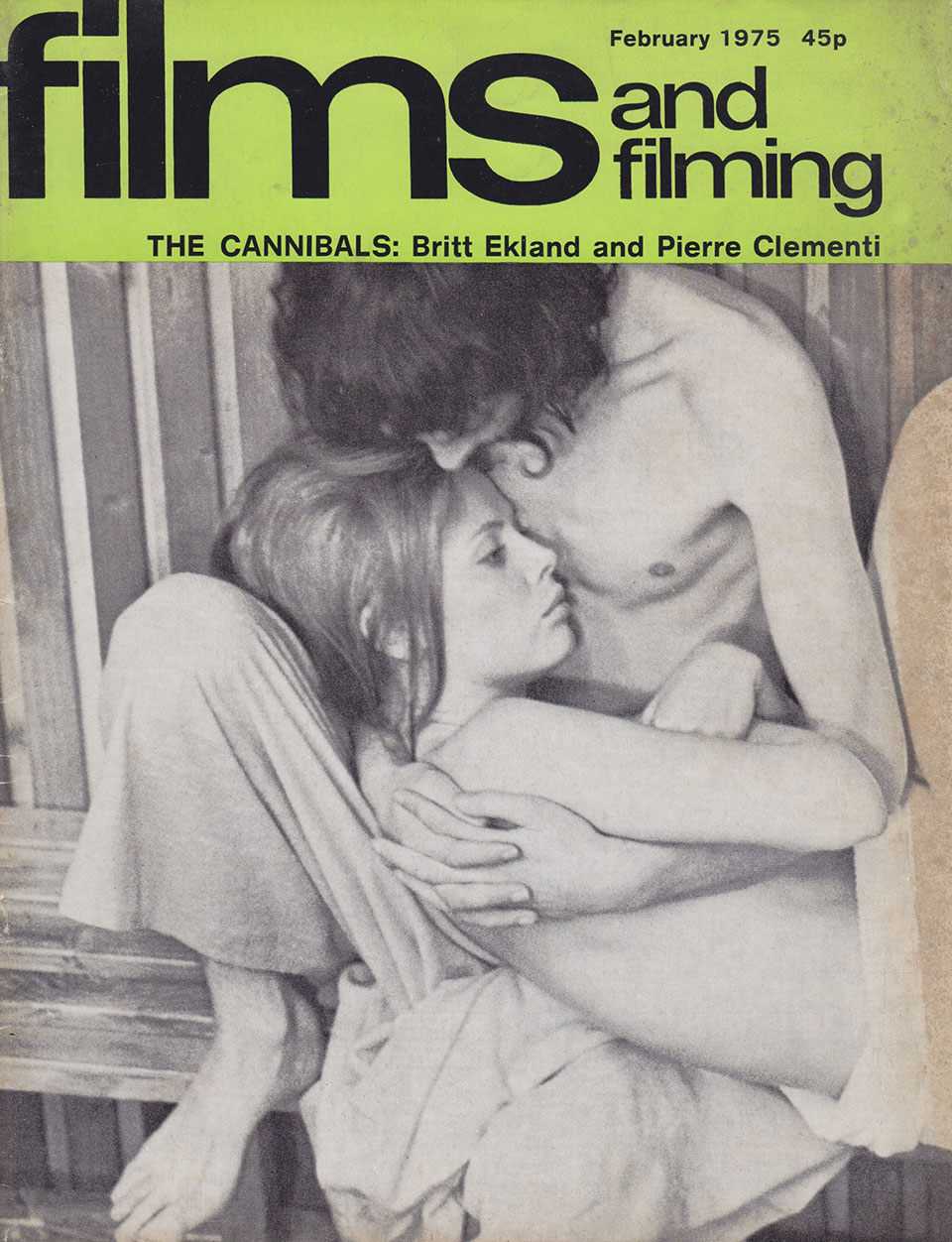


Consciousness and Conscience
LILIANA CAVANI, Italy’s foremost woman director whose The Night Porter has been the centre of political and critical controversy, in an interview with Alexander Stuart.
LILIANA CAVAN, has, in a very short period of time, established herself as one of Italy’s leading film directors – and certainly its foremost woman director. She first made her presence known with a series of startling, controversial television films on such subjects as The Third Reich, the women of the Resistance and the proposed rehabilitation of Philippe Petain. In 1969 she directed her first feature film for the cinema, I Cannibali (The Cannibals), which was screened in Britain at the London Film Festival, but then disappeared from view now. During the past six months or so, her latest feature, The Night Porter, has become an international success, breaking box-office records and sailing through a storm of critical controversy. Now, she is in Rome preparing a film about Nietzsche and the revolution in thinking that he set in motion.
The Night Porter is a film rich in symbolism, the most obvious example being the night itself, of course. Do you feel you have any special affinity with the night?
Yes, considering it as a metaphor for the subconscious. The significance – the meaning, of the title is that Max, Dirk Bogarde’s character, is literally the porter – or gate-keeper – of the night.
Do you consider the night to possess a kind of protective quality? There’s a point in the film where Max says he lives at night because he has a sense of shame in the light … the day.
He has a feeling of guilt, whereas the others don’t. As in fact, most ex-Nazi war criminals don’t. As, in fact, most war criminals, of any country, don’t. This is the situation today. Max considers the night as a sort of refuge. He feels like a churchmouse. He lives, during this post-war period (Vienna, 1957), as a sort of churchmouse. Quiet.
How did the subject matter of the film evolve? Did you do much research into war criminals, into the people who’d experienced the treatment of the SS – who’d been in concentration camps?
My first film was a documentary for the then newly-formed second television channel in Italy … the cultural channel. It was four hours on Hitler’s Germany: Storia del Ill Reich (The Story of the Third Reich). This was in 1962 and up to then, nobody had ever talked about this period publicly in Italy. While I was at university, Fascism and Nazism were just never mentioned. And I had newsreel – hours and hours of newsreel from Germany, from America, from Russia – so for weeks I sat and watched these images from the Nazi era. The newsreel material was quite scarce then. And it was a horrifying expenence, watching these films. I suppose you can trace elements of The Night Porter right back to then.
My picture of the Nazi period grew as I researched for other television films I made. I interviewed a number of politicians, statesmen , lawyers and army officers for a documentary about the question of whether Philippe Petain should be rehabilitated. And I talked to the people of the Resistance – the people who’d lived through this period; who’d suffered the hospitality of the SS – to prove that it was unjust to rehabilitate him. Then I did some other programmes for the cultural channel: one on the women of the Resistance, for which I interviewed several women who’d been in concentration camps. And I did one hour on the generation of the post-war period: Twenty Years After, made in 1965. This was an attempt to understand what the post-war generation thought of the Europe of 20 years earlier. There was a lot of confusion … a lot of ignorance. I interviewed youths from three different German universities and discovered that they not only ignored the Nazi period, but they did it voluntarily – they weren’t forced. So this is the kind of background to The Night Porter. I was very interested in all this and was prompted to go ahead with the production.
Where did you get your concept of the SS men from – in particular, Max filming everything in the concentration camp?
There were many things I learnt doing the programmes for television. The Nazis really loved the cinema and adored filming everything; they did it very well – they had some very good cameramen. A lot of the SS possessed Leicas – like the one Max has in the film: it’s a genuine 1940s Leica. They just loved filming. Everything, even the worst scenes of torture. Not just the reporters – the professionals – but all of them. lt was a hobby. This had a great impact on me. But the Americans are just the same: when they go to war, they like to film everything. It seems to me an attempt to become more objective, to ‘distance’ oneself from what is going on.
In your research into Nazism, did you come up against a concept of collective guilt? Was the blame passed on to the German nation?
After the war, the colonels blamed the sergeants; the sergeants blamed the officers; the officers blamed Hitler. The blame was passed on – Hitler had died and that had finished it. It was as if Nazism had come from Mars. The people who study this period use Wilhelm Reich’s book, which he wrote, in fact, in 1933, when it was immediately banned in Germany. It talks about Nazism as a fact: as if it were a sort of sickness of one’s psyche. It’s not peculiarly German or Italian – it could be of any race. It’s an expression of immaturity, in a sense. A society based on sexual repression, in which a man feels powerful – even sexually – when he’s wearing a uniform. When he’s serving an important master.
You feel, then, that the SS Corps was sexually orientated?
Yes. When researched into the Nazi period. I came to the conclusion that the SS was a homosexual cult – either consciously or subconsciously, realised or not realised. It was a very narcissistic corps. The uniform was studied with particular attention. It was almost like a new, 20th century Templar order. Albert Speer, who was a normal middle class man with a family who became the choreographer for the mass rallies at Nuremburg – choreographer for the Third Reich, in fact – has written about how Hitler and the Nazi party seduced him. With the distance of 20 years or so, he asks himself well how on earth was this possible? But he was seduced. On May 1st 1945, when he heard about Hitler’s death, he took out the framed picture of Hitler he kept in his wallet and he looked at it and cried. Yet at the same time he felt free. The psychology of this is the key to one’s understanding of this kind of phenomenon: the whole Nazi cult, and in particular the SS cult.
Hitler was a god, especially to the SS Corp. This was a special corps that had a lot of power. They were like black angels: the beautiful angels of the night. They were, in reality, imaginings created by a cheoreographer. They had great impact. In an interview with Speer a couple of years ago, he talked about one of the last reunions at Nuremburg. The Nazi hierarchy had become rather fat and out of condition and Speer didn’t know what to do. So he arranged for the lighting for the rally to be at ground level – from below the participants. This made them look slimmer and fitter. And he mentions this to stress how narcissistic they were . . . and also how able they were to cope with such a problem and disguise the fact that they were no longer so beautiful. This is what I had in my mind when I shot the sequence in The Night Porter of the dance – when this young male dancer performs before his comrades. This is the crux of the matter. The SS wanted to impress.
Dirk Bogarde has described the film as a love story. How do you feel about this?
It is a love story, yes. It’s not a sentimental love story. It’s like love in Shakespeare: love always comes out as a drama in which the whole situation – the socio-political situation; the psychological situation – comes to the fore. It is a complex pattern. The film is not a love story in the sense of continual ‘great drama’, like in comic strips. It’s the sort of love story where the characters possess great experience, great knowledge. This allows the two protagonists to be clearer and more intelligent than the other characters. More conscious, in fact. They are human beings.
Do you see the ending of the film as pessimistic or optimistic, or neither?
The point of the relationship between Max and Lucia, Charlotte Rampling’s character, was that they would know each other better. They would each feel guilty … of what they had been in the past. In a sense, this makes them human. They know their relationship – their living together – will bring them to their deaths;there’s no way out. They can’t just pack a suitcase and go off to the seaside. It’s coherent: they pay right up to the very end. They accept this role they had in the concentration camp – which Nazis don’t generally do. This is the difference between Max and the others.
How closely do you identify with The Night Porter? You’ve stated in the past that you consider it your most personal film to date.
This is true. I’ve made two feature films on commission for television companies – one was about St Francis of Assissi and the other, Galileo – and a feature for the cinema, I Cannibali. This was born in 1968 during the period of political uprising and in fact it was very closely tied to the situation of the moment. Whereas The Night Porter developed very, very slowly in my mind. I wrote the screenplay in 1970 and only at the end of 1972 did I find people who would finance the film. Nobody wanted to undertake it, because they thought it was too difficult – too complex. But the public will go and see this sort of film … and they will understand it.
What elements of the political situation of 1968 did The Cannibals concentrate on?
In part, the theme is the complicity of everyone in any kind of political situation. Even doing nothing is a decision and an expression of one’s political consciousness. The film is a metaphor. It concerns a European city in which there is a revolution and all the revolutionaries are killed. The Fascist government orders that the bodies must not be touched – they must me left where they are, in the city streets, on the roads. This is a warning; it is intended to scare prospective revolutionaries. And the people of the city just walk along the streets, stepping over the bodies, carrying on life quite calmly without taking notice of the situation. One can get used to anything … eventually … because the majority of people don’t possess a conscience, a social conscience – a collective social conscience. But the young people of the city fight for a new way of life. Some of the other inhabitants consider them as wild animals, but in fact the young people are aware. They want to improve the quality of life. They start by taking these bodies and burying them, so they assume in themselves a dignity … a dignity in man.
Both The Cannibals and The Night Porter, as well as most of your early television films, have been very much concerned with this century. What attracted you to the subjects of your two television feature films on St Francis and Galileo?
I didn’t grow up in the Catholic religion and I really didn’t want to do this film on a saint at first, because a saint didn’t mean much to me. Then I read a very good book, written by a non-Catholic, and I realised that St Francis was a good subject. It is the story of the adventures of a young man who was very similar to me, to many people of my generation and to many people of the younger generation. I saw him as the first hippie. He wanted to discover life anew; he wasn’t interested in the normal humdrum type of existence. And he discovers the beauty of the world, which makes him a poet, because he sees nature for the first time. He sees how beautiful nature is and actually manages to communicate this beauty. I saw it in this way, but there were problems when the film was broadcast on television. In Italy, St Francis is a great saint, but in the film he’s seen in a completely different fashion. Young people accepted this and loved it, but the majority of people complained. In fact, the matter was raised in Parliament. You see, St Francis is a great saint, the patron saint. The film was just not acceptable to many people. They’d built St Francis lots of churches – it was a cult. Whereas St Francis would have hated all that. So it was an interesting experience for me.
The film on Galilee wasn’t a straightforward biography: it looked at only part of his life: the trial. Galilee was part of a pre-luministic movement in Italy – scientists and philosophers – and they interpreted reality in a completely different fashion from the Catholic Church. And the Church eliminated all the new science, the new civilisation, the new way of thinking. They completely congealed it. This particular period interested me, because the Church lost for ever. It lost the faith that the cultural men had had in the Church and it has never regained this.
So in fact this relates to your current project, the film on Nietzsche? Like Galileo, his work represented a new way of thinking.
Yes. The film is about the period in Nietzsche’s life when he meets Lou Andreas-Salome. She’s a very particular type of woman, a very emancipated woman. She wrote theories on sex which were very modern. She divided sex from sentiment, vindicating the rights of the body. The story is very interesting. This period when Nietsche and Lou Andreas-Salome were together really sees the end of 19th century thought and the birth of modern, 20th century thinking. These two people are fundamental to that development. There’s been a lot of confusion created around Nietzsche and his life, because of the connection with Nazism, and it’s only recently that we’ve started to understand what it was all about. One can call him the father of psychoanalysis – he was the first. He destroyed all kinds of philosophies, of metaphysics. But the basic equivocal point that has been created around him is the connection with the Nazis, or rather their connection with his works. But talking about Nietzsche one is really at the root of Europe: the root of modern Europe. One can understand more about today if one understands what happened then. It’s a fascinating subject. END

