Films and Filming – Jan 1965


King and Country
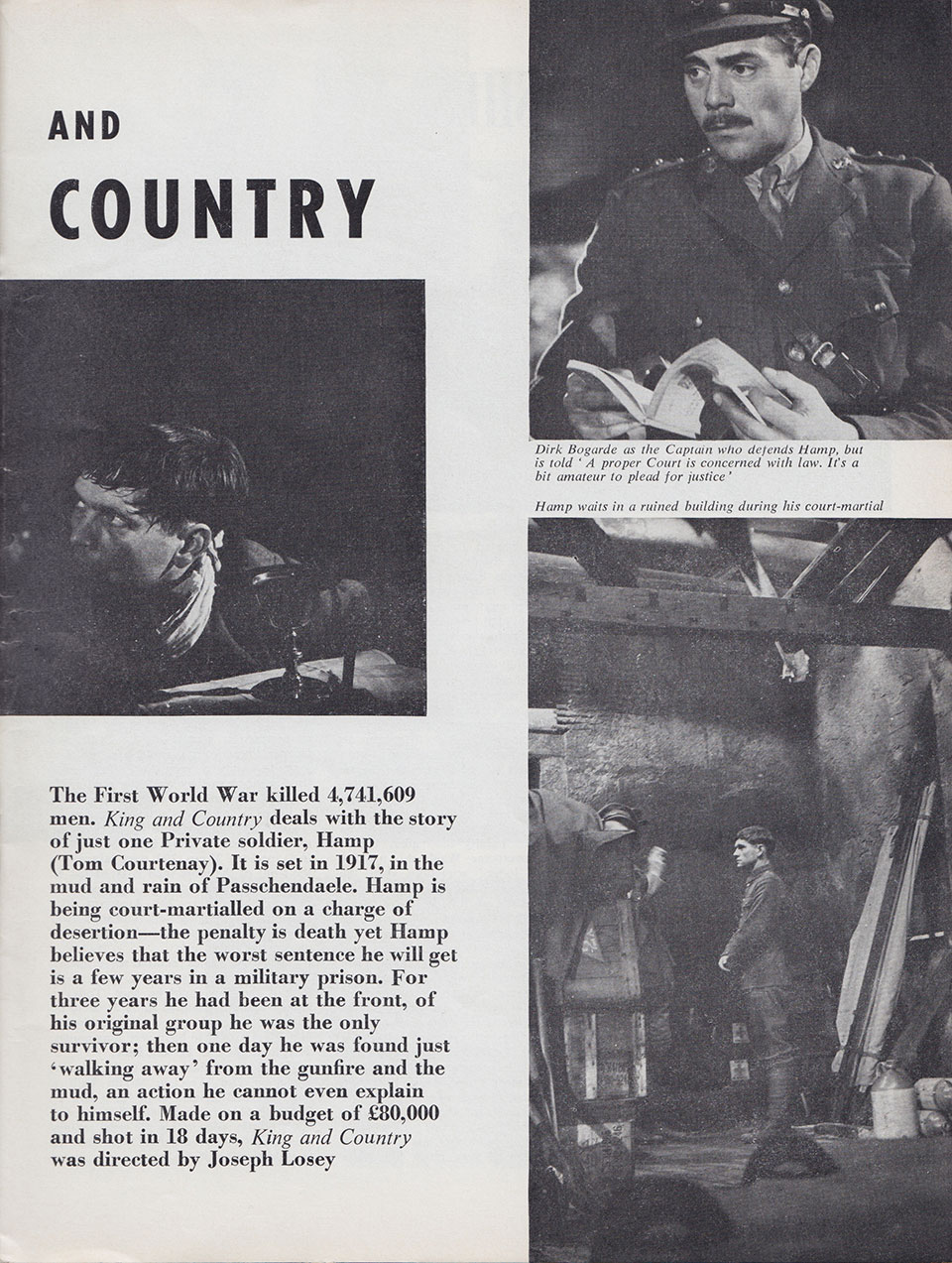
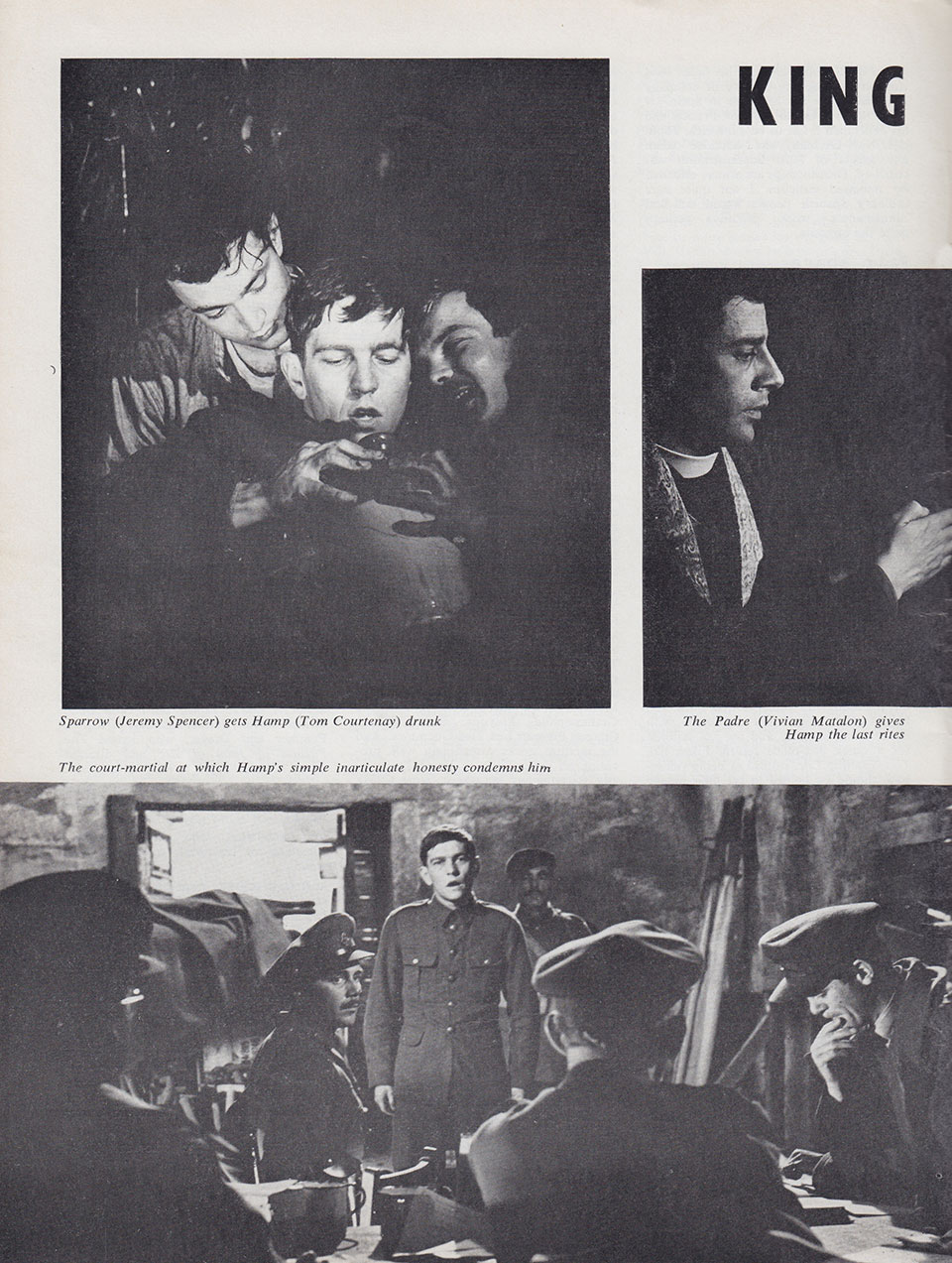
The First World War killed 4,741,609 men. King and Country deals with the story of just one Private soldier, Hamp (Tom Courtenay). It is set in 1917, in the mud and rain of Passchendaele. Hamp is being court-martialled on a charge of desertion-the penalty is death yet Hamp believes that the worst sentence he will get is a few years in a military prison. For three years he had been at the front, of his original group he was the only survivor; then one day he was found just ‘walking away’ from the gunfire and the mud, an action he cannot even explain to himself. Made on a budget of £80,000 and shot in 18 days, King and Country was directed by Joseph Losey.
KING AND COUNTRY
To follow the splendid complexities of The Servant, Joseph Losey has chosen a very simple narrative in King and Country, which seems for a time to be no more than an unsubtle contribution toward the deglorification of war. On the one side we have a persecuted private, on the other a bunch of black-hearted militarists. The story is factual, we are told, and this is easy to credit, since no writer of fiction would dare concoct such a tale unless his objective were melodrama. The private has been accused of desertion, having walked away from the battlefield sometime during the 1914-18 war. Attitudes have changed by now, and there are plenty of people who would concede that a soldier who ran screaming from gunfire would have been reacting naturally to a monstrously unnatural situation. This private, however, does not appear to have screamed, nor to have run; he simply walked away because, for the time being, he felt he’d had enough. He was not a conscript but a volunteer, he had been three years in the thick of it, and he was in the first stages of shellshock. In other words, the argument is over-loaded, a sermon for the stubbornly unconverted, and it is a considerable stroke of luck that the private is played by Tom Courtenay, who can suggest innocence and simplicity in the most genuine unsentimental way.
The real power of the piece emerges by degrees through the character of the defending officer, played with anticipated perception by Dirk Bogarde. Here, amid the cut-and-dried dramatics, is the realistic jolt of contradictions and inconsistencies. The officer has been conditioned, his mental discipline is strong, he defends the private because he has been ordered to do so and orders are duty, but he is inclined to deplore the fact that the private, for all his past bravery and present mental deficiency, has abandoned duty. Then, as the trial goes on, the officer grows uncomfortably aware of a discrepancy between his own sense of duty and his private conscience, and his internal struggle is carried to a powerful extreme in the final moments. By that time the emphasis has shifted: the military injustice toward the private has prompted the quick angry reaction, to be sure, but more importantly the character of the officer has indicated that, once war is on, expedient concepts of duty make little allowance for such things as conscience and humanity. And so, by implication, an accusation is hurled at the corridors of power where, given civilized communication, wars can be prevented from happening, and where a diplomatic failure is infinitely more deplorable than the human default of a soldier in battle.
Even so, a further dimension is really needed now in the anti-war film. Brownlow and Mollo have gone a long way toward providing it in It Happened Here, which acknowledges the fact that fanaticism breeds resistance in kind, that just causes are apt to be defended by emulation of the adversary, and therefore, again by implication, it is in the initial negotiations that causes should be defended, without death, and madmen and predators subdued around a table. This is an ideal, daunting but not to be shrugged off. Humanity is fallible, optimism is undermined, but hope must be sustained … and Camelot says the whole thing better than King and Country and It Happened Here, anyway, but Camelot entertains incidentally, which is perhaps ambigious but not necessarily ineffective.
However, to render the present plea into cinema is a daunting chore which Losey has faced with extraordinary skill. Realism in the usual sense is out. The story has been told already in a book, a TV play, and on the stage, and the structure is so theatrical as to require a deal of filmic compromise.
Written up and (except for Courtenay and Bogarde) played up, it demands a semi-formalism and gets it. War monuments and drawings merge into bodies and mud, and the position of a dead soldier’s limbs as he sinks in the mud is repeated in the attitude of the private as he lies captive. Sets and lighting are inclined to draw attention to themselves, reminding us that what we behold is an extension of the real thing, and thereby encouraging us to think beyond the real thing and face up to the implications. A chorus of common soldiery progresses from dialogue – chant to the ritual torturing of rats, and eventually to a noctural spree with the condemned private in which drunken compassion switches to a game of blind man’s buff and the private is placed at a similar disadvantage to the rats. Blind corruption and bone-headed expediency are reinforced by the nagging persistence of rain outside.
Denys Coop’s camera moulds strong and
pertinent images. The entire treatment, in
the circumstances, is very clever and
right, and there is no commercial compromise,
no nervously seized-upon reconstruction
of the preliminary action to
placate those customers who expect from
anti-war films a bonus of blood. When
violence comes, bitterly and sickeningly,
at the end, it is very much to the vital and
implicit point.
GORDON GOW
Directed by Joseph Losey.
Produced by Joseph Losey and Norman Priggen.
Screenplay by Evan Jones, from the play Hamp by John Wilson, based on a
story by James Lansdale Hodson.
Director of photography, Denys Coop.
Editor, Reginald Mills.
Music, Larry Adler.
Art director, Peter Mullins.
a BHS production, distributed by Warner-Pathé. British.
Cert X. 86 mins.
Captain Hargreaves, DIRK BOGARDE;
Hamp, TOM COURTENAY;
Captain O’Sullivan, LEO McKERN;
Lieut Webb, BARRY FOSTER;
Cpt. Midgley, JAMES VILLIERS;
Colonel. PETER COPLEY;
Lieut Prescott, BARRY JUSTICE;
Padre, VIVIAN MATALON;
Sparrow, JEREMY SPENCER;
Sykes, JAMES HUNTER;
Wilson, DAVID COOK;
Sgt Major, LARRY TAYLOR;
Corporal MP, JONAH SEYMOUR;
Corporal of the Guard, KEITH BUCKLEY;
Guard ‘Charlie’, RICHARD ARTHURS;
Cpt at Court Martial, DEREK PARTRIDGE;
Lieut Court Martial, BRIAN TIPPING;
1st Soldier, RAYMOND BRODY;
2nd Soldier, TERRY PALMER;
3rd Soldier, DAN CORNWALL.

