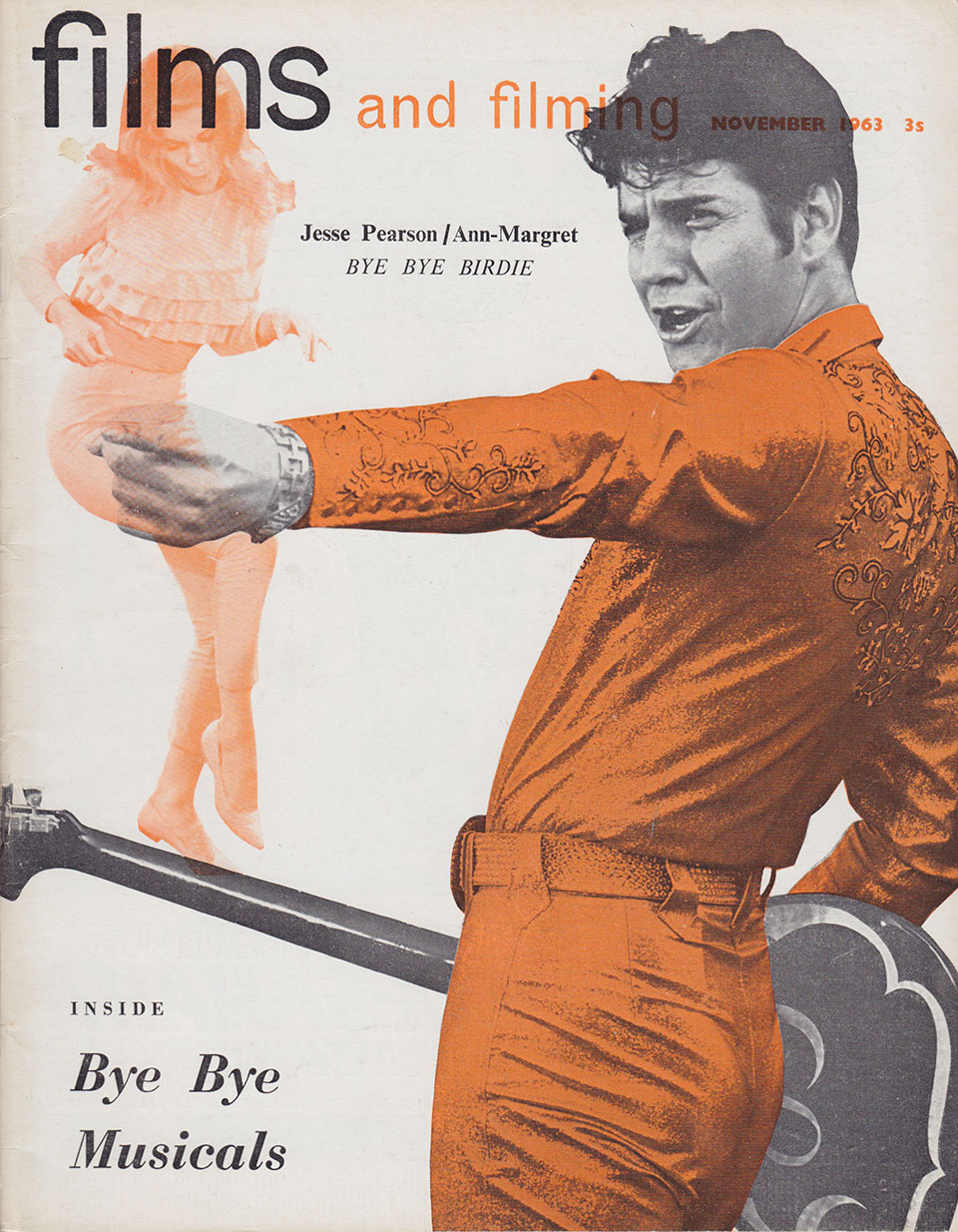
Films and Filming – Nov 1963
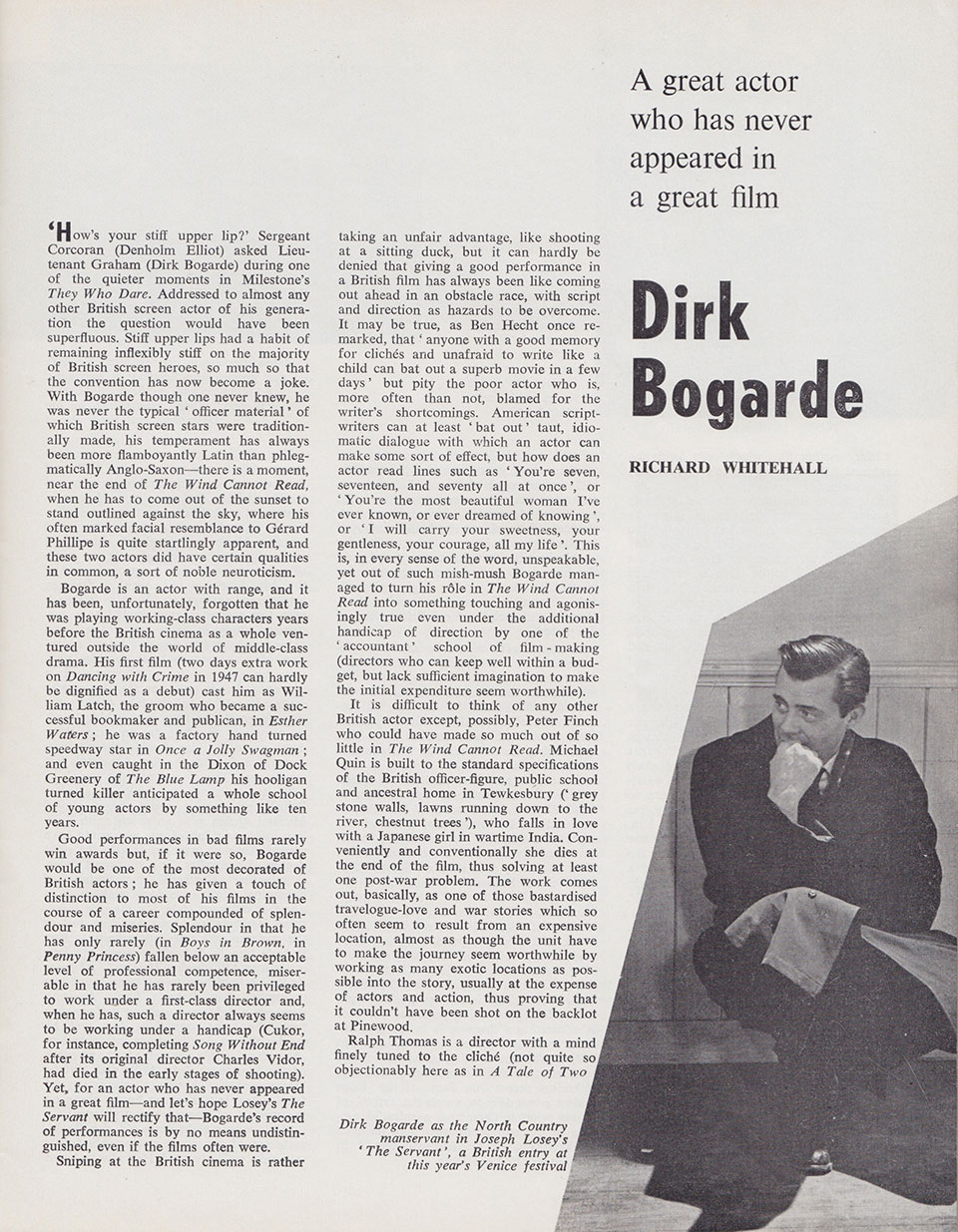

A great actor who has never appeared in a great film
Dirk Bogarde
RICHARD WIDTEHALL
‘How’s your stiff upper lip?’ Sergeant Corcoran (Denholm Elliot) asked Lieutenant Graham (Dirk Bogarde) during one of the quieter moments in Milestone’s They Who Dare. Addressed to almost any other British screen actor of his generation the question would have been superfluous. Stiff upper lips had a habit of remaining inflexibly stiff on the majority of British screen heroes, so much so that the convention has now become a joke. With Bogarde though one never knew, he was never the typical ‘officer material’ of which British screen stars were traditionally made, his temperament has always been more flamboyantly Latin than phlegmatically Anglo-Saxon – there is a moment, near the end of The Wind Cannot Read, when he has to come out of the sunset to stand outlined against the sky, where his often marked facial resemblance to Gerard Phillipe is quite startlingly apparent, and these two actors did have certain qualities in common, a sort of noble neuroticism.
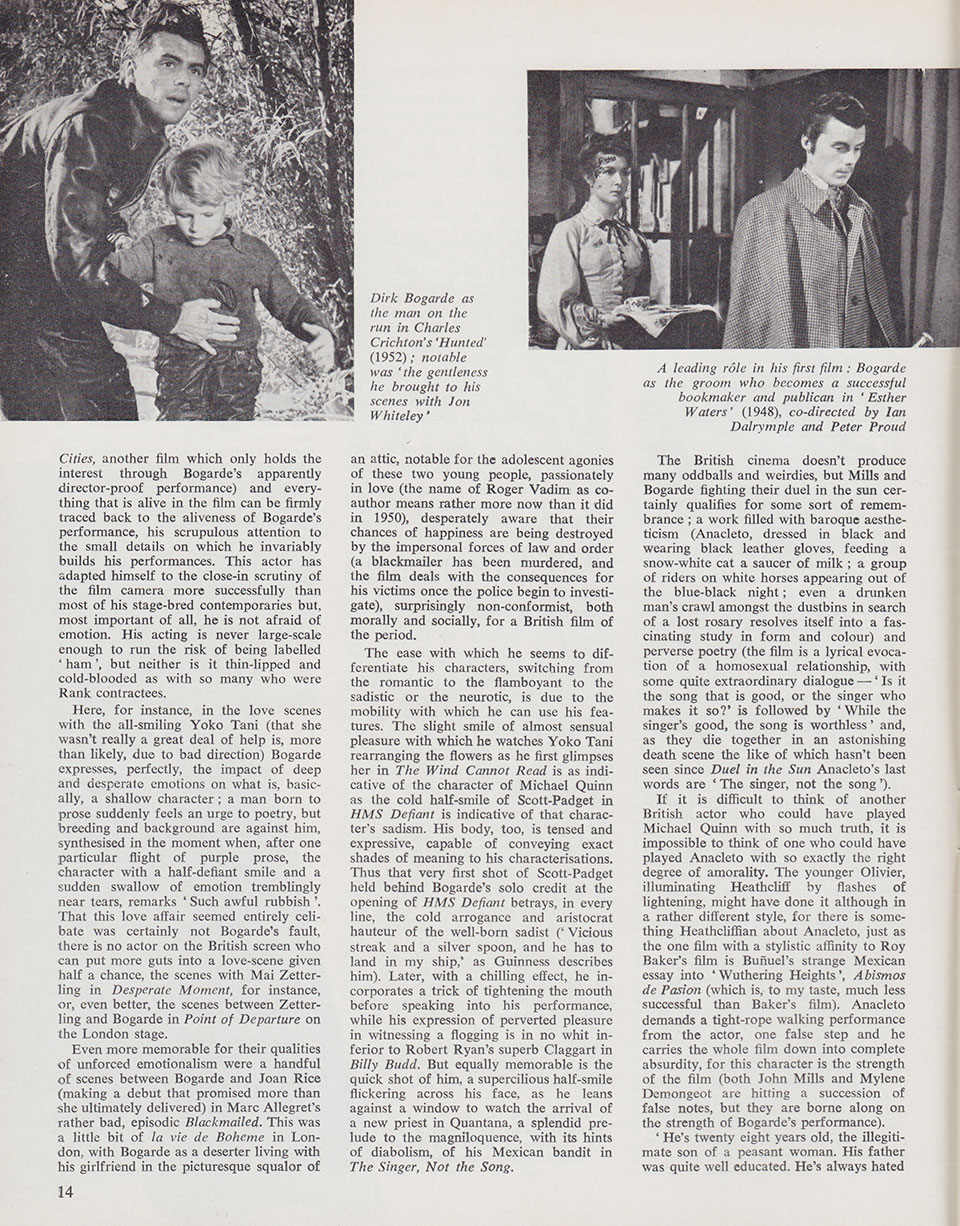
Bogarde is an actor with range, and it has been, unfortunately, forgotten that he was playing working-class characters years before the British cinema as a whole ventured outside the world of middle-class drama. His first film (two days extra work on Dancing with Crime in 1947 can hardly be dignified as a debut) cast him as William Latch, the groom who became a successful bookmaker and publican, in Esther Waters; he was a factory hand turned speedway star in Once a Jolly Swagman; and even caught in the Dixon of Dock Greenery of The Blue Lamp his hooligan turned killer anticipated a whole school of young actors by something like ten years.
Good performances in bad films rarely win awards but, if it were so, Bogarde would be one of the most decorated of British actors; he has given a touch of distinction to most of his films in the course of a career compounded of splendour and miseries. Splendour in that he has only rarely (in Boys in Brown, in Penny Princess) fallen below an acceptable level of professional competence, miserable in that he has rarely been privileged to work under a first-class director and, when he has, such a director always seems to be working under a handicap (Cukor, for instance, completing Song Without End after its original director Charles Vidor, had died in the early stages of shooting). Yet, for an actor who has never appeared in a great film – and let’s hope Losey’s The Servant will rectify that – Bogarde’s record of performances is by no means undistinguished, even if the films often were.
Sniping at the British cinema is rather taking an unfair advantage, like shooting at a sitting duck, but it can hardly be denied that giving a good performance in a British film has always been like coming out ahead in an obstacle race, with script and direction as hazards to be overcome. It may be true, as Ben Hecht once remarked, that ‘anyone with a good memory for clichés and unafraid to write like a child can bat out a superb movie in a few days’ but pity the poor actor who is, more often than not, blamed for the writer’s shortcomings. American scriptwriters can at least ‘bat out’ taut, idiomatic dialogue with which an actor can make some sort of effect, but how does an actor read lines such as ‘You’re seven, seventeen, and seventy all at once’, or ‘You’re the most beautiful woman I’ve ever known, or ever dreamed of knowing’, or ‘I will carry your sweetness, your gentleness, your courage, all my life’. This is, in every sense of the word, unspeakable, yet out of such mish-mush Bogarde managed to turn his role in The Wind Cannot Read into something touching and agonisingly true even under the additional handicap of direction by one of the ‘accountant’ school of film-making (directors who can keep well within a budget, but lack sufficient imagination to make the initial expenditure seem worthwhile).
It is difficult to think of any other British actor except, possibly, Peter Finch who could have made so much out of so little in The Wind Cannot Read. Michael Quin is built to the standard specifications of the British officer-figure, public school and ancestral home in Tewkesbury (‘grey stone walls, lawns running down to the river, chestnut trees’), who falls in love with a Japanese girl in wartime India. Conveniently and conventionally she dies at the end of the film, thus solving at least one post-war problem. The work comes out, basically, as one of those bastardised travelogue-love and war stories which so often seem to result from an expensive location, almost as though the unit have to make the journey seem worthwhile by working as many exotic locations as possible into the story, usually at the expense of actors and action, thus proving that it couldn’t have been shot on the backlot at Pinewood.
Ralph Thomas is a director with a mind finely tuned to the cliché (not quite so objectionably here as in A Tale of Two Cities, another film which only holds the interest through Bogarde’s apparently director-proof performance) and everything that is alive in the film can be firmly traced back to the aliveness of Bogarde’s performance, his scrupulous attention to the small details on which he invariably builds his performances. This actor has adapted himself to the close-in scrutiny of the film camera more successfully than most of his stage-bred contemporaries but, most important of all, he is not afraid of emotion. His acting is never large-scale enough to run the risk of being labelled ‘ham’, but neither is it thin-lipped and cold-blooded as with so many who were Rank contractees.
Here, for instance, in the love scenes with the all-smiling Yoko Tani (that she wasn’t really a great deal of help is, more than likely, due to bad direction) Bogarde expresses, perfectly, the impact of deep and desperate emotions on what is, basically, a shallow character ; a man born to prose suddenly feels an urge to poetry, but breeding and background are against him, synthesised in the moment when, after one particular flight of purple prose, the character with a half-defiant smile and a sudden swallow of emotion tremblingly near tears, remarks ‘Such awful rubbish’. That this love affair seemed entirely celibate was certainly not Bogarde’s fault, there is no actor on the British screen who can put more guts into a love-scene given half a chance, the scenes with Mai Zetterling in Desperate Moment, for instance, or, even better, the scenes between Zetterling and Bogarde in Point of Departure on the London stage.
Even more memorable for their qualities of unforced emotionalism were a handful of scenes between Bogarde and Joan Rice (making a debut that promised more than she ultimately delivered) in Marc Allegret’s rather bad, episodic Blackmailed. This was a little bit of la vie de Boheme in London, with Bogarde as a deserter living with his girlfriend in the picturesque squalor of an attic, notable for the adolescent agonies of these two young people, passionately in love (the name of Roger Vadim as co-author means rather more now than it did in 1950), desperately aware that their chances of happiness are being destroyed by the impersonal forces of law and order (a blackmailer has been murdered, and the film deals with the consequences for his victims once the police begin to investigate), surprisingly non-conformist, both morally and socially, for a British film of the period.
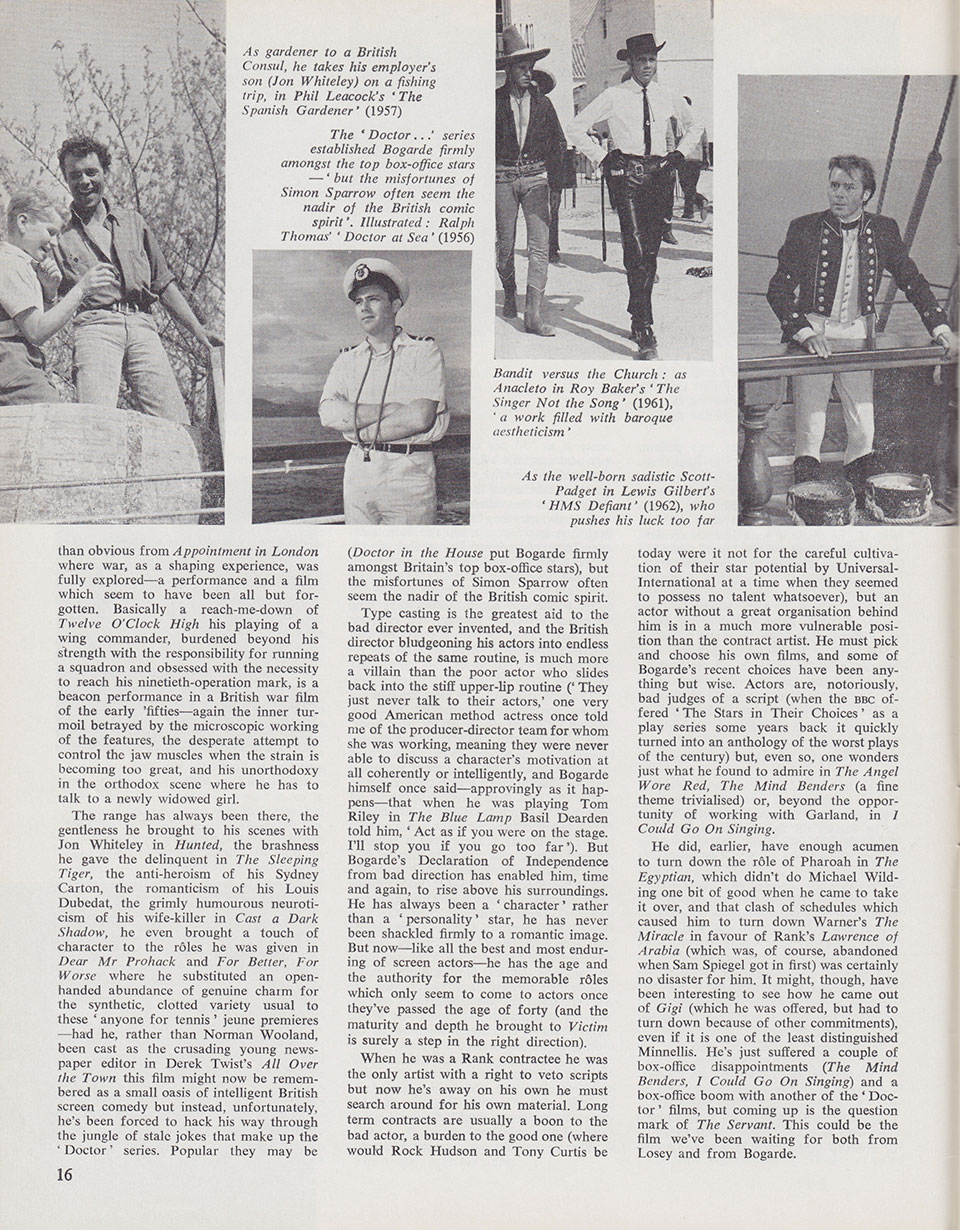
The ease with which he seems to differentiate his characters, switching from the romantic to the flamboyant to the sadistic or the neurotic, is due to the mobility with which he can use his features. The slight smile of almost sensual pleasure with which he watches Yoko Tani rearranging the flowers as he first glimpses her in The Wind Cannot Read is as indicative of the character of Michael Quinn as the cold half-smile of Scott-Padget in HMS Defiant is indicative of that character’s sadism. His body, too, is tensed and expressive, capable of conveying exact shades of meaning to his characterisations. Thus that very first shot of Scott-Padget held behind Bogarde’s solo credit at the opening of HMS Defiant betrays, in every line, the cold arrogance and aristocrat hauteur of the well-born sadist (‘Vicious streak and a silver spoon, and he has to land in my ship,’ as Guinness describes him). Later, with a chilling effect, he incorporates a trick of tightening the mouth before speaking into his performance, while his expression of perverted pleasure in witnessing a flogging is in no whit inferior to Robert Ryan’s superb Claggart in Billy Budd. But equally memorable is the quick shot of him, a supercilious half-smile flickering across his face, as he leans against a window to watch the arrival of a new priest in Quantana, a splendid prelude to the magniloquence, with its hints of diabolism, of his Mexican bandit in The Singer, Not the Song.
The British cinema doesn’t produce many oddballs and weirdies, but Mills and Bogarde fighting their duel in the sun certainly qualifies for some sort of remembrance; a work filled with baroque aestheticism (Anacleto, dressed in black and wearing black leather gloves, feeding a snow-white cat a saucer of milk; a group of riders on white horses appearing out of the blue-black night; even a drunken man’s crawl amongst the dustbins in search of a lost rosary resolves itself into a fascinating study in form and colour) and perverse poetry (the film is a lyrical evocation of a homosexual relationship, with some quite extraordinary dialogue – ‘Is it the song that is good, or the singer who makes it so?’ is followed by ‘While the singer’s good, the song is worthless’ and, as they die together in an astonishing death scene the like of which hasn’t been seen since Duel in the Sun Anacleto’s last words are ‘The singer, not the song’).
If it is difficult to think of another British actor who could have played Michael Quinn with so much truth, it is impossible to think of one who could have played Anacleto with so exactly the right degree of amorality. The younger Olivier, illuminating Heathcliff by flashes of lightening, might have done it although in a rather different style, for there is something Heathcliffian about Anacleto, just as the one film with a stylistic affinity to Roy Baker’s film is Buñuel’s strange Mexican essay into ‘Wuthering Heights’, Abismos de Pasion (which is, to my taste, much less successful than Baker’s film). Anacleto demands a tight-rope walking performance from the actor, one false step and he carries the whole film down into complete absurdity, for this character is the strength of the film (both John Mills and Mylene Demongeot are hitting a succession of false notes, but they are borne along on the strength of Bogarde’s performance).
‘He’s twenty eight years old, the illegitimate son of a peasant woman. His father was quite well educated. He’s always hated the church… he’s clever, he’s patient, and utterly unscrupulous; he likes cats, but not from kindness – he has no kindness in him… and he’s killed, first a man whose name began with with A, then a man who’s name began with B, then with C, he made it look like an accident but it was always murder,’ so the terrified little Father Gomez describes to his replacement, Father Keogh, the enigmatic bandit who is hounding him from the village. A few seconds later, Anacleto bursts in upon them, dramatic in black shirt and leather jeans, handling a riding-whip and a broad-brimmed black hat (symbolically Anacleto is always coming out of the dark into the light and, in most of their scenes together, he is in shadow while Father Keogh is in the full light).
Any actor who tries to play a character like that with a stiff upper lip isn’t going to get very far, but Bogarde brings to it what one might describe as a touch of visual rhetoric, of feline elegance, wearing his bizarrity like a turtle his carapace. Bogarde can do the vocal flourishes as well as he carries off the visual – during their death throes Anacleto whispers over Father Keogh the words, ‘O priest! O priest! Where is your God now?’ which he breathes movingly, almost like a prayer, and one remembers Scott-Padget jet of hatred on ‘You mutinous dogs’ just before the Defiant‘s seamen cut him down, and Franz Liszt’s furious ‘Seductive!’ cry to the Mannheim Orchestra (early in 1955 he had planned a modern-dress ‘Hamlet’ on the stage, but it fell through at the last moment, so we shall never know just what he would have given to this most demanding, and most rewarding, of all roles).
In a completely different style was his performance ‘… as a hero named Coward … whose true story out-thrills all fiction!’ – to quote the advertisements – in Andrew and Virginia Stone’s The Password is Courage, a performance (and a film) crammed with felicities, a quicksilver blending of comedy and drama – the Stone’s estimate it as ’55 per cent comedy and 45 per cent suspense’. Least studio-bound of film-makers (no trick work for the Stone’s, passionate believers in the ‘you are there’ approach in that when they want to show a train wreck they arrange with British Railways to wreck a train) the Stone’s demand a certain adaptability of their actors. Bogarde gave Coward a real sense of guts and initiative without a touch of the false heroics – it is this Cockney quality of quick-wittedness which makes that long sequence in which Coward, an escaping POW, gets mixed up with a group of German wounded and which ends on his receiving the Iron Cross, so completely hilarious.
The film, it is true, is a mere husk of the book, from which the kernel has been discarded. The whole point of the book. which has been carefully cut away by the scriptwriter (Andrew Stone himself) is summed up in a German court judgment of 1953, Wollheim v I G Farbenindustrie, that ‘the fact that a British prisoner of war had to show the German defendants what moral courage involved is a matter of regret to the Chamber as a German Court’. Using only the light-hearted first half of the book, skating merrily over the dark passages of the latter half dealing with Auschwitz and the horrifying rôle of the I G Farben chemical trust, the film lessens the stature of Charles Coward, and this is a pity. The Stone’s can, of course, counter with perfect truth, that they were not making a horror film (and both public and censor demand that horror films are far enough removed from reality not to stir the conscience, just as the rôle of the Krupp and I G Farben combines in the sociology of the damned will never be explored in a cinema of vested interests) but, instead of the picture of a man growing to full moral stature under the stresses and horrors of war we (and Bogarde, who has more than enough sensibility to do this) were given much less.
That he can shape a character was more than obvious from Appointment in London where war, as a shaping experience, was fully explored – a performance and a film which seem to have been all but forgotten. Basically a reach-me-down of Twelve O’Clock High his playing of a wing commander, burdened beyond his strength with the responsibility for running a squadron and obsessed with the necessity to reach his ninetieth-operation mark, is a beacon performance in a British war film of the early ‘fifties-again the inner turmoil betrayed by the microscopic working of the features, the desperate attempt to control the jaw muscles when the strain is becoming too great, and his unorthodoxy in the orthodox scene where he has to talk to a newly widowed girl.
The range has always been there, the gentleness he brought to his scenes with Jon Whiteley in Hunted, the brashness he gave the delinquent in The Sleeping Tiger, the anti-heroism of his Sydney Carton, the romanticism of his Louis Dubedat, the grimly humourous neuroticism of his wife-killer in Cast a Dark Shadow, he even brought a touch of character to the rôles he was given in Dear Mr Prohack and For Better, For Worse where he substituted an open-handed abundance of genuine charm for the synthetic, clotted variety usual to these ‘anyone for tennis’ jeune premieres – had he, rather than Norman Wooland, been cast as the crusading young newspaper editor in Derek Twist’s All Over the Town this film might now be remembered as a small oasis of intelligent British screen comedy but instead, unfortunately, he’s been forced to hack his way through the jungle of stale jokes that make up the ‘Doctor’ series. Popular they may be (Doctor in the House put Bogarde firmly amongst Britain’s top box-office stars), but the misfortunes of Simon Sparrow often seem the nadir of the British comic spirit.
Type casting is the greatest aid to the bad director ever invented, and the British director bludgeoning his actors into endless repeats of the same routine, is much more a villain than the poor actor who slides back into the stiff upper-lip routine (‘They just never talk to their actors,’ one very good American method actress once told me of the producer-director team for whom she was working, meaning they were never able to discuss a character’s motivation at all coherently or intelligently, and Bogarde himself once said – approvingly as it happens – that when he was playing Tom Riley in The Blue Lamp Basil Dearden told him, ‘Act as if you were on the stage. I’ll stop you if you go too far’). But Bogarde’s Declaration of Independence from bad direction has enabled him, time and again, to rise above his surroundings. He has always been a ‘character’ rather than a ‘personality’ star, he has never been shackled firmly to a romantic image. But now – like all the best and most enduring of screen actors – he has the age and the authority for the memorable roles which only seem to come to actors once they’ve passed the age of forty (and the maturity and depth he brought to Victim is surely a step in the right direction).
When he was a Rank contractee he was the only artist with a right to veto scripts but now he’s away on his own he must search around for his own material. Long term contracts are usually a boon to the bad actor, a burden to the good one (where would Rock Hudson and Tony Curtis be today were it not for the careful cultivation of their star potential by Universal International at a time when they seemed to possess no talent whatsoever), but an actor without a great organisation behind him is in a much more vulnerable position than the contract artist. He must pick and choose his own films, and some of Bogarde’s recent choices have been anything but wise. Actors are, notoriously, bad judges of a script (when the BBC offered ‘The Stars in Their Choices’ as a play series some years back it quickly turned into an anthology of the worst plays of the century) but, even so, one wonders just what he found to admire in The Angel Wore Red, The Mind Benders (a fine theme trivialised) or, beyond the opportunity of working with Garland, in I Could Go On Singing.
He did, earlier, have enough acumen to turn down the role of Pharoah in The Egyptian, which didn’t do Michael Wilding one bit of good when he came to take it over, and that clash of schedules which caused him to turn down Warner’s The Miracle in favour of Rank’s Lawrence of Arabia (which was, of course, abandoned when Sam Spiegel got in first) was certainly no disaster for him. It might, though, have been interesting to see how he came out of Gigi (which he was offered, but had to turn down because of other commitments), even if it is one of the least distinguished Minnellis. He’s just suffered a couple of box-office disappointments (The Mind Benders, I Could Go On Singing) and a box-office boom with another of the ‘Doctor’ films, but coming up is the question mark of The Servant. This could be the film we’ve been waiting for both from Losey and from Bogarde.
Producer Dirk
Dirk Bogarde, who is the subject of a detailed critical review of this month’s issue, is to produce his first film. He has set up his own production company, Bendrose Film Productions, and picked a subject with a compelling title, Awake in Fright, as his first venture. Joseph Losey, who directed him in The Servant, is expected to direct the film, which will be made later this year in Australia.

