Photoplay – Nov 1969

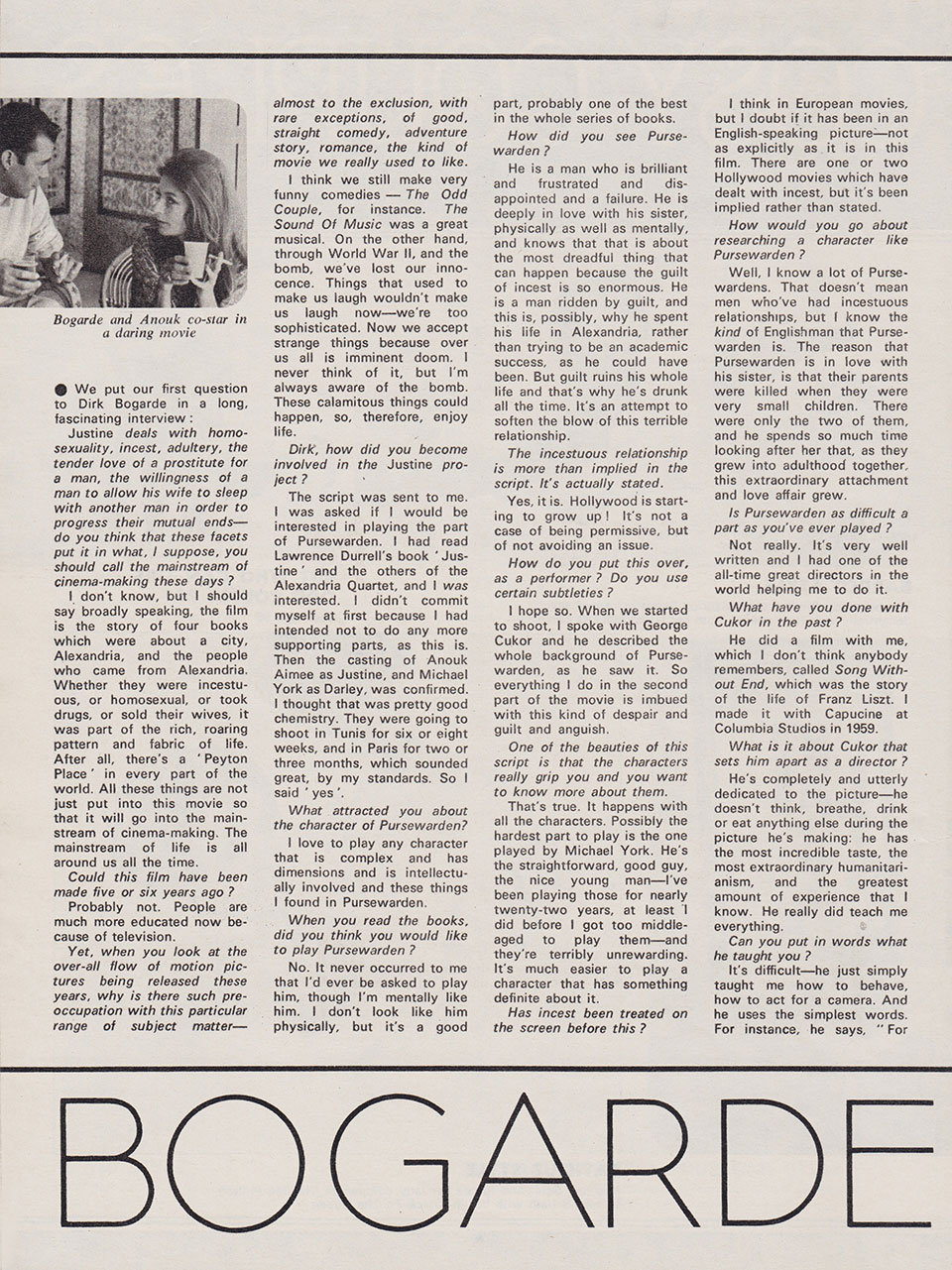
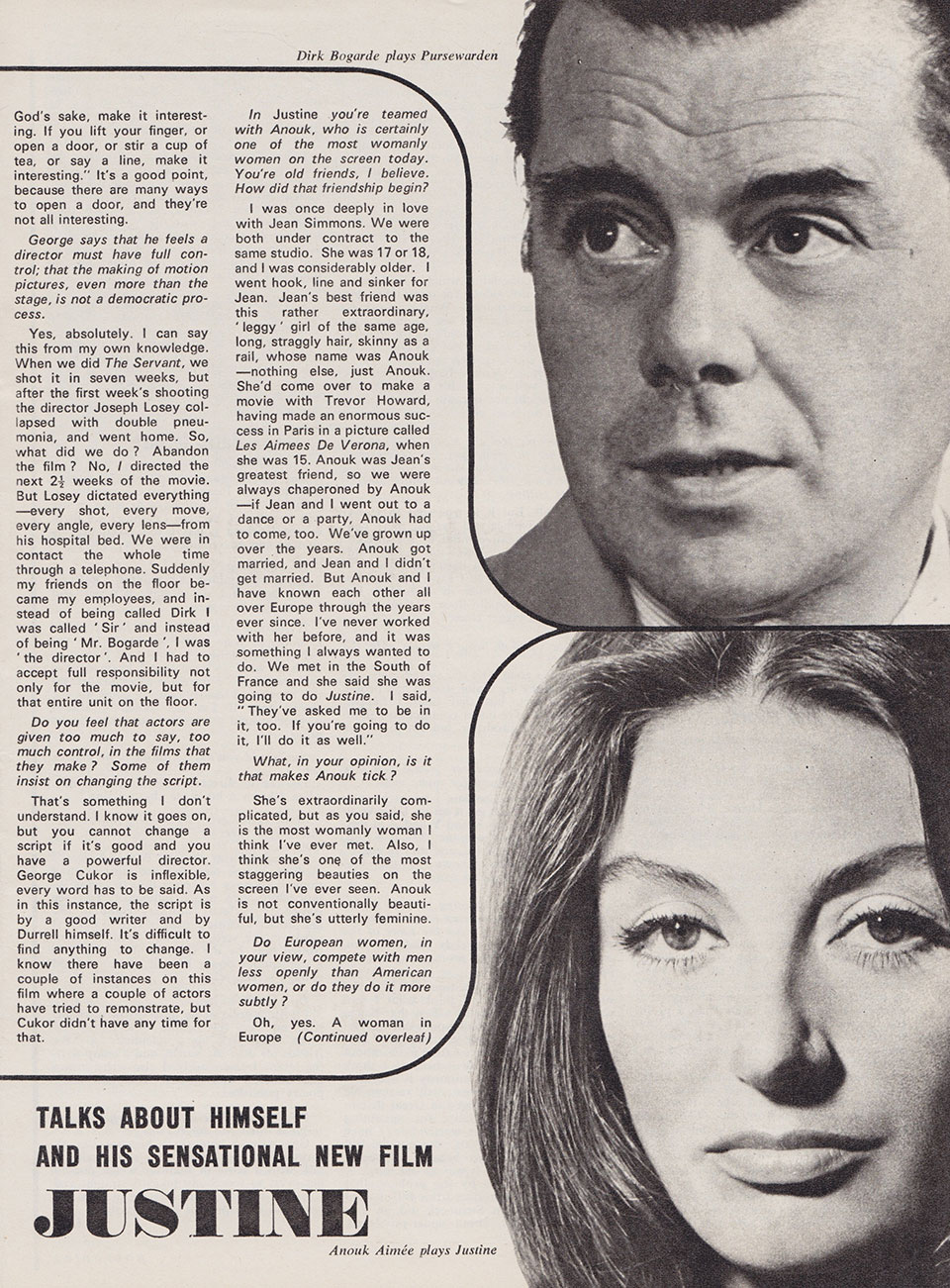
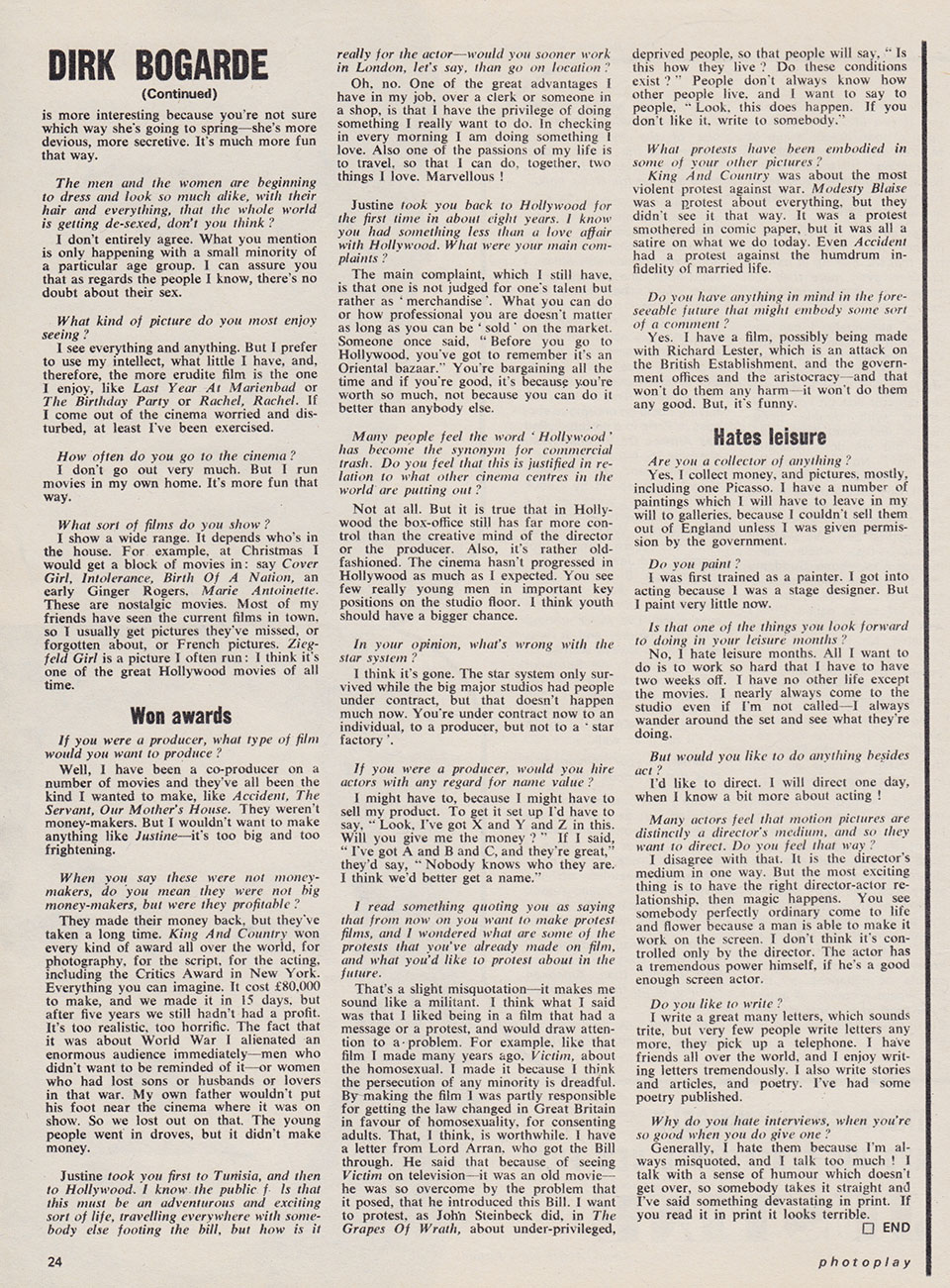
Bogarde talks about himself and his sensational new film JUSTINE
We put our first question to Dirk Bogarde in a long, fascinating interview;
Justine deals with homosexuality, incest, adultery, the tender love of a prostitute for a man, the willingness of a man to allow his wife to sleep with another man in order to progress their mutual ends, do you think that these facets put it in what, I suppose, you should call the mainstream of cinema-making these days?
I don’t know, but I should say broadly speaking, the film is the story of four books which were about a city, Alexandria, and the people who came from Alexandria. Whether they were incestuous, or homosexual, or took drugs, or sold their wives, it was part of the rich, roaring pattern and fabric of life. After all, there’s a ‘Peyton Place‘ in every part of the world. All these things are not just put into this movie so that it will go into the mainstream of cinema-making. The mainstream of life is all around us all the time.
Could this film have been made five or six years ago?
Probably not. People are much more educated now because of television. Yet, when you look at the over-all flow of motion pictures being released these years, why is there such preoccupation with this particular range of subject matter almost to the exclusion, with rare exceptions, of good, straight comedy, adventure story, romance, the kind of movie we really used to like. I think we still make very funny comedies – The Odd Couple, for instance. The Sound Of Music was a great musical. On the other hand, through World War II, and the bomb, we’ve lost our innocence. Things that used to make us laugh wouldn’t make us laugh now – we’re too sophisticated. Now we accept strange things because over us all is imminent doom. I never think of it, but I’m always aware of the bomb. These calamitous things could happen, so, therefore, enjoy life.
Dirk, how did you become involved in the Justine project?
The script was sent to me. I was asked if I would be interested in playing the part of Pursewarden. I had read Lawrence Durrell’s book ‘Justine ‘ and the others of the Alexandria Quartet, and I was interested. I didn’t commit myself at first because I had intended not to do any more supporting parts, as this is. Then the casting of Anouk Aimee as Justine, and Michael York as Darley, was confirmed. I thought that was pretty good chemistry. They were going to shoot in Tunis for six or eight weeks, and in Paris for two or three months, which sounded great, by my standards. So I said ‘yes’.
What attracted you about the character of Pursewarden?
I love to play any character that is complex and has dimensions and is intellectually involved and these things I found in Pursewarden.
When you read the books, did you think you would like to play Pursewarden?
No. It never occurred to me that I’d ever be asked to play him, though I’m mentally like him. I don’t look like him physically, but it’s a good part, probably one of the best in the whole series of books.
How did you see Pursewarden?
He is a man who is brilliant and frustrated and disappointed and a failure. He is deeply in love with his sister, physically as well as mentally, and knows that that is about the most dreadful thing that can happen because the guilt of incest is so enormous. He is a man ridden by guilt, and this is, possibly, why he spent his life in Alexandria, rather than trying to be an academic success, as he could have been. But guilt ruins his whole life and that’s why he’s drunk all the time. It’s an attempt to soften the blow of this terrible relationship.
The incestuous relationship is more than implied in the script. It’s actually stated.
Yes, it is. Hollywood is starting to grow up ! It’s not a case of being permissive, but of not avoiding an issue.
How do you put this over, as a performer? Do you use certain subtleties?
I hope so. When we started to shoot, I spoke with George Cukor and he described the whole background of Pursewarden, as he saw it. So everything I do in the second part of the movie is imbued with this kind of despair and guilt and anguish.
One of the beauties of this script is that the characters really grip you and you want to know more about them.
That’s true. It happens with all the characters. Possibly the hardest part to play is the one played by Michael York. He’s the straightforward, good guy, the nice young man – I’ve been playing those for nearly twenty-two years, at least I did before I got too middle-aged to play them – and they’re terribly unrewarding. It’s much easier to play a character that has something definite about it.
Has incest been treated on the screen before this?
I think in European movies, but I doubt if it has been in an English-speaking picture; not as explicitly as it is in this film. There are one or two Hollywood movies which have dealt with incest, but it’s been implied rather than stated.
How would you go about researching a character like Pursewarden?
Well, I know a lot of Pursewardens. That doesn’t mean men who’ve had incestuous relationships, but I know the kind of Englishman that Pursewarden is. The reason that Pursewarden is in love with his sister, is that their parents were killed when they were very small children. There were only the two of them, and he spends so much time looking after her that, as they grew into adulthood together, this extraordinary attachment and love affair grew.
Is Pursewarden as difficult a part as you’ve ever played?
Not really. It’s very well written and I had one of the all-time great directors in the world helping me to do it.
What have you done with Cukor in the past?
He did a film with me, which I don’t think anybody remembers, called Song Without End, which was the story of the life of Franz Liszt. I made it with Capucine at Columbia Studios in 1959.
What is it about Cukor that sets him apart as a director?
He’s completely and utterly dedicated to the picture – he doesn’t think, breathe, drink or eat anything else during the picture he’s making: he has the most incredible taste, the most extraordinary humanitarianism, and the greatest amount of experience that I know. He really did teach me everything.
Can you put in words what he taught you?
It’s difficult – he just simply taught me how to behave, how to act for a camera. And he uses the simplest words. For instance, he says, ” For God’s sake, make it interesting. If you lift your finger, or open a door, or stir a cup of tea, or say a line, make it interesting.” It’s a good point, because there are many ways to open a door, and they’re not all interesting.
George says that he feels a director must have full control; that the making of motion pictures, even more than the stage, is not a democratic process.
Yes, absolutely. I can say this from my own knowledge. When we did The Servant, we shot it in seven weeks, but after the first week’s shooting the director Joseph Losey collapsed with double pneumonia, and went home. So, what did we do? Abandon the film? No, I directed the next two weeks of the movie. But Losey dictated everything – every shot, every move, every angle, every lens – from his hospital bed. We were in contact the whole time through a telephone. Suddenly my friends on the floor became my employees, and instead of being called Dirk I was called ‘Sir, and instead of being ‘Mr. Bogarde I was ‘the director’. And I had to accept full responsibility not only for the movie, but for that entire unit on the floor.
Do you feel that actors are given too much to say, too much control, in the films that they make? Some of them insist on changing the script.
That’s something I don’t understand. I know it goes on, but you cannot change a script if it’s good and you have a powerful director. George Cukor is inflexible, every word has to be said. As in this instance, the script is by a good writer and by Durrell himself. It’s difficult to find anything to change. I know there have been a couple of instances on this film where a couple of actors have tried to remonstrate, but Cukor didn’t have any time for that.
In Justine you’re teamed with Anouk, who is certainly one of the most womanly women on the screen today. You’re old friends, I believe. How did that friendship begin?
I was once deeply in love with Jean Simmons. We were both under contract to the same studio. She was 17 or 18, and I was considerably older. I went hook, line and sinker for Jean. Jean’s best friend was this rather extraordinary, ‘leggy’ girl of the same age, long, straggly hair, skinny as a rail, whose name was Anouk – nothing else, just Anouk. She’d come over to make a movie with Trevor Howard, having made an enormous success in Paris in a picture called Les Aimees De Verona, when she was 15. Anouk was Jean’s greatest friend, so we were always chaperoned by Anouk – if Jean and I went out to a dance or a party, Anouk had to come, too. We’ve grown up over the years. Anouk got married, and Jean and I didn’t get married. But Anouk and I have known each other all over Europe through the years ever since. I’ve never worked with her before, and it was something I always wanted to do. We met in the South of France and she said she was going to do Justine. I said, “They’ve asked me to be in it, too. If you’re going to do it, I’ll do it as well.”
What, in your opinion, is it that makes Anouk tick?
She’s extraordinarily complicated, but as you said, she is the most womanly woman I think I’ve ever met. Also, I think she’s one of the most staggering beauties on the screen I’ve ever seen. Anouk is not conventionally beautiful, but she’s utterly feminine.
Do European women, in your view, compete with men less openly than American women, or do they do it more subtly?
Oh, yes. A woman in Europe is more interesting because you’re not sure which way she’s going to spring – she’s more devious, more secretive. It’s much more fun that way.
The men and the women are beginning to dress and look so much alike, with their hair and everything, that the whole world is getting de-sexed, don’t you think?
I don’t entirely agree. What you mention is only happening with a small minority of a particular age group. I can assure you that as regards the people I know, there’s no doubt about their sex.
What kind of picture do you most enjoy seeing?
I see everything and anything. But I prefer to use my intellect, what little I have, and, therefore, the more erudite film is the one I enjoy, like Last Year At Marienbad or The Birthday Party or Rachel, Rachel. If I come out of the cinema worried and disturbed, at least I’ve been exercised.
How often do you go to the cinema?
I don’t go out very much. But I run movies in my own home. It’s more fun that way.
What sort of films do you show?
I show a wide range. It depends who’s in the house. For example, at Christmas I would get a block of movies in: say Cover Girl, Intolerance, Birth Of A Nation, an early Ginger Rogers. Marie Antoinette. These are nostalgic movies. Most of my friends have seen the current films in town so I usually get pictures they’ve missed, or forgotten about, or French pictures. Ziegfeld Girl is a picture I often run: I think it’s one of the great Hollywood movies of all time.
Won awards
If you were a producer, what type of film would you want to produce?
Well, I have been a co-producer on a number of movies, and they’ve all been the kind I wanted to make, like Accident, The Servant, Our Mother’s House. They weren’t money-makers. But I wouldn’t want to make anything like Justine – it’s too big and too frightening.
When you say these were not moneymakers, do you mean they were not big money-makers, but were they profitable?
They made their money back, but they’ve taken a long time. King And Country won every kind of award all over the world, for photography, for the script, for the acting, including the Critics Award in New York. Everything you can imagine. It cost £80.000 to make, and we made it in 15 days, but after five years we still hadn’t had a profit. It’s too realistic, too horrific. The fact that it was about World War I alienated an enormous audience immediately – men who didn’t want to be reminded of it – or women who had lost sons or husbands or lovers in that war. My own father wouldn’t put his foot near the cinema where it was on show. So we lost out on that. The young people went in droves, but it didn’t make money.
Justine took you first to Tunisia, and then to Hollywood … I know the public thinks that this must be an adventurous and exciting sort of life, travelling everywhere with somebody else footing the bill, but how is it really for the actor – would you sooner work in London, let’s say, than go on location?
Oh, no. One of the great advantages I have in my job, over a clerk or someone in a shop, is that I have the privilege of doing something I really want to do. In checking in every morning I am doing something I love. Also one of the passions of my life is to travel, so that I can do, together, two things I love. Marvellous!
Justine took you back to Hollywood for the first time in about eight years. I know you had something less than a love affair with Hollywood. What were your main complaints?
The main complaint, which I still have, is that one is not judged for one’s talent but rather as ‘merchandise. What you can do or how professional you are doesn’t matter as long as you can be ‘sold’ on the market. Someone once said, “Before you go to Hollywood, you’ve got to remember it’s an Oriental bazaar.” You’re bargaining all the time and if you’re good, it’s because you’re worth so much, not because you can do it better than anybody else.
Many people feel the word ‘Hollywood’ has become the synonym for commercial trash. Do you feel that this is justified in relation to what other cinema centres in the world are pumping out!
Not at all. But it is true that in Hollywood the box-office still has far more control than the creative mind of the director or the producer. Also, it’s rather old fashioned. The cinema hasn’t progressed in Hollywood as much as I expected. You see few really young men in important key positions on the studio floor. I think youth should have a bigger chance.
In your opinion, what’s wrong with the star system?
I think, it’s gone. The star system only survived while the big major studios had people under contract, but that doesn’t happen much now. You’re under contract now to an individual, to a producer, but not to a ‘star factory’.
If you were a producer, would you hire actors with any regard for name value?
I might have to, because I might have to sell my product. To get it set up I’d have to say, … “Look, I’ve got X and Y and Z in this. Will you give me the money?” If I said, “I’ve got A and Band C, and they’re great,” they’d say, nobody knows who they are. I think we’d better get a name.”
I read something quoting you as saying that from now on you want to make protest films, and I wondered what are some of the protests that you’ve already made on film, and what you’d like to protest about in the future?
That’s a slight misquotation – it makes me sound like a militant. I think what I said was that I liked being in a film that had a message or a protest, and would draw attention to a problem. For example, like that film I made many years ago, Victim, about the homosexual. I made it because I think the persecution of any minority is dreadful. By making the film I was partly responsible for getting the law changed in Great Britain in favour of homosexuality, for consenting adults. That, I think, is worthwhile. I have a letter from Lord Arran, who got the Bill through. He said that because of seeing Victim on television – it was an old movie – he was so overcome by the problem that it posed, that he introduced this Bill. I want to protest, as John Steinbeck did, in The Grapes Of Wrath, about under-privileged, deprived people, so that people will say, “Is this how they live? Do these conditions exist?” People don’t always know how other people live, and I want to say to people, .. Look, this does happen. If you don’t like it, write to somebody.”
What protests have been embodied in some of your other pictures?
King And Country was about the most violent protest against war. Modesty Blaise was a protest about everything, but they didn’t see it that way. It was a protest smothered in comic paper, but it was all a satire on what we do today. Even Accident had a protest against the humdrum infidelity of married life.
Do you have anything in mind in the foreseeable future that might embody some sort of a comment?
Yes I have a film, possibly being made with Richard Lester, which is an attack on the British Establishment, and the government offices and the aristocracy and that won’t do them any harm – it won’t do them any good. But, it’s funny.
Hates leisure
Are you a collector of anything?
Yes, I collect money, and pictures, mostly, including one Picasso. I have a number of paintings which I will have to leave in my will to galleries, because I couldn’t sell them out of England unless I was given permission by the government.
Do you paint?
I was first trained as a painter. I got into acting because I was a stage designer. But I paint very little now.
Is that one of the things you look forward to doing in your leisure months.
No, I hate leisure months. All I want to do is to work so hard that I have to have two weeks off. I have no other life except the movies. I nearly always come to the studio even if I’m not called – I always wander around the set and see what they’re doing.
But would you like to do anything besides act?
I’d like to direct. I will direct one day, when I know a bit more about acting! Many actors feel that motion pictures are distinctly a directors medium, and so they are reluctant to direct.
Do you feel that way?
I disagree with that. It is the director’s medium in one way. But the most exciting thing is to have the right director-actor relationship, then magic happens. You see somebody perfectly ordinary come to life and flowers because a man is able to make it work on the screen. I don’t think it’s controlled only by the director. The actor has a tremendous power himself, if he’s a good enough screen actor.
Do you like to write?
I write a great many letters, which sounds trite, but very few people write letters any more, they pick up a telephone. I have friends all over the world, and I enjoy writing letters tremendously. I also write stories and articles, and poetry. I’ve had some poetry published.
Why do you hate interviews, when you’re so good when you do give one?
Generally, I hate them because I’m always misquoted, and I talk too much! I talk with a sense of humour which doesn’t get over, so somebody takes it straight and I’ve said something devastating in print. If you read it in print it looks terrible.
THE END

