Picture Show – Feb 24th 1951

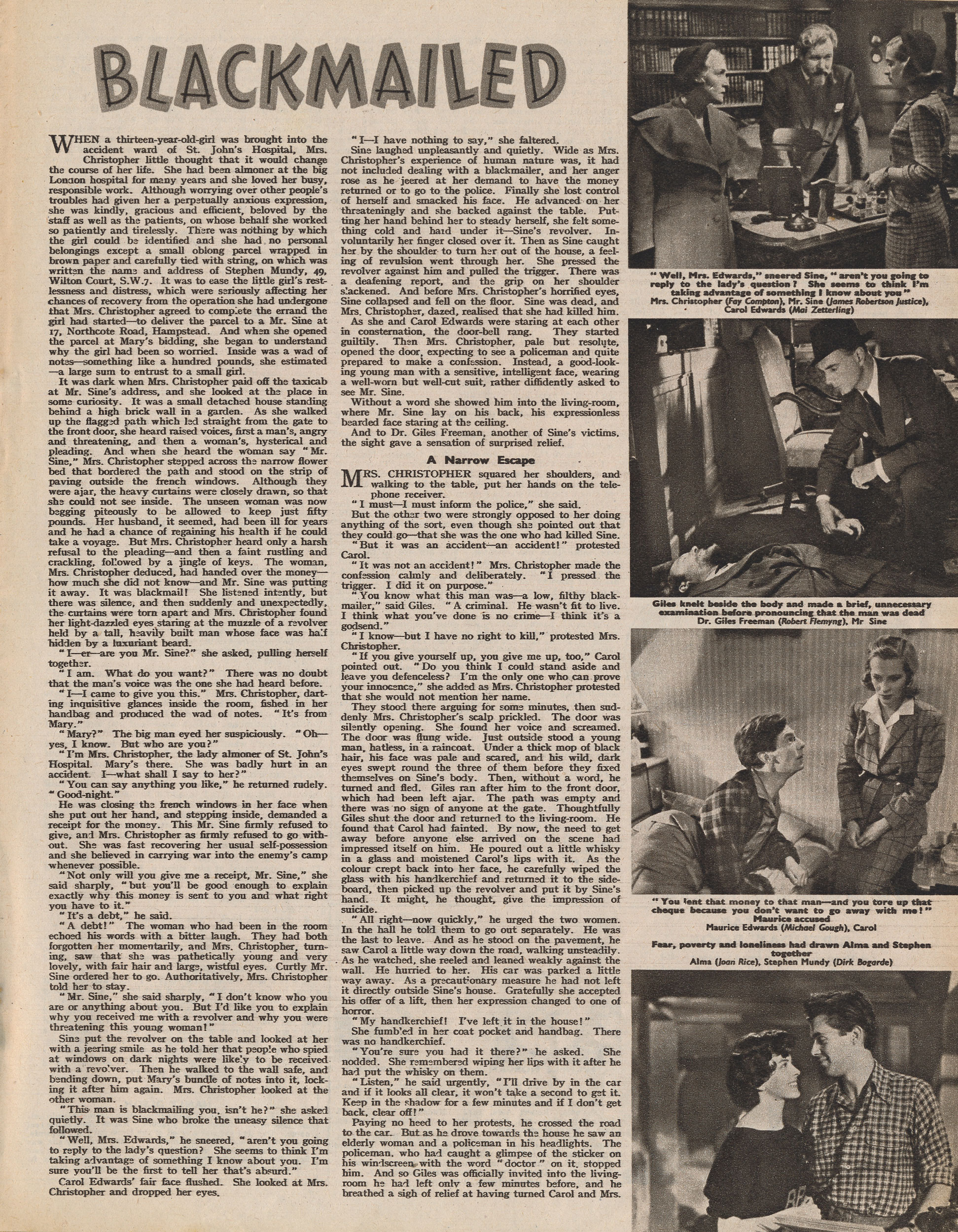
Blackmailed
When a thirteen-year-old-girl was brought into the accident ward of St. John’s Hospital. Mrs. Christopher little thought that it would change the course of her life. She had been almoner at the big London hospital for many years and she loved her busy, responsible work. Although worrying over other people’s troubles had given her a perpetually anxious expression, she was kindly, gracious and efficient, beloved by the staff as well as the patients, on whose behalf she worked so patiently and tirelessly. There was nothing by which the girl could be identified and she had no personal belongings except a small oblong parcel wrapped in brown paper and carefully tied with string, on which was written the name and address of Stephen Mundy, 49. Wilton Court, S.W.7. It was to ease the little girl’s restlessness and distress, which were seriously affecting her chances of recovery from the operation she had undergone that Mrs. Christopher agreed to complete the errand the girl had started – to deliver the parcel to a Mr. Sine at 17, Northcote Road, Hampstead. And when she opened the parcel at Mary’s bidding, she began to understand why the girl bad been so worried. Inside was a wad of notes – something like a hundred pounds, she estimated – a large sum to entrust to a small girl.
It was dark when Mrs. Christopher paid off the taxicab at Mr. Sine’s address, and she looked at the place in some curiosity. It was a small detached house “standing behind a high brick wall in a garden. As she walked up the flagged path which led straight from the gate to the front door, she heard raised voices, first a man’s, angry and threatening, and then a woman’s, hysterical and pleading. And when she heard the woman say “Mr. Sine.” Mrs. Christopher stepped across the narrow flower bed that bordered the path and stood on the strip of paving outside the french windows. Although they were ajar, the heavy curtains were closely drawn, so that she could not see inside. The unseen woman was now begging piteously to be allowed to keep just fifty pounds. Her husband, it seemed, had been ill for years and he had a chance of regaining his health if he could take a voyage. But Mrs. Christopher heard only a harsh refusal to the pleading – and then a faint rustling and crackling, followed by a jingle of keys. The woman, Mrs. Christopher deduced, had handed over the money – how much she did not know – and Mr. Sine was putting it away. It was blackmail! She listened intently, but there was silence, and then suddenly and unexpectedly, the curtains were torn apart and Mrs. Christopher found her light-dazzled eyes staring at the muzzle of a revolver held by a tall, heavily built man whose face was half hidden by a luxuriant beard.
“I-er-are you Mr. Sine?” she asked, pulling herself together.
“I am. What do you want?” There was no doubt that the man’s voice was the one she had heard before.
“I-I came to give you this.” Mrs. Christopher, darting inquisitive glances inside the room, fished in her handbag and produced the wad of notes. “It’s from Mary.”
“Mary?” The big man eyed her suspiciously. “Oh – yes, I know. But who are you?”
“I’m Mrs. Christopher, the lady almoner of St. John’s Hospital. Mary’s there. She was badly hurt in an accident. I – what shall I say to her?”
“You can say anything you like,” he returned rudely. “Good-night.”
He was closing the french windows in her face when she put out her hand, and stepping inside, demanded a receipt for the money. This Mr. Sine firmly refused to give, and Mrs. Christopher as firmly refused to go without. She was fast recovering her usual self-possession and she believed in carrying war into the enemy’s camp whenever possible.
“Not only will you give me a receipt, Mr. Sine,” she said sharply, “but you’ll be good enough to explain exactly why this money is sent to you and what right you have to it.”
“It’s a debt,” he said.
“A debt!” The woman who had been in the room echoed his words with a bitter laugh. They had both forgotten her momentarily, and Mrs. Christopher, turning, saw that she was pathetically young and very lovely, with fair hair and large, wistful eyes. Curtly Mr. Sine ordered her to go. Authoritatively, Mrs. Christopher told her to stay.
“Mr. Sine,” she said sharply, “I don’t know who you are or anything about you. But I’d like you to explain why you received me with a revolver and why you were threatening this young woman!”
Sine put the revolver on the table and looked at her with a jeering smile as he told her that people who spied at windows on dark nights were likely to be received with a revolver. Then he walked to the wall safe, and bending down, put Mary’s bundle of notes into it, locking it after him again. Mrs. Christopher looked at the other woman.
“This man is blackmailing you, isn’t he?” she asked quietly. It was Sine who broke the uneasy silence that followed.
“Well, Mrs. Edwards,” he sneered, “aren’t you going to reply to the lady’s question? She seems to think I’m taking advantage of something I know about you. I’m sure you’ll be the first to tell her that’s absurd.”
Carol Edwards’ fair face flushed. She looked at Mrs. Christopher and dropped her eyes.
“I-I have nothing to say,” she faltered.
Sine laughed unpleasantly and quietly. Wide as Mrs. Christopher’s experience of human nature was, it had not included dealing with a blackmailer, and her anger rose as he “jeered at her demand to have the money returned or to go to the police. Finally she lost control of herself and smacked his face. He advanced on her threateningly and she backed against the table. Putting her hand behind her to steady herself, she felt something cold and hard under it – Sine’s revolver. Involuntarily her finger closed over it. Then as Sine caught her by the shoulder to turn her out of the house, a feeling of revulsion went through her. She pressed the revolver against him and pulled the trigger. There was a deafening report, and the grip on her shoulder slackened. And before Mrs. Christopher’s horrified eyes, Sine collapsed and fell on the floor. Sine was dead. and Mrs. Christopher, dazed, realised that she had killed him.
As she and Carol Edwards were staring at each other in consternation, the door-bell rang. They started guiltily. Then Mrs. Christopher, pale but resolute, opened the door, expecting to see a policeman and quite prepared to make a confession. Instead, a good-looking young man with a sensitive, intelligent face, wearing a well-worn but well-cut suit, rather diffidently asked to see Mr. Sine.
Without a word she showed him into the living-room. where Mr. Sine lay on his back, his expressionless bearded face staring at the ceiling.
And to Dr. Giles Freeman, another of Sine’s victims, the sight gave a sensation of surprised relief.
A Narrow Escape
Mrs. Christopher squared her shoulders, and walking to the table, put her hands on the telephone receiver.
“I must – I must inform the police,” she said.
But the other two were strongly opposed to her doing anything of the sort, even though she pointed out that they could go – that she was the one who had killed Sine.
“But it was an accident – an accident!” protested Carol.
“It was not an accident!” Mrs. Christopher made the confession calmly and deliberately. “I pressed the trigger. I did it on purpose.”
“You know what this man was – a low, filthy blackmailer.” said Giles. “A criminal. He wasn’t fit to live. I think what you’ve done is no crime – I think it’s a godsend.”
“I know – but I have no right to kill,” protested Mrs. Christopher.
“If you give yourself up, you give me up, too,” Carol pointed out. “Do you think I could stand aside and leave you defenceless? I’m the only one who can prove your innocence,” she added as Mrs. Christopher protested that she would not mention her name.
They stood there arguing for some minutes, then suddenly Mrs. Christopher’s scalp prickled. The door was silently opening. She found her voice and screamed. The door was flung wide. Just outside stood a young man, hatless, in a raincoat. Under a thick mop of black hair, his face was pale and scared, and his wild, dark eyes swept round the three of them before they fixed themselves on Sine’s body. Then, without a word, he turned and fled. Giles ran after him to the front door, which had been left ajar. The path was empty and there was no sign of anyone at the gate. Thoughtfully Giles shut the door and returned to the living-room. He found that Carol had fainted. By now, the need to get away before anyone else arrived on the scene had impressed itself on him. He poured out a little whisky in a glass and moistened Carol’s lips with it. As the colour crept back into her face, be carefully wiped the glass with his handkerchief and returned it to the sideboard, then picked up the revolver and put it by Sine’s hand. It might, he thought, give the impression of suicide.
“All right – now quickly,” he urged the two women. In the hall he told them to go out separately. He was the last to leave. And as he stood on the pavement, he saw Carol a little way down the road, walking unsteadily. As he watched, she reeled and leaned weakly against the wall. He hurried to her. His car was parked a little way away. As a precautionary measure he had not left it directly outside Sine’s house. Gratefully she accepted his offer of a lift, then her expression changed to one of horror.
“My handkerchief! I’ve left it in the house!”
She fumbled in her coat pocket and handbag. There was no handkerchief.
“You’re sure you had it there?” he asked. She nodded. She remembered wiping her lips with it after he had put the whisky on them.
“Listen he said urgently, “I’ll drive by in the car and if it looks all clear, it won’t take a second to get it. Keep in the shadow for a few minutes and if I don’t get back, clear off!”
Paying no heed to her protests, he crossed the road to the car. But as he drove towards the house he saw an elderly woman and a policeman in his headlights. The policeman, who had caught a glimpse of the sticker on his windscreen with the word “doctor” on it, stopped him. And so Giles was officially invited into the living-room he had left only a few minutes before, and he breathed a sigh of relief at having turned Carol and Mrs Christopher out in such a hurry, for in the short interval since then, Sine’s housekeeper had returned and found the body.
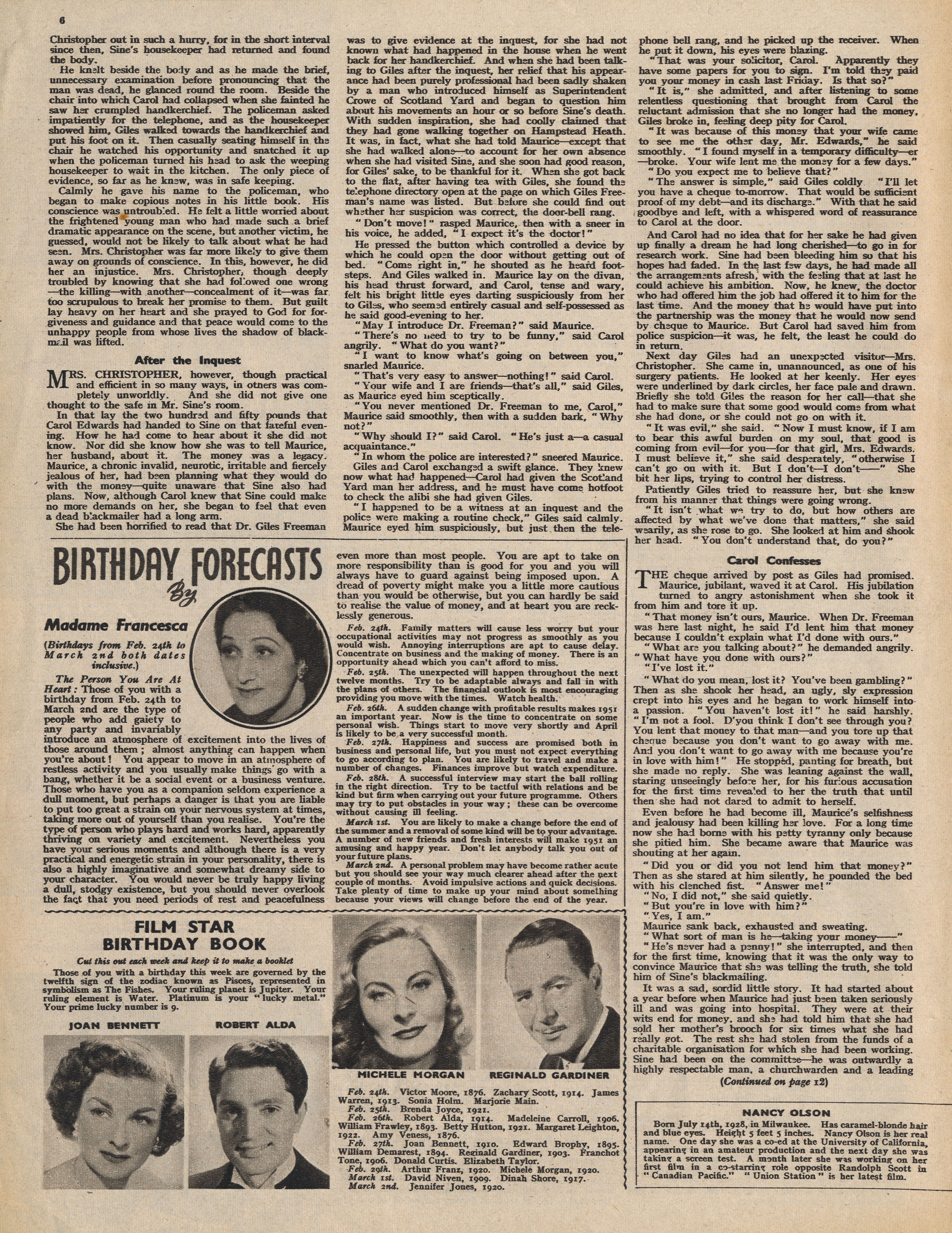
He knelt beside the body and as he made the brief, unnecessary examination before pronouncing that the man was dead, he glanced round the room. Beside the chair into which Carol had collapsed when she fainted he saw her crumpled handkerchief. The policeman asked impatiently for the telephone, and as the housekeeper showed him, Giles walked towards the handkerchief and put his foot on it. Then casually seating himself in the chair he watched his opportunity and snatched it up when the policeman turned his head to ask the weeping housekeeper to wait in the kitchen. The only piece of evidence, so far as he knew, was in safe keeping.
Calmly he gave his name to the policeman, who began to make copious notes in his little book. His conscience was untroubled. He felt a little worried about the frightened young man who had made such a brief dramatic appearance on the scene, but another victim, he guessed, would not be likely to talk about what be had seen. Mrs. Christopher was far more likely to give them away on grounds of conscience. In this, however, he did her an injustice. Mrs. Christopher; though deeply troubled by knowing that she had followed one wrong – the killing – with another – concealment of it – was far too scrupulous to break her promise to them. But guilt lay heavy on her heart and she prayed to God for forgiveness and guidance and that peace would come to the unhappy people from whose lives the shadow of blackmail was lifted.
After the Inquest
Mrs. Christopher, however, though practical and efficient in so many ways, in others was completely unworldly. And she did not give one thought to the safe in Mr. Sine’s room.
In that lay the two hundred and fifty pounds that Carol Edwards had handed to Sine on that fateful evening. How he had come to hear about it she did not know. Nor did she know how she was to tell Maurice, her husband, about it. The money was a legacy. Maurice, a chronic invalid, neurotic, irritable and fiercely jealous of her, had been planning what they would do with the money – quite unaware that Sine also had plans. Now, although Carol knew that Sine could make no more demands on her, she began to feel that even a dead blackmailer had a long arm.
She had been horrified to read that Dr. Giles Freeman was to give evidence at the inquest, for she had not known what had happened in the house when he went back for her handkerchief. And when she had been talking to Giles after the inquest, her relief that his appearance bad been purely professional had been sadly shaken by a man who introduced himself as Superintendent Crowe of Scotland Yard and began to question him about his movements an hour or so before Sine’s death. With sudden inspiration, she had coolly claimed that they had gone walking together on Hampstead Heath. It was, in fact, what she had told Maurice – except that she had walked alone – to account for her own absence when she had visited Sine, and she soon had good reason, for Giles’ sake, to be thankful for it. When she got back to the flat, after having tea with Giles, she found the telephone directory open at the page on which Giles Freeman’s name was listed. But before she could find out whether her suspicion was correct, the door-bell rang.
“Don’t move!” rasped Maurice, then with a sneer in his voice, he added, “I expect it’s the doctor!”
He pressed the button which controlled a device by which he could open the door without getting out of bed. “Come right in,” he shouted as he heard footsteps. And Giles walked in. Maurice lay on the divan, his head thrust forward, and Carol, tense and wary, felt his bright little eyes darting suspiciously from her to Giles, who seemed entirely casual and as he said good-evening to her.
“May I introduce Dr. Freeman?” said Maurice.
“There’s no need to try to be funny,” said Carol angrily. “What do you want?”
“I want to know what’s going on between you,” snarled Maurice.
“That’s very easy to answer – nothing!” said Carol.
“Your wife and I are friends – that’s all,” said Giles, as Maurice eyed him sceptically.
“You never mentioned Dr. Freeman to me, Carol,” Maurice said smoothly, then with a sudden bark, “Why not?”
“Why should I?” said Carol. “He’s just a – a casual acquaintance.”
“In whom the police are interested?” sneered Maurice.
Giles and Carol exchanged a swift glance. They knew now what had happened – Carol had given the Scotland Yard man her address, and he must have come hotfoot to check the alibi she had given Giles.
“I happened to be a witness at an inquest and the police were making a routine check,” Giles said calmly. Maurice eyed him suspiciously, but just then the telephone bell rang, and he picked up the receiver. When he put it down, his eyes were blazing.
“That was your solicitor, Carol. Apparently they have some papers for you to sign. I’m told they paid you your money in cash last Friday. Is that so?”
“It is,” she admitted, and after listening to some relentless questioning that brought from Carol the reluctant admission that she no longer had the money, Giles broke in, feeling deep pity for Carol.
“It was because of this money that your wife came to see me the other day, Mr. Edwards,” he said smoothly. “I found myself in a temporary difficulty-er-broke. Your wife lent me the money for a few days.”
“Do you expect me to believe that?”
“The answer is simple,” said Giles coldly. “I’ll let you have a cheque tomorrow. That would be sufficient proof of my debt – and its discharge.” With that he said goodbye and left, with a whispered word of reassurance to Carol at the door.
And Carol had no idea that for her sake he had given up finally a dream he had long cherished – to go in for research work. Sine had been bleeding him so that his hopes had faded. In the last few days, he had made all the arrangements afresh, with the feeling that at last he could achieve his ambition. Now, he knew, the doctor who had offered him the job had offered it to him for the last time. And the money that he would have put into the partnership was the money that he would now send by cheque to Maurice. But Carol had saved him from police suspicion – it was, he felt, the least he could do in return.
Next day Giles had an unexpected visitor – Mrs. Christopher. She came in, unannounced, as one of his surgery patients. He looked at her keenly. Her eyes were underlined by dark circles, her face pale and drawn. Briefly she told Giles the reason for her call – that she had to make sure that some good would come from what she had done, or she could not go on with it.
“It was evil,” she said. “Now I must know, if I am to bear this awful burden on my soul, that good is coming from evil – for you – for that girl, Mrs. Edwards. I must believe it,” she said desperately, “otherwise I can’t go on with it. But I don’t – I don’t – ” She bit her lips, trying to control her distress.
Patiently Giles tried to reassure her, but she knew from his manner that things were going wrong.
“It isn’t what we try to do, but how others are affected by what we’ve done that matters” she said wearily, as she rose to go. She looked at him and shook her head. “You don’t understand that, do you?”
Carol Confesses
The cheque arrived by post as Giles had promised. Maurice, jubilant, waved it at Carol. His jubilation turned to angry astonishment when she took it from him and tore it up.
“That money isn’t ours, Maurice. When Dr. Freeman was here last night, he said I’d lent him that money because I couldn’t explain what I’d done with ours.”
“What are you talking about?” he demanded angrily. “What have you done with ours?”
“I’ve lost it.”
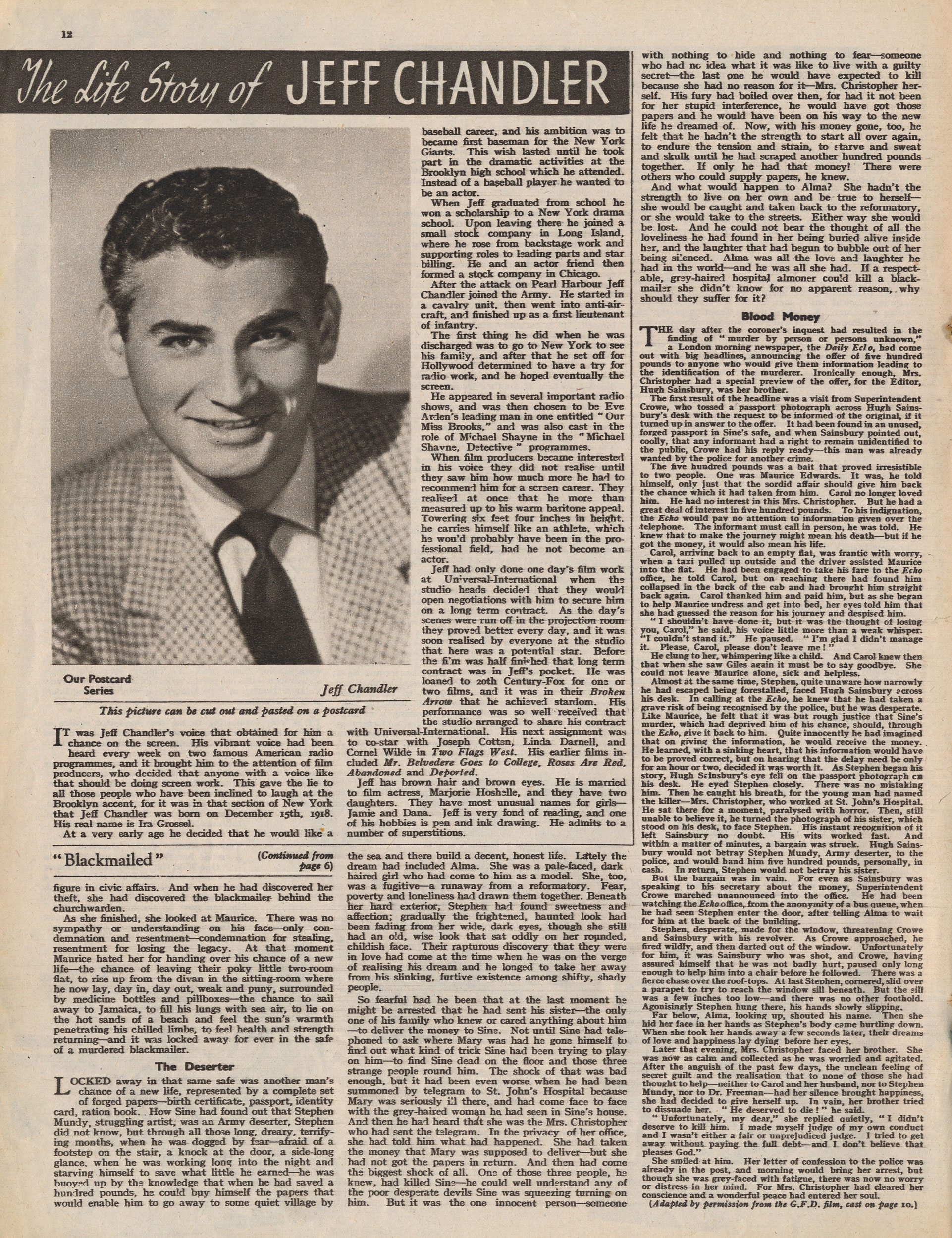
“What do you mean, lost it? You’ve been gambling?” Then as she shook her head, an ugly, sly expression crept into his eyes and he began to work himself into a passion. “You haven’t lost it!” he said harshly. “I’m not a fool. D’you think I don’t see through you? You lent that money to that man – and you tore up that cheque because you don’t want to go away with me. And you don’t want to go away with me because you’re in love with him!” He stopped, panting for breath, but she made no reply. She was leaning against the wall, staring unseeingly before her, for his furious accusation for the first time revealed to her the truth that until then she had not dared to admit to herself.
Even before he had become ill, Maurice’s selfishness and jealousy had been killing her love. For a long time now she had borne with his petty tyranny only because she pitied him. She became aware that Maurice was shouting at her again.
“Did you or did you not lend him that money?” Then as she stared at him silently, he pounded the bed with his clenched fist. “Answer me!”
“No, I did not,” she said quietly.
“But you’re in love with him?”
“Yes. I am.”
Maurice sank back, exhausted and sweating.
“What sort of man is he – taking your money -“
“He’s never had a penny!” she interrupted, and then for the first time, knowing that it was the only way to convince Maurice that she was telling the truth, she told him of Sine’s blackmailing.
It was a sad, sordid little story. It had started about a year before when Maurice had just been taken seriously ill and was going into hospital. They were at their wits end for money, and she had told him that she had sold her mother’s brooch for six times what she had really got. The rest she had stolen from the funds of a charitable organisation for which she had been working. Sine had been on the committee – he was outwardly a highly respectable man, a churchwarden and a leading figure in civic affairs. And when he had discovered her theft, she had discovered the blackmailer behind the churchwarden.
As she finished, she looked at Maurice. There was no sympathy or understanding on his face – only condemnation and resentment – condemnation for stealing, resentment for losing the legacy. At that moment Maurice hated her for handing over his chance of a new life – the chance of leaving their poky little two-room flat, to rise up from the divan in the sitting-room where he now lay, day in, day out, weak and puny, surrounded by medicine bottles and pillboxes – the chance to sail away to Jamaica, to fill his lungs with sea air, to lie on the hot sands of a beach and feel the sun’s warmth penetrating his chilled limbs, to feel health and strength returning – and it was locked away for ever in the safe of a murdered blackmailer.
The Deserter
Locked away in that same safe was another man’s chance of a new life, represented by a complete set of forged papers – birth certificate, passport, identity card, ration book. How Sine had found out that Stephen Mundy, struggling artist, was an Army deserter, Stephen did not know, but through all those long, dreary, terrifying months, when he was dogged by fear – afraid of a footstep on the stair, a knock at the door, a side-long glance, when he was working long into the night and starving himself to save what little he earned – he was buoyed up by the knowledge that when he had saved a hundred pounds, be could buy himself the papers that would enable him to go away to some quiet village by the sea and there build a decent, honest life. Lately the dream had included Alma. She was a pale-faced, dark haired girl who had come to him as a model. She, too, was a fugitive a runaway from a reformatory. Fear, poverty and loneliness had drawn them together. Beneath her hard exterior Stephen had found sweetness and affection; gradually the frightened, haunted look had been fading from her wide, dark eyes, though she still had an old, wise look that sat oddly on her rounded, childish face. Their rapturous discovery that they were in love had come at the time when he was on the verge of realising his dream and he longed to take her away from his slinking, furtive existence among shifty, shady people.
So fearful had he been that at the last moment he might be arrested that he had sent his sister – the only one of his family who knew or cared anything about him – to deliver the money to Sine. Not until Sine had telephoned to ask where Mary was had he gone himself to find out what kind of trick Sine had been trying to play on him – to find Sine dead on the floor and those three strange people round him. The shock of that was bad enough, but it had been even worse when he had been summoned by telegram to St. John’s Hospital because Mary was seriously ill there, and had come face to face with the grey-haired woman he had seen in Sine’s house. And then he had heard that she was the Mrs. Christopher who had sent the telegram. In the privacy of her office, she had told him what had happened. She had taken the money that Mary was supposed to deliver – but she had not got the papers in return. And then had come the biggest shock of all. One of those three people, he knew, had killed Sine – he could well understand any of the poor desperate devils Sine was squeezing turning on him. But it was the one innocent person – someone with nothing to hide and nothing to fear – someone who had no idea what it was like to live with a guilty secret – the last one he would have expected to kill because she had no reason for it – Mrs. Christopher herself. His fury had boiled over then, for had it not been for her stupid interference, he would have got those papers and he would have been on his way to the new life he dreamed of. Now, with his money gone, too, he felt that he hadn’t the strength to start all over again, to endure the tension and strain, to starve and sweat and skulk until he had scraped another hundred pounds together. If only he had that money! There were others who could supply papers, he knew.
And what would happen to Alma? She hadn’t the strength to live on her own and be true to herself – she would be caught and taken back to the reformatory, or she would take to the streets. Either way she would be lost. And he could not bear the thought of all the loveliness he had found in her being buried alive inside her, and the laughter that had begun to bubble out of her being silenced. Alma was all the love and laughter he had in the world – and he was all she had. If a respectable, grey-haired hospital almoner could kill a blackmailer she didn’t know for no apparent reason, why should they suffer for it?
Blood Money
The day after the coroner’s inquest had resulted in the finding of “murder by person or persons unknown,” a London morning newspaper, the Daily Echo, had come out with big headlines, announcing the offer of five hundred pounds to anyone who would give them information leading to the identification of the murderer. Ironically enough, Mrs. Christopher had a special preview of the offer, for the Editor, Hugh Sainsbury, was her brother.
The first result of the headline was a visit from Superintendent Crowe, who tossed a passport photograph across Hugh Sainsbury’s desk with the request to be informed of the original, if it turned up in answer to the offer. It had been found in an unused, forged passport in Sine’s safe, and when Sainsbury pointed out, coolly, that any informant had a right to remain unidentified to the public, Crowe had his reply ready – this man was already wanted by the police for another crime.
The five hundred pounds was a bait that proved irresistible to two people. One was Maurice Edwards. It was, he told himself, only just that the sordid affair should give him back the chance which it had taken from him. Carol no longer loved him. He had no interest in this Mrs. Christopher. But he had a great deal of interest in five hundred pounds. To his indignation, the Echo would pay no attention to information given over the telephone. The informant must call in person, he was told. He knew that to make the journey might mean his death – but if he got the money, it would also mean his life.
Carol, arriving back to an empty flat, was frantic with worry, when a taxi pulled up outside and the driver assisted Maurice into the flat. He had been engaged to take his fare to the Echo office, he told Carol, but on reaching there had found him collapsed in the back of the cab and had brought him straight back again. Carol thanked him and paid him, but as she began to help Maurice undress and get into bed, her eyes told him that she had guessed the reason for his journey and despised him.
“I shouldn’t have done it, but it was the thought of losing you, Carol,” he said, his voice little more than a weak whisper. “I couldn’t stand it.” He paused. “I’m glad I didn’t manage it. Please, Carol, please don’t leave me!”
He clung to her, whimpering like a child. And Carol knew then that when she saw Giles again it must be to say goodbye. She could not leave Maurice alone, sick and helpless.
Almost at the same time, Stephen, quite unaware how narrowly he had escaped being forestalled, faced Hugh Sainsbury across his desk. In calling at the Echo, he knew that he had taken a grave risk of being recognised by the police, but he was desperate. Like Maurice, he felt that it was but rough justice that Sine’s murder, which had deprived him of his chance, should, through tile Echo, give it back to him. Quite innocently he had imagined that on giving the information, he would receive the money. He learned, with a sinking heart, that his information would have to be proved correct, but on hearing that the delay need be only for an hour or two, decided it was worth it. As Stephen began his story, Hugh Sainsbury’s eye fell on the passport photograph on his desk. He eyed Stephen closely. There was no mistaking him. Then he caught his breath, for the young man had named the killer – Mrs. Christopher, who worked at St. John’s Hospital. He sat there for a moment, paralysed with horror. Then, still unable to believe it, he turned the photograph of his sister, which stood on his desk, to face Stephen. His instant recognition of it left Sainsbury no doubt. His wits worked fast. And within a matter of minutes, a bargain was struck. Hugh Sainsbury would not betray Stephen Mundy, Army deserter, to the police, and would hand him five hundred pounds, personally, in cash. In return, Stephen would not betray his sister.
But the bargain was in vain. For even as Sainsbury was speaking to his secretary about the money, Superintendent Crowe marched unannounced into the office. He had been watching the Echo office, from the anonymity of a bus queue, when he had seen Stephen enter the door, after telling Alma to wait for him at the back of the building.
Stephen desperate, made for the window, threatening Crowe and Sainsbury with his revolver. As Crowe approached, he fired wildly, and then darted out of the window. Unfortunately for him, it was Sainsbury who was shot, and Crowe, having assured himself that he was not badly hurt, paused only long enough to help him into a chair before he followed. There was a fierce chase over the roof-tops. At last Stephen, cornered, slid over a parapet to try to reach the window sill beneath. But the sill was a few inches too low – and there was no other foothold, Agonisingly Stephen hung there, his hands slowly slipping.
Far below, Alma, looking up, shouted his name. Then she hid her face in her hands as Stephen’s body came hurtling down. When she took her hands away a few seconds later, their dreams of love and happiness lay dying before her eyes.
Later that evening, Mrs. Christopher faced her brother. She was now as calm and collected as he was worried and agitated. After the anguish of the past few days, the unclean feeling of secret guilt and the realisation that to none of those she had thought to help – neither to Carol and her husband, nor to Stephen Mundy, nor to Dr. Freeman – had her silence brought happiness, she had decided to give herself up. In vain, her brother tried to dissuade her. “He deserved to die!” he said.
“Unfortunately, my dear,” she replied quietly, “I didn’t deserve to kill him. I made myself judge of my own conduct and I wasn’t either a fair or unprejudiced judge. I tried to get away without paying the full debt – and I don’t believe that pleases God.”
She smiled at him. Her letter of confession to the police was already in the post, and morning would bring her arrest, but though she was grey-faced with fatigue, there was now no worry or distress in her mind. For Mrs. Christopher had cleared her conscience and a wonderful peace had entered her soul.

