Picture Show – May 19th 1951

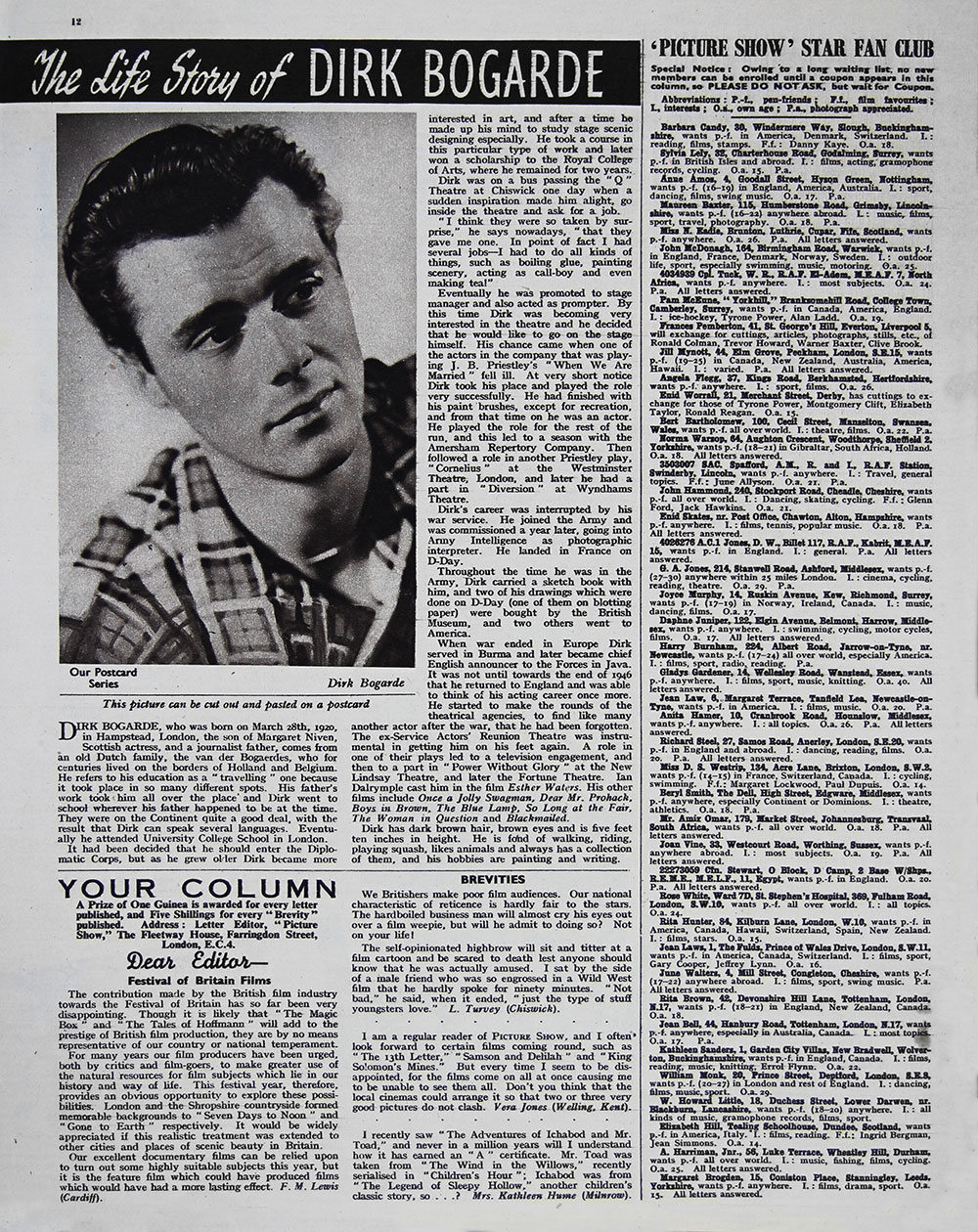
The Life Story of Dirk Bogarde
Dirk Bogarde, who was born on March 28th, 1920, in Hampstead, London, the son of Margaret Niven, Scottish actress, and a journalist father, comes from an old Dutch family, the van der Bogaerdes, who for centuries lived on the borders of Holland and Belgium. He refers to his education as a “travelling” one because it took place in so many different spots. His father’s work took him all over the place and Dirk went to school wherever his father happened to be at the time. They went on the Continent quite a good deal, with the result that Dirk can speak several languages. Eventually he attended Univetsity College School in London. It had been decided that he should enter the Diplomatic Corps, but as he grew older Dirk became more interested in art, and after a time he made up his mind to study stage scenic designing especially. He took a course in this particular type of work and later won a scholarship to the Royal College of Arts, where he remained for two years.
Dirk was on a bus passing the “Q” Theatre at Chiswick one day when a sudden inspiration made him alight, go inside the theatre and ask for a job.
“I think they were so taken by surprise,” he says nowadays, “that they gave me one. In point of fact I had several jobs – I had to do all kinds of things, such as boiling glue, painting scenery, acting as call-boy and even making tea!”
Eventually he was promoted to stage manager and also acted as prompter. By this time Dirk was becoming very interested in the theatre and he decided that he would like to go on the stage himself. His chance came when one of the actors in the company that was playing J. B. Priestley’s “When We Are Married” fell ill. At very short notice Dirk took his place and played the role very successfully. He had finished with his paint brushes, except for recreation, and from that time on he was an actor. He played the role for the rest of the run, and this led to a season with the Amersham Repertory Company. Then followed a role in another Priestley play, “Cornelius” at the Westminster Theatre, London, and later he had a part in “Diversion” at Wyndhams Theatre.
Dirk’s career was interrupted by his war service. He joined the Army and was commissioned a year later, going into Army Intelligence as photographic interpreter. He landed in France on D-Day.
Throughout the time he was in the Army, Dirk carried a sketch book with him, and two of his drawings which were done on D-Day (one of them on blotting paper) were bought by the British Museum, and two others went to America.
When war ended in Europe Dirk served in Burma and later became chief English announcer to the Forces in Java. It was not until towards the end of 1946 that he returned to England and was able to think of his acting career once more. He started to make the rounds of the theatrical agencies, to find like many another actor after the war, that he had been forgotten. The ex-Service Actors’ Reunion Theatre was instrumental in getting him on his feet again. A role in one of their plays led to a television engagement, and then to a part in “Power Without Glory” at the New Lindsay Theatre, and later the Foxtone Theatre. Ian Dalrymple cast him in the film Esther Waters. His other films include Once a Jolly Swagman, Dear Mr. Prohack, Boys in Brown, The Blue Lamp, So Long at the Fair, The Woman in Question and Blackmailed.
Dirk has dark brown hair, brown eyes and is five feet ten inches in height. He is fond of walking, riding, playing squash, likes animals and always has a collection of them, and his hobbies are painting and writing.

