Picture Show – Nov 10th 1954
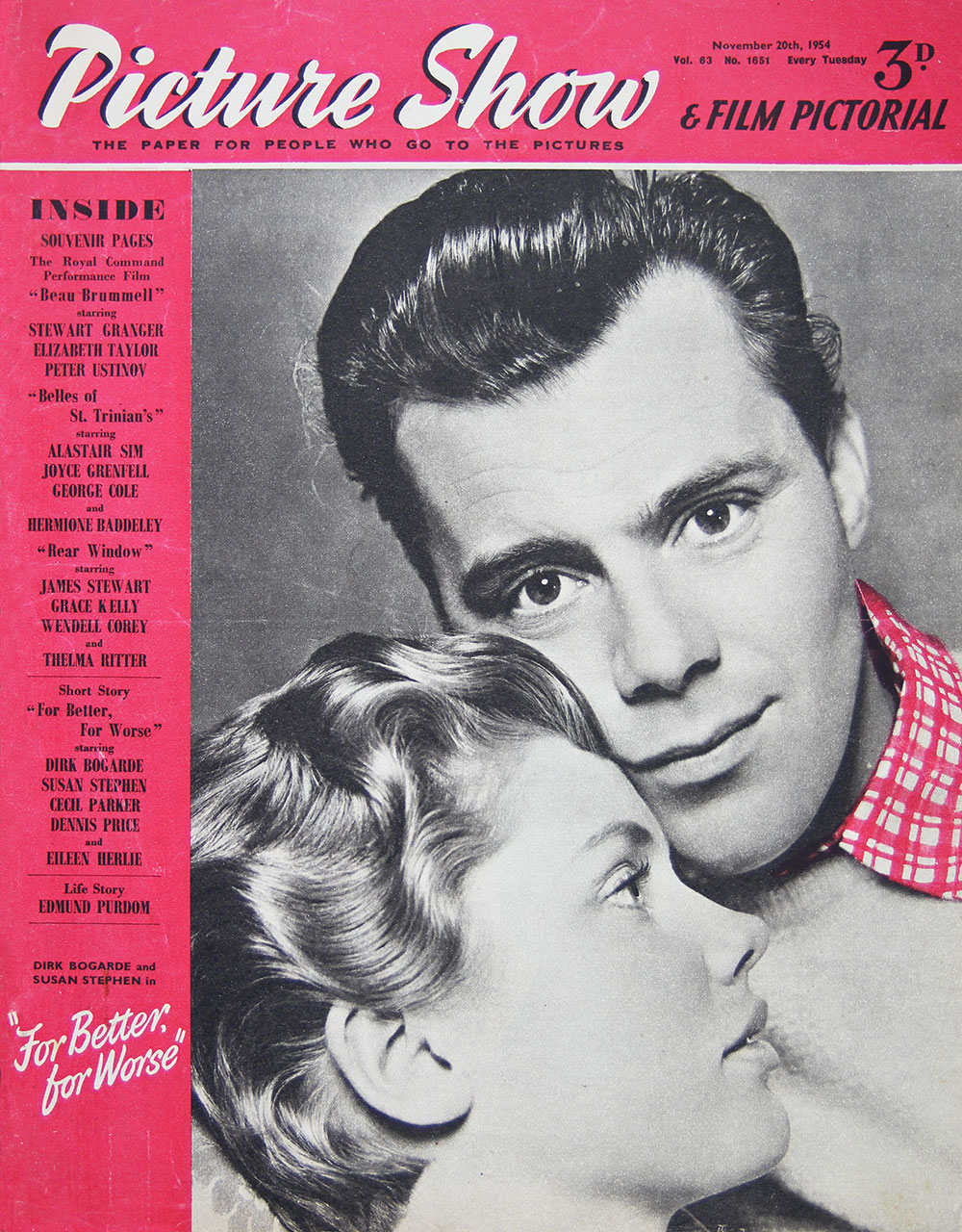


Round the British Studios
by Edith Mepean
On the set at Pinewood I found myself within the walls of a settler’s wrecked home in Kenya, and Dirk Bogarde playing one of the most exciting roles of his film career, in the highly topical picture, “Simba.” On this particular day, Dirk, as Allan Howard, having been out on a cattle drive, arrives back to find his home wrecked, and the hated word “Simba” scrawled in blood on the wreckage, the visiting card of the dreaded Mau Mau.
I am glad to report that in this film Dirk finds real romance, for in Kenya he meets lovely Mary Crawford, played by Virginia McKenna. Dirk Bogarde has a part after his own heart as an adventurous young Englishman who goes out to Kenya to settle and is at once caught up in the savage struggle against the terrorists. “But I met Mary Crawford,” he smilingly explained, “a beautiful, courageous girl who is quite sure that ahead of this period of violence and suffering a time: will come again when black men and white will live together in peace and happiness.”
On the set I also met Donald Sinden, as Tom Drummond, a hard-bitten police inspector with the awful responsibility of defending the scattered white settlements against attack.
I also met Basil Sydney, playing the part of Virginia McKenna’s father, and Marie Ney is her mother in the film. The outstanding coloured actor Earl Cameron has the role of his career as Karanja, an African doctor torn between conflicting loyalties, and Orlando Martins plays his father, the local headman.
The picture is packed with interest. It is filmed in Eastman Colour and the greater part of the production has been made against the beauty of Kenya and, alas, to-day’s unhappiness. Brian Desmond-Hurst is the director of the picture. We always look out for romance and a strong human note in his films. Do you remember “Prison Without Bars,” “The Lion Has Wings,” “Dangerous Moonlight,” “Theirs Is The Glory,” “Trottie True,” “Tom Brown’s Schooldays” and “Malta Story”? Peter De Sarigny is the producer; he acted as associate producer on such films as “Brighton Rock” and “Seven Days to Noon,” before teaming with Brian Desmond-Hurst to make that memorable picture, “Malta Story.”
❖ ❖ ❖ ❖ ❖ ❖
Virginia McKenna is always enthusiastic about her work. This is the first time she has been starred with Dirk Bogarde, ultimately becoming his wife in the film. It adds to the drama of the picture that love and death await Allan Howard (Dirk Bogarde) on the very first day of his arrival in Kenya. “I had previously met Allan Howard in London.” Virginia McKenna explained, “and so I go to the airport to welcome him.” He is eager to meet his brother George. for they are going to run the farm in partnership. But on arrival Dirk finds his brother dead, killed by Mau Mau terrorists. But with his natural anger and distress over the murder, he stays on in Kenya. He feels a growing attraction for Mary Crawford (Virginia McKenna), who works in a native clinic in charge of an African doctor, Karanja (Earl Cameron). There is suspicion, doubt and fear, and it culminates in the brutal murder of Mary’s parents, and the drama grows, also the love of Mary Crawford for Allan Howard !
❖ ❖ ❖ ❖ ❖ ❖
Dirk Bogarde’s life is almost as interesting as many of the films in which be plays.” I began my professional career as a scenic designer,” he told me. “I made my stage debut in 1939 at the ‘Q’ Theatre in J. B. Priestley’s When We Are Married. In 1940 I appeared with the Amersham Repertory Company as Lawrence in Cornelius, later playing the same part in the play’s revival at the Westminster Theatre. Following further repertory experience, I returned to the West End stage in Diversion at Wyndham’s.”
Serving in the Army, 1940-6, in Europe and the Far East, Dirk Bogarde was demobbed with the rank of major.
“I reappeared on the stage,” he said, “at the New Lindsey, 1947, in Power Without Glory.” That earned Dirk a long-term contract with the J. Arthur Rank Organisation. Other plays in which he has since appeared, include: For Better For Worse, Foxhole In The Parlour, Sleep On My Shoulder, The Shaughraun, Point Of Departure with Mai Zetterling, and The Vorte.
“Do you remember my first film?” Dirk Bogarde asked me one day. “We met at a fun fair scene in the grounds of Pinewood; the film was ‘Esther Waters’.” His films since then have included “Alien Corn,” an episode of Somerset Maugham’s “Quartet,” “Once A Jolly Swagman,” “Dear Mr. Prohack,” “Boys in Brown,” “The Blue Lamp,” “So Long At The Fair,” “The Woman in Question,” “Blackmailed,” “Hunted,” “Penny Princess,” “The Gentle Gunman,” “Desperate Moment,” “Appointment in London,” “They Who Dare,” ” Doctor in the House,” “The Sleeping Tiger,” “The Sea Shall Not Have Them” and “For Better For Worse.”
❖ ❖ ❖ ❖ ❖ ❖
Donald Sinden was telling me that he was born in Plymouth. “I made my first stage appearance at the Little Theatre, Brighton, and joined Mobile Entertainment for the Southern Area in 1941 and embarked on a series of ‘one-night stands,’ including entertaining D-Day troops at their secret embarkation camps,” he said. “Throughout the rest of the war I toured overseas battlefronts, including Belgium, France, Germany, India and Burma, entertaining the troops. I appeared at Stratford during 1946-7 season, and then I formed my own company and toured Sussex and Devon. I made appearances with the Bristol and London Old Vics, then joined the cast of The Heiress at the Haymarket Theatre. Afterwards I returned to the Bristol Old Vic. Later, I toured with Jean Kent in Frou Frou.”
Following his outstanding performance in Red Letter Day at the Garrick Theatre, Donald Sinden was given a starring part in his first film, “The Cruel Sea,” made at Eating Studios. The same year he was signed to a long-term contract by the J. Arthur Rank Organisation. His films since then have included “Doctor in the House,” “The Beachcomber” and “Mad About Men.”
❖ ❖ ❖ ❖ ❖ ❖
I first met Virginia McKenna with her grey-blue eyes and ash-blonde hair when she was making “The Cruel Sea” in the Ealing Studios.
Virginia McKenna speaks fluent French and a fair amount of Spanish. She inherited Irish blood from her father; French and Scots from her mother, Anna de Nys, who is a well-known cabaret pianist. “I studied for the stage,” she said, “and gained experience in repertory at Dundee, in the West End, on television and in films with ‘The Second Mrs. Tanqueray,’ ‘Father’s Doing Fine’ and ‘The Oracle’.”
Virginia McKenna is married to actor Denholm Elliott.
❖ ❖ ❖ ❖ ❖ ❖
Basil Sydney is certainly an outstanding figure both on the stare and screen. “One of my favourite roles,” he told me, “was that of Claudius in the Laurence Olivier film ‘Hamlet,’ a part which I first played in 1914 at the Old Vic.” His stage successes are numberless, and some of his outstanding film appearances, if you remember, include “Caesar and Cleopatra,” “The Man Within,” “Meet Me At Dawn,” “Ivanhoe,” ” Salome,” “Hell Below Zero” and “Star of India.”
❖ ❖ ❖ ❖ ❖ ❖
Irish-born Joseph Tomelty is one of the best-loved actors of the stage and screen. This actor-playwright was well known for his work at the famous Dublin Abbey Theatre. He has appeared in many British films, including “The Sound Barrier,” “The Gentle Gunman,” “Happy Ever After” and “The Young Lovers.” Another new film of his is “Prize of Gold.”
❖ ❖ ❖ ❖ ❖ ❖
FOR BETTER FOR WORSE
“Anne, will you marry me ?”
Tony asked the question in a loud whisper just as the song which was being sung on the screen ended. He reddened and sweated as he realised how many people must have heard it as well as the girl for whoso ears it was intended, then suddenly he put his trembling hand on hers and said huskily:
“Let’s get out of here!”
They both stumbled out of the dark cinema into the alleyway on to which the side door gave way, and there Tony’s heart felt as if it would burst, for Anne, looking at him with shining eyes, her cheeks pink, her lips smiling, put her arms round his neck and said:
“Yes, darling, yes!”
Tony caught her in his arms and kissed her.
“I’m so utterly happy!” she sighed, and hand in hand they walked away across the road, risking their lives in the way of people and traffic, until they reached Tony’s small, elderly car.
They both got in it, Tony’s jaw setting as he drove Anne to her home. Now he had something far worse to face – he had Anne’s consent; now he must get her parents’. Both of them were out, he realised with a sense of relief when they went in, and Anne snuggled against him.
“I absolutely adore you!” she whispered, looking in to his grey eyes.
His arms tightened about her, then they both jumped as they heard the front door slam. And when Mrs. Purves came into the lounge, her daughter was there alone.
“Cushion, mummy?” asked Anne, as Mrs. Purves sank on to the sofa wearily. Her mother glanced at her suspiciously.
“How was the picture?” she asked, and realising that Anne had no idea what it was about, asked whom she had gone with.
“Tony.”
“Tony?” Mrs. Purves paused, then she remembered him as a dark-haired, sturdy-looking young man. “Nice boy!” she nodded.
“Oh, that’s wonderful!” said Anne, running to her mother. “We’re going to get married!”
Mrs. Purves looked at her daughter with a shake of her head.
“Anne, I told you – I’ve had a tiring afternoon!” she reproved. Then, catching Anne’s pleading eyes, she added as she rose to her feet : “Let’s have a nice talk about it in three years’ time.”
“Mummy, please get it out of your head that nineteen today means what it did in your era!” said Anne firmly. “In your days, girls of nineteen knew nothing – literally nothing!”
This was too much for Mrs. Purves.
“If you know half what I knew then, you wouldn’t want to marry a man you’ve only met four times!” she said sharply.
“Five!” corrected Anne indignantly; then she added in a tone that caught her mother’s ear because she recognised the intensity of it: “Mummy, I want to marry Tony. I want to live with him happily somewhere not too far from you. I love him, mummy.”
Mrs. Purves gazed at Anne for a few moments, and Anne met her eye without any doubt.
“Yes, mummy,” said Anne. “Can I call him in?”
Mrs. Purves nodded, feeling dazed by the suddenness of this happening, and watched Anne go to the french window. Then Tony was standing opposite her, somewhat diffidently, saying nothing, keeping his eyes on her as if he expected her to hit him on the head, an agonised expression on his good-looking face.
“Anne’s told me,” Mrs. Purves said solemnly.
Tony gulped.
“And – how – did you take it?” he inquired jerkily.
“Fifty-fifty,” said Anne behind him.
“The first fifty is that you’re both absurdly young and I don’t think you know your own minds. The other fifty – that although I hardly know you, there’s something I rather like about you.”
M rs. Purves smiled at Tony, who felt that he could have embraced her with the relief that he felt.
“That’s a good seventy-five,” said Anne cheerfully. “And I’ll have a shot, Mrs. Purves, at making it into a hundred!” Tony promised enthusiastically.
“But first listen – consider Mr. Purves – where you start from nought!” warned Mrs. Purves solemnly, and Tony’s face fell and his confidence and enthusiasm disappeared.
“I know,” he groaned, and Mrs. Purves, saying something about getting dinner ready, gave them both an encouraging smile and went out. As soon as the door closed Tony took Anne into his arms.
“She likes me,” he said hopefully. “How about leaving it at that for to-day and let her work on your father?”
“No!” replied Anne firmly, releasing herself from his arm. “The iron’s hot and you’re going to strike it.”
They wandered into the garden, discussing methods, until Tony took Anne into his arms again and kissed her. In the midst of this they suddenly heard a cough and leapt guiltily apart. Mr. Purves stood at the french window regarding them with a suspicion of a smile, and to Tony’s relief, he saw a tall, heavily-built man with a wisely-humorous face surveying him.
“Daddy, this is Tony Howard,” Anne said as he crossed the lawn towards them .
Tho two men shook hands, and Anne promptly said, with a warning glance at Tony, that she had heard her mother call.
“I didn’t,” said Mr. Purves and, turning towards the kitchen window, said: “Helen – did you call Anne?”
“Did she think I did?” inquired Mrs. Purves, taking in the group outside.
“Yes,” replied Mr. Purves.
“Then I did,” smiled Mrs. Purves.
There was a brief, awkward pause after Anne had left. Tony looked as embarrassed as he felt, and Mr. Purves felt the same, but tried not to show it, although he was decidedly startled when Tony suddenly asked how old be thought he was.
“Er-” Mr. Purves looked at him in astonishment. “Twenty-one?” he hazarded.
“Twenty-three,” amended Tony triumphantly. “It makes a difference.” He cleared his throat. “I think a fellow of my age knows his own mind and where he is going – and ” – he gulped and shot a sidelong glance at Mr. Purves, who was staring at him in bewilderment -“who he wants to go with.”
Suddenly this last remark jolted: Mr. Purves into the realisation of why Anne had disappeared and what Tony was trying to say.
“I think we’d better have a drink!” he announced firmly, and Tony followed him into the lounge. Mr. Purves went across to the table and, picking up the whisky decanter, poured out two drinks. “Soda or water?” he inquired.
“Neat, please, sir,” croaked Tony. He swallowed the whisky despairingly, gasped, “I want to marry Anne!” and choked so violently from the effect of the unaccustomed whisky that Mr. Purves thumped him on the back until he could get his breath. When he did he looked at Mr. Purves.
“Did you hear what I said, sir?” be asked.
Mr. Purves had heard, and made it clear. What was more, he began to question Tony about his prospects. Tony, it appeared, had no job – chiefly because he had only just come down from Oxford – and had no house. He had fifty pounds saved and was living on a barge. His parents were living abroad to avoid paying income tax, and he frankly admitted that although Anne was only nineteen, he did not think that by the time she was twenty-three she would have changed her mind about him.
“Well, Howard,” Mr. Purves said at length, “I can only tell you I have the greatest possible admiration for your nerve.”
Tony stared at him, aghast and disappointed.
“Do you mean you are turning me down, sir?” he asked indignantly.
At this point Mrs. Purves entered, Anne behind her, and Mr. Purves turned to her with great relief.
“Well, what do you think, Helen?” he asked.
“They’re both absurdly young, of course,” Mrs. Purves said with a smile. “And in three months they’ll be living with us. Luckily we have room for them.”
“Wait a moment!” said Tony firmly. “We haven’t the least intention of living with you.”
“You may not intend to, but it usually happens,” Mr. Purves said lugubriously, realising that with his wife on the side of the young people, his own objection to their marriage would be overruled. “Now, you want my answer. You’ve told me everything about yourself frankly and sincerely. I doubt if any parent has ever had to listen to so uncompromising a recital. To sum up, Howard; I don’t like a single thing you said – but I liked the way you said it!”
Mr. Purves suddenly beamed at Tony as he spoke the last few words, and Anne, who had moved towards Tony unhappily during the first part of his speech, gasped loudly and glanced from her parents, both smiling, to Tony, who was looking utterly bewildered.
“Does that mean you’re going to give me a chance, sir?” be asked hoarsely.
“A chance to get a job and find a flat,” Mr. Purves assured him.
“And if I do, sir?”
“Come and see me again!”
Anne flung her arms round her father and kissed him then, turning to Tony, thrust her hands into his.
“We’re engaged!” she said with triumphant solemnity.
Preparations
So Anne and Tony were engaged. She wore an engagement ring w1th a small diamond in it, and Tony did his best to get a flat to live in and a job on which to live. He achieved both the same day – and neither was exactly what he wanted or expected, but a young man with ambitions and desires has to make do sometimes. The job was with the Government, temporary clerk, grade three – three being the lowest grade possible – and the weekly salary was five pounds ten shillings. The flat – well, Anne met Tony to see it. As Mr. Debenham, the superior man who showed them the flat when they arrived, explained, when he opened the door:
“This is a place in what might be termed a state of nature. Of course, with unfurnished flats you have to use your imagination. You want to see the place with furniture in. I don’t know whether you have that sort of eye. I have – I can look at a place like this and say:’Charming!'”
Anne. and Tony looked at the place. It was a large, bare, dirty room, with a telephone on the window-sill, a built-in cupboard, and a door leading to the bathroom. And that, they discovered, for thirty shillings a week, was all that they got.
“You mean, this is where we live, eat and sleep?” asked Tony unbelievingly.
“There are four hundred other people in this building doing it. Ask them whether they want to change!” Mr. Debenham announced with a supercilious expression.
“It may interest you to know that I live here myself. It’s exactly like this one – in fact, it’s directly above.”
“You don’t find it cramped?” inquired Anne.
“Cramped!” exclaimed Mr. Debenham.” Have you considered the advantages – everything within easy reach – only one room to clean? No leaving the fireside to go to bed, no carrying the dishes from kitchen to dining-room?”
“Kitchen!” The word struck Anne as something thus far omitted. “Where do I cook?”
Mr. Debenham flung open the sliding doors of the built-in cupboard.
“There – gas cooker with two rings, sink, draining-board and shelves, all in two foot by four!” he announced with pride at the achievement.
Seeing Tony’s face, he drew his attention to the telephone, which he assured him was ready to use.
“We could sell the telephone without the flat” he assured him haughtily, then glanctd at his watch.
“Well, what is your answer?” he inquired.
Tony did not know and said so.
“Mr. Howard,” said Mr. Debenham firmly, “when I come back I shall want your answer, and if it’s ‘Yes,’ your cheque. A month’s rent in advance and twenty pounds for fittings!”
“Twenty pounds?” gasped Tony, with a depreciatory glance round. “They’re not worth twenty shillings.”
Mr. Debenham did not argue about that.
“You have four minutes to decide what they’re worth. I shall be downstairs,” he said firmly and, opening the door, left them alone. Anne and Tony stared at each other.
“Extraordinary fellow!” commented Tony.
“Well, he’s offered us this flat,” Anne reminded him gently. “It’ll hold us. So let’s go down and give that horrid man his cheque – “
“Darling – there’s something I’ve got to tell you. I could write him a cheque for twenty pounds – no trouble at all. But it wouldn’t be much use to him. I’ve only got four pounds ten in the bank!” He paused.
“And I drew out two this morning – I put them – on something. You’ll hardly believe it – but it was a horse. It was second by a short head!” he ended dismally.
“Oh, Tony!” Anne’s tragic eyes fixed themselves remorselessly on his. “If our future housekeeping is going to depend on the result of the two-thirty – “
“No, darling!” promised Tony, catching her hands in his. Next, Monday, when I start my job, we’ll pay as we go. Its just that to-day – I can’t buy the fittings!”
At Anne’s urging he telephoned the bank to find out whether they would lend him twenty-five pounds and when he put the receiver down, be told her unhappily that there would be no difficulty if he could find someone to guarantee it. Anne’s spirits fell – but only for a moment. She suddenly turned to him, her eyes shining.
” Daddy!” she cried happily.
To her annoyance, Tony flatly refused to ask her father to guarantee the loan, but her annoyance lessened on heanng that be intended to get his own house by himself, without her father’s money.
“Besides,” he added glumly, “your father won’t be too pleased to see me. I gave him the tip for that horse!”
Suddenly there was a knock on the door, and when Anne opened it, they saw Mr. Debenham standing there.
“Well?” he inquired.
Tony faced him for a moment, then took a deep breath.
“I’ll – take the flat!” he said, and Anne watched with horrified fascination as he wrote out the cheque for four weeks’ rent and twenty pounds and handed it to Mr. Debenham, who thanked them, bowed, and went out. Anne looked at Tony – but as she was opening her mouth, there came another knock at the door – and her mother and father entered.
“So you’ve got a flat!” said Mr. Purves, eyeing the room.
“I’ve got a flat, sir,” said Tony.
“Such a snug little room!” commented Mrs. Purves.
“Mummy – this is it. There isn’t any more – you don’t have to go anywhere for anything!” said Anne.
“I call it indecent!” declared Mr. Purves.
“Anyway, it’s a start!” Mrs. Purves said soothingly, and on hearing that Tony had a job and hearing what the job was, she hurried Mr. Purves out of the flat, saying that they could talk about it that evening.
Anne and Tony were left alone, Tony facing the realisation that the only way of getting twenty-six pounds by the next morning was to sell Albertina, his treasured old car. There was more in this than he thought, as the dealer to whom he tried to sell it showed him.
“I got to sell it again,” he pointed out. “I got to show it to a customer and say this is the car you want!”
He surveyed it with his head on one side for a moment, a somewhat disgusted expression on his face; then he made a thorough inspection of it, commenting good naturedly but pointedly on the king-pins, steering-wheel, the sbock-absorbers, the engine, the starter, the spare wheel.
“How much?” Tony asked as the commentary ended.
“Well, I’ll be doing myself – but ten pounds,” was the reply.
Tony shook his head, and he and Anne got into it and drove away towards the Purves’ home.
“We’ll get double that,” he said comfortingly to Anne, as they arrived after a silent journey and he went inside the house to face Mr. Purves.
“And you think you can support Anne on that?” Mr. Purves inquired, in an appalled voice on learning Tony’s salary.
“Daddy – Tony and I have worked it all out. We can manage – and we want to!” Anne told him firmly.
“A one-room flat – Anne not to work – and your salary. That’s how you want to start your life together?”
Tony clutched Anne’s hand and nodded. To Anne’s relief, her father smiled at them suddenly.
“All right!” he said. “My wife and I had our struggles when we were married, so we know what it is but things are much harder now. Still, you’re determined and I admire your pluck. If you don’t have to come to me in six months’ time to get you out of some jam or other, I’ll – ” he ended.
“We’ll never do that, sir,” said Tony hopefully.
“I’ve nothing else to say – except to wish you all the luck in the world,” Mr. Purves added sincerely; then to Tony he added delightedly: “By the way, Tony, thank you for that tip – there was an objection to the winner – the second horse – our horse – won at fifteen to one!”
“And I’ve won thirty pounds!” gasped Tony in relief. Debenham’s cheque was saved!
Married
The next thing was moving into the flat. Tony sold Albertina for the ten pounds offered by the dealer, who, on learning that they were getting married, added a fiver to it and wished them luck. So one afternoon Anne and Tony stood in their room which was newly painted, a carpet on the floor, curtains at the windows, waiting for the furniture they had ordered. To begin with, however, two unexpected “surprises” were delivered. They were wedding gifts. An enormous old tallboy and a grand piano with harp attachments and the room that they occupied wrecked Anne’s plan for the disposal of the rest of the furniture. Tony was for sending them back, but this Anne refused to allow; and when to them were added the divan bed, the settee, the two armchairs, the dining-room table, standard lamp, hatstand, a stool, a kitchen cabinet, a sideboard and a bookcase, some bought with Mr. Purves’ wedding present cheque and the rest on the hire system, there was scarcely enough room to take three steps in any direction. But Tony and Anne were married and returned to it after their honeymoon week-end.
By this time all the surplus stuff had gone – they had sold it, and paid for their honeymoon on the amount received. They looked round the flatlet with pride and pleasure, recognising that it had been transformed into a home of charm and welcome – their own little world, in which they could lock the door and shut out the rest of the world.
As the weeks went by, Anne came to know some of their neighbours, especially Miss Mainbrace, an elderly, friendly spinster who was always popping in to use their telephone. At length, at Tony’s suggestion, they asked Anne’s mother and father to dinner one evening, to show how well a happy married couple could do in a one room flat.
“We’ll do it in style!” Tony said triumphantly.
The date was fixed, and Anne was busy making the crust for the steak-and-kidney pudding when she had a telephone call from Tony to say that he had been made a temporary clerk, grade two, and that he was coming home early and bringing the wine. He was as good as his word – and burst excitedly into the flat to find it in absolute chaos.
There was a bucket on the floor catching drips from the ceiling, on which was a large damp patch; Mrs. Doyle, the charwoman, with a pugnacious expression, was laying the table; Medlicott, a deaf but by no means dumb plumber, was clanging away at the sink; Anne, feeling worn out after a verbal sparring match between the plumber and the charwoman, had her back to him and was apparently doing nothing.
“Tony, my darling!” she cried, as she turned round and saw him; then, as she hurried towards him, she wailed: “That frightful woman!”
Tony stared at her blankly and flopped on to the settee, his arms still full of parcels.
“Which frightful woman?” he demanded, and by an unfortunate accident his eye lit on Mrs. Doyle as he said it, while Mrs. Doyle’s eyes, swivelling round, met his.
“Nah then, there’s no call to be insulting!” she objected as she moved towards him. Turning to Anne, she observed: “I think I’d like my bucket!”
With a contemptuous glance at the plumber she left, and Anne realised that she must do something about the drips. Tony, spurred by her, was standing catching the drips in his cupped hands, when there was a knock at the door, and Anne, opening it, saw Miss Mainbrace.
“I saw Mrs. Doyle leaving ” Miss Mainbrace said. then, catching a glimpse of Tony, added: “Would it help if I lent a bucket?”
“Oh, Miss Mainbrace, yes, it would!” said Anne thankfully, and viewing her retreating backview, Anne ran to Tony, who was now holding his bowler hat. “Darling,” she said in a low, intense voice, “we’ve got her kidneys!” Tony stared at her in blank horror. “She’s been running about without them!”
At that moment there came a violent hammering from the direction of the sink.
“What’s that?” Tony demanded.
He put the hat on the floor and began to walk in the direction of the plumber, when there was a ring at the doorbell, and Anne took the bucket from Miss Mainbrace and passed it to Tony.
“My dear child!” Miss Mainbrace gasped. “Your gas is going out!”
Neither Anne nor Tony had a shilling, they discovered.
“Don’t worry,” said Miss Mainbrace.
She ran out of the room again and quickly returned with a coin – and Anne to her joy heard the gas spurt up.
“Miss Mainbrace – it’s dreadful of me to have left it as late as this,” she said, “but would you care to join us at dinner? We wouldn’t enjoy a bit of what we’re going to have if you didn’t.”
“Well” – Miss Mainbrace’s eyes crinkled in a smile – if you put it as charmingly as that – but you know there’s next to nothing I can eat,” she added, after a moment’s thought. ” Would it be rude to ask what actually you’re having? “
“Steak and kidney!” said Anne somewhat guiltily.
“Well” Miss. Mainbrace paused, then nodded.
“Perhaps I could manage just a little of the kidney. I’d better go and do something about myself! After all, in a life like mine there isn’t often anything to do something about oneself for!”
Anne turned to Tony, who in his annoyance fell over the bucket. Then, as he swore, she took his hands in hers. “It only wants one more thing to happen and we shall lose our grip – we’ll go batty!” Tony agreed fervently. “We’ve got to take ourselves firmly in hand and do quietly what remains to be done.”
“I’ll see to the burgundy,” he said quietly.
Anne turned to the stove, to come face to face with Medlicott, who announced that he had finished and showed her the tea-leaves he had removed, then bent down to pick up his tools and leave. Anne took the potatoes off the gas to test them with a fork – and as she did so, Medlicott straightened up, hit the saucepan with his back, and let out a yell as the boiling water splashed on him. He tore out of the flat, followed by Tony, who had picked up his tools.
On Tony’s return to the flat, he tripped over the clothes-horse, which Anne had been moving, and fell flat on his face. Anne’s announcement that they were expecting her parents brought about his immediate recovery. There was no time to be wasted – and they did not waste any.
In fact, when Miss Mainbrace raised her glass and proposed a toast to her young host and hostess, with a word of praise for their courage and determination, Anne said: “It’s just by being happy!”
And Tony, despite other people being present, got up and put his arms round her and kissed her.
❖ ❖ ❖ ❖ ❖ ❖
Six Months Later
They had been married for six months and the time had gone like a flash – and so had Tony’s salary, which accounted for his glum face when he totalled his weekly earnings and spendings. His spendlngs were six pounds fourteen shillings and he announced that his salary since his promotion had been six pounds one shilling – thirteen shillings short. And Anne was horrified to learn that the bit missing had been taken from the rent, due next day, and the last five weekly unpaid instalments on the furniture. After some dlscussion about what to do, Anne said reluctantly, “We’ll have to go to Daddy.”
But “Daddy,” Tony explained firmly, was out of the question. He was keeping the doorkey in his own pocket.
“Shall we drink to that?” he asked and striding to the cupboard, brought out the bottle of gin which Anne’s father had given them. As he tilted it, he saw an envelope stuck to the bottom. It was unopened – and proved to be a curt note from the furniture people informing them that in default of receiving remittance, arrangements had been made to collect the furniture on Saturday, January 24th.
“That’s to-day!” cried Anne aghast.
“They must be stopped,” said Tony. His face brightened. “We’ll go for a walk. As long as we’re out they can’t get in and since it’s Saturday they finish at one – we’ll be safe till Monday morning.”
Anne hastened to the mirror and hastily dabbed some powder on her face, grabbed a coat and they flung open the door and came face to face with Mr. and Mrs. Debenham – both had forgotten that Anne had invited them to coffee in an attempt to overcome their differences. The Debenbams accepted Tony’s offer of a gin with pleasure, so he divided the gin between them and poured himself out the same amount of deceptive water. There were a few moments of polite, stilted conversation followed by the Debenhams’ announcement that they were leaving their flatlet – because they couldn’t afford it. Anne and Tony thereupon confessed that on Monday Mr. Debenham would be posting a letter to them turning them out and that most of their furniture would shortly be moved.
“Come upstairs with us,” suggested Mrs. Debenham, and when Anne signalled that the van had arrived, they left the flat with Mr. Debenham cheerfully misquoting, “He who runs away lives to pay another day.” They returned about fifteen minutes later on seeing the van depart and were staggered to find Mr. and Mrs. Purves waiting in the flatlet, Mrs. Purves having been lent Anne’s key.
On questioning, Tony discovered that the furniture van people had called while they were there. “They went away satisfied,” Mr. Purves remarked, then after a few moments, they were all seated in the Purves’ car and drove along to a restaurant to lunch. Everything went extremely well until M r. Purves paid the bill. As he took the notes from his wallet, a piece of paper fell from it before Tony. It was the furniture company’s receipt.
“This Is yours, I think, sir,” Tony said and swallowed. “And I owe you four pounds ten.”
Anne gasped and Mrs. Purves sat up apprehensively.
“Look, my boy, I just happened to have it on me,” said Mr. Purves. “There’s no sort of hurry. Tell me -” he leaned forward towards Tony – “how are things – really?”
“Terrific, sir,” said Tony, and his eyes met his father-in-law’s searching ones unflinchingly. Then he added, “I dare say you and Mrs. Purves didn’t find it all plain sailing – ” he glanced at Mrs. Purves, whose smile of embarrassment corroborated his suggestion.
“That doesn’t say-er-a little-er-timely assistance,” protested Mr. Purves.
But Tony made it clear that he could accept no assistance and he told him why.
“And you know I’m right, sir,” he added. “Either we make a go of it or we don’t. And it’s not just us, you know, sir,” he added. “There are hundreds like us – all In the same boat. And they haven’t all got parents who can cough up four pounds ten at short notice.” He rose and smiled. “And thank you for a good lunch.”
Mr. Purves watched Tony and Anne leaving with a pleased, approving smile.
“Well, you’ve got to hand it to him. He knows his own mind – he’ll get somewhere,” he conceded.
Anne and Tony, meanwhile, were walking along the street, on the way home – to their own little world – and they would have changed places with nobody!

