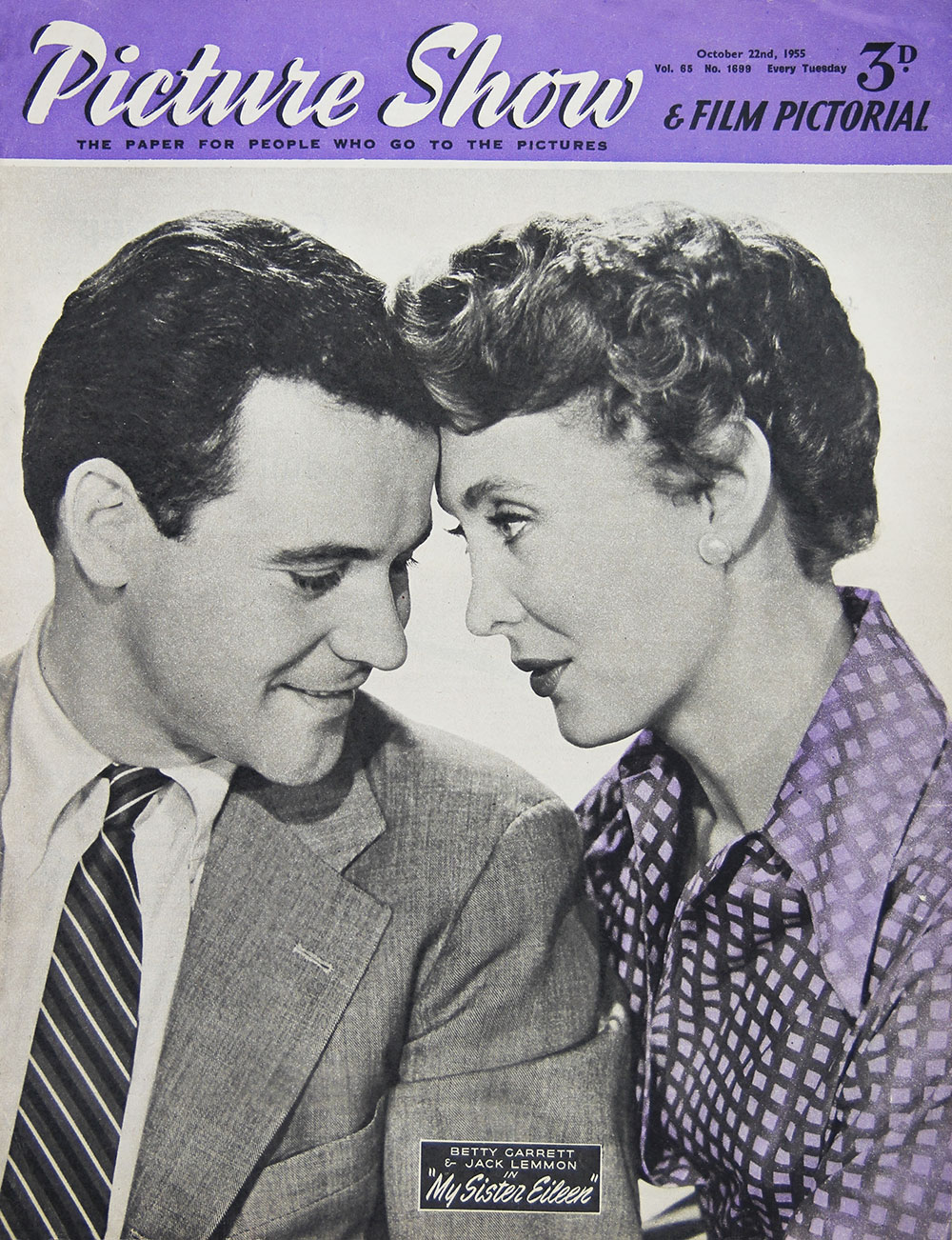
Picture Show – Oct 22nd 1955


Cast A Dark Shadow
This story adaptation is exclusive to PICTURE SHOW by permission of Eros Films
THERE could have been no two people with less in common than Monica Bare and her husband Edward, yet Emmie, Monica’s old housekeeper, and many others believed them to be an ideally happy pair. Edward, youthful and charming, had good looks but no money, and Monica, grey-haired, had a larger bank balance than most middle-class women. Edward looked after his elderly wife with unsparing devotion, and she found in him a dear companion, and someone on whom she could lavish all the generosity of her good, kind heart.
Before she married him Edward had been a clerk in the local estate office of Charles Mann, and Monica had met him when she bad thought of selling the family business, a shop, which had grown in scope and size until it yielded a fortune. The sale had gone through after their wedding; after the wedding, too, Edward had given up working, and looking after “Monnie” had become his sole occupation.
They had only been married a year when Monnie had a bad attack of ‘flu, and the two decided to take a short holiday at Brighton. Like an excited child, Monica rode on the “ghost train” and sampled the other “side-shows,” and Edward cleverly hid his boredom behind his charm of manner.
“We’ll have our tea now,” he told her, after their third trip on the ” ghost train,” and, taking her arm, led her towards the cafe they usually frequented. A slatternly waitress set a tea-tray on the table between them, and from his pocket Edward drew out a small fiat bottle of whisky and poured a generous amount into each of their cups. “Oh, Teddy, yon spoil me,” Monica giggled.
Monica’s growing indulgence in “spirits” was something for which many people in the small country town where they lived blamed Edward, but he cared little what people thought. Monnie enjoyed a glass or two of brandy or whisky, and she could afford it, and long ago Edward had decided it was no business of anyone’s but their own.
The day they returned home to “Stoneleigh,” a large Victorian house standing in its own grounds at the top of a steep incline locally known as “Sunrise Hill.” Edward was annoyed to see Philip Mortimer’s car in the drive. Philip was Monica’s lawyer, a shrewd young man, who thought his client’s marriage to Edward Bare a mistake, and Edward disliked him, fearing his influence on his wife. Emmie welcomed them warmly. She was a simple soul, too good-hearted to see wrong in anyone, and she loved her mistress, whom she had served for twenty years. For Emmie, “Stoneleigh” was “home,” and, despite her years, which were several more than Monica’s, she kept the old mansion clean and waited on her elderly mistress with slow but thoughtful attention.
At first Monica was evasive about the reason for Philip’s visit. Unknown to Edward, she had already made a will bequeathing him the house and a small bungalow; her money she had left to her only living relative, her sister, Dora MacKintosh, who lived in Jamaica. But life with Teddy had been an enchantment for which at her age she had been unprepared, and in gratitude she had decided that Edward was entitled to all her money, especially as Dora’s husband had died leaving his wife an enormous fortune. Philip’s worried disapproval was something which Monica dealt with swiftly, and hotly she denied his accusation that Teddy had asked her to make a new will.
“He doesn’t even know about the first,” she said angrily. ” Now, I know my sister does not need any money.”
Philip left the house with instructions to come along in the morning with the document ready for her to sign. Edward was appalled when Monica told him why she had sent for her lawyer. Not knowing of her first will, he assumed that she meant to leave her money away from him.
“It’s morbid. I won’t have you making a will, Monnie,” he argued. “I told you when we married that there was no need for a will. If you outlive me, you have what I’ve got. If I outlive you, I can have what you’ve got. That’s the law. Next-of-kin-that’s all you have to be. Leave it like that,” he urged her.
Monica smiled tenderly, but she did not tell Edward that the will secured his future, and he became terribly worried at his inability to influence her not to make one.
“He’s bringing it for me to sign to-morrow,”Monica said, looking at Edward fondly. Edward’s eyes narrowed in cold concentration.
“I’m sorry about that, Monnie really I am,” he muttered.
By half-past seven that evening Edward had subtly induced Monica to drink so much brandy she was fuddled and sleepy, and her head fell back against the cushion of the old rocking-chair in which she loved to sit, whilst she strove to keep awake.
“Finished your library book, Monica?” Edward asked, picking it up.
“Didn’t like it,” Monica drooled.
“You’ll want something for to-night,” Edward said, and telling her he would slip down to the library and change it, tucked a rug around her and left her to sleep.
“Mrs. Bare’s going to have a nice snooze,” he told Emmie. “When she wants you she’ll ring, see?”
“I won’t disturb her,” Emmie promised, and stealing in to the room to fetch the coffee-tray, she tiptoed out, satisfied that Monica was warm and comfortable.
A few minutes later Edward, wearing gloves, opened the french window, and Monica, half awake, shivered as the night wind blew through the parted white curtains. Edward bent over her.
“Teddy Bare,” Monica breathed dazedly.
“You’re tired, aren’t you, Monnie? Tired and cold,” Edward said. “Let’s have the fire on. Come on, a nice little warm we’ll have,” and his gloved hand pressed a box of matches into her hand, closing her fingers round it. Monica made an inaudible reply, and, taking the rug off her, Edward gently eased her out of the chair. As she fell in front of the unlit gas fire, the matches scattered, and Edward guided her hand to the tap and helped her fingers to turn it. Then, with the hiss of escaping gas filling his ears, he stole out unseen by the way he had come. The will Philip was bringing in the morning would never be signed, he thought exultantly.
❖ ❖ ❖ ❖ ❖ ❖
IT was Emmie who first found Monnie later that evening, and tearfully she gave evidence at the inquest, denying loyally that Monica ever drank too much. But the doctor’s evidence, based on scientific tests, proved the contrary, and, assuming that Monica had fallen in an attempt to light the unlit fire because she was incapable of doing so, a verdict of accidental death was given. But Philip was suspicious. He knew with unshakable conviction that Monica’s death was not “accidental,” and his suspicions were increased when he met Emmie and Edward outside the courtroom, and the old servant told him that Edward had rehearsed her evidence with her so that she should not be nervous.
“Of course, you know, Edward,” Philip said, “it’s a curious thing about a coroner’s verdict – it’s not final. If further information comes to light the case can be reopened.” Edward smiled confidently. He planned to shut up the house and travel, and Philip’s suspicions did not trouble him.
Some hours later the lawyer drove up to “Stoneleigh,” and Edward learned with dismayed astonishment that Monica’s will, which he had prevented her signing, would have given him “Stoneleigh” and the bungalow and all Monica’s money, with the exception of two hundred pounds for Emmie. The will that was already signed left him the house and bungalow. All Monica’s money, after Emmie bad been paid, was left in trust to her sister, Dora MacKintosh.
“When she dies you’ll get it,” Philip told Edward. Snatching hold of the document, Edward searched frenziedly for the date. “Mrs. Bare made it just after you were married,” Philip went on. ” Before you fuddled her mind with too much drink.”
“Monnie wanted to put me right, didn’t she ? Wanted to scratch this will and make another?” Edward said, struggling for self-control. Philip nodded. A sudden fit of remorse overwhelmed Edward, “I’m sorry, Monnie. You poor old girl,” he muttered.
Seething with rage and frustration, Edward told Emmie she must go.
“I can’t afford servants,” be said cruelly. Emmie stared unbelievingly. At her age no one would employ her, and hopefully she offered to work without wages. “I wonder if Mrs. Bare meant that two hundred pounds for wages?” Edward suggested. “Did she ever say anything?”
“I don’t remember,” Emmie said doubtfully, and then added simply: “But perhaps she did.”
“I’ll take your word for it, Emmie,” Edward said sharply. “You can stay,” he conceded, and, grateful and relieved, Emmie put the kettle on for tea.
With his affairs in a desperate state, Edward returned to Brighton, a loan from Charlie Mann financing the trip. His hopes were centred on finding someone to pay his passage to Jamaica to see Dora; but the likelihood of realising them seemed remote.
❖ ❖ ❖ ❖ ❖ ❖
ONE afternoon, as he sat in the same cafe frequented by himself and Monnie, a youngish woman came down the wooden steps of the entrance, and seated herself at a table not far from him. She was dressed expensively but without taste, and a predacious look came into Edward’s eyes. Her name was Freda Jeffries, and in a loud way she was quite attractive. Underneath her cheerful, down-to-earth manner she possessed a simple dignity; she was also practical and inquisitive. Beginning as a barmaid, she had ended up by marrying the “guv’nor,” and six months earlier he had died and left her his money.
The cafe that afternoon was almost empty, and it was not long before Edward and Freda got into conversation. Matching her frankness about herself, Edward talked freely.
“My late wife left a big hole in my heart,” he told her, and later flattered her subtly by asking her advice. “I’ve got enough to live on,” he told Freda, “more than enough, but I’m bored – I’m lonely – “
“Look around. Trundle up the aisle again. Get married,” Freda suggested.
“Why haven’t you taken a note out of your own book?” Edward asked.
Freda laughed.
“There’ve been several occasions when I nearly have.” she confessed. “But I found it was the money-bags they wanted, not the old bag herself. I shan’t entertain matrimony again,” she went on significantly, “not until I find someone that puts down pound for pound.”
Edward met her gaze steadily, then, pretending disinterest in the subject, he said casually:
“I had thought of letting my place and going abroad.”
“Let it furnished and then you can do what you like,” Freda said.
“But I wouldn’t want to have anyone turning over my late wife’s things,” Edward objected, looking at Freda boldly . “Not unless I liked the look of them,” he added.
“Well, do you like the look of me?” Freda asked. She was tired of living in hotels and thought taking a furnished house might be a pleasant change. “I’d have to make sure I liked the property first,” she added practically.
It was a simple matter to arrange to drive her over to Stoneleigh, and as the car climbed Sunrise Hill and the great house came into view, Freda’s first impression was unfavourable.
“Bit old-fashioned, isn’t it?” she commented.
Emmie was not expecting them, and Edward was annoyed to discover that Philip had called to see her.
“It takes a long time to clear up an Estate,” he told Edward. “There are still outstanding problems. Emmie’s a very simple soul. But some day she’s going to say something that will lead to the truth,” he said meaningly.
“What truth?” Edward shouted angrily.
“You know what I’m trying to prove,” Philip said levelly.
“The jury said it was ‘ accidental death,'” Edward said defensively.
Philip raised his eyebrows.
“You seem to know what I’m talking about, Edward,” he returned. As he turned to go, Freda, who had been looking round, came in, and Edward introduced them. “You’ve decided to let it then?” Philip said, on hearing the reason for Freda’s visit.
“I might,” Edward said evasively.
“If you take this house, Mrs. Jeffries, make Edward get rid of that gas fire,” Philip said, staring at the fireplace, and Freda heard for the first time how Monica had died, and how much older she had been than Edward, and how rich.
Emmie, gently prompted by Edward, enlarged on his good qualities as a husband to Freda on one of her visits, and after a brief interval Freda decided to make Stonleigh her home and Edward her second husband.
Various incidents made Freda slightly suspicious about Edward’s dealings with money. The discovery that Emmie’s tiny legacy was regarded by him as her wages in advance astounded her, and Emmie was childishly grateful when Freda arranged to pay her for her services.
Freda was also to learn that Edward was capable of outbursts of almost insane anger, and her fist experience of this was on the day she went into the bedroom shared by him and Monica. The door had been kept locked since her death, and Freda, getting the key from Emmie, wandered round. It was one of the best rooms in the house, and she decided to get rid of the dead woman’s clothes and open it up. Edward found her there.
“Get out, get out. This is Monnie’s room,” he stormed, his face livid with fury.
Freda walked leisurely to the door.
“What a carry on!” she said calmly. “I’m sorry, Ed, I didn’t know it meant that much to you,” and she tossed the key on the bed. Edward made a grab for it. He had slipped up badly in contriving Monica’s death, and although her rocking-chair and the gas fine disturbed him little, he did not want to sleep in her room, nor let anyone meddle with Monica’s belongings. Monica belonged to the past.
That afternoon the two went for a drive.
“I can’t be angry with you for long,” Edward said, pushing a box of crystallised fruits into Freda’s lap. Freda patted his hand.
“Glad you’ve come round. I don’t like sulks,” she smiled. They drove on in apparent contentment.
“Old Charlie’s on to a good thing,” Edward said easily. ” Bit of land behind the cathedral. The fellow’s asking three thousand for it. But he’ll take two. It’ll be worth twice that in three years.”
“Why?” Freda questioned.
“They’re going to build a cinema there,” Edward explained. “Charlie’s got a cousin in the surveyor’s department.”
“I’d say your money was safer in the bank,” Freda said cautiously.
“We can do it in your name, if you like,” Edward went on, “only I thought you’d want to hold the counters.”
Freda’s mouth hardened.
“If you’re so sure, you write out your own cheque,” she retorted. Edward bit his lip. Charlie had made several references to the money he had lent him for the trip to Brighton, and some form of repayment was becoming necessary.
“Anyway, I asked Charlie to come up and see you,” Edward said as amiably as be could.
Freda turned on him angrily.
“Then you’d better put him off,” she retorted. “I’m not going to play.”
“You’ll do as I say,” Edward shouted, beginning to tremble, as he always did when be was thwarted, and he lifted his hand as if to strike her.
” If you hit me, Ed, I’ll hit you back,” Freda told him, facing him unflinchingly. ” Tit for tat, pound for pound, remember. I’m not making a present of two thousand smackers to you or your friend Charlie Mann,” she went on. “My money’s my own and it stays mine,” and defeated, Edward was silent.
On the drive home they came across a car parked on the grass verge not far from Stoneleigh, and beside it a smart, attractive-looking woman tinkering about with the engine.
“What’s up? Something wrong?” Edward called out.
“The engine stalled as I was coming up the hill, and I can’t get it started again,” the woman explained.
Edward found her appealing and readily offered his help.
“My name’s Bare,” he said. “This is my wife. We live just here.”
“I’m Charlotte Young,” the young woman smiled, and Edward smiled back in his most friendly manner.
Freda frowned.
“You get on with it, Ed,” she called out, and invited Charlotte back to Stoneleigh for a drink, leaving him to investigate the trouble. It was a small job and took Edward only a few minutes.
“Your car’s in perfect order,” he announced breezily, as he came in through the french windows. Charlotte thanked him and got up to go.
“Miss Young’s looking for a house round here, Ed,” Freda said, with hidden meaning in her voice. “I told her you used to be in the estate business,” she added.
“What sort of price were you thinking about?” Edward asked with studied casualness.
“Twelve thousand – something like that,” Charlotte said. “I’m going to start a riding school. I ran one for some years, but I wasn’t my own boss,” she went on. “Then, when my father died, I found myself – well, independent – so I gave in my notice and went off – round the world,” she explained.
With the idea of making something for himself, Edward offered to help her find the type of place she needed, and told her that the only worthwhile agent was Charlie Mann.
“Thank you very much,” Charlotte accepted gratefully, going towards the door. She was just about to leave when she turned back. “Oh, my bag,” she said.
Edward picked it up. It was a large, light-coloured one, and he gazed at it for a fraction of a second before handing it to her, a thoughtful expression in his eyes, for the initial on it was neither “C ” nor “Y.”
❖ ❖ ❖ ❖ ❖ ❖
IN the days which followed, Edward and Charlotte saw over several properties, without finding what she wanted, and her open liking for Edward provoked jealous scenes between him and Freda.
“‘Fraid we’ve looked at our last house together, Charlotte,” Edward told her one day regretfully. “It’s Mrs. Bare she’s very jealous of you,” he went on. “She’s a very neurotic woman altogether,” he confided, “always threatening to commit suicide.”
“But she’s such a practical woman,” Charlotte said, puzzled.
“That’s the way she deceives people,” Edward explained, and with a burst of confidence he added: “Think of my position if she did take her own life. My first wife died in a most featful accident.”
Charlotte had heard how Monica had died; she had also heard that many people blamed Edward for her death, for he had encouraged her to drink, and she looked at him anxiously.
“I’m sorry Freda feels this way about me,” she said.
“You see, I was going to ask you if you could put me up for a few days. The hotel can’t find room for me next week.”
“I’m still boss in my own house,” Edward told her.
The scene between Freda and Edward when he suggested that Charlotte should stay with them surpassed any of those in their previous quarrels, for she decided to break up the association, and Charlotte had no chance of mistaking her meaning when she told her that in future Charlie Mann would show her over the properties.
“I don’t want to drop her until she’s bought that bit of land by the cathedral,” Edward protested angrily when they were alone.
“What’s in it for you if she does? ” Freda snapped.
Edward smiled unpleasantly.
“Charlie’ll look after me,” be said. ” You slipped up, Mrs. Bare,” he went on. ” You should have gone to Somerset House and checked like I did … ” and bluntly he told her that Monnie had left him penniless.
“I know now why you’ve been making up to Charlotte Young,” Freda said slowly. “She’s a plumper bird than me. Well, I’m not having it, Ed. We’ve got the bungalow. We’ll go there.”
“We’ll take Emmie with us,” Freda went on. “Get the car round by five. I’ll have Emmie pack. And don’t go phoning Charlotte – make it a clean break.”
Trembling with rage, Edward drove to the nearest public telephone and, muffling his voice, be dialled his own number, and left a message to say that Philip wished to see him; then, slamming down the receiver, he drove back home. In the hall Emmie was wailing loudly at having to leave Stoneleigh. The journey, she wept, would kill Simon and Susan, her two love- · birds, and she herself was always “travel sick.”
With a blank face, Edward received the message he had sent to himself and, taking off the receiver, but slyly keeping his finger on the bar, so there was no dialling tone, he pretended to be speaking to the clerk at Philip’s office.
“It’s very inconvenient,” he said, as if in reply to something the clerk had said, ” but you’d better tell Mr. Mortimer I’ll be there,” and turning to Freda, he said: “Young Philip wants to see me-to-night at nine o’clock. He said it was urgent.”
“Then you catch the ten-five. I’ll meet you at the station,” Freda said relentlessly.
As soon as he heard her drive away, Edward telephoned Charlotte and asked her to come round quickly. Then, tumbling two cushions on the floor in front of the gas fire, he placed the gas-poker near them, and opened the front door. It was only a matter of minutes before Charlotte arrived and, finding the door open, she walked in. Hesitantly she made her way into the drawing-room, and gave a gasp of horror as the significance of the gas-poker and the cushions dawned on her.
“Mrs. Bare!” she shouted. “Mrs. Bare!”
Only silence answered her, and, puzzled and frightened at seeing no one about, Charlotte turned and fled from the room, meeting Edward in the hall.
“Left your bag in the car,” he said in a strained voice, holding it out to her. Charlotte clutched at it.
“Where’s Mrs. Bare?” she gasped.
“All right now,” Edward said reassuringly and led her back into the sitting-room.
“You sounded desperate on the telephone,” Charlotte said.
“She’s hysterical, blind hysterical,” Edward went on, and gave Charlotte an exaggerated account of his quarrel with Freda. “I’ve got so much on my mind,” he said heavily. “I’ve got to talk to somebody.”
Charlotte’s eyes were following every move Edward made, and in a mild, unnatural voice be confessed to having killed Monnie and told her the reason why.
“Do you know what you’re saying?” Charlotte asked.
“Of course I know,” Edward admitted. “I’m saying I killed your sister, Dora.”
The use of her real name made Charlotte go cold with shock, and she wondered how Edward had discovered her real identity.
“These windows,” Edward said, pointing to the catch on them. “Monnie’s grandfather had a phobia about burglars and got this comic lock fitted. Monnie had to teach me how to open it. I had to teach Mrs. Bare. But you clicked the catch at once.
“You lowered yourself to make out you’d fallen for me,” Edward went on contemptuously. “I know who I appeal to-Freda, because she’s my class, and Monnie because she was getting old and lonely. What did you come here for?”
“I wasn’t satisfied with the result of the inquest,” Dora said in a hard, cold voice. ” I came here to put you where you can’t harm anyone else. Where’s Mrs. Bare? ” she demanded. “Have you killed her, too?”
“Find her!” Edward said with an insane laugh.
Dora took off her coat. She realised that so long as she was in the house she was safe, for Edward dare not run the risk of having to explain away another dead body. Involuntarily she looked at her watch.
“Did you phone young Philip before you came?” Edward demanded.
“Yes, I did,” Dora admitted quietly.
” He’s in Canterbury on Fridays,” Edward said. “Still, I expect you left a message. It’ll be a sweet touch when he finds you where I intend to dump you.”
“I’ve been to Romford, Edward,” Dora said calmly, “and Acton. I met your schoolmaster. The one you hated so. I talked to him and I know what an unbalanced mess you really are. At Acton,” she went on, “I talked to the small boy – the one you tried to kill.”
“I won’t hear – I won’t hear!” screamed Edward.
“Oh, yes, you will,” Dora told him.
Edward picked up the poker.
“Get out – get out!” he yelled, bringing it down on the back of the chair, splintering the woodwork.
“I’ve come across the world to see you like this, Edward,” Dora said. ” Now I know you won’t go free.”
While she was speaking, the door opened and Freda stood there, partly supporting Emmie.
“What’s all this shouting, Ed? I could hear you down in the drive,” she asked.
“Up to bed, Emmie,” she went on. “You’ll be better in the morning. All my fault, dear.”
Emmie climbed the stairs weakly. She had become seriously car-sick, and Freda had been compelled to bring her back.
“Funny time to visit my house, Miss Young, while I’m away,” Freda said icily.
“My name’s Dora Mackintosh. Your husband killed my sister,” Dora answered.
“Come off it, Miss Young,” Freda said. “I know Ed’s a bad boy, but he’s not as bad as that.”
“I must phone the police,” Dora said. “I can’t leave you alone with this man – it’s not safe.”
Freda put her hand on the receiver.
“I’m asking you to go,” she told Dora threateningly.
“Your bag – Miss Young,” Edward said with some semblance of control. Dora snatched it and, putting on her coat, ran out to her car.
“I’ve won, I’ve won!” Edward shouted, convulsed with laughter. “She’ll go over Sunrise Hill like a bird, then down, down, down, right into the valley,” he cried exultantly. “Hydraulic brakes,” he explained. “Snip! I cut the tube so that the oil ran out. I know what I’ve done. I’ve got my money.”
Freda looked at him, stunned with horror, and triumphantly Edward rattled on.
“I’ve got to make sure you won’t stick, haven’t I?” he laughed. “Can’t have you banging round my neck now I’ve got Monnie’s money. I killed Monnie and her sister – and I did it for gain,” he shouted insanely.
But Dora had only driven as far as the gates, where she had met Philip, and together they returned to the house and stood silent witnesses to Edward’s admission of murder. Realising the game was up, Edward begged for a drink and, raising his glass, he flung the liquid in Philip’s face and dashed through the door and into the car Freda had left in the drive. As he reached the gates he saw two cars blocking his way and heard Philip’s running footsteps. Abandoning his own car, he leapt into the one nearest the road.
Pulling the car round a dangerous bend, his eyes fell on a bag on the seat beside him and, panic-stricken, he realised it was Dora’s, and that the cut oil tube was dangling beneath the chassis of the car. Wrenching at the handbrake, Edward tried to slow down. But the car skidded erratically down Sunrise Hill and crashed through the fence at the side of the road, toppling down into the quarry below, where it burst into flames, consuming itself and its driver.
Meanwhile, Philip, unable to stop Edward, had returned to Stoneleigb, and as the flames from the quarry lighted up the night sky he and Dora exchanged significant glances. Freda turned away from the window.
“The only time in my life when my heart ruled my head,” she said brokenly, tears falling down her cheeks.
Philip led Dora through the door and blindly Freda followed. In the empty, moonlit room only the clock broke the silence, shadowed with ghostly memories.
(Title cast of “Cast a Dark Shadow” appeared in the October 8th issue of PICTURE SHOW.)
Caption – Margaret Lockwood as Freda, and Dirk Bogarde as Edward

