Picturegoer – Apr 24th 1954
Here’s a new slant: a well known young actress gives her impression of the star they’re all talking about Kenneth More, the “Genevieve” and “Doctor” man
More Again Please
by Dorothy Alison
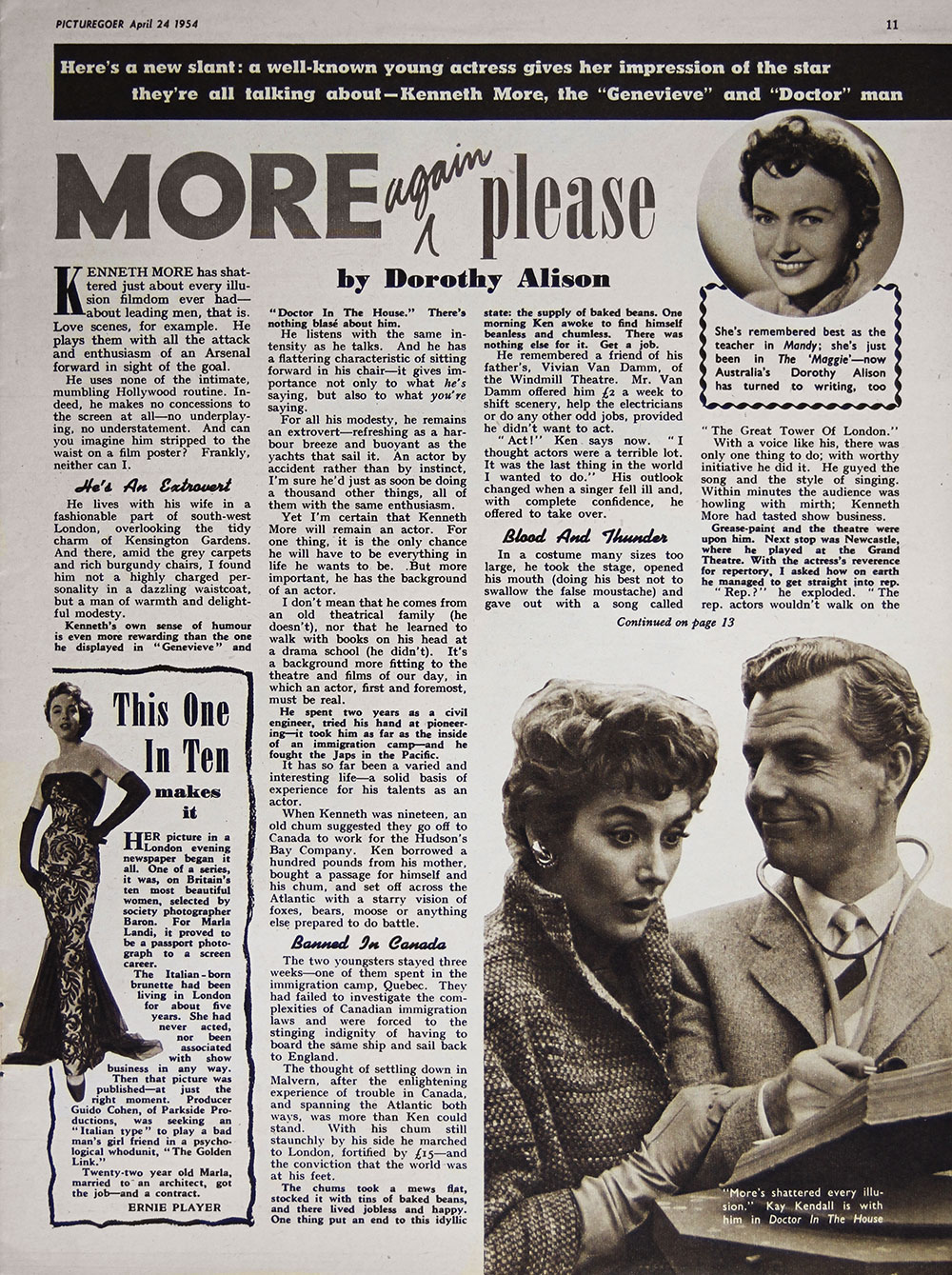
KENNETH MORE has shattered just about every illusion filmdom ever had – about leading men, that is. Love scenes, for example. He plays them with all the attack and enthusiasm of an Arsenal forward in sight of the goal.
He uses none of the intimate, mumbling Hollywood routine. Indeed, he makes no concessions to the screen at all – no underplaying, no understatement. And can you imagine him stripped to the waist on a film poster? Frankly, neither can I.
He’s An Extrovert
He lives with his wife in a fashionable part of south-west London, overlooking the tidy charm of Kensington Gardens. And there, amid the grey carpets and rich burgundy chairs, I found him not a highly charged personality in a dazzling waistcoat, but a man of warmth and delightful modesty.
Kenneth’s own sense of humour is even more rewarding than the one be displayed in “Genevieve” and “Doctor In The House.” There’s nothing blasé about him.
He listens with the same intensity as he talks. And he has a flattering characteristic of sitting forward in his chair – it gives importance not only to what he’s saying, but also to what you’re saying.
For all his modesty, he remains an extrovert – refreshing as a harbour breeze and buoyant as the yachts that sail it. An actor by accident rather than by instinct, I’m sure he’d just as soon be doing a thousand other things, all of them with the same enthusiasm.
Yet I’m certain that Kenneth More will remain an actor. For one thing, it is the only chance he will have to be everything in life be wants to be. But more important, he has the background of an actor.
I don’t mean that he comes from an old theatrical family (he doesn’t), nor that he learned to walk with books on his bead at a drama school (he didn’t). It’s a background more fitting to the theatre and films of our day, in which an actor, first and foremost, must be real.
He spent two years as a civil engineer, tried his hand at pioneering – it took him as far as the inside of an immigration camp – and he fought the Japs in the Pacific.
It has so far been a varied and interesting life – a solid basis of experience for his talents as an actor.
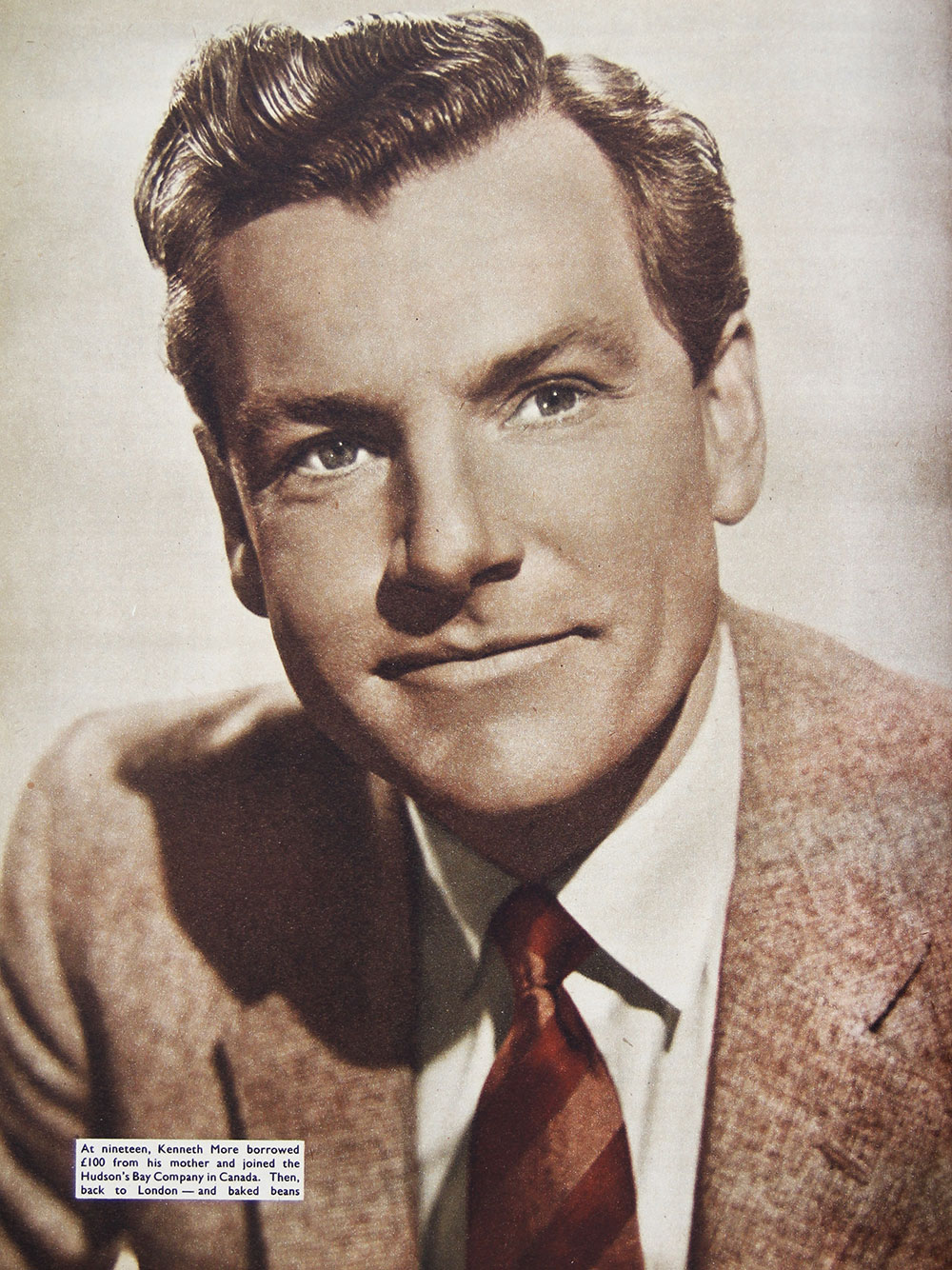
When Kenneth was nineteen, an old chum suggested they go off to Canada to work for the Hudson’s Bay Company. Ken borrowed a hundred pounds from his mother, bought a passage for himself and his chum, and set off across the Atlantic with a starry vision of foxes, bears. moose or anything else prepared to do battle.
Banned in Canada
The two youngsters stayed three weeks – one of them spent in the immigration camp, Quebec. They had failed to investigate the complexities of Canadian immigration laws and were forced to the stinging indignity of having to board the same ship and sail back to England.
The thought of settling down in Malvern, after the enlightening experience of trouble in Canada. and spanning the Atlantic both ways, was more than Ken could stand. With his chum still staunchly by his side he marched to London, fortified by £15 – and the conviction that the world was at his feet.
The chums, took a mews flat, stocked it with tins of baked beans, and there lived jobless and happy. One thing put an end to this idyllic state: the supply of baked beans. One morning Ken awoke to find himself beanless and chumless. There was nothing else for it. Get a job.
He remembered a friend of his father’s, Vivian Van Damm, of the Windmill Theatre. Mr. Van Damm offered him £2 a week to shift scenery, help the electricians or do any other odd jobs, provided he didn’t want to act.
“Act!” Ken says now. “I thought actors were a terrible lot. It was the last thing in the world I wanted to do.” His outlook changed when a singer fell ill and, with complete confidence, he offered to take over.
Blood and Thunder
In a costume many sizes too large, he took the stage, opened his mouth (doing his best not to swallow the false moustache) and gave out with a song called “The Great Tower Of London.”
With a voice like his, there was only one thing to do; with worthy initiative he did it. He guyed the song and the style of singing. Within minutes the audience was howling with mirth; Kenneth More had tasted show business.
Grease-paint and the theatre were upon him. Next stop was Newcastle, where he played at the Grand Theatre. With the actress’s reverence for repertory, I asked bow on earth he manqed to let straight into rep.
“Rep?” he exploded. “The rep. actors wouldn’t walk on the same side of the street. It was good old blood and thunder!”
More will take a risk – he won’t be typed as the man with the woodpecker laugh
Then, as if to quell any snobbishness I might have about rep. he said: “Spit and sawdust. And jolly good fun it was, too.”
After six months of it he did find his way into rep., however. He remained until the navy claimed him.
Postwar Struggle
His war years he dismissed with a fleeting reference to my home town, Sydney, where he spent a hilarious three weeks’ leave during the Pacific campaign. The brown eyes glowed and the grin widened. “Jolly good place, Sydney.”
The war over, Ken More returned to the jungle of theatre-land – just one more actor trying to pick up the threads of an interrupted career, only to find the gaps bad been filled by other actors, and that the memories of managements were short.
He managed to get a part in a play at the old Gateway Theatre, in London, and Michael Barry, who had a lot to say in the casting of television plays, saw him there. Result: a rôle in the first play to be televised from Alexandra Palace after the war – “The Silence Of The Sea.”
In those days television was not the potent force that it is now; the fifteen plays that Ken appeared in were soon forgotten by the small minority who owned TV sets. Bizarre waistcoats and “Genevieve” were still a long way off.
All this time, however, he was developing as a stage actor. He had good parts in good plays, but progress was slow. Alter appearing in Nöel Coward’s “Peace In Our Time,” he was out of work for twelve months. I suggested that for a man who would as soon do a thousand things as act, here was a splendid opportunity to start getting them done.
But no, be had preferred to wait. I asked him bow long he had been prepared to give it, and be said another twelve months. “And then what?”
He thought for a moment and then grinned that disarming grin. “I never really thought about it. I’m a fatalist. I was sure that something would turn up.”
Two things, you see, have mentally armour-plated Kenneth More for the precarious life of an actor: his sublime patience and his superb resilience. Even his disappointment at losing a job never outlasts a day, as he works on the optimistic, but usually unreliable theory that something better always turns up.
Quite A Turn-Up
In his case, he is completely justified. What better to turn up than “The Deep Blue Sea,” which established his reputation overnight on the London stage?
There were films all the time, but the parts were neither large nor memorable. Then came Genevieve. And here lies the hazard of success.
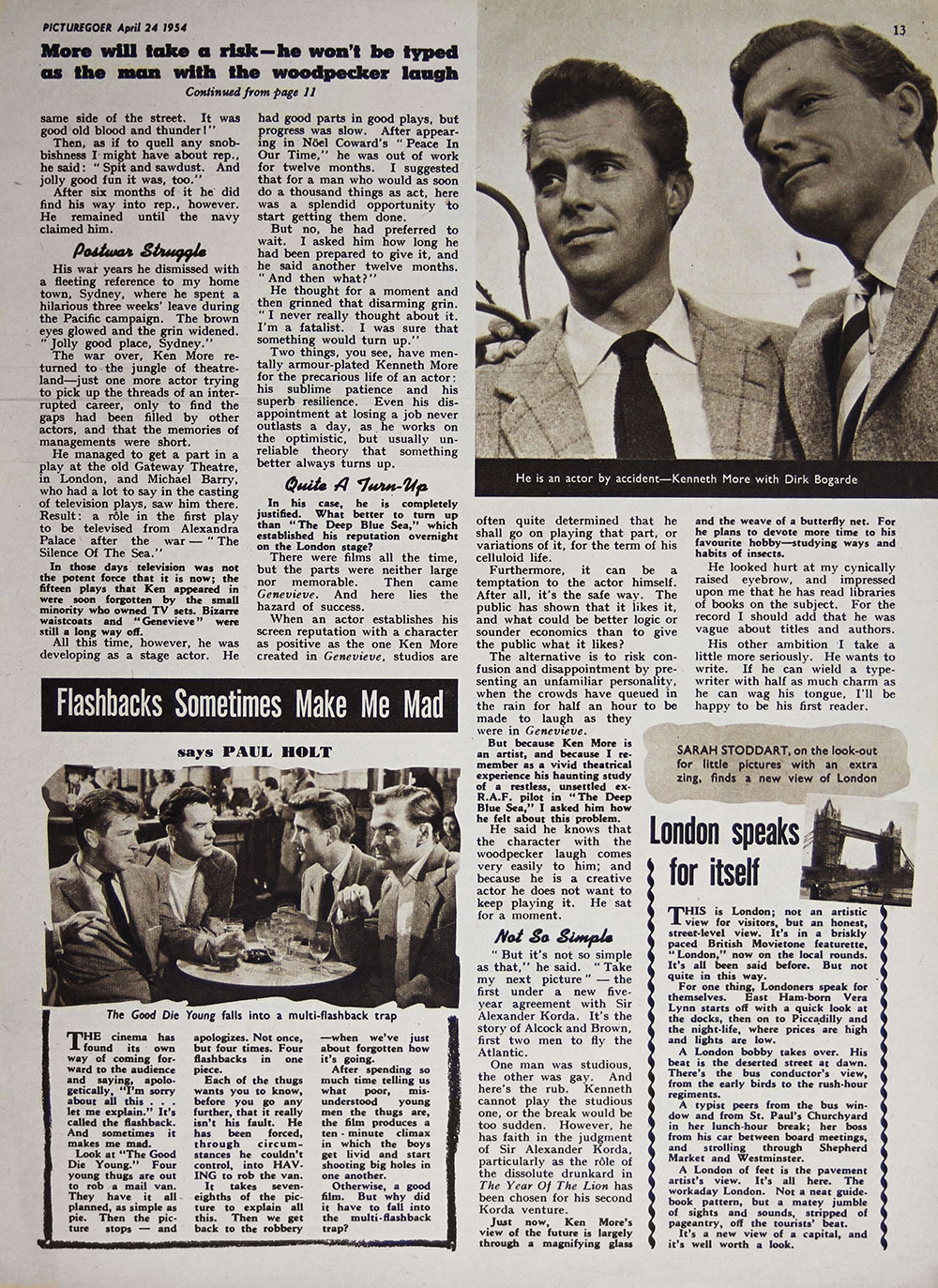
When an actor establishes his screen reputation with a character as positive as the one Ken More created in Genevieve, studios are often quite determined that he shall go on playing that part, or variations of it, for the term of his celluloid life.
Furthermore. it can be a temptation to the actor himself. After all, it’s the safe way. The public has shown that it likes it, and what could be better logic or sounder economics than to give the public what it likes?
The alternative is to risk confusion and disappointment by presenting an unfamiliar personality. when the crowds have queued in the rain for half an hour to be made to laugh as they were in Genevieve.
But because Ken More is an artist, and because I remember as a vivid theatrical experience his haunting study of a restless, unsettled ex-R.A.F. pilot in “The Deep Blue Sea,” I asked him how he felt about this problem.
He said be knows that the character with the woodpecker laugh comes very easily to him; and because be is a creative actor be does not want to keep playing it. He sat for a moment.
Not So Simple
“But it’s not so simple as that,” he said. “Take my next picture” – the first under a new five year agreement with Sir Alexander Korda. It’s the story of Alcock and Brown, first two men to fly the Atlantic.
One man was studious, the other was gay. And here’s the rub. Kenneth cannot play the studious one, or the break would be too sudden. However, he has faith in the judgment of Sir Alexander Korda, particularly as the rôle of the dissolute drunkard in The Year Of The Lion has been chosen for his second Korda venture.
Just now, Ken More’s view of the future is largely through a magnifying glass and the weave of a butterfly net. For he plans to devote more time to his favourite hobby – studying ways and habits of insects.
He looked hurt at my cynically raised eyebrow, and impressed upon me that he has read libraries of books on the subject. For the record I should add that he was vague about titles and authors.
His other ambition I take a little more seriously. He wants to write. If he can wield a typewriter with half as much charm as he can wag his tongue, I’ll be happy to be his first reader.

