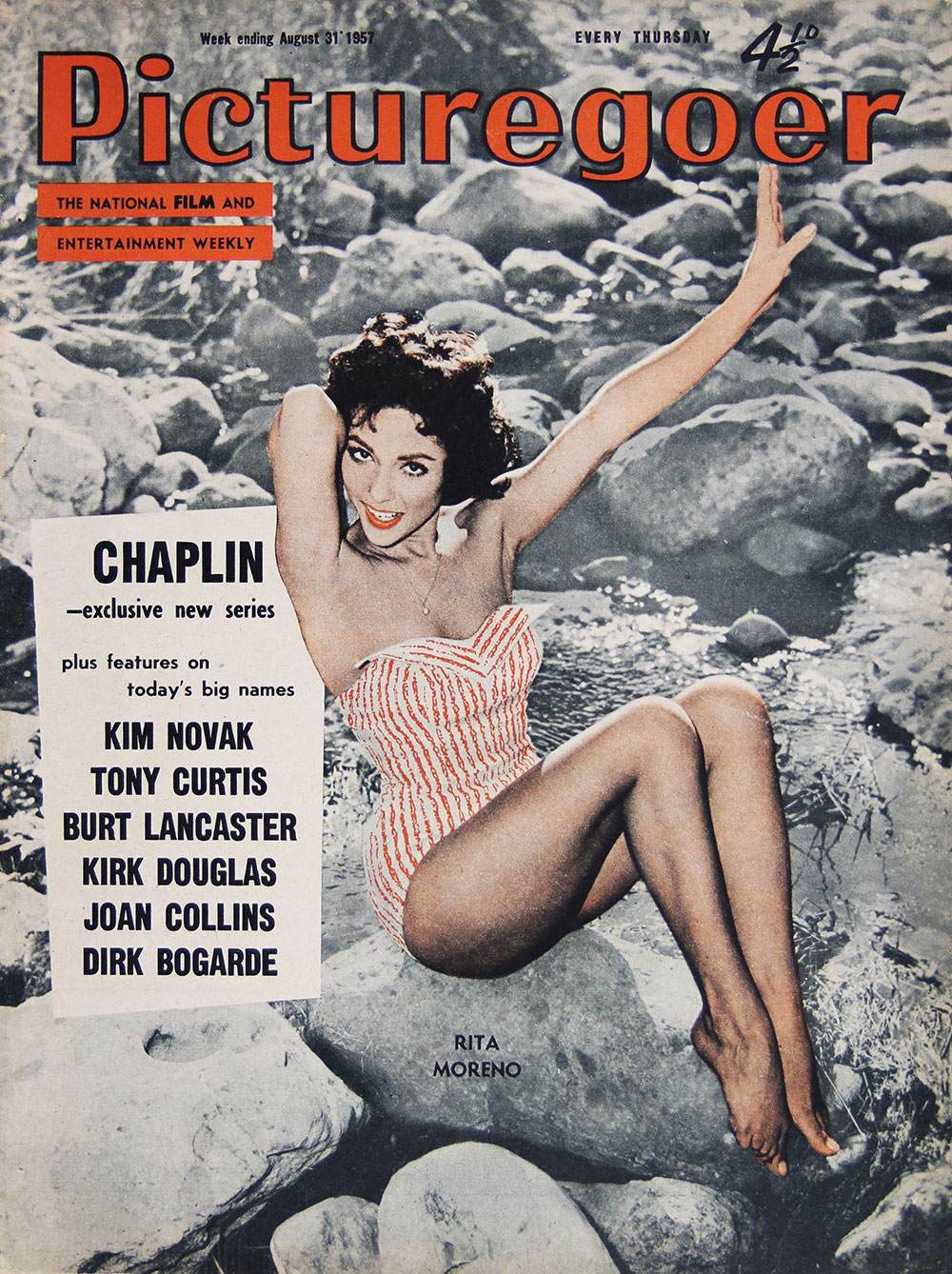
Picturegoer – Aug 31st 1957


BOGARDE REALLY UNDERSTANDS YOU
LONDON versus Hollywood – the whole story is in Dirk Bogarde’s “A Tale Of Two Cities.” Not the ancient Dickens novel but the new production. All London needs to beat Hollywood is more people in production who think like actors – good actors. How this combination works is being illustrated now. Have a look with me.
Take, first, the extraordinary grasp Bogarde has of his meaning and value for picturegoers. Sitting on a cold stone step in the ancient town of Bourges – the nearest thing left in France to Paris of the Revolution – Bogarde told me: “An actor has to keep climbing. What he thinks is the top may be only a ledge in the mist.
“He mustn’t repeat himself, mustn’t go back. I’ve made too many pictures that haven’t proved anything.”
Proving something, for Bogarde, includes playing Lawrence of Arabia on his schedule for next year and to this end A Tale Of Two Cities is a logical step.
Such A Shock
“I couldn’t go practically straight to Lawrence from Dr. Simon Sparrow. It would be too much of a shock for picturegoers. Besides, it wouldn’t give me a chance to prepare. An actor has to prepare, you know.
“I’m studying Lawrence’s habits and mannerisms, reading everything ever written about him, talking to all the people I can find who knew him – there were about five thousand and they all give a slightly different account of him.
“Of course, I can’t hope to look like him, but what I can do perhaps is to convey what he stood for.”
Bogarde’s “A Tale Of Two Cities” came into being through Betty Box, the producer who, with director Ralph Thomas, was responsible for the fabulously successful “Doctor” series – I would say Britain’s biggest cinema dollar-earners to date.
This Is Fate
“It was nearly two years ago, over dinner. I said: ‘I don’t fancy myself in doublet and hose, but I want to do something in the Regency period, or thereabouts.’ ‘Like what?’ said Betty, and I said: ‘Well, like A Tale Of Two Cities.’
To this, he recalls, Betty’s reaction was: “Well, isn’t life full of fate?” Her brother Sidney had just bought the rights. The picture was prepared for Bogarde as you would a glove for a hand.
“I particularly wanted Ralph Thomas to direct it because, aside from understanding each other so well, he knows what I did as Dr. Sparrow. If Simon shows up in any of Sidney Carton he’ll be the first to spot it and have it out.”
Bogarde is not playing the dual rôle of the young Paris aristocrat Darnay and the seedy London lawyer, Sidney Carton. Historically, every famous actor-manager on the stage has played both.
Strong Love Story
Ten years ago, a girl gave Bogarde a novel by Richard Mason called “The Wind Cannot Read.” She wrote on the fly-leaf: “Some day, when you’re a big film star, you might like to play this.”
And this is Bogarde’s next choice as his second step from Dr. Sparrow to the mystic, desert-fighting Lawrence of Arabia.
“It is a strong love story – something British films haven’t had for years – set in New Delhi in 1945·
“It is very sad and very beautiful. David Lean has done a script that just makes your tears come, it’s so beautiful,” added Bogarde.
From brave self-sacrifice to hopeless love, then to the dash and daredevilry of guerrilla fighting on horseback in the Arabian desert. It’s the Bogarde formula for keeping us dug in with Dirk – but what, you may well ask, can he possibly do for an encore?
“After that, I’m going to do Richard Of Bordeaux, the lovely play that John Gielgud was so fascinating in – and he’s promised to help me with it.
“Although she doesn’t know yet, I want Dorothy Tutin to play Catherine.”
Bogarde ants her in that rôle – it will be one of the most demanding for a girl that British films have ever known because he claims, as I do, that screen star quality in a person can be recognized: that a Box Office Personality is predictable.
In fact, he has very positive – sometimes profane – always explosive ideas on this country’s failure to find, or build, as many stars as it could and should.
Proving What?
Meanwhile, when Bogarde has played these four disparate rôles, what then? What, actually, will he have “proved”?
Natutally, I asked him for you. “Then? Ah! Assuming I’ve got away with them, I’ll be able to do anything: stand on my head, play ‘Charley’s Aunt’…”
It was an honest answer, but I honestly doubt that the heart-beat of his tremendous drive is the will to play “Charley’s Aunt.”
I suggest that Bogarde just doesn’t know why, as he once put it, he “has to act.” I hope he never finds out. HE MIGHT STOP.
NEXT WEEK: Bogarde on the wet-mouth school of star spotting. And what that has to do with Dorothy Tutin.

