Picturegoer – Nov 28ht 1959

How I battled with that piano!
by Dirk Bogarde
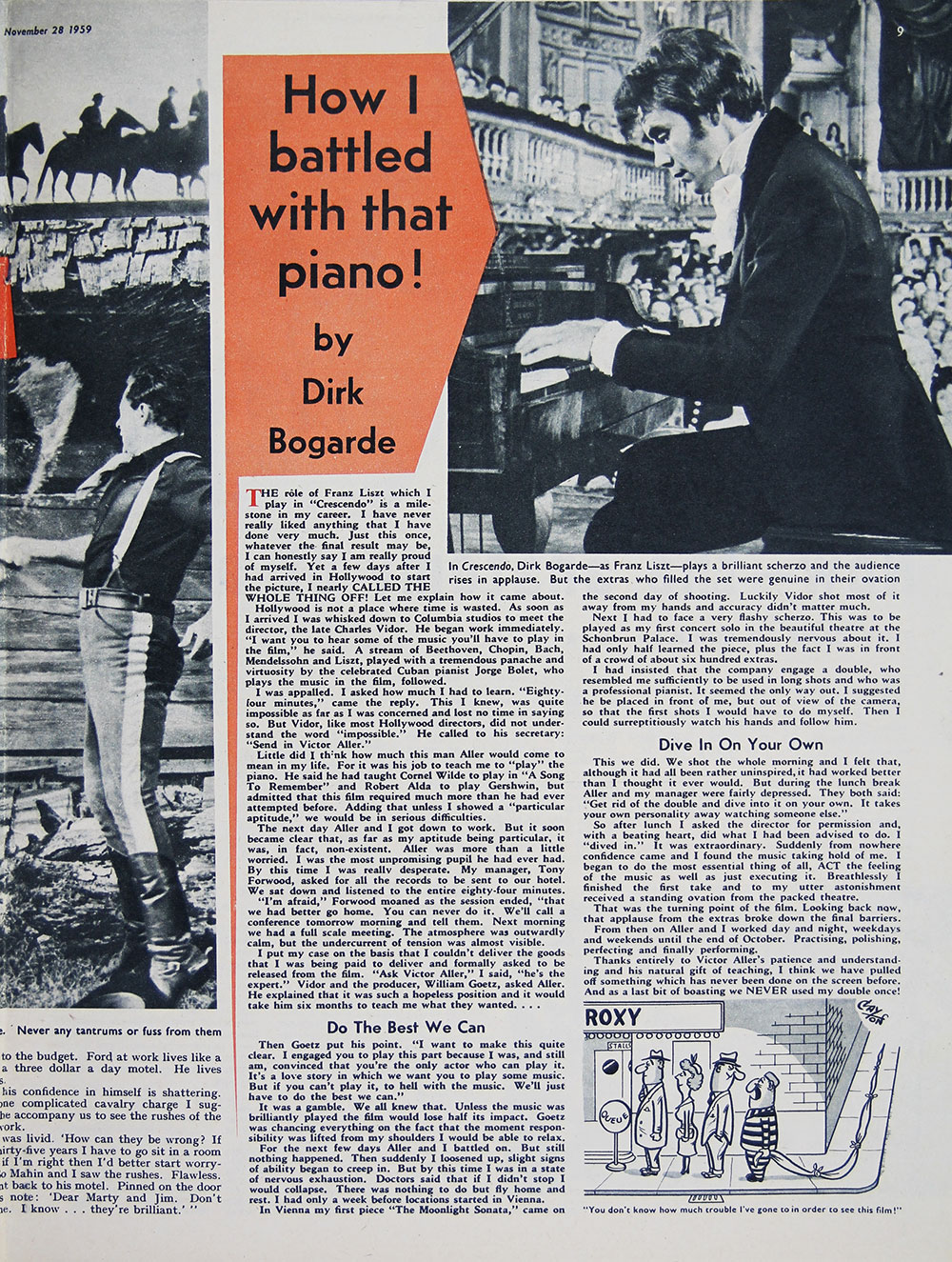
THE rôle of Franz Liszt which I play in “Crescendo” is a milestone in my career. I have never really liked anything that I have done very much. Just this once, whatever the final result may be, I can honestly say I am really proud of myself. Yet a few days after I had arrived in Hollywood to start the picture, I nearly CALLED THE WHOLE THING OFF! Let me explain how it came about.
Hollywood is not a place where time is wasted. As soon as I arrived I was whisked down to Columbia studios to meet the director, the late Charles Vidor. He began work immediately. “I want you to hear some of the music you’ll have to play in the film,” he said. A stream of Beethoven, Chopin, Bach, Mendelssohn and Liszt, played with a tremendous panache and virtuosity by the celebrated Cuban pianist Jorge Bolet, who plays the music in the film, followed.
I was appalled. I asked how much I had to learn. “Eighty· four minutes,” came the reply. This I knew, was quite impossible as far as I was concerned and lost no time in saying so. But Vidor, like most Hollywood directors, did not understand the word “impossible.” He called to his secretary: “Send in Victor Aller.”
Little did I think how much this man Aller would come to mean in my life. For it was his job to teach me to “play” the piano. He said he had taught Cornel Wilde to play in “A Song To Remember” and Robert Alda to play Gershwin, but admitted that this film required much more than he had ever attempted before. Adding that unless I showed a “particular aptitude,” we would be in serious difficulties.
The next day Aller and I got down to work. But it soon became clear that, as far as my aptitude being particular, it was, in fact, non-existent. Aller was more than a little worried. I was the most unpromising pupil he had ever had. By this time I was really desperate. My manager, Tony Forwood, asked for all the records to be sent to our hotel. We sat down and listened to the entire eighty-four minutes.
“I’m afraid,” Forwood moaned as the session ended, “that we had better go home. You can never do it. We’ll call a conference tomorrow morning and tell them. Next morning we had a full scale meeting. The atmosphere was outwardly calm, but the undercurrent of tension was almost visible.
I put my case on the basis that I couldn’t deliver the goods that I was being paid to deliver and formally asked to be released from the film. “Ask Victor Aller.” I said, “he’s the expert.” Vidor and the producer, William Goetz, asked Aller. He explained that it was such a hopeless position and it would take him six months to teach me what they wanted…
Do The Best We Can
Then Goetz put his point. “I want to make this quite clear. I engaged you to play this part because I was, and still am, convinced that you’re the only actor who can play it. It’s a love story in which we want you to play some music. But if you can’t play it, to hell with the music. We’ll just have to do the best we can.”
It was a gamble. We all knew that. Unless the music was brilliantly played the film would lose half its impact. Goetz was chancing everything on the fact that the moment responsibility was lifted from my shoulders I would be able to relax.
For the next few days Aller and I battled on. But still nothing happened. Then suddenly I loosened up, slight signs of ability began to creep in. But by this time I was in a state of nervous exhaustion. Doctors said that if I didn’t stop I would collapse. There was nothing to do but fly home and rest. I had only a week before locations started in Vienna.
In Vienna my first piece “The Moonlight Sonata,” came on the second day of shooting. Luckily Vidor shot most of it away from my hands and accuracy didn’t matter much.
Next I had to face a very flashy scherzo. This was to be played as my first concert solo in the beautiful theatre at the Schonbrun Palace. I was tremendously nervous about it. I had only half learned the piece, plus the fact I was in front of a crowd of about six hundred extras.
I had insisted that the company engage a double, who resembled me sufficiently to be used in long shots and who was a professional pianist. It seemed the only way out. I suggested he be placed in front of me, but out of view of the camera, so that the first shots I would have to do myself. Then I could surreptitiously watch his hands and follow him.
Dive In On Your Own
This we did. We shot the whole morning and I felt that, although it had all been rather uninspired, it had worked better than I thought it ever would. But during the lunch break Aller and my manager were fairly depressed. They both said: “Get rid of the double and dive into it on your own. It takes your own personality away watching someone else.”
So after lunch I asked the director for permission and, with a beating heart, did what I had been advised to do. I “dived in.” It was extraordinary. Suddenly from nowhere confidence came and I found the music taking hold of me. I began to do the most essential thing of all, ACT the feeling of the music as well as just executing it. Breathlessly I finished the first take and to my utter astonishment received a standing ovation from the packed theatre.
That was the turning point of the film. Looking back now, that applause from the extras broke down the final barriers.
From then on Aller and I worked day and night, weekdays and weekends until the end of October. Practising, polishing, perfecting and finally performing.
Thanks entirely to Victor Aller’s patience and understanding and his natural gift of teaching, I think we have pulled off something which has never been done on the screen before. And as a last bit of boasting we NEVER used my double once!

