Plays and Players – Nov 1965


This month Plays and Players concludes its backward glance at the last fifty years of theatre with a look at 1956. Peter Ansorge writes of the year in which Look Back In Anger opened at the Royal Court and the Berliner Ensemble arrived at the Palace a few days after the death of Brecht.
All our yesterdays – 1956
Peter Ansorge
Read this:
‘What is in your mind, Harry?
I can guess about the past and what
you mean about the future
But a present is missing: needed to connect them.’
So, prophetically, spoke Agatha in T S Eliot’s The Family Reunion, revived by Peter Brook at the Phoenix Theatre during the summer of 1956. It would be hard to imagine a more cogent testimony to the troubles and triumphs of the English theatre in 1956. This was a year obsessed with the ritual empires of the past, awed by the future and frightened by the present. For the first time in 30 years, the stable framework of the English stage, its family reunions and cocktail parties, had been threatened. Outside the windows of Eliot’s drawing room poetic-drama, lurked the hideous spectre of the ancient furies unable to find accommodation. What Agatha searches for, is precisely the promised land which had eluded Eliot himself; a drama which would unleash the furies upon the stage, and so enable the English theatre to find a ‘connection’ with the present.
In January, 1956, Theatre World lamented over the past year as having been ‘uninspiring … in regard to new plays from new English writers’. Yet the same issue carried an interview with the designer, James Bailey, which poses the ideal of a ‘dream picture, a visual impression, conjured up by any given theme’, for a stage setting. Bailey designed for two Peter Hall productions that year, Ugo Betti’s Summertime at the Apollo, and Love’s Labour’s Lost at Stratford. In each production the designer boldly sought for the ‘abstract’ with ‘no pretence of realism’. ‘Escapism? ‘, asks the interviewer, ‘Maybe … for does not the very charm of the theatre lie in the escape from humdrum realities?’ It is significant that 1956, the fiftieth anniversary of Ibsen’s death, saw not one new production from the Norwegian genius’ mighty ouvre in the West End. The year was full of death-bed speeches for naturalism. ‘The realist theatre is dead,’ ran the June editorial of Plays and Players. The feeling that fourth-wall illusion was a strait-jacket for a live theatre, facing the new competition of television (ITA had opened in Sept., 1955), explains the emphasis Bailey gives to an abstract, dream setting. It also helps us to chart the reason for the year’s romantic yet uneasy flirtation with the past.
‘Theatre’s Fairyland is flourishing,’ pronounced Theatre World, as the public rushed to pantomimes, Peter Pan, The Pajama Game and The Boy Friend. While on the serious front, Anouilh’s Waltz of the Toreadors, directed by Peter Hall, showed Hugh Griffith stepping in time to the twilight music of a pre-first World War French general, cynically rasping at his life while trying to make love to the maid. (One of the year’s hits.) Empire-fetishism also accounts for Tyrone Guthrie’s successful updating, at the Old Vie, of Troilus and Cressida to Imperial Germany struggling with the passions of the Edwardian officer class. The crucial word in the reviews of the year is ‘atmosphere’; a sense of style, panache, glitter, seemingly lost in the naturalistic desert of the Welfare State, was demanded and sought after with much delight.
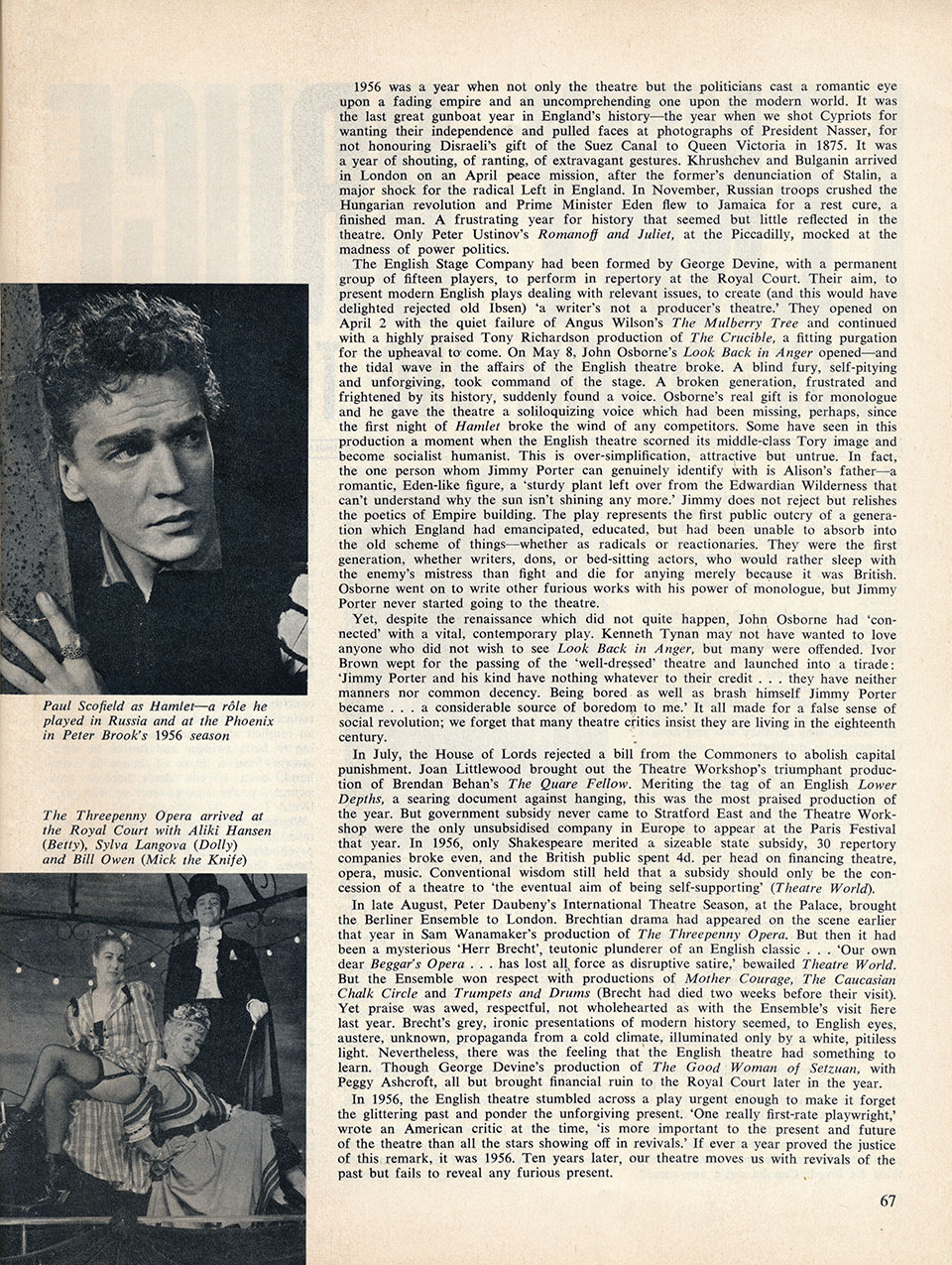
This is seen most clearly in the year’s treatment of its ‘revivals of the past’. Peter Brook began his season at the Phoenix with Paul Scofield’s Hamlet, recently back from a Moscow tour (the first English production to go to Russia since 1917). Seven years previously, this Hamlet had been hailed as a great romantic reading of the role, now it was greeted with puzzlement. ‘The new Mr Scofield protests too much,’ objected Tynan. Plays and Players complained that the production emphasised pace without poetry. The critics had come, perhaps, expecting to see an image of their own hopes; a Hamlet clinging to the past, mourning for the passing of Feudal ritual and chastising the coming of the modern world. Instead they saw a Hamlet who had come unstuck from all worlds and pageantry-one, angry in speech and action. This sour Prince brooding in his incestuous sty was too near humdrum human reality for most. At Stratford in the summer, Alan Badel played Hamlet upon a stage stripped bare of scenery or decoration. It was typical of the year’s version of Shakespeare in the wilderness. The emphasis was entirely upon austere abstraction, a private poetics shaped out of nothing – taking place now in Edwardian England, now in a black cavern, now – as Gielgud’s Lear of the previous year – somewhere upon the moon, with Richard Burton playing Othello, at the Old Vie, one night and Iago the next. The idea that Shakespeare’s Histories could be played in the confused world of modern politics, or King Lear in the theatre of the absurd, or Hamlet upon the terrain of teenage apathy- was still far distant in the careers of Peter Hall and Peter Brook.
1956 was a year when not only the theatre but the politicians cast a romantic eye upon a fading empire and an uncomprehending one upon the modern world. It was the last great gunboat year in England’s history – the year when we shot Cypriots for wanting their independence and pulled faces at photographs of President Nasser, for not honouring Disraeli’s gift of the Suez Canal to Queen Victoria in 1875. It was a year of shouting, of ranting, of extravagant gestures. Khrushchev and Bulganin arrived in London on an April peace mission, after the former’s denunciation of Stalin, a major shock for the radical Left in England. In November, Russian troops crushed the Hungarian revolution and Prime Minister Eden flew to Jamaica for a rest cure, a finished man. A frustrating year for history that seemed but little reflected in the theatre. Only Peter Ustinov’s Romanoff and Juliet, at the Piccadilly, mocked at the madness of power politics.
The English Stage Company had been formed by George Devine, with a permanent group of fifteen players, to perform in repertory at the Royal Court. Their aim, to present modern English plays dealing with relevant issues, to create (and this would have delighted rejected old Ibsen) ‘a writer’s not a producer’s theatre.’ They opened on April 2 with the quiet failure of Angus Wilson’s The Mulberry Tree and continued with a highly praised Tony Richardson production of The Crucible, a fitting purgation for the upheaval to come. On May 8, John Osborne’s Look Back in Anger opened – and the tidal wave in the affairs of the English theatre broke. A blind fury, self-pitying and unforgiving, took command of the stage. A broken generation, frustrated and frightened by its history, suddenly found a voice. Osborne’s real gift is for monologue and he gave the theatre a soliloquizing voice which had been missing, perhaps, since the first night of Hamlet broke the wind of any competitors. Some have seen in this production a moment when the English theatre scorned its middle-class Tory image and become socialist humanist. This is over-simplification, attractive but untrue. In fact, the one person whom Jimmy Porter can genuinely identify with is Alison’s father – a romantic, Eden-like figure, a ‘sturdy plant left over from the Edwardian Wilderness that can’t understand why the sun isn’t shining any more.’ Jimmy does not reject but relishes the poetics of Empire building. The play represents the first public outcry of a generation which England had emancipated, educated, but had been unable to absorb into the old scheme of things- whether as radicals or reactionaries. They were the first generation, whether writers, dons, or bed-sitting actors, who would rather sleep with the enemy’s mistress than fight and die for anything merely because it was British. Osborne went on to write other furious works with his power of monologue, but Jimmy Porter never started going to the theatre.
Yet, despite the renaissance which did not quite happen, John Osborne had ‘connected’ with a vital, contemporary play. Kenneth Tynan may not have wanted to love anyone who did not wish to see Look Back in Anger, but many were offended. Ivor Brown wept for the passing of the ‘ well-dressed’ theatre and launched into a tirade: ‘Jimmy Porter and his kind have nothing whatever to their credit… they have neither manners nor common decency. Being bored as well as brash himself Jimmy Porter became… a considerable source of boredom to me.’ It all made for a false sense of social revolution; we forget that many theatre critics insist they are living in the eighteenth century.
In July, the House of Lords rejected a bill from the Commoners to abolish capital punishment. Joan Littlewood brought out the Theatre Workshop’s triumphant production of Brendan Behan’s The Quare Fellow. Meriting the tag of an English Lower Depths, a searing document against hanging, this was the most praised production of the year. But government subsidy never came to Stratford East and the Theatre Workshop were the only unsubsidised company in Europe to appear at the Paris Festival that year. In 1956, only Shakespeare merited a sizeable state subsidy, 30 repertory companies broke even, and the British public spent 4d. per head on financing theatre, opera, music. Conventional wisdom still held that a subsidy should only be the concession of a theatre to ‘the eventual aim of being self-supporting’ (Theatre World).
In late August, Peter Daubeny’s International Theatre Season, at the Palace, brought the Berliner Ensemble to London. Brechtian drama had appeared on the scene earlier that year in Sam Wanamaker’s production of The Threepenny Opera. But then it had been a mysterious ‘Herr Brecht’, teutonic plunderer of an English classic … ‘Our own dear Beggar’s Opera… has lost all force as disruptive satire,’ bewailed Theatre World. But the Ensemble won respect with productions of Mother Courage, The Caucasian Chalk Circle and Trumpets and Drums (Brecht had died two weeks before their visit). Yet praise was awed, respectful, not wholehearted as with the Ensemble’s visit here last year. Brecht’s grey, ironic presentations of modern history seemed, to English eyes, austere, unknown, propaganda from a cold climate, illuminated only by a white, pitiless light. Nevertheless, there was the feeling that the English theatre had something to learn. Though George Devine’s production of The Good Woman of Setzuan, with Peggy Ashcroft, all but brought financial ruin to the Royal Court later in the year.
In 1956, the English theatre stumbled across a play urgent enough to make it forget the glittering past and ponder the unforgiving present. ‘One really first-rate playwright,’ wrote an American critic at the time, ‘is more important to the present and future of the theatre than all the stars showing off in revivals.’ If ever a year proved the justice of this remark, it was 1956. Ten years later, our theatre moves us with revivals of the past but fails to reveal any furious present.

