Radio Times – Dec 15th 2001
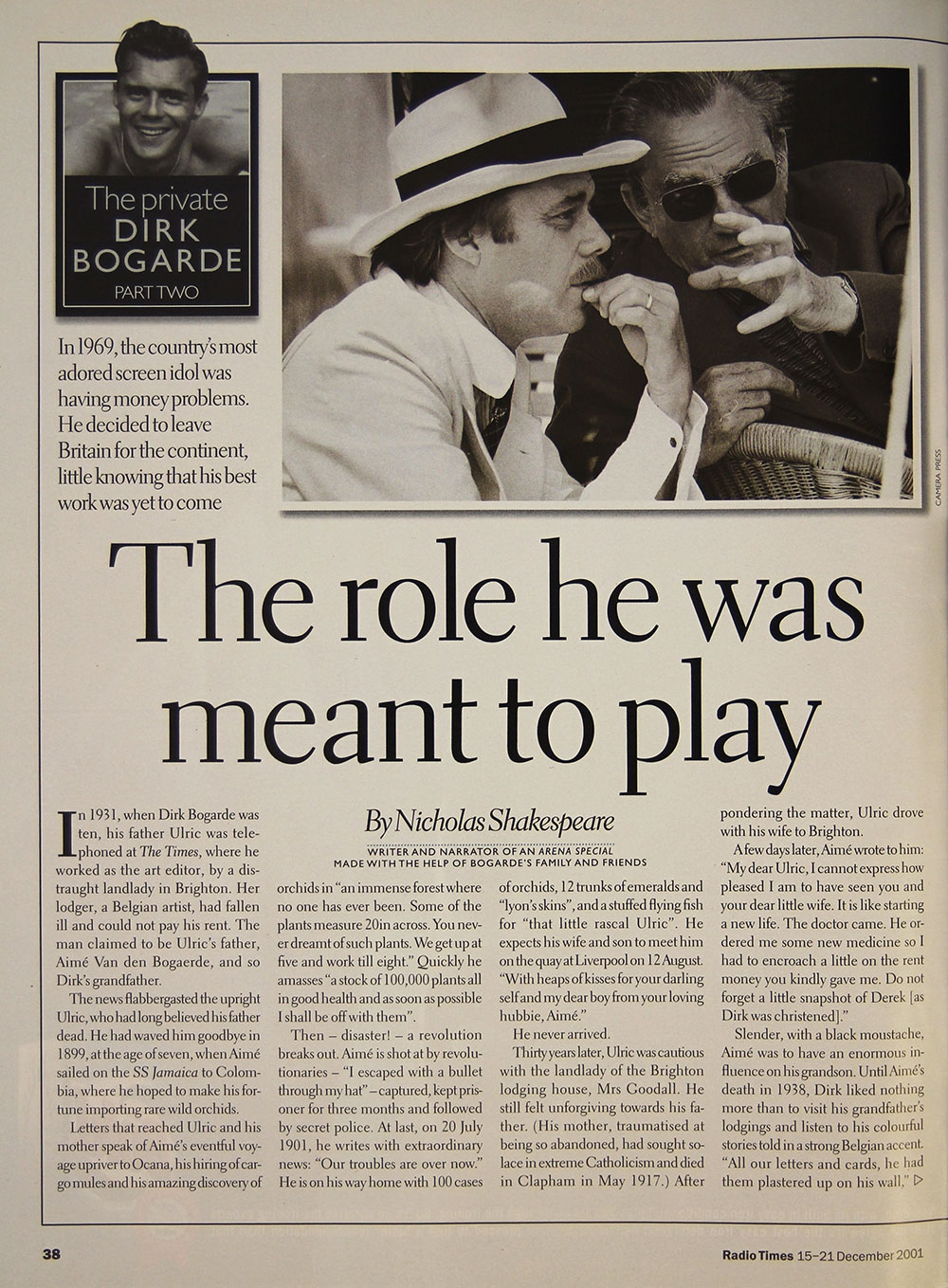

The Private Dirk Bogarde: Part Two
In 1969, the country’s most adored screen idol was having money problems. He decided to leave Britain for the continent, little knowing that his best work was yet to come
The role he was meant to play
By Nicolas Shakespeare
Writer and narrator of an Arena special made with the help of Bogarde’s family and friends
In 1931, when Dirk Bogarde was ten, his father Ulric was telephoned at The Times, where he worked as the art editor, by a distraught landlady in Brighton. Her lodger, a Belgian artist, had fallen ill and could not pay his rent. The man claimed to be Ulric’s father, Aimé Van den Bogaerde, and so Dirk’s grandfather.
The news flabbergasted the upright Ulric, who had long believed his father dead. He had waved him goodbye in 1899, at the age of seven, when Aimé sailed on the SS Jamaica to Colombia, where he hoped to make his fortune importing rare wild orchids.
Letters that reached Ulric and his mother speak of Aimé’s eventful voyage upriver to Ocana, his hiring of cargo mules and his amazing discovery of orchids in “an immense forest where no one has ever been. Some of the plants measure 20in across. You never dreamt of such plants. We get up at five and work till eight.” Quickly he amasses “a stock of 100,000 plants all in good health and as soon as possible I shall be off with them”.
Then – disaster! – a revolution breaks out. Aimé is shot at by revolutionaries – “I escaped with a bullet through my hat” -captured, kept prisoner for three months and followed by secret police. At last, on 20 July 1901, he writes with extraordinary news: “Our troubles are over now.” He is on his way home with 100 cases of orchids, 12 trunks of emeralds and “lyon’s skins”, and a stuffed flying fish for “that little rascal Ulric”. He expects his wife and son to meet him on the quay at Liverpool on 12 August. “With heaps of kisses for your darling self and my dear boy from your loving hubbie, Aimé.”
He never arrived.
Thirty years later, Ulric was cautious with the landlady of the Brighton lodging house, Mrs Goodall. He still felt unforgiving towards his father. (His mother, traumatised at being so abandoned, had sought solace in extreme Catholicism and died in Clapham in May 1917.) After pondering the matter, Ulric drove with his wife to Brighton.
A few days later, Aimé wrote to him: “My dear Ulric, I cannot express how pleased I am to have seen you and your dear little wife. It is like starting a new life. The doctor came. He ordered me some new medicine so I had to encroach a little on the rent money you kindly gave me. Do not forget a little snapshot of Derek [as Dirk was christened].”
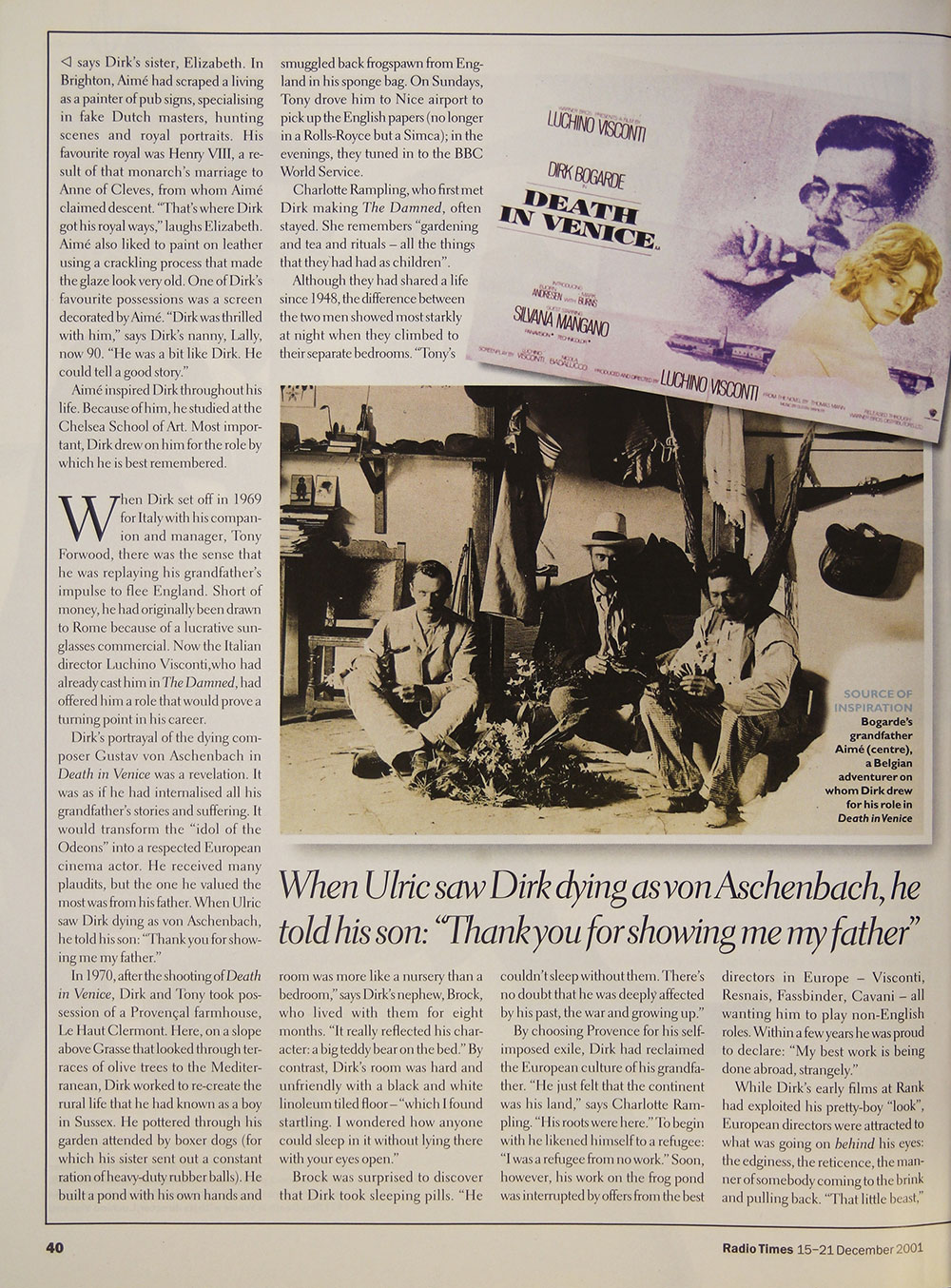
Slender, with a black moustache, Aimé was to have an enormous influence on his grandson. Until Aime’s death in 1938, Dirk liked nothing more than to visit his grandfather’s lodgings and listen to his colourful stories told in a strong Belgian accent.
“All our letters and cards, he had them plastered up on his wall,” says Dirk’s sister, Elizabeth. In Brighton, Aimé had scraped a living as a painter of pub signs, specialising in fake Dutch masters, hunting scenes and royal portraits. His favourite royal was Henry VIII, a result of that monarch’s marriage to Anne of Cleves, from whom Aimé claimed descent.
“That’s where Dirk got his royal ways,” laughs Elizabeth.
Aimé also liked to paint on leather using a crackling process that made the glaze look very old. One of Dirk’s favourite possessions was a screen decorated by Aimé.
“Dirk was thrilled with him,” says Dirk’s nanny, Lally, now 90. “He was a bit like Dirk. He could tell a good story.”
Aimé inspired Dirk throughout his life. Because of him, he studied at the Chelsea School of Art. Most important, Dirk drew on him for the role by which he is best remembered.
When Dirk set off in 1969 for Italy with his companion and manager, Tony Forwood, there was the sense that he was replaying his grandfather’s impulse to flee England. Short of money, he had originally been drawn to Rome because of a lucrative sunglasses commercial. Now the Italian director Luchino Visconti, who had already cast him in The Damned, had offered him a role that would prove a turning point in his career.
Dirk’s portrayal of the dying composer Gustav von Aschenbach in Death in Venice was a revelation. It was as if he had internalised all his grandfather’s stories and suffering. It would transform the “idol of the Odeons” into a respected European cinema actor. He received many plaudits, but the one he valued the most was from his father. When Ulric saw Dirk dying as von Aschenbach, he told his son: “Thank you for showing me my father.”
When Ulric saw Dirk dying as von Aschenbach, he told his son: “Thank you for showing me my father.”
In 1970, after the shooting of Death in Venice, Dirk and Tony took possession of a Provençal farmhouse, Le Haul Clermont. Here, on a slope above Grasse that looked through terraces of olive trees to the Mediterranean, Dirk worked to re-create the rural life that he had known as a boy in Sussex. He pottered through his garden attended by boxer dogs (for which his sister sent out a constant ration of heavy-duty rubber balls). He built a pond with his own hands and smuggled back frogspawn from England in his sponge bag. On Sundays, Tony drove him to Nice airport to pick up the English papers (no longer in a Rolls-Royce but a Simca); in the evenings, they tuned in to the BBC World Service.
Charlotte Rampling, who first met Dirk making The Damned, often stayed. She remembers “gardening and tea and rituals – all the things that they had had as children”.
Although they had shared a life since 1948, the difference between the two men showed most starkly at night when they climbed to their separate bedrooms.
“Tony’s room was more like a nursery than a bedroom,” says Dirk’s nephew, Brock, who lived with them for eight months. “It really reflected his character: a big teddy bear on the bed.”
By contrast, Dirk’s room was hard and unfriendly. With a black and white linoleum tiled floor – “which I found startling. I wondered how anyone could sleep in it without lying there with your eyes open.”
Brock was surprised to discover that Dirk took sleeping pills. “He couldn’t sleep without them. There’s no doubt that he was deeply affected by his past, the war and growing up.”
By choosing Provence for his self-imposed exile, Dirk had reclaimed the European culture of his grandfather. “He just felt that the continent was his land,” says Charlotte Rampling. “His roots were here.” To begin with he likened himself to a refugee:
“I was a refugee from no work.” Soon, however, his work on the frog pond was interrupted by offers from the best directors in Europe – Visconti, Renais, Fassbinder, Cavani – all wanting him to play non-English roles. Within a few years he was proud to declare: “My best work is being done abroad, strangely.”
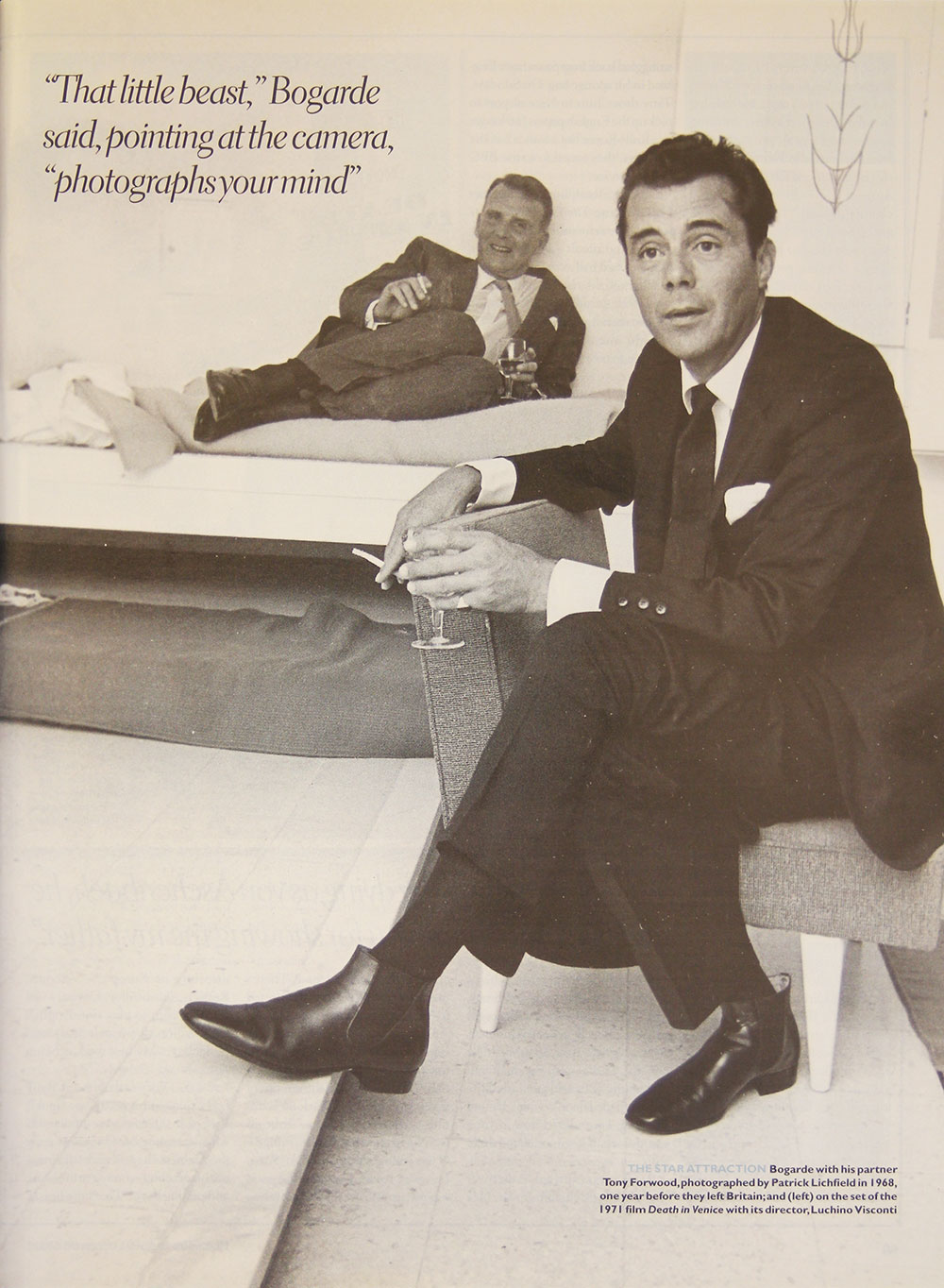
While Dirk’s early films at Rank had exploited his pretty-boy “look”, European directors were attracted to what was going on behind his eyes: the edginess, the reticence, the manner of somebody coming to the brink and pulling back. “That little beast,” Bogarde once said, pointing at the camera, “photographs your mind.” Michael York, who worked with him in Accident, says: “You could almost hear Dirk thinking.” York refers to him as “the master of the raised eyebrow”. His most magnetic roles, such as Gustav von Aschenbach in Death in Venice, require him hardly to speak at all.
Dirk’s quality of mystery and stillness is why Charlotte Rampling rates him “one of the finest screen actors of the century” She says: “He’s one of the actors who gets closest to making it possible for the spectator to actually feel that they are inside his thoughts and know what he’s thinking. It’s about silence and it’s about allowing the camera to invade you. It’s a magnetic quality. You are compelled to look. And the more you look, the more you’re drawn into that person. And Dirk had this in a very, very strong way.”
But what was Dirk thinking exactly? Off screen as well as on, he guarded his mystery with a ferocity that permitted few people, perhaps not even Tony, to discover what lay under his crab-shell. “I was probably as close as anyone could get to Dirk,” says Rampling. “But if you approached too close – baff, he’d close the door.” Once closed, there were no return paths. He was capable of huge gentleness, but he was also waspish, humiliating, intolerant. “If you did him a wrong turn,” says his sister Elizabeth, “end of story – even if you went on your knees and said ‘I’m sorry’. He was totally unforgiving.”
Dirk’s dread of losing control is hinted at in his punctuality. If you were late he would not answer the door and you could hear him behind it, whistling. “Dirk never waited for people who were late,” says his nephew Brock.
This dread provided the tension in his film roles, where his level of neurosis acts like a vibrating wire. Only with his screen personae did he risk losing himself. He was able to be possessed by the characters he chose to play and to give them his emotional investment, often to the point of obsession, for the very reason that they echoed troubled aspects of himself.
In Death in Venice he not so much played Aschenbach as became him. For most of the shoot he ate apart from the crew and fed himself on boiled potatoes and fish. “He was always sitting by himself,” remembers Bjorn Andresen, who acted the young boy, Tadzio. Charlotte Rampling once went to visit him on set. “I didn’t stay long. Aschenbach is not great company.” She observes: “He was haunted by his characters and they sort of morphed into him.”
After Aschenbach, perhaps no part became Dirk more than the character he played opposite Rampling in The Night Porter: Max, the former officer of a German concentration camp. In 1945, as a young lieutenant in reconnaissance, Dirk had entered the newly liberated camps of Soltau and Bergen-Belsen. Somewhere in the tree-dappled shadow outside Hanover, his tent peg had slipped into a mass grave. His visual recall was so powerful that he could barely speak of what he had seen without weeping. “The thing about filming,” says Rampling, “is it can be a form of exorcism. I think the reason he eventually wanted to do The Night Porter was to somehow release himself of the guilt, of the terrors that he’d been through in the war.”
She watched him in the dawn as they prepared to film in Vienna. “You could just feel the churning, the churning, the churning. He was like a bleeding person.”
Brock remembers staying with Dirk after he had finished filming Fassbinder’s Despair in 1977. “He was still in character. He spoke in a German accent the whole time. It was quite strange having a German uncle all of a sudden.”
In over 60 films spanning half a century, Dirk had, if you like, compensated for his mother’s thwarted passion to be an actress. It was in France, in a small room overlooking his frog pond, that he began his second career as a writer, thereby fulfilling his father’s original ambition for him to join The Times.
Dirk owed his new opportunity to a small, somewhat hunched insomniac called Norah Smallwood, who ran the publishing firm Chatto and Windus. Not a salacious person, nor often given to wit, she announced to a surprised editorial meeting: “Last night, I was listening to this interview on the wireless and there was this man called Dick Buggered and he was absolutely fascinating talking about his life. Who could it possibly be?”
After much head-scratching, Geoffrey Trevelyan said: “I think you mean Dirk Bogarde.”
“Well, whoever.”
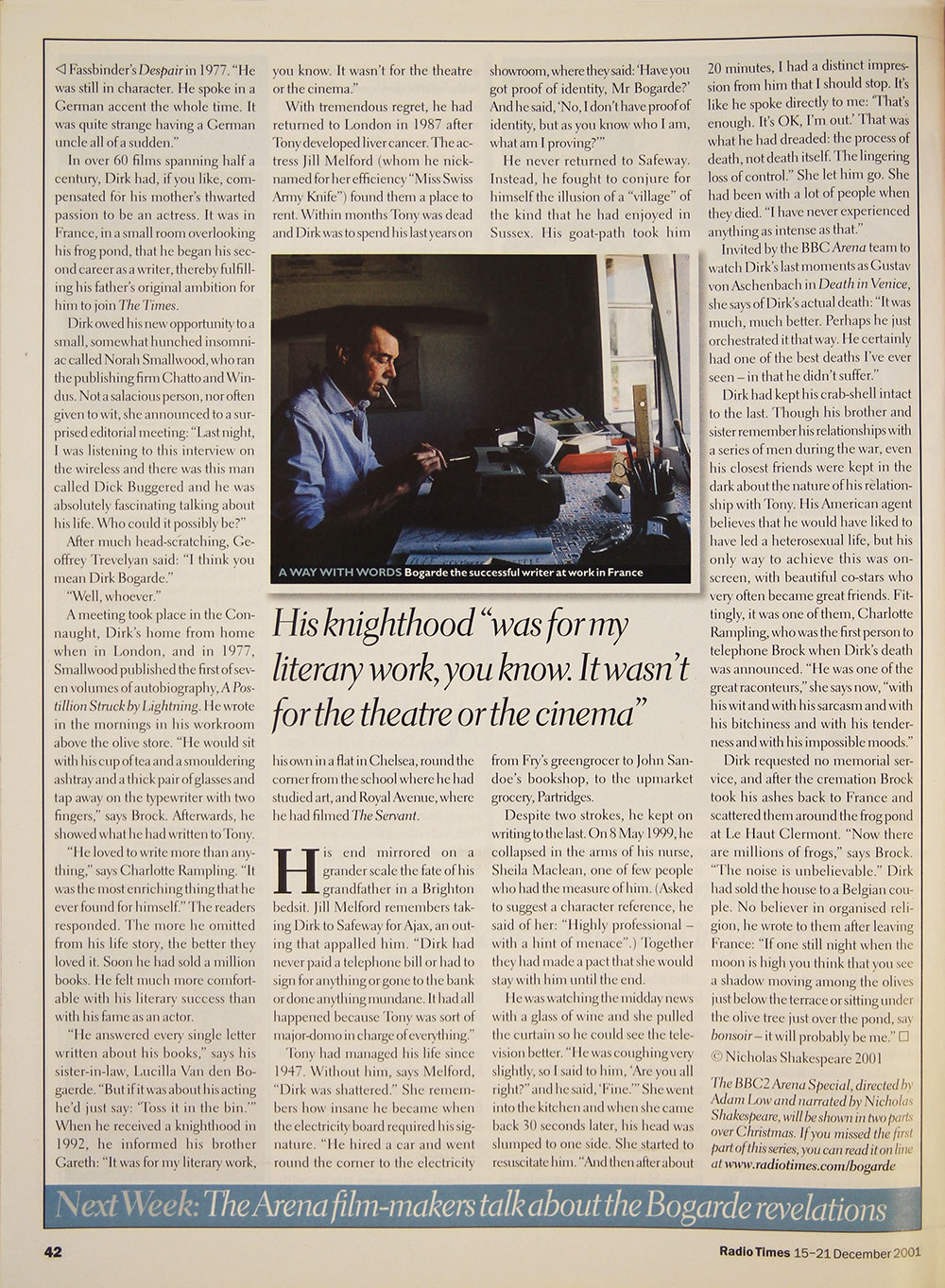
A meeting took place in the Connaught, Dirk’s home from home when in London, and in 1977, Smallwood published the first of seven volumes of autobiography, A Postillion Struck by Lightning. He wrote in the mornings in his workroom above the olive store. “He would sit with his cup of tea and a smouldering ashtray and a thick pair of glasses and tap away on the typewriter with two fingers,” says Brock. Afterwards, he showed what he had written to Tony.
“He loved to write more than anything,” says Charlotte Rampling. “It was the most enriching thing that he ever found for himself.” The readers responded. The more he omitted from his life story, the better they loved it. Soon he had sold a million books. He felt much more comfortable with his literary success than with his fame as an actor.
“He answered every single letter written about his books,” says his sister-in-law, Lucilla Van den Bogaerde. “But if it was about his acting he’d just say: ‘Toss it in the bin.'” When he received a knighthood in 1992, he informed his brother Gareth: “It was for my literary work, you know. It wasn’t for the theatre or the cinema.”
With tremendous regret, he had returned to London in 1987 after Tony developed liver cancer. The actress Jill Melford (whom he nick-named for her efficiency “Miss Swiss Army Knife”) found them a place to rent. Within months Tony was dead and Dirk was to spend his last years on his own in a flat in Chelsea, round the corner from the school where he had studied art, and Royal Avenue, where he had filmed The Servant.
His knighthood “was for my literary work, you know. It wasn’t for the theatre or the cinema”
His end mirrored on a grander scale the fate of his grandfather in a Brighton bedsit. Jill Melford remembers taking Dirk to Safeway for Ajax, an outing that appalled him. “Dirk had never paid a telephone bill or had to sign for anything or gone to the bank or done anything mundane. It had all happened because Tony was sort of major-domo in charge of everything.”
Tony had managed his life since 1947. Without him, says Melford, “Dirk was shattered.” She remembers how insane he became when the electricity board required his signature. “He hired a car and went round the corner to the electricity showroom, where they said: ‘Have you got proof of identity, Mr Bogarde?’ And he said,’No, I don’t have proof of identity, but as you know who I am, what am I proving?'”
He never returned to Safeway. Instead, he fought to conjure for himself the illusion of a “village” of the kind that he had enjoyed in Sussex. His goat-path took him from Fry’s greengrocer to John Sandoe’s bookshop, to the upmarket grocery, Partridges.
Despite two strokes, he kept on writing to the last. On 8 May 1999, he collapsed in the arms of his nurse, Sheila Maclean, one of few people who had the measure of him. (Asked to suggest a character reference, he said of her: “Highly professional – with a hint of menace”.) Together they had made a pact that she would stay with him until the end.
He was watching the midday news with a glass of wine and she pulled the curtain so he could see the television better.”He was coughing very slightly, so I said to him, ‘Are you all right?” and he said, ‘Fine.'” She went into the kitchen and when she came back 30 seconds later, his head was slumped to one side. She started to resuscitate him. “And then after about 20 minutes, I had a distinct impression from him that I should stop. It’s like he spoke directly to me: ‘That’s enough. It’s OK, I’m out.’ That was what he had dreaded: the process of death, not death itself. The lingering loss of control.” She let him go. She had been with a lot of people when they died. “I have never experienced anything as intense as that.”
Invited by the BBC Arena team to watch Dirk’s last moments as Gustav von Aschenbach in Death in Venice, she says of Dirk’s actual death: “It was much, much better. Perhaps he just orchestrated it that way. He certainly had one of the best deaths I’ve ever seen- in that he didn’t suffer.”
Dirk had kept his crab-shell intact to the last. Though his brother and sister remember his relationships with a series of men during the war, even his closest friends were kept in the dark about the nature of his relationship with Tony. His American agent believes that he would have liked to have led a heterosexual life, but his only way to achieve this was on-screen, with beautiful co-stars who very often became great friends. Fittingly, it was one of them, Charlotte Rampling, who was the first person to telephone Brock when Dirk’s death was announced. “He was one of the great raconteurs,”she says now,”with his wit and with his sarcasm and with his bitchiness and with his tenderness and with his impossible moods.”
Dirk requested no memorial service, and after the cremation Brock took his ashes back to France and scattered them around the frog pond at Le Haut Clermont. “Now there are millions of frogs,” says Brock. “The noise is unbelievable.” Dirk had sold the house to a Belgian couple. No believer in organised religion, he wrote to them after leaving France: “If one still night when the moon is high you think that you see a shadow moving among the olives just below the terrace or sitting under the olive tree just over the pond, say bonsoir – it will probably be me.”
© Nicholas Shakespeare 2001
The BBC2 Arena Special, directed by Adam Low and narrated bv Nicholas Shakespeare, will be shown in two parts over Christmas. If you missed the first part of this series, you can read it online.
The Editor
We have something a little different this week-a two-part series written specially for Radio Times by Nicholas Shakespeare, the writer and narrator of The Private Dirk Bogarde, a fascinating film which will be showing at Christmas on BBC2.
The writer’s connection with the legendary screen actor goes back to the early nineties when he was literary editor of The Daily Telegraph and Bogarde was enjoying a second career writing a series of autobiographies. He asked Bogarde to review a book for the newspaper and it was such a success that the actor went on to become a regular reviewer. After his death in 1999, Bogarde’s family invited Shakespeare to make use of private letters and photographs – never seen until now – for an Arena film and this accompanying series.
Nicholas Shakespeare will be known to some of you for his recent biography of the writer and adventurer Bruce Chatwin (published by Vintage). He’s also the maker, with the same director, Adam Low, of a previous Arena – a trilogy on the life of Evelyn Waugh. Anyone who has enjoyed Dirk Bogarde’s films – whether a jolly Doctor romp on a Sunday afternoon, or one of the more serious works such as Accident or Death in Venice – will, I hope, find this series as revealing as we did. It starts on page 36.
Nigel Horne, editor

