Radio Times – Jan 9th 1988

Bogarde’s Vision
Dirk Bogarde plays a satellite TV anchor man in a story of dirty tricks, corrupted ideals and one man’s struggle with the truth. ‘It’s scary and believable,’ he tells Philip Oakes
Screen Two: The Vision, Sunday BBC2
DIRK BOGARDE has his own way of dealing with unsolicited scripts. Usually he tears them up. A year ago he was staying in a Paris hotel, glum after selling his Provencal farmhouse and stuck with a novel which obstinately refused to be written. ‘Then out of the blue this script arrived. I saw the BBC lettering on the envelope and thought. “That’s out. It’ll be a supporting role.” And I began to rip it to shreds.’
Fortunately, says Bogarde, it was a fat script of 238 pages. ‘And it’s quite a job to demolish something that size.’ But with the waste-paper basket half full he began to read what was left. ‘It struck me as rather good, so I found the accompanying letter and saw that I was being offered a very large part’. He spent the next hour on his hands and knees piecing together what he had torn up. ‘And at the end of it I realised that I was in danger of missing out on something really worthwhile.’
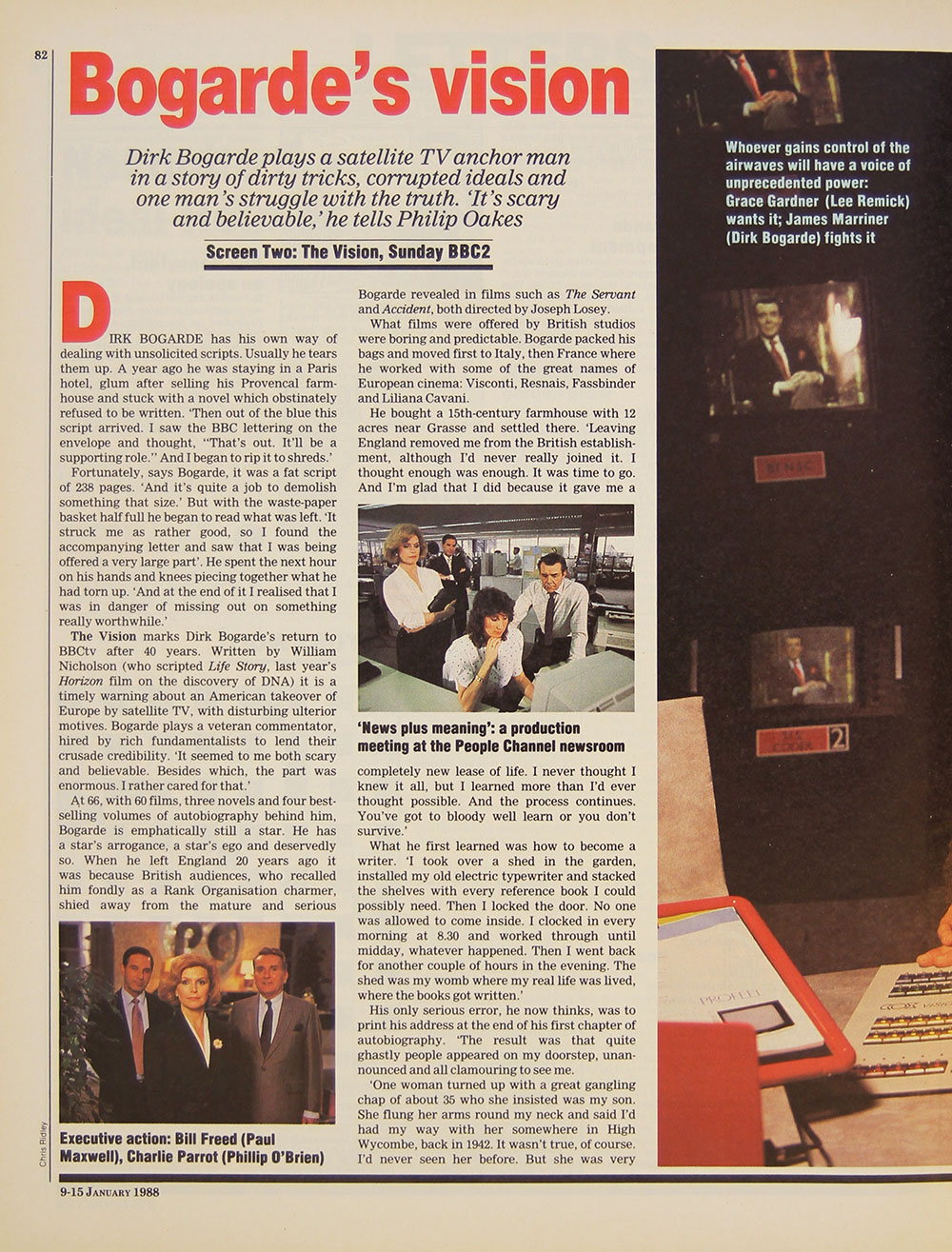
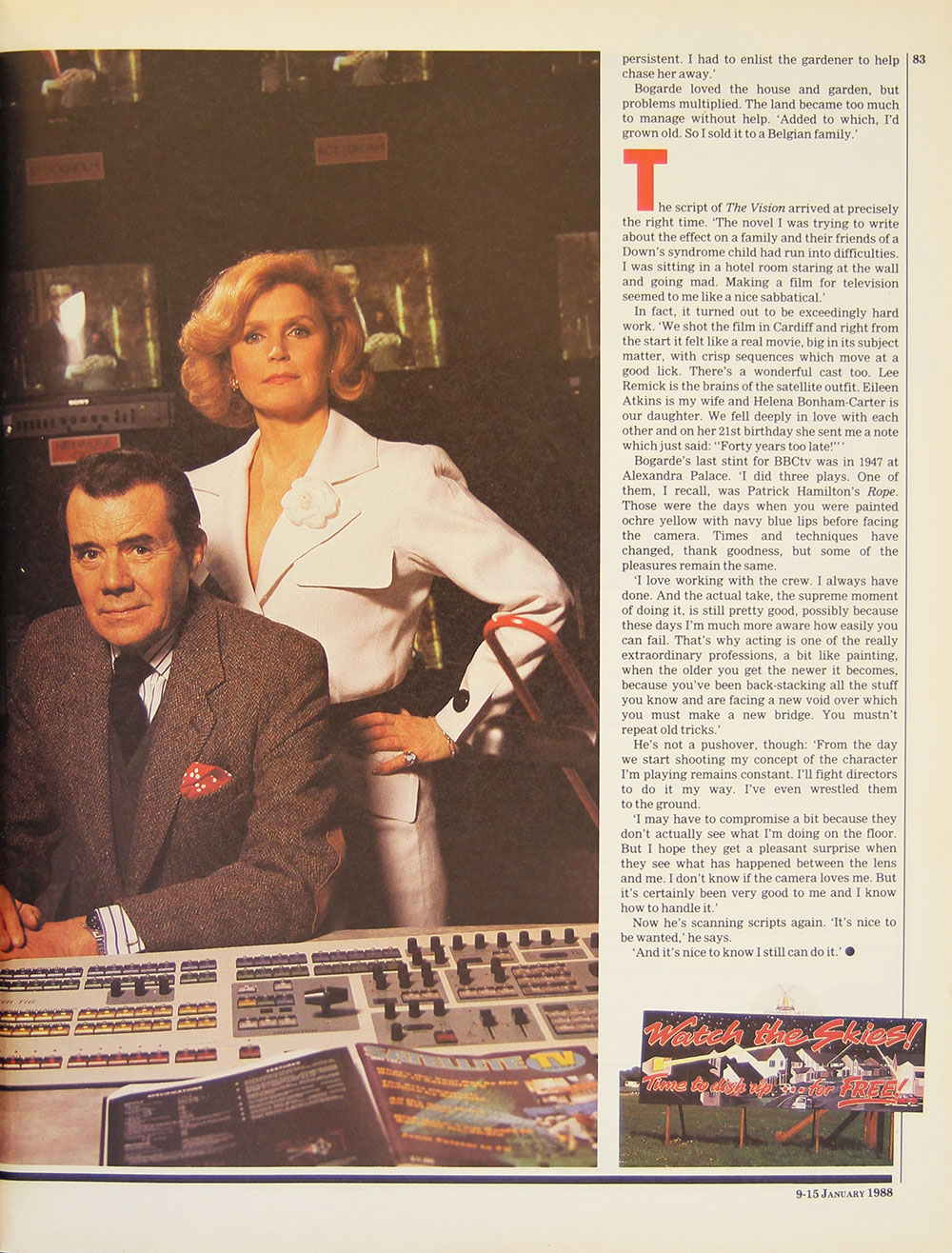
The Vision marks Dirk Bogarde’s return to BBCtv after 40 years. Written by William Nicholson (who scripted Life Story, last year’s Horizon film on the discovery of DNA) it is a timely warning about an American takeover of Europe by satellite TV, with disturbing ulterior motives. Bogarde plays a veteran commentator, hired by rich fundamentalists to lend their crusade credibility. ‘It seemed to me both scary and believable. Besides which, the part was enormous. I rather cared for that.’
At 66, with 60 films, three novels and four bestselling volumes of autobiography behind him, Bogarde is emphatically still a star. He has a star’s arrogance, a star’s ego and deservedly so. When he left England 20 years ago it was because British audiences, who recalled him fondly as a Rank Organisation charmer, shied away from the mature and serious Bogarde revealed in films such as The Servant and Accident, both directed by Joseph Losey.
What films were offered by British studios were boring and predictable. Bogarde packed his bags and moved first to Italy, then France where he worked with some of the great names of European cinema: Visconti, Resnais, Fassbinder and Liliana Cavani.
He bought a 15th-century farmhouse with 12 acres near Grasse and settled there. ‘Leaving England removed me from the British establishment, although I’d never really joined it. I thought enough was enough. It was time to go. And I’m glad that I did because it gave me a completely new lease of life. I never thought I knew it all, but I learned more than I’d ever thought possible. And the process continues. You’ve got to bloody well learn or you don’t survive.’
What he first learned was how to become a writer. ‘I took over a shed in the garden, installed my old electric typewriter and stacked the shelves with every reference book I could possibly need. Then I locked the door. No one was allowed to come inside. I clocked in every morning at 8.30 and worked through until midday, whatever happened. Then I went back for another couple of hours in the evening. The shed was my womb where my real life was lived, where the books got written.’
His only serious error, he now thinks, was to print his address at the end of his first chapter of autobiography. ‘The result was that quite ghastly people appeared on my doorstep, unannounced and all clamouring to see me.
‘One woman turned up with a great gangling chap of about 35 who she insisted was my son. She flung her arms round my neck and said I’d had my way with her somewhere in High Wycombe, back in 1942. It wasn’t true, of course. I’d never seen her before. But she was very persistent. I had to enlist the gardener to help chase her away.
Bogarde loved the house and garden, but problems multiplied. The land became too much to manage without help. ‘Added to which, I’d grown old. So I sold it to a Belgian family.’
The script of The Vision arrived at precisely the right time. ‘The novel I was trying to write about the effect on a family and their friends of a Down’s syndrome child had run into difficulties. I was sitting in a hotel room staring at the wall and going mad. Making a film for television seemed to me like a nice sabbatical.’
In fact, it turned out to be exceedingly hard work. ‘We shot the film in Cardiff and right from the start it felt like a real movie, big in its subject matter, with crisp sequences which move at a good lick. There’s a wonderful cast too. Lee Remick is the brains of the satellite outfit. Eileen Atkins is my wife and Helena Bonham-Carter is our daughter. We fell deeply in love with each other and on her 21st birthday she sent me a note which just said: “Forty years too late!”‘
Bogarde’s last stint for BBCtv was in 1947 at Alexandra Palace. ‘I did three plays. One of them, I recall, was Patrick Hamilton’s Rope. Those were the days when you were painted ochre yellow with navy blue lips before facing the camera. Times and techniques have changed, thank goodness, but some of the pleasures remain the same.
‘I love working with the crew. I always have done. And the actual take, the supreme moment of doing it, is still pretty good, possibly because these days I’m much more aware how easily you can fail. That’s why acting is one of the really extraordinary professions, a bit like painting, when the older you get the newer it becomes, because you’ve been back-stacking all the stuff you know and are facing a new void over which you must make a new bridge. You mustn’t repeat old tricks.’
He’s not a pushover, though: ‘From the day we start shooting my concept of the character I’m playing remains constant. I’ll fight directors to do it my way. I’ve even wrestled them to the ground.
‘I may have to compromise a bit because they don’t actually see what I’m doing on the floor. But I hope they get a pleasant surprise when they see what has happened between the lens and me. I don’t know if the camera loves me. But it’s certainly been very good to me and I know how to handle it.’
Now he’s scanning scripts again. ‘It’s nice to be wanted,’ he says.
‘And it’s nice to know I still can do it.’

