Show – May 1970


Dirk Bogarde’s Love Affair with the Camera
Don’t knock it if you’ve never tried it – especially if you’re an actor wondering why Dirk Bogarde gets all those great reviews.
by Ann Guerin
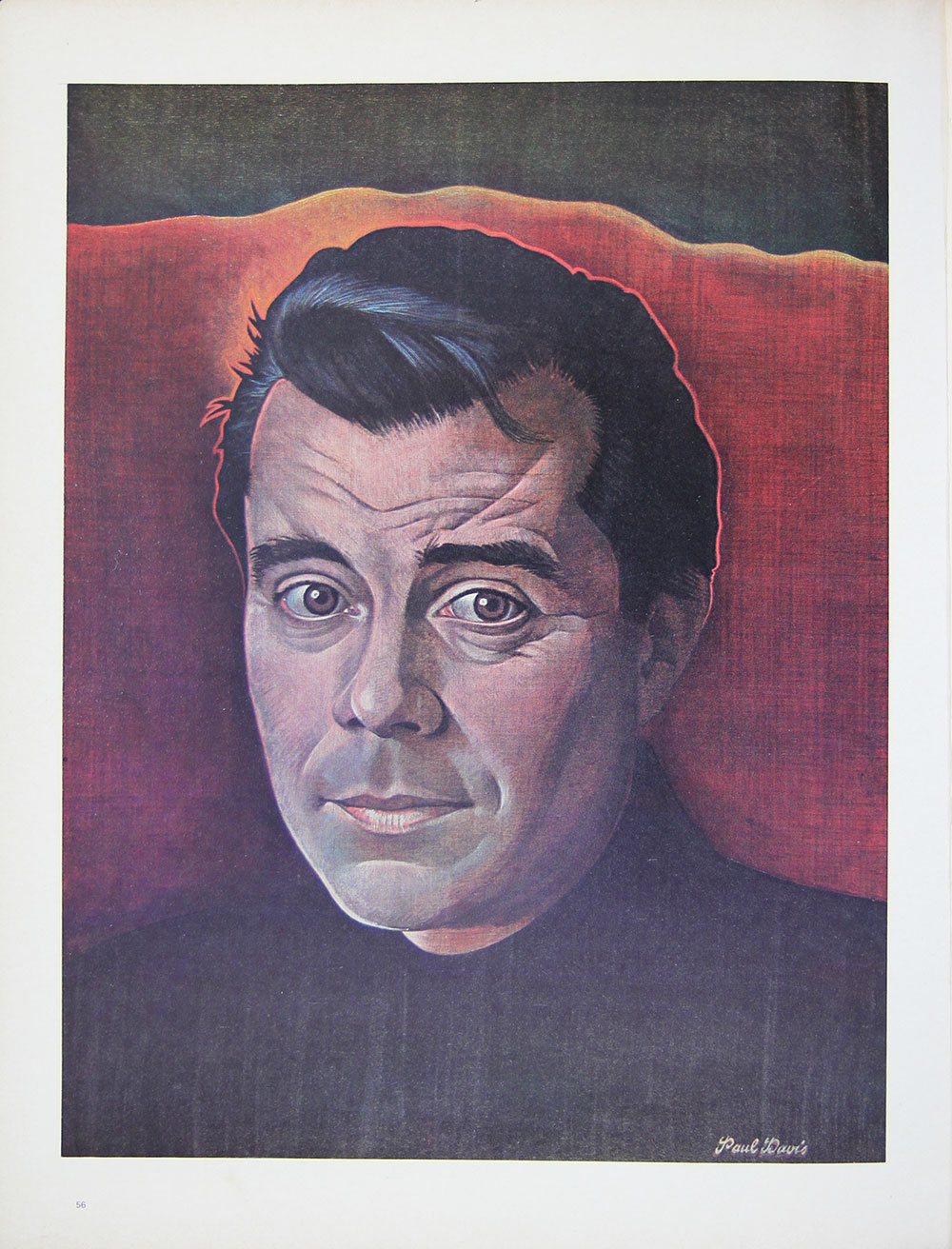
painting by Paul Davis
At a few minutes short of high noon, on a brilliant, biting Sunday morning last November, a portly Rolls-Royce inched cautiously along a Roman road jammed by throngs of the faithful on their way to Mass. The men pranced by in their dark suits and downy white shirts like gamboling black sheep in an overcrowded pasture. The women marched behind more sedately, chattering merrily, supremely confident Bopeeps with nary a thought for their heedless charges. As his manager maneuvered the heavy car in and out of the human traffic, Dirk Bogarde watched the procession with an indulgent eye. “Undoubtedly,” he said, “going to pray forgiveness for the havoc they’ve caused on the road all week.” As the dubious penitents filed into the baroque church, the Rolls picked up speed. “I live on the wrong side of the tracks in the unfashionable part of the city. The Romans don’t quite know what to make of it. The beautiful people think it’s ‘verree amusing’ – ‘amusing’ is their word this year. The others just put it down to my being English.” As he spoke, the car made an abrupt left turn, bumped over a red-dust, labyrinthine road and finally stopped at the entranceway to a small but well-proportioned villa. Bogarde jumped out of the car, swung wide the wrought-iron gates and the Rolls sailed to rest in a safe and appropriate harbor.
As he walked toward the house, Bogarde said, “I rented it from a ravishingly beautiful, extremely naughty lady. After I decided on it, her lawyer called me down to his office for the signing of the lease. When I arrived I was faced with three leases. One for the figure the lady asked, one for the figure we agreed on and one for the figure she was presenting to the government for tax purposes. When I refused to sign all three, the lawyer merely shrugged his shoulders and smiled, as though to say, ‘Well, I tried that one on and it didn’t work.’ ” He laughed at the recollection. “Living in Rome,” he said, “is rather like being a counselor in a summer camp for children from the city. The only difference being that the little brats never go to bed.” The words were sharp, but the look that accompanied them was that of an exasperated but loving parent, full of understanding and compassion. It was a look peculiar to Bogarde, for he can with a glance run the gamut of emotion – not in the classic Parker tradition, from A to B, but seemingly from A to infinity. The ice-edged contempt in his eye in Darling when he tells Julie Christie, “I don’t take whores in taxis”; his vicious leer of triumphant evil in The Servant as he witnesses James Fox’s total corruption; the sudden horror and heartbreak of his expression in Justine when as Pursewarden he hears of his sister’s engagement – all are film moments that sear themselves indelibly on the memory. Countless stars have sat in theaters, gnashing their teeth, and watched him silently steal their films with one power-packed look. For while they were playing to a vast, invisible audience, Bogarde was assiduously courting the camera.
Inside the house, Bogarde threw a log on the fire to warm the high-ceilinged room. “I know now, late in my life, I know that I am a screen actor. I love the camera, I simply love the camera and it loves me. It has nothing to do with me; it’s a complete, magical thing. But the amount of concentration you have to use to feed that camera is so enormous that you are absolutely ragged out at the end of a day after doing something very simple, like a look. I remember once, years ago, it was in a Hollywood commissary. Alan Ladd came in. His gang were waiting for him and they’d been drinking. They said, ‘What did you do on the set today, Alan?’ trying to send him up. He sat down in complete silence, had a drink and then, after a long pause, said, ‘I did a great look.’ They didn’t know what the hell he meant. I know what a great look means, Visconti does, Joe Losey does, Resnais does, John Schlesinger, well, he isn’t always sure. But Alan Ladd bloody well knew about a look. It’s what the cinema is all about. You don’t depend on the words or the lines; you depend on the thought for the lens and it doesn’t always show on the floor. Sometimes, when I work with a new director, I have to say, ‘Look, you won’t see what I’m doing until tomorrow, so don’t stop me today, wait until tomorrow and the dailies. Then you’ll see, or I hope you’ll see, but you won’t see it on the floor. If you do see it on the floor, then it’s wrong. If I make you cry on the floor, that’s wrong. And it is wrong. I can come off the floor having had a marvelous time. The crew had been crying and there’s been applause, and the next day it’s ghastly, because I did the wrong performance for the wrong audience. The audience then is the lens; that’s it, it’s that camera. It’s the most unfrightening instrument in the world to me and it paralyzes most people. And also, what is much worse is that many of the rather splendid top actors that play now despise it and don’t pay it any court. They straighten their ties in front of it- use it as a reflection- and that is the most heinous crime you can commit. It’s an extraordinary thing to say, but I know exactly what I mean- that box is the only reverential thing on the whole floor. That is your lifeblood because that is the thing that takes the back of your head right off; and if you’ve got nothing in there, sweetie, it’s going to show that you’ve got nothing in there. You can do anything you like with your face – turn it left, right, twitch, lift your eyebrow, but it’s not going to work because nothing’s really pulled it up. It’s not a question of technical tricks; something has to be happening inside. And the majority of actors who are not movie actors, by that I mean people who just work for the cinema, don’t understand that. And you can’t explain it. You can’t explain how to relax before the camera and you can’t teach someone that that box is the womb figure, the mother figure, the father figure. It’s your life-to hell with the director. I mean, do what he tells you, but remember that box is what you channel it through. At least, I can’t explain it. I wish I could. One of the highest compliments I’ve ever been paid by a critic was to be bracketed with Spencer Tracy as a film actor. He was the absolute film actor. I think there are only about six in the world and I’m one of them.
“I wouldn’t have chosen to be an actor.” said Bogarde as, the fire now blazing, he dropped into an easy chair, “if I hadn’t had to be one. My mother was an actress and her father was an actor and his father was, so it was kind of like a virus, the good old blood thing. You couldn’t not be.” And he certainly didn’t plan to be a film actor; like most English actors, his Mecca was the London stage. “I started the way you simply do in England: I went to a little theater. In the village where I lived in Sussex there was a theater built by a rather eccentric old lady, which was then revolutionary. It was a theater in the round, like Chichester is now. One day I rode by it on my bicycle, I think I was about 15 or 16, and I stopped. I saw this old lady -I can see her now – painting furniture, and I walked down and said, ‘Could I have a job?’ and she said, grumpily, ‘Well, you’d better go on and do some painting,’ and that was that.” He went home to collect his clothes, and his father, who was an editor of the London Times, was not at all pleased. “He thought it was no career for a man,” said Bogarde, “and I think he was right in a way, unless you make it, which fortunately to some degree I have.” But, reluctantly, the senior Bogarde agreed, stipulating that if he wasn’t earning a living by the time he was 18 he’d have to give it up. Bogarde returned to the theater and for two shillings a week painted sets, boiled glue, called actors and finally got a part. “I was very good; I mean I was dreadful but it was all right.” Eventually, before the war started, he went up to London and became a professional. In 1940 he got a job in a show called Diversion. “It was put together to try to keep up the morale,” he said, “and it played at the Windmill Theatre, which was a revue house – it never closed and we didn’t either. We played three shows a day, we did sketches, topical things. It was very simple, just six principals and six kids. Peter Ustinov and I were among the kids.” They were also the show’s biggest boosters, because helping the morale had earned them deferments from the army. “But we knew the moment the damn play came off we had to go.” Off it came and the two 19-year-olds joined up on the very same day. “Peter was sent West.” said Bogarde, “issued three right boots and had a miserable war. I was sent North and ended up rather better.”
The war was a six-and-a-half-year gap, and when he got back it was impossible to find work. “The London theater,” be said “was still struggling with those awful things to amuse the troops and the bombed populace, and they wouldn’t budge. And all the old deadbeats who hadn’t gone to war were sitting very nicely in their niches in the theater. I don’t mean the great classic actors, but the rest. I couldn’t get a job anywhere, and I had spent all my money. I’d been a major in the army and naturally the adjustment to poverty was acute.” An army friend said he could get him a job teaching art and games in a boys’ prep school, and Bogarde had almost decided to try it when he got a call for a final reading of a television play. “I thought,” he said, “Well, I’ll make this the last. If I don’t get the job. I’ll go straight down to Windlesham tomorrow and teach the little beasts. And I got the job by one of those extraordinary flukes of going to the wrong room at the wrong time – it was a case of mistaken identity. I’d been sent to read in Studio A. I gave the man at the door my name and he said, ‘Well, sit and wait,’ and I sat and waited while Studio A cast their play and went and I didn’t know. Upstairs in Studio B they were casting and a woman came running down the stairs -I can remember it to this minute, I shall never forget her- and just yelled at me, ‘You’re late, you’re late, come upstairs!’ She just screamed and yelled and dragged me upstairs and pushed me into a room. I sat down and read something and I knew it wasn’t what I’d come to do. Before I could say, ‘I’m sorry, I’m in the wrong place,’ she said, ‘What’s your name?’ and looked at her list. Naturally I wasn’t on the list so I got a terrible bawling out and she said, ‘You know, you’ve wasted our time,’ and I skulked out. I had no money at all. I’d borrowed some money from my father to get there and it was snowing -it’s a very sad story- and I walked from Bond Street to the train station. So, with the very few pennies I had left to get the train back to Sussex, I called my agent and said, ‘I’ve made a terrible cockup, I went to the wrong studio at the wrong time.’ And he said, ‘But you got the job. They’re trying to find you.'”
The play was about murder in a family. “I had the second lead,” said Bogarde. “I played the younger brother who commits the murder, but the older brother, played by Kenneth More, who circumstantially could have done it, is just back from the war -weary, disillusioned, doesn’t want to live. He takes the rap himself and I let him. But the censors in those days were very tough and they wouldn’t allow it, so on the day of the dress rehearsal Ken’s part was cut so vastly that he hardly had a part at all. The whole balance shifted on to me, and I ran away with the play.” The show was put on in a very small theater, the London equivalent of an off-Broadway house. “On opening night,” said Bogarde, “when the curtain went down there was an absolute silence, not a breath, not a murmur. And we thought. ‘God. that’s it, we’ve absolutely laid an egg,’ and we all assembled rather miserably on the stage for the curtain to go up. Then suddenly the audience came up on the stage and pushed up the curtain, which was simply marvelous. It was literally a case of being a star overnight. We were taken up, we were immediately the smart thing. Then Noel Coward came round and supported us, sort of fathered the whole lot, gave us lectures. And then we moved into the West End, where we opened either two nights before or two nights after Oklahoma!, so you can imagine what happened to us.” It was then that the movie moguls closed in on him.
“I went into films,” said Bogarde with a wry smile, “simply because I was broke. The play was paying very little, £7 a week in the little theater. I think we got 10 guineas when we moved to the West End, which was quite a lot in those days, but I had been out of work for a long time. Then the cinema people came. At first I was very snobbish about them. I really hated them terribly and didn’t want any part of them at all, and then they said, ‘There’s a marvelous part, a small part of a priest in an historical drama starring Stewart Granger,’ who was at that time the great popular star. So I said I’d do it because there were no strings attached and I couldn’t believe the money. Then Stewart Granger didn’t like the part and they pushed me into the lead, and a marvelous actor, Cyril Cusack, took my part and stole the picture. It was a movie called Esther Waters. I was just godawful. The very first morning, dressed in this extraordinary costume, I remember going to the director and saying, ‘What do I do?’ And he said, ‘Well, I don’t know, my dear. You’re the actor, I’m the director,’ which I thought was super. That was my introduction to the cinema and I struggled through for six years without knowing what the hell I was doing.”
At the end of that time Bogarde discovered he was enclosed in a silken trap. He was rich, he was one of the top boxoffice stars in England, he could not budge outside of his house for fear of being pounced upon by screaming teenagers. But few of the numerous films he made had any merit and he was no longer considered a serious actor. He was a “movie star.” He had signed what appeared to be a most generous seven-year contract with the J. Arthur Rank organization which permitted him six months a year or every alternate year to do a play. Bogarde tried touring with serious plays -Anouilh and Ugo Belli- only to find the theaters stuffed with his young fans who squealed at the sight of him but cared little for what he was doing. “What I didn’t realize,” said Bogarde. “in my simple little head was that every six months or every year I took off they added onto the contract. So when I said, ‘Now I’ve done all this and I’m through, finished,’ they said, ‘Oh,no, because we’ve added up all this time and you’ve got another two years.’ So it went on and on.” Bogarde continued giving fine performances in inferior films and became more and more popular with the public. For five years running, from 1955 to 1960, he won the Motion Picture Academy poll in Europe over such stars as Rock Hudson and Doris Day. “I won cups,” he said, “and all those boring things, and I was getting prizes for quantity much more than quality. And the critics- well, I remember one man at a press showing lifting up his glass of gin and tonic and saying, ‘Don’t think this is going to buy you good notices.’ It was that attitude all the time, and I was beginning to rile against it.” He knew he had to change his image, but how to do it? After 13 years of gilt-edged indenture. a daring script provided the breakthrough.
“In 1960 I had gone to California to make the life of Franz Liszt: ‘Ah, Schubert. you know my friend Beethoven, this is George Sand.’ I was fairly disillusioned and had just gotten on a jet to come home, and I thought that town’s not for me, never, never, never, and back I come. It was Christmas and I had just bought a brand-new home and on Christmas Eve the script of Victim came. It was from an independent company run by Basil Dearden and Bryan Forbes. Rank merely guaranteed to finance them.” The script had been sent to a number of other actors who had all turned it down because it dealt with homosexuality. Bogarde read it and said he would do it on the condition “that they rewrote it so that the man went to jail at the end, or his life was ruined, that there was no compromise, that it did not end with him and his wife walking into the sunset and on the condition that the fact had been true, that he had been in love with another man. Or otherwise why make it?” There was a tremendous battle to film it. “I remember.” said Bogarde “one of the lawyers saying when he read the script that he would like to wash his hands, that there was nothing he could do to stop us, but he would like to wash his hands and clean out his mouth. I ask you. That’s how it was in those days. So it was very brave and it was a closed set and all the press were forewarned about it. It was a great strain -stupid- to do it that way. The whole crew was told, ‘You must not mention the word homosexual, queer, fag, pervert. The word we use in this movie is invert.’ It got stupider and stupider; it was like we were attacking the New Testament. Suddenly one morning, after about four days of this reverential work, a carpenter was bending down to pick up a piece of wood and a man up on the rigging said, ‘Watch your ass, Charley,’ and it broke the thing. We fell apart laughing, and from then on you would have thought we were making a Judy Holliday comedy. In that attitude the film worked. And it was an enormous, surprising hit.”
More important, it did for Bogarde what he wanted it to do. “It slung the whole of the Elvis Presley image. It busted the thing wonderfully wide open because the kids just fell away overnight like grass, not because I was playing a homosexual, because in England the word ‘queer’ usually means that you’re not feeling very well, so they didn’t get it anyway, but I did have gray temples and I was broaching my own age, playing a man about 45. I wasn’t the bouncy, happy doctor with a little perm in the front lock of my hair and my caps in and my left profile -every set was built for my left profile, nobody ever saw the right side of my face in something like 30 pictures. I was the Loretta Young of England. And so that all broke. The caps came out, the hair was never permed again, and a different audience came.” After Victim Bogarde still had two other films to do under contract to Rank. “When I went back to the studio,” he said, laughing, “one of the publicists said to me, ‘This is where you belong. We’ll make you a star again.'” The films completed, he was finally released from Rank after 15 years.
Audiences accepted the new Bogarde, but he was still without honor in his own industry. “It was a very long, cold, drafty business because the regular money was coming from nowhere and it didn’t come and I was living on capital. I had to sell my house and pack up -it wasn’t quite as grim as that, but it was pretty grim and I could not get a job. Oh, I could get jobs in the things I didn’t want, but no good director, no serious director would touch me. They’d seen Victim, but so what- Tale of Two Cities, well, possibly. David Lean is reputed to have said, ‘I’d like to use Dirk Bogarde, but I really do want an actor, not a movie star.’ It was very, very unpleasant. Added to that. Franz Liszt, Song To Remember, Song To Forget, whatever it was called, had opened in Radio City Music Hall and they kept screaming down the telephone from California, ‘How does it feel to be a star?’ because Song without End broke every known record at the Music Hall, except for North by Northwest. And I thought, well, we’re in. The gamble has paid off, because Columbia’s gamble at that time was that the kids were ready to accept that kind of music -which they were not- but at Radio City they were around the block 50 deep and the Rockettes were singing “Ave Maria” and I was the golden boy. Scripts poured in from Columbia. I could have anything. I could play Mary Magdalene or Jesus Christ. Anything was right: they would adapt it to fit. Then the movie went out on nationwide and I don’t think anyone but the doormen saw it. I never heard from Columbia ever again, or from anybody else.
“So in the middle of this decision to break my career, being out of work and having this great, long gap of nothing, I was also a disaster in America -which I got blamed for, not Liszt. I felt very uncomfortable.” Fortunately, when he was at the edge of despair, he encountered an old friend, director Joseph Losey, and they decided to collaborate on the making of The Servant.
“I first met Joe Losey in 1950, and he was just straight off the McCarthy rack. I had done three movies that year, and I was tired and fairly successful. I was getting a little bit-not grand, don’t think I’ve ever been grand, but I didn’t like the Rank organization. I was determined to call the tune, and I had said. ‘No more.’ Someone from the office sent me a script and said. ‘Could you read it, because it could go almost immediately. It’s going to be a small film made by a director who has a big reputation in America. They’re not paying much money because they don’t have much money, but if you’ll do it it will mean that the budget will be doubled and he can therefore make a better picture.’ I think the movie was going to cost something idiotic like £20,000. I was bad-tempered and I didn’t want to read it, but I did and it was good. I said. ‘Well, I’d like to see what this man’s done,’ because I’d never heard of Joseph Losey, which was fair because then I was so wrapped up in myself. At that time I lived quite close to the studio in London. I went back that very evening and Losey was there with two films. One was The Prowler, with Evelyn Keyes and Van Heflin. and the other was his version of M. I said I’d look at them and see. I was sort of being autocratic, like Mr. Zanuck. Joe came into the room, set the projector and said, ‘I don’t want to see it with you.’And I said. ‘How do you do?’ and he said, ‘How do you do? I’ll wait outside.’ I saw the first reel of The Prowler and knew I’d do the film with him. I went outside. It was snowing and Joe was standing in the parking lot wearing what you’d call a maxicoat today, and I said, ‘Come in. I’ll do the picture.’ Then we did The Sleeping Tiger, and it was on extraordinary, magical experience. It gave me my first taste of what making a movie could be, which was smothered later by all the well-paid junk that gave me Rolls Royces and lovely houses. When the movie was finished Joe said. ‘I’ve got a marvelous book if we could ever get the money to do it,’ and he gave me a very thin volume called The Servant. I didn’t like it or understand it at that time, and Joe went off into the wilderness. Eleven years later we finally got around to making it.
“We were hand and hand in the film, and we did it for very little money. We didn’t take any money ourselves but did it for percentages which, thank goodness, came in for both of us because the film worked. Naturally, by 1961 I was too old to play the boy and I didn’t want to play the bloody man either. I said to Joe, ‘I’ll produce the film with you, but I don’t want to be in it because I’m not the right age.’ He said, ‘Somebody has got to be in it because it’s got to have some kind of a name or something to help.’ So I said yes. But we could not find the boy. One night I was sitting watching television and I was worrying and fiddling. There was an awful play on, and suddenly on the screen came this boy. His name was Maurice Oliver: that’s what James Fox was called in those days. I called Joe and told him to watch. Then I called my agent and said, ‘I’ve seen a most extraordinary boy on television tonight. We’re going to test him tomorrow and he’s marvelous.’ And he said, ‘You can’t. I know Maurice Oliver very well: he can’t act.’ We had this great battle and I said, ‘He’s simply marvelous. We want him. He’s a gentleman and he’s right. What he can’t do we’ll do for him, and everything else.’ And my agent said, ‘He can’t act. I know perfectly well, he’s my son,’ which was sort of the fallout of all time. So I said, ‘Well, we’re going to test him tomorrow.’ He said, ‘All right, you test him, but it won’t work.’ The next day Joe was doing a commercial for fruit juice in somebody’s house and at the luncheon break we just pushed Fox in front of the camera and we did two silent tests. The first test was awful but in the second we made him do things like play with the brandy glass and act drunk, and this extraordinary quality came off on the screen. It worked.” At the end of the first week’s shooting, Bogarde called Losey to tell him how delighted he was with the progress they were making only to learn that Losey was in the hospital with double pneumonia. Losey told him, “The film will be abandoned unless you can take over.'”So I took over,” said Bogarde, “and Joe wrote every inch of the directions down, every detail. He called every hour and directed the film from bed for a fortnight. Reluctantly, the doctors let him out of the hospital after three weeks on condition that he come to the studio and lie on a bed and direct the movie from there, which of course he didn’t do. The only concession he made was that we were not allowed to smoke within 20 feet of him. We finished the film in seven weeks. I think I saw The Servant over 300 times with Joe, and it works successfully in every degree. But there was always a problem about The Servant in the early days. People always said it’s fine up to the moment of the great party, but then it’s rubbish. They didn’t know then, in England at any rate, about LSD, and that’s what we were dealing with. We didn’t even know it was called that in those days: we just knew it was an extract from mushrooms. Now when the film is shown people just take it for granted, but we made a breakthrough on that long before anybody else did.”
Bogarde settled back in his chair, took a long puff on his cigarette and said, “You can’t imagine the difficulties we had with The Servant. We made it for no money under very difficult circumstances, and when it was finished it looked as if nobody was going to see it or to show it, which was worse. Warners’ bought it because they thought it was salacious and put it in with their backlog of old films. By the grace of God, when they were running their backlog, a rather clever man called Arthur Abeles -to whom I’ll always be grateful, although I only met him once in my life- saw the film and said. ‘That’s what we’ll put on. We’ll try it for four weeks at the Warners in London.’ And then the whole lid blew and it was magic. But with all the films we made in the four or five years we worked together between 1961-67 we faced the most violent opposition. You can’t imagine the opposition we had. We made King and Country in 18 days for £35,000, which isn’t bad. We still haven’t made our costs bock, but Joe enjoyed doing it because it was wet and uncomfortable and muddy and we were all in misery, so he loved it. When we finished we were very proud and pleased with it because we had made it as honestly and truthfully as we could. Then I called a secretary at the office and was told she was at a screening of King and Country. I called Joe and said, ‘Where are you showing King and Country?’He said, ‘I’m not.’ We discovered there were two cuts. The company had made their own version without all the nasty things–the rats and the horses–and they were showing both versions together. They had instructed all the secretaries of the firm, about 300, to come to the screening and to vote on which version they preferred. We stopped that in the middle of the running. But it was that kind of thing all the time, even with Accident. Nobody was ever going to show it, it was going to be cut, it was unbelievable. It was only when we went to Venice and to Cannes with it and everybody was raving about it that they said, ‘Oh, well, maybe there’s something here.’ We battled and fought for years, so really I don’t blame Joe at all for doing the Burton pictures. I blame him, but I don’t blame him, because he had such a belting before that he was entitled to a bit of pleasure, some fun and a bit of color. Why not?”
Even The Servant, which was nominated for eight British film awards and won Bogarde the British equivalent of the Oscar, did not bring him studio recognition. When he was sent the script of Darling, he was told, “Oh, we tried to get William Holden but he wasn’t available.” “They always tell me quite honestly,” he said, “very nicely, that I’m taking over for somebody else. Nobody wanted that part; they said it was a drag, that he was a draggy, draggy fellow. I loved him, but I did say rather tentatively, ‘Well, if you haven’t cast Miles, it’s a smaller part and I’d do it for less money.’ It was a super, super part, the picture-stealer of all time. And they said, ‘Oh, no, we have to have a big name for that.’ So Laurence Harvey got the part. Then when we started shooting I fought very hard to play the character the way I wanted to play it. John Schlesinger had me cut out of the film at one point, completely cut out of the film because I would not play it the way he wanted me to. He was not in sympathy with the man and I know that kind of a man pretty well. Then suddenly he called up and said, ‘You’re back in the film, dear, you’re back in the film. We put you back because without you something happens and Julie’s a little bitch.’ Then, during the shooting of Darling, Julie received a telephone call, and when she came back she said, ‘They want me to go to Madrid to test for a film called Dr. Zhivago.’ A call came for me a very short time after, asking, ‘What film have you got, because David Lean would like to see something on you (which makes him sound like a hermit, since I had been in close to 60 movies). He’d like you to be in Zhivago.’ I wanted desperately to play the Omar Sharif part, especially because Julie was going to be in it. We sat and hugged each other because we’d both been asked. Five or six days later Julie got another call. She was very calm when she came back and everybody knew what it was about. She had the part. There was no call for me. It was a bitter afternoon. I’ve never, never gotten the parts that I would actually like to have, and I don’t know what it is that holds me back–something obviously does because they all think I’m a great actor, but they don’t want to sort of touch it. My form of work is much too undercover, much too subtle for the majority mind to take.”
Bogarde claims that he lives in Europe because that is where he gets offers– not from England or America. “I wasn’t asked to do Justine by the Americans,” he said. I was asked by Joseph Strick, who for all his faults had the wit to knock the thing into shape and the marvelous idea to cast Anouk Aimee for Justine. Whether she’s a good or bad actress or whatever happened on the film, and that’s a saga in itself, she was immediately, visually one’s absolute image of Justine-not Elizabeth, not Sophia. I don’t understand about Strick at all. I met him here in Rome. He had fantastic ideas for doing it, and I thought at least Durrell was not going to be disjointed, but none of it happened. The film was going to be made on location in Tunis and then in Paris at Billiancourt. That was great because I did not have to go to that awful evil city. Then he called and said, ‘It’s a runaway movie and Fox says there’s no reason why the interiors shouldn’t be done in California.’ I knew from that moment we were lost, long before Joe couldn’t handle the picture. I really honest to God’s honor don’t know what happened to Strick. They shot two weeks in Tunis without me and I arrived in California after two weeks of working on The Damned. The first person I met said, ‘This is a disaster.’ Then I watched a shot and Strick didn’t know what to do with the camera. Nothing. He didn’t know anything at all. He was extremely nice to me, one of the nicest people I’ve ever met, but lunatic. I mean we used to go to his house on the beach for readings in the evening, and he’d say, ‘I’d like to read scene 48,’ and we’d think that he had made a mistake and meant scene 148 because 48 said, ‘A camel goes by,’ or something like that. It was most extraordinary. We’d all sit there nervously and not say anything and then he’d say, ‘Well, you can go home.’ One knew the film was doomed because we had not shot anything in Tunis in two months that you could show, nothing at all. I will never, ever work with Fox or see Fox at all. Mr. Zanuck used to send cables to Strick in Tunis saying, ‘This is the best footage since the Battle of Atlanta,’ and he was at the Olympic Games in Mexico -he never saw it. So poor Strick was saying, ‘Why have they sacked me? They’ve sent me these marvelous cables and I’m out.’ In the end we had a great big, lovely Hollywood musical, and thank God George Cukor was there and was able to come in, not to take over but to start a new movie.
It was a very strange situation. Well, anyway, one made a lot of money and came straight back to Rome to the arms of Papa Visconti.”
Visconti? “How long have you got?” asked Bogarde. “He’s the most complete, the best, the most marvelous thing I’ve ever known in all my career. All right, I’m not so much evident in The Damned. It’s one of the best performances of voiceover I’ve ever given, but still it’s the most exciting film I’ve ever made in my life. And I knew it was a rotten part when I started. I got the script sent to me ages ago in England, and I said no because I thought it was a dreadful, dreadful part. In those days he wanted Vanessa Redgrave to play Lady Macbeth and me to play Macbeth. I said no -a great idea, but I don’t think it will work, and the translation is terrible, too. Nothing further was said and months went by. Then I got an offer from America to do a television commercial, which I had never done. It was such extraordinary money for one day’s work -to walk up and down the Spanish steps with a pair of sunshades on, without opening my mouth -I thought, ‘I’d love to go back to Rome for a week’s holiday. I’ll do this commercial because I don’t have to speak. They won’t know who I am because I’ll be wearing sunglasses, which is the best disguise in the world.’ At the end of it a voice says, ‘Wasn’t that Rip Torn I saw going up those stairs?’ -and I thought, ‘Fine, anonymity for $25,000 and a week’s expenses at the Hassler Hotel. So I came. In the meantime, somebody clever tipped off Visconti’s agent here that I was going to be in Rome working on a little documentary. He telephoned and said he would come to the hotel and I told him, ‘I would rather come and see you, sir.’ He said, ‘No, it’s more convenient for me. I am going to pass your hotel on my way to dinner. but I can only give you half an hour.’ He came into my room in the hotel, this giant of a man with his little entourage, and asked me, ‘Why don’t you like my film?’ I told him why, because he is immediately the kind of man you have to be honest with, and he said. ‘Well, those are perfectly true remarks. Everything you say is true, but I once was in a position when I was, you understand, a big director. I never asked an actor to be in my film and gave him a script. I asked him if he would like to be in my film and he said yes. Now things have changed and actors are idiots. They must see what they have to say, but if you think that I’m going to shoot that shit that you have there you’re completely mad. Because I’m not -but I haven’t got very long….’ and I said, ‘All right, I’ll do it.’ ‘You’re sure you want to?’ he asked. I said, ‘Well, I’m not absolutely sure,’ and he said, ‘Don’t make false decisions.’ I asked who was playing the wife and he said, ‘We signed Ingrid Thulin this morning.’ So I said, ‘Then I’ll do it.’ ‘Fine, va bene.’ It took about 14 minutes and three rather large whiskies, which he poured down. He was far more terrified than I was, but then he had his package. He’d gotten the unplayable part agreed to be played by me, he’d got Ingrid to play Lady Macbeth and he had the boy.”
The shadows of twilight fell on the tiled floor of the villa as Bogarde stopped talking of the Master and lit another cigarette. After a long pause, he said, “I would play a stick in a fireplace for him if he’d ask me, and he has. I’m going to do Death in Venice with him. He called one Sunday and said, ‘I have to go to see my lawyer tonight. I want to make a little program of films.’ ‘But you’re retiring,’ I said. ‘No, no, I’ve changed my mind.’ In the middle of The Damned he announced, ‘This is my finale now. I go back to opera; this is too difficult. I’m finished, I’ve made six films, no more.’ Now it’s a big success and he’s back in business, and a Little program he makes. So I asked, ‘Where?’ And he said. ‘Would you like to play Aschenbach?’ Now Ashenbach is the name of one of the characters in The Damned, and I said, ‘Listen, that is what I wanted to play all the time.’ ‘No, no, no, we’ve finished that film. I’ve put Aschenbach in for my favorite book, Death in Venice. I used it as my little mascot. Would you like to be Aschenbach?’ I said I would. ‘You understand the book, you’ve read it?’ And I said yes. ‘But you’re too young.’ Immediately he was talking himself out of it. I told him, ‘Listen. I’ll shave my head, I’ll do anything.’ ‘Very good.’ he said. ‘I’ll call you one day. We’ll make Aschenbach.’ And he put down the phone and that’s it, that’s a contract. We’ll do Death in Venice this spring. But his wheels grind very slowly and he must get all kinds of permissions and rights.
“It’s a sort of love affair at a great distance -not Midnight Cowboy in any degree at all, but it’s on the same theme of loneliness and barrenness- between a man of 50 and a boy of 14 in Venice for one summer. And they never speak to each other. It will be magical for Visconti to do it. So that’s why I’m sitting here today, hopefully waiting. I’ve always been good in bad pictures. I would like just once to be great in a great picture.”

