Showtime – Aug 1967


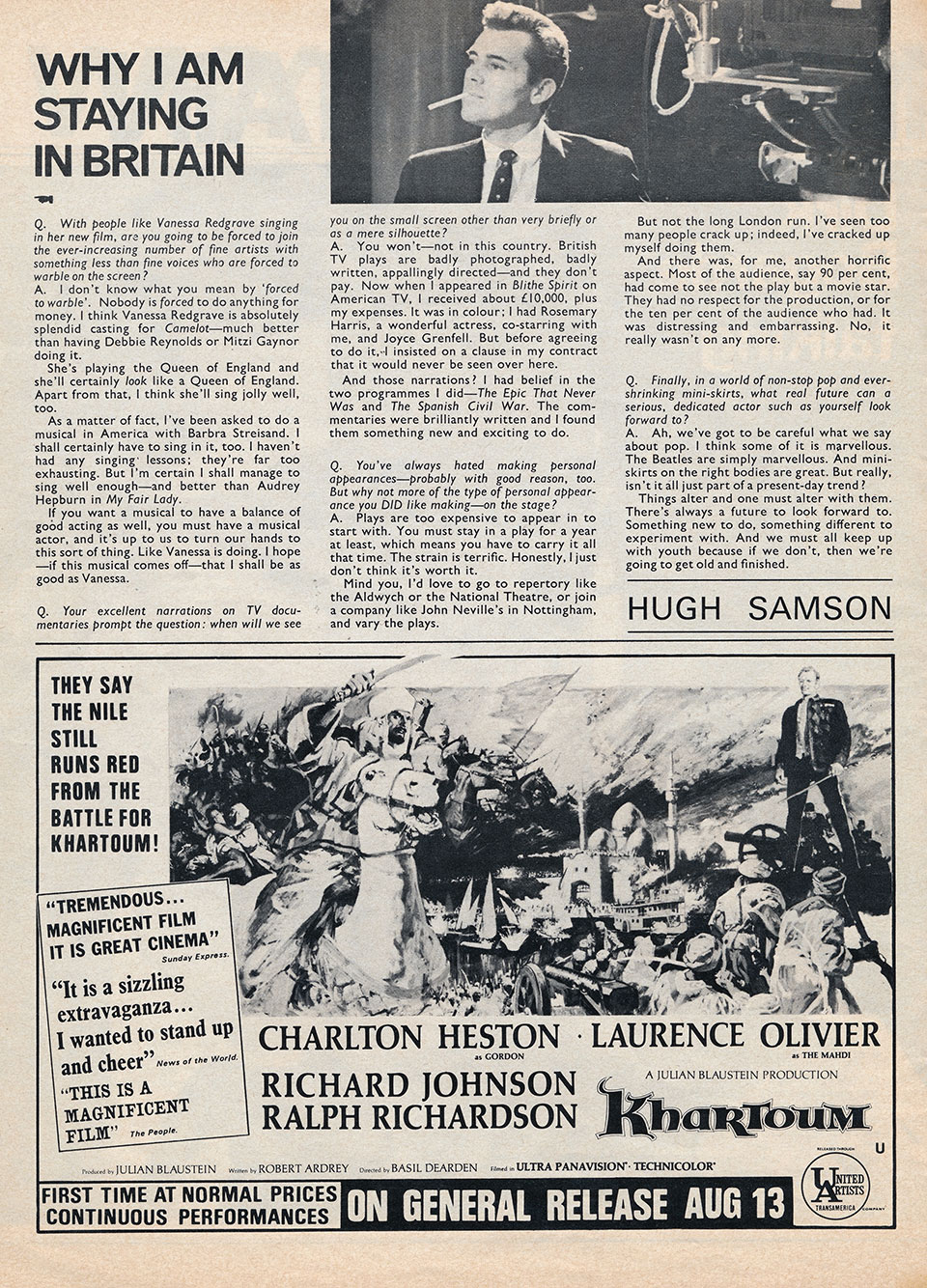
WHY I AM STAYING IN BRITAIN
Dirk Bogarde talking
Q. You’ve gone on record as saying that conformity is one of the curses of the British people. Yet, at the same time, you complain that glamour today is being non-conformist; you cite longhaired pop-groups and way-out films where the camera never stands still.
A. I DO think we’re far too conservative and conformist. As for the long-haired pop-art people being non-conformist-well, are they? They’re merely copying others, such as the Beatles.
Now the Beatles are not boring at all. They’re brilliant, way above everybody else in their field. Trouble is, so many others with much less talent attempt what the Beatles do so well. And they fail. They should try something new. The Beatles were responsible for the trend and a new method of music. Nobody can follow them.
As for the roaming camera-that was a trick that people have used rather glibly in the past. But, thank Heavens, new techniques have brought different methods.
Q. Talking of conformity, surely nothing conformed more than those Doctor films of yours. They stuck to an almost rigid code of British humour. Did you, perhaps, appear in them more in sorrow than from desire?
A. Yes, the Doctor films were conformist films; they always had the same pattern. They couldn’t be played any other way and that’s really why I left them. Anyway, I was growing too old for them – it was becoming obscene to be a student doctor at 40 or over. The pattern, too, was becoming tired. Even so, I think those films had a tremendous value for audiences.
One of the most important things to do as an entertainer is to make people laugh or feel happy or secure. The Doctor films – and I have proof of this – did just this. They may have been a bit jokey, but they did truthfully reflect ward life and in so doing, gave people a lot of security.
Of course, they were great fun to make and were lucrative, too. But in the end I felt I had nothing more to give them.
Q. You’ve said that that fine film of yours, King And Country, wouldn’t pay your income tax. Presumably, it didn’t make much at the box office. Can the film industry afford to make these specialised subjects?
A. All the films I make are on a percentage basis with a minimal salary because I believe this to be the only way to make pictures. After two years King And Country hasn’t even covered its cost, which was only £81,000.
The truth is, most people just didn’t want to go and see that type of picture. But I still think it was worth making for the small number that did. You can’t always make purely entertainment pictures, after all.
The odd thing is that although King And Country didn’t pay the rent, I won more awards for that than any other picture. And Tom Courtenay, of course, won the Venice Award for the Best Actor for his part. So you win awards, get the satisfaction of having done a good cinematic job, but you make no money.
Because of this, however, I don’t see that we should stop making pictures for the minority groups. Of course the British film industry can’t afford them. But then, the films that we are making now are being financed by the Americans, anyway. The British will under-write only the sure-fire success; they’re afraid to take risks. That’s bad luck for us and the cinema-goers, too.
“I’ve had plenty of opportunities in the last year to go back to Hollywood but each time I’ve said No”
Q. I know you seek perfection; that you have immense integrity as an actor. But with your latest tally of pictures around the 45-46 mark, don’t you ever get bored and tend to regard any film as “just another picture”?
A. No, never! A lot of those 45-46 pictures were learning pictures. Four or five of them I would say were quite good. A number were happy, jolly pictures-like the Doctors, The Wind Cannot Read and Campbell’s Kingdom. Everyone enjoyed them and they made a lot of money.
But now I’m getting older, I intend making only pictures which I think matter. I’ve had plenty of opportunities in the last year or so to go back to Hollywood to do awful films which would have paid a great deal. But no: they were the old formula pictures which people like to see; frankly, I don’t want any part of them. I’d rather stick it out here in the cold.
I waited a year, for instance, to make Accident with Joseph Losey, the director. But I wanted to make that film more than any other. That should answer your question about boredom.
Q. It’s been reported that you love Britain but not its people. You say ‘we have the herd instinct. As millions of us happen to be your public, isn’t it rather hard for you to care whether or not you please us?
A. That remark about hating Britain was one reason why I said I would never give another interview. You’re the exception. The gentleman who quoted me in that context was completely wrong. I certainly deplore the conformity and casualness of the British people today. I think we’ve got into a terrible state of ‘my ladder’s up, blow you Jack’; it’s appalling and it’s dangerous.
But I certainly don’t hate the British. How could I, when I’m British myself? In fact, I have had plenty of opportunity to uproot and live in Switzerland, the Bahamas or Bermuda, but I’ve never wanted to because, simply, I couldn’t live anywhere but in this country and with my own people.
That doesn’t stop me being critical of some people’s behaviour. So many people here have lost the ability to work hard. This bothers me. I work hard for this country because I’m deeply proud of it. If I do offend some of those people whom I’ve criticised-then it’s just bad luck.
Q. With more and more finance coming from the States to bolster pictures made in this country, can you ever really see a return to those fine pictures which were once the pride of our home product?
A. A difficult question. Money to make films – our own British films – just isn’t forthcoming. It’s the big American film companies who provide the finance which enables us to make pictures such as Bridge On The River Kwai, Modesty Blaise, The Wrong Box, Alfie – name almost any that are coming up now. But all the same, they ARE English products. There is very little interference from Hollywood.
Take my picture Darling. That was an English picture financed by American money. And nobody in America interfered in the slightest. Certainly they cut it a bit for themselves in the States, but this was because they have a different code of manners from us. Yet that film made Julie Christie an international star; and John Schlesinger a doubly better director. But if we’d relied on this country for the cash, the picture would never have been made at all.
Q. With people like Vanessa Redgrave singing in her new film, are you going to be forced to join the ever-increasing number of fine artists with something less than fine voices who are forced to warble on the screen?
A. I don’t know what you mean by ‘forced to warble’. Nobody is forced to do anything for money. I think Vanessa Redgrave is absolutely splendid casting for Camelot – much better than having Debbie Reynolds or Mitzi Gaynor doing it.
She’s playing the Queen of England and she’ll certainly look like a Queen of England. Apart from that, I think she’ll sing jolly well, too.
As a matter of fact, I’ve been asked to do a musical in America with Barbra Streisand. I shall certainly have to sing in it, too. I haven’t had any singing lessons; they’re far too exhausting. But I’m certain I shall manage to sing well enough – and better than Audrey Hepburn in My Fair Lady.
If you want a musical to have a balance of good acting as well, you must have a musical actor, and it’s up to us to turn our hands to this sort of thing. Like Vanessa is doing. I hope – if this musical comes off – that I shall be as good as Vanessa.
Q. Your excellent narrations on TV documentaries prompt the question: when will we see you on the small screen other than very briefly or as a mere silhouette?
A. You won’t – not in this country. British TV plays are badly photographed, badly written, appallingly directed – and they don’t pay. Now when I appeared in Blithe Spirit on American TV, I received about £10,000, plus my expenses. It was in colour; I had Rosemary Harris, a wonderful actress, co-starring with me, and Joyce Grenfell. But before agreeing to do it, I insisted on a clause in my contract that it would never be seen over here.
And those narrations? I had belief in the two programmes I did – The Epic That Never Was and The Spanish Civil War. The commentaries were brilliantly written and I found them something new and exciting to do.
Q. You’ve always hated making personal appearances – probably with good reason, too. But why not more of the type of personal appearance you DID like making – on the stage?
A. Plays are too expensive to appear in to start with. You must stay in a play for a year at least, which means you have to carry it all that time. The strain is terrific. Honestly, I just don’t think it’s worth it.
Mind you, I’d love to go to repertory like the Aldwych or the National Theatre, or join a company like John Neville’s in Nottingham, and vary the plays.
But not the long London run. I’ve seen too many people crack up; indeed, I’ve cracked up myself doing them.
And there was, for me, another horrific aspect. Most of the audience, say 90 per cent, had come to see not the play but a movie star. They had no respect for the production, or for the ten per cent of the audience who had. It was distressing and embarrassing. No, it really wasn’t on any more.
Q. Finally, in a world of non-stop pop and ever-shrinking mini-skirts, what real future can a serious, dedicated actor such as yourself look forward to?
A. Ah, we’ve got to be careful what we say about pop. I think some of it is marvellous. The Beatles are simply marvellous. And miniskirts on the right bodies are great. But really, isn’t it all just part of a present-day trend?
Things alter and one must alter with them. There’s always a future to look forward to. Something new to do, something different to experiment with. And we must all keep up with youth because if we don’t, then we’re going to get old and finished.

