Sight and Sound – Autumn 1966




Accident
John Russell Taylor
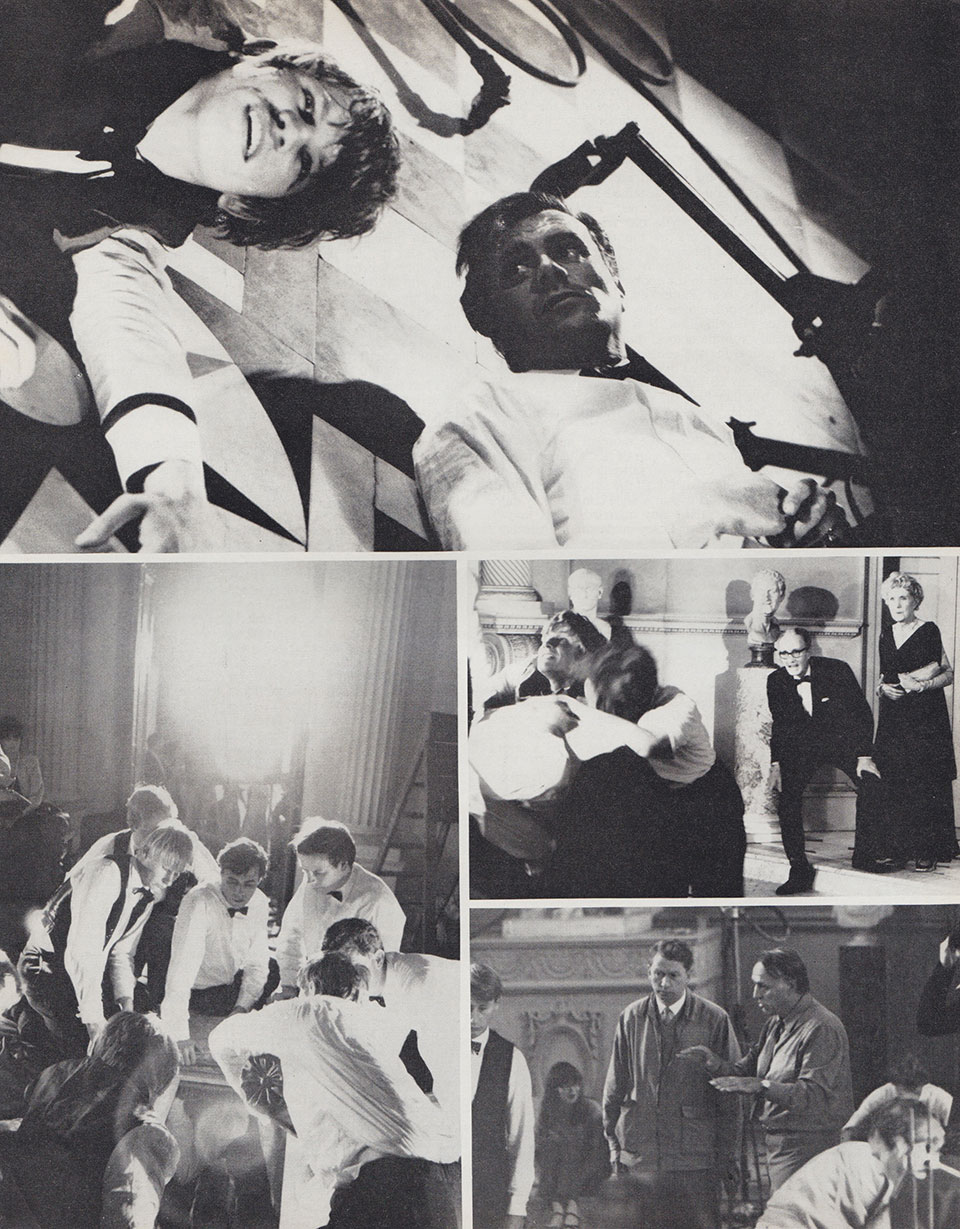
Photographs by Peter Theobald
AT LEAST I HAD READ the book. Nicholas Mosley’s novel Accident was pressed into my hands by a friend who had to review it, with the urgent enquiry, was he mad, or did I dislike it as much as he did. The answer, on the whole, was yes. This was a couple of years ago now, and little of the book remained in my mind apart from a general impression of a lot of rather overwrought, self-consciously fine writing, and a perhaps rather interesting plot in there somewhere struggling obscurely to get out. It was about a group of Oxford dons and their wives, and the disturbing impact on their close circle of an attractive foreign girl and a bright young man student the latter killed in the accident round which the other characters’ dramas, especially Stephen’s, through whose mind we dimly see everything, in a sense revolve.
So the news that Joseph Losey was going to film the book came as a bit of a surprise- a first reaction being, but what is there to film? That Harold Pinter was writing the script guaranteed that there would be something, and something interesting at that. And then there was Dirk Bogarde playing the lead- Stephen, presumably- and Stanley Baker, Delphine Seyrig . . . It was all, evidently, something to be seen in process. It would be interesting, and perhaps illuminating, to find out just how everybody saw the project at the start, and how all the pieces fitted together, before post-production jitters and rationalisations set in. That, in short, was what I meant to do, and what in early August, I set out to do.
Easier said than done, of course. To begin with, the unit were elusive. Locations in Oxford early in the shooting, then Cobham, Syon House, and back to the studio at Twickenham. Could I perhaps catch them at Syon? My first contact was with Losey himself, whom I shamelessly rang up at 10 p.m., when I was fairly sure he would be back from a day’s shooting. He was, but only just, between the door and a bath. Still, he was very forbearing: of course I might come, but things were really very complicated and he didn’t know how they would arrange themselves in the next few days. Would they be at Syon, I ventured. No, those locations had been moved forward from tomorrow and the day after tomorrow to yesterday and the day before yesterday. You see, said Losey, the trouble is the sun. There are certain scenes in this picture that just must be shot in dazzling summer heat, and we haven’t had any. By next week we’ll know: either we’ve had three days of sun and got them done, or we’re in trouble. Whichever way it is, we’ll probably be in the studio, so come along and take your chance with the rest of us.
Fair enough. In the intervening days the sun was fitful at best, and when I arrived at Twickenham the unit had been shooting on set for a week but gazing out wistfully at the sky and racing for Cobham whenever the sun peeped through. Not, obviously, the best circumstances for sane and balanced views from anybody- but then, after all, when is it a good time to get those from film-makers at work?
As it happened, my arrival more or less coincided with a return from one of these lightning jaunts, and so I was able to catch the designer Carmen Dillon and lighting cameraman Gerry Fisher together and for once at rest. To start with first things first, what I wanted to know from them was, did the film, like most of Losey’s, have a ‘look’, and if so what was it? Carmen Dillon, on this film working with Losey for the first time, answered at once: ” No, not really. At least its look is that of not having a look, of avoiding any obtrusive visual stylisation . It’s very much a film about people who appear to be ordinary, and perhaps are, though during the film we learn what depths of violence and uncontrollable emotion they constantly skirt. So in the sets we have concentrated on making everything look used, lived in, believable as a background for them: in real life no one ever has six matching coffee-cups because two have got broken and they have to use something else that doesn’t match. That’s the sort of feeling I’ve tried to get in the sets.”
Realism above all, then, I said. “No … a step down from strict realism, a toning down or selection. In colour, for instance, we are limiting our range beyond what basic realism would dictate, trying to make a colour film almost in monochrome, with just occasional accents of colour.” Colour? I said. I didn’t know the film was in colour; somehow I’d pictured it in black and white. “Yes,” said Gerry Fisher, “it was originally planned that way. But these days there is always a purely economic pressure to make films in colour, because of the eventual possibility of sale to colour television . So it was decided to make the film in colour. But I think anyway the decision was the right one: it makes it all much more interesting to use colour in this way, to make points by its absence rather than its presence. Of course, it’s not always easy : interiors you can control, but exteriors . .. ” Carmen Dillon: “Yes, get some sun on the wall of an Oxford college and it glows like jewels; there’s nothing you can do about that.”
Anyway, I said, it could all hardly be more different from Modesty Blaise, the last Losey film on which Gerry Fisher worked (as camera operator). It was almost as though since Eva he had decided to alternate the ornate and flamboyant – The Servant, Modesty Blaise– with more restrained, toned-down subjects- King and Country, Accident. Gerry Fisher: “Not really. It does look like that, but you have to remember that Modesty Blaise wasn’t really a film of his own choosing. Obviously, if it was to be made at all, it had to be made like that; but I think it was a special style for a special film , and not necessarily representative of what Losey might ideally have chosen to do at that stage. In general I would say that this film continues a trend of The Servent and King and Country, towards something much more restrained and sober, altogether less visually flamboyant and closer to the characters.” Carmen Dillon: “Oh yes, no mirrors, no cages. Far, far less mannered than any of his recent films …”
By now they were on the set and preparing to shoot, so over I went. It was a complex, sustained scene involving a dinner at Stephen’s, with Dirk Bogarde, Vivien Merchant as his wife, Stanley Baker as their old friend, a successful television don, Michael York as the undergraduate, and Jacqueline Sassard as the foreign girl whose presence begins the trouble, or at least brings latent troubles to a head. All the men are pretty drunk, and in the course of a barbed, indirect conversation in the best Pinter manner the resentments bubbling underneath look dangerously like breaking through the brittle surface of civilisation. It is rehearsed all through three times, mainly for the actors, though simultaneously a rather intricate course for the camera is plotted out so that the whole thing can be covered in one master-shot (I suppose, though maybe not, to be followed by close-ups). After the rehearsals, and while they light the set, director and cast retire to plan the scene further, and spend nearly half an hour deep in discussion.
At last Losey is satisfied- for the moment anyway-and they break for five minutes and a cup of tea. Chance to trap Stanley Baker, marooned on a plush settee in Stephen’s living- room (I note, incidentally, that for all the subdued realism of the film, these dons seem to live in a style considerably more elevated and glamorous than any married don I know). I accuse him of playing another Losey intellectual. “Another? Have I played one before? The characters in The Criminal and Blind Date could hardly be more unintellectual.” But Eva? “Well, yes, in a way. But then he’s a pseudo-intellectual. And so is this man in Accident, only a little less so: he has become one, corrupted by television celebrity, success . ..” Obviously, I said, you must enjoy working with Losey since this is the fourth film you’ve made with him. “He’s a marvellous director for actors, and by now I think we understand each other pretty well. When I say that he’s a good director for actors, by the way, I mean just that: he’s good/or actors. When actors talk of someone as an actors’ director, they usually mean one who lets them have their own way as much as possible and keeps them smoothed down by telling them they are marvellous. Joe never does that, but he does know, better than any other director I’ve ever encountered, how to help actors and get the best out of actors.
“To begin with, he really gets to know his actors, their whole histories and what makes them tick- I think that’s one of the reasons he likes to use the same actors often. This means that when you come up against something you just cannot see how to do, some line you think you can’t say, he always knows how to help you out of it. Where many directors just wring their hands, and many more hand out some sort of generalised Reader’s Digest psychology, Joe can really get to you because he knows you well enough to see what experiences he can call on, what sides of your temperament, to get what he wants out of you.”
Was this film making very different calls from the other Losey films he had worked on? “For me, certainly, but I think probably for all of us. For me it’s a much less extravagant, extrovert part, though in the context of the film I am a relatively extrovert figure. But in The Criminal and Blind Date, and almost as much in Eva, the characters had interesting, picturesque, extravagant exteriors, and the actor wasn’t called on to dig so deep into them. Of course I enjoyed that-what actor doesn’t enjoy playing someone colourful and a bit larger than life? But this is in many ways more interesting because the characters in this film are all beneath the surface: everything happens in their minds, and in the electric gap between them. To play it you really have to dig into yourself, and bank all the fires down. The script is extraordinary: to read the dialogue you would say that most of it was just slight exchanges of small talk, that there was nothing to it. But once we get together, so many characters in a room, and start to say the lines and live the action, suddenly everything becomes clear, you know just what is going on behind the masks, just what violent emotions the clipped civilised conversation covers. And this something hidden behind and beneath is what Joe is getting on to the screen: I think this could easily be his best film.”
Next on my list was Dirk Bogarde, whom I ran to earth a couple of days later, tearing his hair in his dressing-room and muttering darkly, “I don’t know how the hell I’m going to make an omelette in that kitchen, much less feed Stanley Baker with it …” Be that as it might, though, he seemed thoroughly cheerful about the film in general, the way it was going, and his own part in it. “When Joe first told me about it I asked him, quite simply, ‘What sort of a film is it going to be, what sort of film do you want to make?’ He looked at me for a minute, to see that I wasn’t being smart, and then he said, ‘The perfect film. This time I’m going to make the perfect film. I’ve got the perfect script, the perfect cast, the perfect crew. All I need now is the sun for as long as it takes.’ And really that’s just how it has been. The script is fantastic-I think the best script Harold has done. It’s so sharp, and spare, and pared down. And the cast, well, I can’t imagine how we could fit more perfectly together …”
Interesting particularly, I said, to see him and Stanley Baker together in a Losey film – Losey’s two worlds brought together, as it were. “In head-on collision? Not quite, actually, though our characters in the film are pretty antagonistic under the surface. I wondered myself how it would work out, but in the event I think it bears out Joe’s judgment absolutely- it’s a marvellous matching of contrasted flavours, a real strong country Cheddar and a more delicate, insidious Demi-sel …” I had gathered, I said, that this was going to be a very plain, severe, self-denying sort of Losey film; I wondered whether the absence of Richard Macdonald from the line-up had anything to do with this.
“In a way, I suppose so, but only because Joe wants it that way. You see, Richard is a marvellous improvisator, an ideas man who throws off dazzling notions every minute of the day and leaves others to work out the prosaic details. This is exactly right for a film like Modesty Blaise. But Carmen is a completely practical designer from top to toe; she is a professionally trained architect and all her designs are calculated exactly to work. In this sort of film, which is meant to have its feet very much on the ground, she is ideal, because she observes so closely and knows exactly how to translate what she sees on to the studio floor. The house set,for instance, is quite uncanny, it matches the exterior so exactly, with no cheating at all (well, maybe an extra foot in the hall, to get the camera in). And it is so meticulously detailed according to the way people like this actually live that it aids the actor enormously when he is playing in it.” (Stanley Baker too had commented on the sets, observing that it was often the intangible unnoticeables, like set design and even camera lighting, which were most likely to throw an actor’s timing off if they were wrong.)
Someone quoted Losey as saying when he began the film that he was going to make it as a continuous texture, without defined sequences, and without exits and entrances. Dirk Bogarde laughed: “I don’t know about that- I seem to do nothing in this film but sweep in and out of doors, get in and out of cars. But I do know what he means: the whole film is based on strange time-shifts, a bit like what Resnais does in La Guerre est Finie, only more consistently. In fact the whole action is seen as refracted through my mind (I didn’t work this out till we’d been shooting several days, which will show how bright I am!), and so one memory sets off another, and scenes that take place in widely different times and places actually appear on the screen simultaneously.
“We’ve just been doing the second half of one : I am sitting with Vivien (Merchant), who plays my wife, in her garden on an absolutely sweltering summer day, heavy with lassitude, sticky and uncomfortable, and we talk about the other couple’s (Stanley Baker and Ann Firbank’s) marital difficulties and what if anything I can do. And this sets off recollection of another occasion when I actually go and talk to Ann Firbank about it in a torrential downpour, with everything sopping and miserable. And in the montage these scenes will be intercut, because in Stephen’s mind they are inextricable. This will be something quite new for Losey, and partly because the structure is so complex the visual style will be very simple and direct- no bare feet, no mirrors, nothing fancy. And if, every now and then, he looks like getting a little fancy, I kick him … “
* * *
With all this discussion of the script and the way it worked, it seemed about time to talk to Harold Pinter himself, and this I was able to do a few days later again, off on location one weekend when the sun was supposed to be shining (but of course wasn’t) a few miles outside Esher. Our conversation, as a matter of fact, was rather like a scene in some sub Antonioni film: a country lane, the fields stretching blandly away to either side, two solitary figures walking away from the farm and human contact towards a distant gate across the road (locked and barred, symbolically no doubt) and then back, talking, talking, and as they do so changing places, now one, now the other drawing ahead, or stopping to make or illustrate a point. Very pretty it would have looked, no doubt, in very distant long-shot or in sustained, artfully casual travellings. What we actually said, though, was far more practical and to the point than film conversations in such circumstances usually are.
Pinter: “It was Losey who first sent me the book. He wanted to do it, and when I had read it I wanted to do it. I think we wanted to do it for the same reasons. We thought a lot about how it should be done, and worked together very closely on it. At first we thought of perhaps trying to do it the way the book does, to find a direct film equivalent to the free association, stream-of-consciousness style of the novel. I tried a draft that way, but it just wouldn’t work-anyway, I couldn’t do it. You see, suppose a character is walking down a lane, this lane, as we are now. You could easily note down a stream of thought which might be perfectly accurate and believable, and then translate it into a series of images: road, field, hedge, grass, corn, wheat, ear, her ear on the pillow, tumbled hair, love, love years ago … But when one’s mind wanders and associates things in this way it’s perfectly unselfconscious. Do exactly the same thing on film and the result is precious, self-conscious, over-elaborate-you’re using absurdly complex means to convey something very simple. Instead, you should be able to convey the same sort of apprehension not by opening out, proliferating, but by closing in, looking closer and closer, harder and harder at things that are there before you.
“For example, it seems to me that Marienbad works very well in its own terms, on the level of fantasy. But there is another way of doing it, and one I personally would find more interesting to explore. In a real, recognisable Paris an ordinary, reasonably attractive woman sits at a cafe table, wearing what she would be wearing, eating and drinking what she would be eating and drinking. An equally ordinary, everyday sort of man comes up to her. ‘Excuse me, but don’t you remember, we met last year at Marienbad?’ ‘Marienbad? Impossible – I was never in Marienbad last year…’and she gets up, walks out to an ordinary, believable street and gets into a real taxi … And so on. Wouldn’t that be just as strange and mysterious and frightening as the way the film does it? Perhaps more so, because of the very ordinariness of the surroundings and apparent normality of the characters.
“It’s something of that sort of feeling we’re trying to get here. In the book, for example, there is a scene in which Stephen, coming home, sees a car outside his house and Charlie (Stanley Baker) standing by it. To convey what effect this has on him the novel needs a couple of pages of free association. But in the film, it seems to me, all that can be conveyed just by the shot of what he sees, photographed in a certain way, held on the screen for a certain length of time, with the two characters in the sort of relationship to each other that we know to exist already. It’s just the same as the way that a novelist may need five or six pages to introduce a character, to tell us what we need to know about his appearance, age, bearing, education, social background and so on.
In a film the actor just walks into a room and it’s done, it’s all there- or should be. So in this film everything is buried, it is implicit. There is really very little dialogue, and that is mostly trivial, meaningless. The drama goes on inside the characters, and by looking hard at the smooth surface we come to see something of what is going on underneath.
“Take the character of Stephen’s wife. She doesn’t do anything significant, she doesn’t say anything significant; she knows from the start that Stephen is attracted to the girl, and that the other man is mad for her too. And Stephen knows that she knows. And life continues, with these strains present and recognised by both, spoken of directly by neither: if anything directly preoccupies Rosalind, it is that she is pregnant. Then in this situation, something happens: the young man is killed in an accident. And this changes things, it makes all the unlocalised, unformulated guilt sharper, nearer the surface. But still the unforgivable, unforgettable things are never said, things are never actually brought to a showdown: life goes on and people, knowing perfectly well what gulfs they are skirting, do their best to keep things going, to let them work themselves out. One thing happens, and then another; and eventually an episode closes, and something else begins.
“The novel ends with the birth and survival of Stephen and Rosalind’s baby; this is a big thing, brought out like this as the saving grace, the one new thing that makes everything right for them. Well, in life of course babies are born, and parents are happy about it, or sometimes they die, and parents are very upset about it: babies are born, babies do die. But in a film … I don’t know- there is always the danger that it will seem as though the baby was brought in just as a device, to live or to die to tie things up neatly. I thought and thought about it, and discussed it with Nicholas Mosley, and in the end I decided to make it as much an ordinary happening, one moment in a continuing life, as possible. The baby is born, and it lives, just, and that is that. The fact has no special result- Stephen gets the news that the baby will live, he accepts it, it has happened and things go on … “
J.R.T.: “I have always thought that there is a lot to be said for drama which uses, as it were, only the most elementary syntax of a child’s story-telling: ‘and then … and then … and then …’ Without all the becauses and therefores and notwithstandings of psychological drama.”
Pinter: “What you are saying is biblical, it’s holy writ for a dramatist- well , for me anyway. I do so hate the becauses of drama. Who are we to say that this happens because that happened, that one thing is the consequence of another? How do we know ? What reason have we to suppose that life is so neat and tidy? The most we know for sure is that the things which have happened have happened in a certain order: any connections we think we see, or choose to make, are pure guesswork. Life is much more mysterious than plays make it out to be. And it is this mystery which fascinates me: what happens between the words, what happens when no words are spoken … In this film everything happens, nothing is explained. It has been pared down and down, all unnecessary words and actions are eliminated. If it is interesting to see a man cross a room, then we see him do it; if not, then we leave out the insignificant stages of the action. I think you’ll be surprised at the directness, the simplicity with which Losey is directing this film: no elaborations, no odd angles, no darting about. Just a level, intense look at people, at things. As though if you look at them hard enough they will give up their secrets. Not that they will , for however much you see and guess at there is always that something more … “
* * *
And finally, two days later, the master himself. It has been, at long last, a day of blinding, blistering sunlight, and at last the locations have gone right. At the end of shooting Losey is happy and relaxed and ready to talk- briefly but to the point: “Realistic colour? I don’t know about that- I don’t really believe such a thing exists on film. But I suppose the colour in Accident is more like that in Muriel than anything else. It is used apparently without arrangement or calculation, just because it is there, and with none of the frantic signalling Antonioni indulges in in Deserto Rosso, but in fact it is all very carefully designed to select and highlight so that- I hope – it will work subliminally on an audience. Simple? Yes, I think the style of this film really is simple. Not altogether: I guess the sort of Eton wall-game sequence we shot at Syon House will give people all the handle they want to call it baroque. But really, most of this film is more simple and direct than any of my recent films: it is the style imposed by the subject and the script. What sort of film is it; what is it essentially about? Let me see, there’s one piece from the novel which I noted down that I think gets to the heart of it- the method and the subject … “
The extract read: “I wish I could say what I mean about all this. There are two things, first, that people are not characters but things moving occasionally in jumps and mostly in indiscernible slowness; and secondly the opposite, that we each of us had in a way got what we wanted … “

