Picturegoer – Oct 3rd 1951
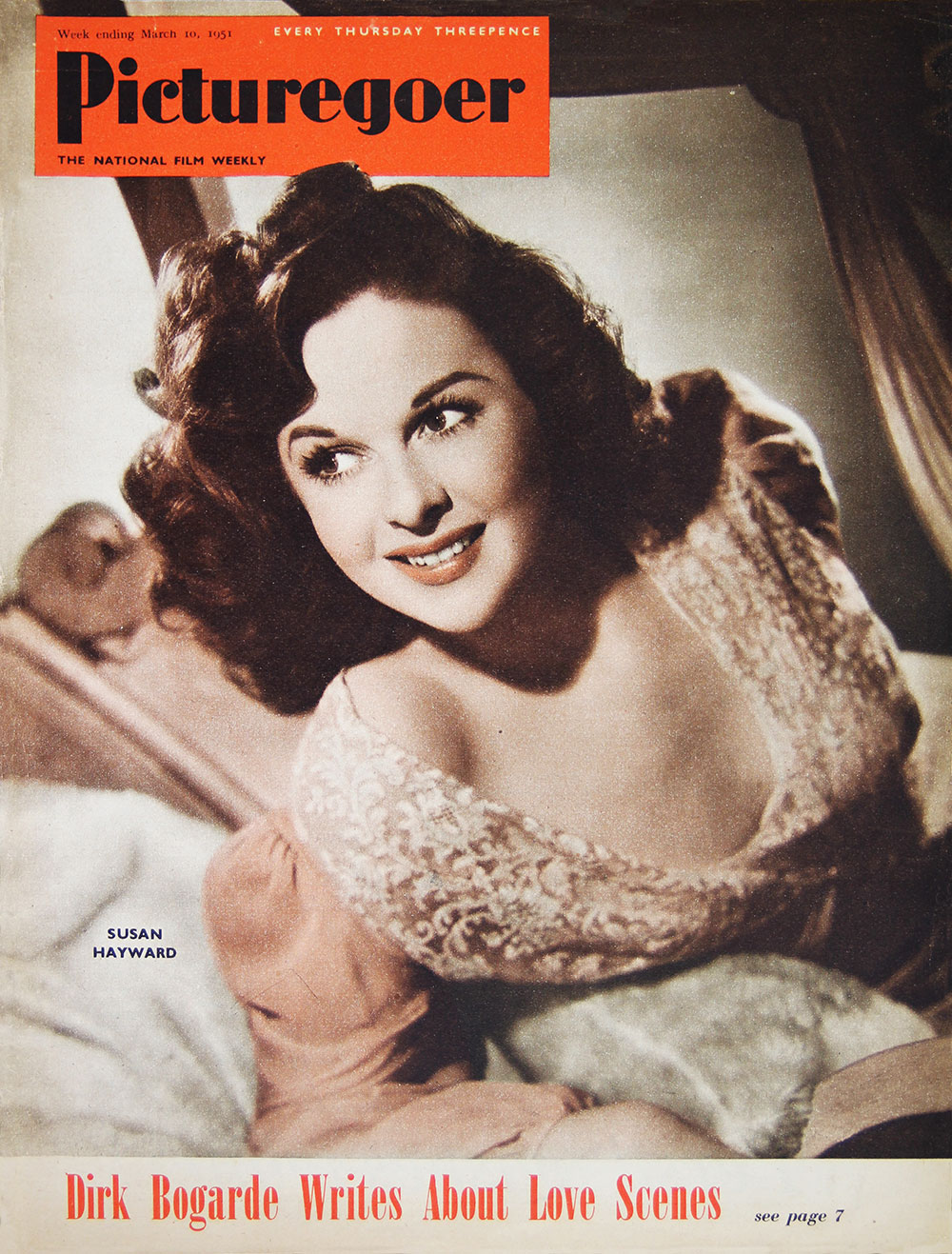

I’VE GOT MY EYE ON LOVE
says Dirk Bogarde
The star who’s never had a love scene wants more screen romance
Five or six years ago the biggest box office successes among British films were pictures such as The Wicked Lady, Fanny by Gaslight, Love Story, Madonna of the Seven Moons and Caravan. They provided the escapism picturegoers needed, and they established many new British stars.
Margaret Lockwood, James Mason, Phyllis Calvert, Stewart Granger, Jean Kent and the others climbed high in pictures of this calibre.
If you remember these British films you’ll recall not only their success, but one other important point about them. They were all love stories – each one of them chock full with romance.
And that’s the point. I know that, like all other vogues, film fashions change. I know that during the war people sought refuge from everyday worries by escaping into film romance. But the success of those screen love stories taught us a lesson. Have we forgotten it?
I’ll tell you why I ask.
Nearly Vanished
The other Sunday I had a party of friends to my house for the day. We had dined, and were sitting around a fire talking – as actors always do – about ourselves and our jobs.
Earlier in the day a daily paper columnist had phoned to ask if I had any opinion on “what’s wrong with British pictures?”
I told him I bad not. I know less than nothing about finance, distribution, booking or choosing good film subjects. I am an actor, and that takes me all my time.
I said, on reflection, however, that I thought the only thing wrong with British pictures was that there were far too few love stories on the screen.
So that evening, as we sat talking, we chewed over the point. It struck us that within the last few years, out-and-out romance has almost vanished from British films.
Where, we asked ourselves, are the real boy-meets-girl stories; the sort Joan Crawford and Yvonne de Carlo make; the type that the names of Garbo and Norma Shearer used to be linked with?
When it comes to films of a semi-documentary nature, films such as The Blue Lamp, Morning Departure, They Were Not Divided and Seven Days to Noon, British studios are magnificent. But they never seem to set out to screen a really tender, heartwarming romance.
I asked a few of my movie friends what they felt. Glynis Johns said: “I haven’t had a real love scene in a picture for about seven years. . I’ve had a few little sequences with no warmth about them, or a couple of comedy love scenes, but. . . . ” Margaret Leighton agreed with me, too. I don’t remember ever seeing her in a really romantic sequence on the screen.
I myself have made ten pictures. In all my time around the studios I have never had a love scene, although I do have some rather tender sequences with Joan Rice in Blackmailed.
Richard Todd is one of our leading male stars right now, and I go to see all the movies he makes. But up to date I can’t recall seeing him have one really big clinch!
Am I wrong, do you think? Or am I right when I say love scenes are important to our films?
One British producer has dared to go all out for a romantic film. He deserves success for his boldness. He is Hugh Stewart, who has just completed Night Without Stars. It’s a story set on the romantic French Riviera, with David Farrar and Nadia Gray.
Is It Enough?
But is one filmic love story in a year sufficient to satisfy picturegoers’ demands?
At the moment I’m appearing with Mai Zetterling in a play on the London stage. Some people think the play is obscure, intellectual, wonderful, pompous, brilliant, awful, sad and one thing and another … but we do splendid business.
Why? My belief is that apart from anything else, the play is essentially a love story.
Some day I want to play in one on the screen – right up to the final fade-out amid apple blossom and rustic bridges.
Corny? Of course it’s corny – wonderfully corny. Old fashioned ? Yes, it’s old fashioned, too . . . and so is love!
By all means let us have brilliant films such as State Secret, Seven Days to Noon and the rest. But just once, every now and again, don’t you think we might have a go at another Wicked Lady or Man in Grey, or possibly a more serious treatment of a perfectly simple romance?
After all, some of the greatest stories ever written have been fundamentally love stories. So why forget them in the 1950s?

