The Times – Past, Present and Future – 1985

THE PICTURE MAN
DIRK BOGARDE introduces a selection of historic photographs from The Times with a profile of his father Ulric Van den Bogaerde art editor for 35 years.
Your father has sacrificed us all on that damned redbrick altar of his in Printing House Square!” my mother would cry in despair as another lovingly prepared supper was burnt or left to go cold by his delayed arrival home.
My mother was an ex-actress and, as such, prone to mild exaggeration. The red-brick altar to which she referred was The Times. It was not our father’s property in any way: it belonged at that time to the Hon. John Jacob Astor, and we weren’t sacrificed. Very.much.
From our earliest days my sister and brother and I were made aware that whatever happened we had to take second place to The Paper: it really caused us very little grief. and we were proud lO be know n as “newspaper children”. If we didn’t completely understand the reasons for the sacrifices which we had to make on occasions, we accepted them anyway as inevitable. Anything. and indeed everything, could be, and often was, set aside, postponed, rearranged or sometimes forgotten to suit the capricious whims and demands of our rival.
Nightly the telephone would ring with the news of kings falling from mountain peaks, train crashes in Scotland, assassinations in Bolivia or floods in India: all this went completely over our heads, naturally. but a marvellous sense of excitement was always in the air.
Birthdays, pantomimes, summer holidays, even Christmas trees suffered from these sudden shrill alarms, but we managed to survive the blows with equanimity. Our mother suffered rather more, for she was the one who had to cope with ruined meals, dinner parties, first nights: anything which she had planned or had looked forward to enjoying with my father.
Many were the times that she sat alone and furious in the foyer of some theatre. having missed the first act and in despair that her husband might not arrive to catch even the second. He was pulling The Paper to bed: and that, depending on the state of the news, could be at any time of the night. It was the main fact in our existences, which we al! had to learn to accept.
But if The Paper was his life, he made certain that we shared a part of it with him. We grew to love it. The art department, which he founded, became as familiar to u’s as our own home. We had tea-parties there, with sugar buns and hot sweet tea in thick china cups from tin trays; we watched the Lord Mayor’s Show from its windows.
I knew every tear in the corridor linoleum. every inch of the chocolate-coloured pipes which writhed like jointed macaroni overhead and along the walls, every grimy window, each crack in the bilious cream distemper of the walls. The smell of dust, printers’ ink, cardboard, newsprint, all overlaid by the heavy scent of sour pipe tobacco smoke, is instantly recallable.
We collected an astonishing number of “uncles”, particularly from the ranks of photographers. I knew every familiar face. and had known them. I suppose, from the earliest moments of recognition, for they are a part of my earliest remembrances.
Right up to the beginning of the war I went there almost every week to borrow a florin or, better still, half a crown, to get me through a difficult time. My “uncles” were needed almost as often as my harassed father, who sometimes found, on my sheepish visits, that he had only notes in his wallet.
In mild despair, picking abstractedly at the side of his nose, he would turn to one of his team, murmuring: “Budge? Any small change on you? A florin? Half a crown? I seem only to have notes today.” And Budge found a coin.
It was the time of surnames. much like.school. Greenwood, Horton, Bell, Budge, Grimwade, O’Gorman, Warhurst (whose son is still with The Times). All were “touched”. All gave willingly. Or at any rate with good humour and kindness, saving me from being chucked out of my lodgings or enabling me pay for a couple of meals.
How grateful I was, and still am, to them. Not only for their largesse, but for the enormous pleasure of their company on many a journey which we made together to “take photographs”.
To tighten the bond between his children and his paper, my father sent us off on some of the less demanding photographic sessions “in the field”. This was quite deliberate: he had determined ideas about my future. The sooner I got to know what was expected of me, he reasoned, the better.
I suppose that the Christmas Photograph ranked as one of the jolliest assignments, if not the most important.
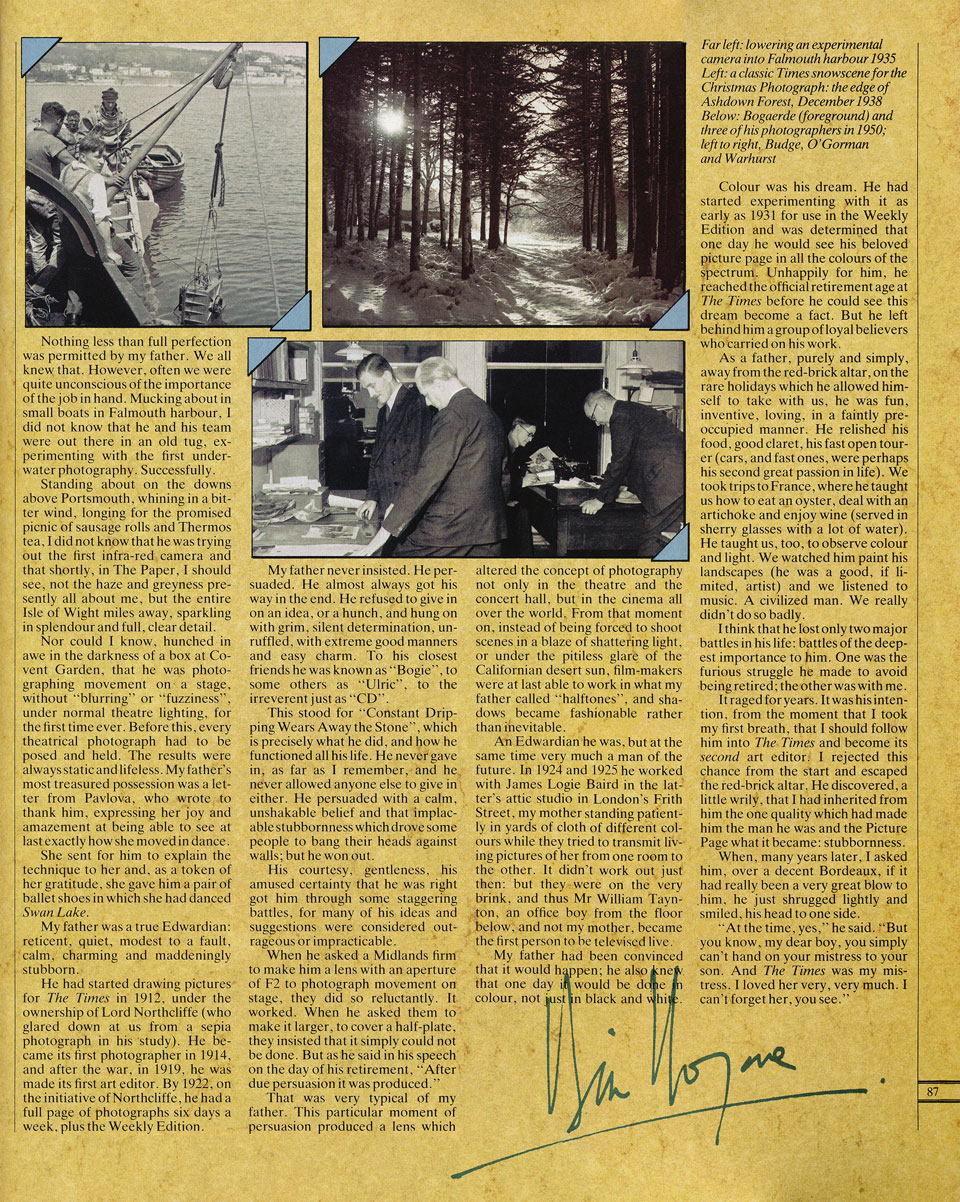
Sometime in November my father would start to become rest· less; telephone calls were made the length and breadth of the country to ascertain if there was any snow, had been any, or was likely to be any.
Photographers were sent off to distant corners and told to huddle there until there was a snowfall. A good hoar frost was acceptable; snow was desirable above all. They sat about from Barra to the Lizard for weeks, waiting.
Planters in Ceylon or India, farmers in Africa or soldiers in Singapore, all would be shown a reminder of Britain at this festive season. So there had to be snow.
My sister and I were often sent out on these “jobs” (if the places were fairly local, such as Hindhead or Ditchling Beacon), and, used to give a little “movement” or “interest” to the scene (back to camera at all times) by carting about faggots, or hauling at far too heavy logs; frozen, grumbling, glum and hungry, waiting for the light to be absolutely right.
Sun breaking through thin cloud was greatly favoured because it thrust down in wide rays of light and sparkled on the snow or frost. Horton or Warhurst and my father would stamp about, obviously impervious to the bitter chill, looking up at the sky through filters and yelling out their readings to each other.
Nothing less than full perfection was permitted by my father. We all knew that. However, often we were quite unconscious of the importance of the job in hand. Mucking about in small boats in Falmouth harbour, I did not know that he and his team were out there in an old tug, experimenting with the first underwater photography. Successfully.
Standing about on the downs above Portsmouth, whining in a bitter wind, longing for the promised picnic of sausage rolls, and Thermos tea, I did not know that he was trying out the first infra-red camera and that shortly, in The Paper, I should see, not the haze and greyness presently all about me, but the entire Isle of Wight miles away, sparkling in splendour and full, clear detail.
Nor could I know, hunched in awe in the darkness of a box at Covent Garden, that he was photographing movement on a stage, without “blurring” or “fuzziness”, under normal theatre lighting, for the first time ever. Before this, every theatrical photograph had to be posed and held. The results were always static and lifeless. My father’s most treasured possession was a letter from Pavlova, who wrote to thank him, expressing her joy and amazement at being able to see at last exactly how she moved in dance.
She sent for him to explain the technique to her and, as a token of her gratitude, she gave him a pair of ballet shoes in which she had danced Swan Lake.
My father was a true Edwardian: reticent, quiet, modest to a fault, calm, charming and maddeningly stubborn.
He had started drawing pictures for The Times in 1912, under the ownership of Lord Northcliffe (who glared down at us from a sepia photograph in his study). He became its first photographer in 1914, and after the war, in 1919, he was made its first art editor. By 1922, on the initiative of Northcliffe, he had a full page of photographs six days a week, plus the Weekly Edition.
My father never insisted. He persuaded. He almost always got his way in the end. He refused to give in on an idea, or a hunch, and hung on with grim, silent determination, unruffled, with extreme good manners and easy charm. To his closest friends he was known as “Bogie”, to some others as “Ulric”, to the irreverent just as “CD”.
This stood for “Constant Dripping Wears Away the Stone”, which is precisely what he did, and how he functioned all his life. He never gave in, as far as I remember, and he never allowed anyone else to give in either. He persuaded with a calm, unshakable belief and that implacable stubbornness which drove some people to bang their heads against walls; but he won out.
His courtesy, gentleness, his amused certainty that he was right got him through some staggering battles, for many of his ideas and suggestions were considered outrageous or impracticable.
When he asked a Midlands firm to make him a lens with an aperture of F2 to photograph movement on stage, they did so reluctantly. It worked. When he asked them to make it larger, to cover a half-plate, they insisted that it simply could not be done. But as he said in his speech on the day of his retirement. “After due persuasion it was produced.”
That was very typical of my father. This particular moment of persuasion produced a lens which altered the concept of photography not only in the theatre and the concert hall, but in the cinema all over the world. From that moment on, instead of being forced to shoot scenes in a blaze of shattering light, or under the pitiless glare of the Californian desert sun, film-makers were at last able to work in what my father called “halftones”, and shadows became fashionable rather than inevitable.
An Edwardian he was, but at the same time very much a man of the future. In 1924 and 1925 he worked with James Logie Baird in the latter’s attic studio in London’s Frith Street, my mother standing patiently in yards of cloth of different colours while they tried to transmit living pictures of her from one room to the other. It didn’t work out just then: but they were on the very brink, and thus Mr William Taynton, an office boy from the floor below, and not my mother became the first person to be televised live.
My father had been convinced that it would happen; he also knew that one day it would be done in colour, not just in black and white.
Colour was his dream. He had started experimenting with it as early as 1931 for use in the Weekly Edition and was determined that one day he would see his beloved picture page in all the colours of the spectrum. Unhappily for him, he reached the official retirement age at The Times before he could see this dream become a fact. But he left behind him a group of loyal believers who carried on his work.
As a father, purely and simply, away from the red-brick altar, on the rare holidays which he allowed himself to take with us, he was fun, inventive, loving, in a faintly pre-occupied manner. He relished his food, good claret, his fast open tourer (cars, and fast ones, were perhaps his second great passion in life). We took trips to France, where he taught us how to eat an oyster, deal with an artichoke and enjoy wine (served in sherry glasses with a lot of water). He taught us, too, to observe colour and light. We watched him paint his landscapes (he was a good, if limited, artist) and we listened to music. A civilized man. We really didn’t do so badly.
I think that he lost only two major battles in his life: battles of the deepest importance to him. One was the furious struggle he made to avoid being retired; the other was with me.
It raged for years. It was his intention, from the moment that I took my first breath, that I should follow him into The Times and become its second art editor. I rejected this chance from the start and escaped the red-brick altar. He discovered, a little wrily, that I had inherited from him the one quality which had made him the man he was and the Picture Page what it became: stubbornness.
When many years later, I asked him, over a decent Bordeaux, if it had really been a very great blow to him, he just shrugged lightly and smiled, his head to one side.
“At the time, yes,” he said. “But you know, my dear boy, you simply can’t hand on your mistress to your son. And The Times was my mistress. I loved her very, very much. I can’t forget her, you see.”

