TV Times Sept 13th 1986

Public tears of a private man
by David James Smith
pictures Paul Stokes
Dirk Bogarde is 65, and says there isn’t a question he hasn’t been asked. This is not strictly true. There are some questions you just don’t ask.
On ITV this Sunday, Dirk Bogarde – Above The Title. A Conversation with Russell Harty, Bogarde gives a performance: warm, caustic, wickedly funny, perhaps evasive, eyebrows always arched theatrically in an expression of something or other. But there’s truth as well, and the wisdom of remarkable experience. Like his books, Bogarde is unputdownable – and not to be underestimated.
Over a sunny French lunch with the documentary crew, I had heard tales of three days’ filming with Bogarde. There was chemistry, electricity even, between Russell Harty and Bogarde. It would be a great television interview. And Bogarde had wept on camera.
Harty had asked about the war, and Bogarde had spoken of Belsen: of being there when the gates were opened on that grotesque pile of human decay. It had changed Bogarde forever, and now he had remembered and broken down, with not a crocodile in sight. Tears had been shed among the crew.
Back at his house I sat down to interview Bogarde, wanting to know what it was like for such a private and dignified man to share this latent display of grief with the viewing millions, but not wanting him to know it had been the subject of lunchtime tittle-tattle.
‘It must have been an intense three days of interview for you. Have there been any particularly emotional moments?’ Good question. Very clever.
A pause. Bogarde fixes me with a discomfiting stare. ‘You’ve been talking to the crew at lunchtime.’
How on earth did he know? He didn’t. Brilliant but deeply unnerving. I lie, badly. ‘No. I haven’t but it, er, seemed likely after such a lengthy interview.’
He smiles. ‘Well, I think you’re fibbing, but never mind. I know the crew were moved by certain aspects of it. OK. I’m on the slab, but I don’t mind with Russell. Of course, you feel you’re whoring a little bit, but I’m enough of a professional to know that if you go on television you don’t go with all your false teeth in and give people half measure. They want the truth, and that’s what they’re seeing.’
Later I confess the sin of fibbing. He didn’t need to be told, and from that moment on he held our interview in his grasp.
We had first met much earlier in the year. Bogarde was in Nice on location, filming the Graham Greene short story May We Borrow Your Husband? for Yorkshire Television (it’s on ITV in November). Bogarde, the actor turned author, was now doing both at once: the star of his own screenplay.
Then summer came, and with it, Russell Harty. Bogarde had a new book to promote and would be filmed at home – but only in conversation with Harty.
It was Bogarde’s fourth and final volume of autobiography, Backcloth (‘I’ve burned all my papers and notes and letters: there’s only the books now’), and this would be his last major television interview.
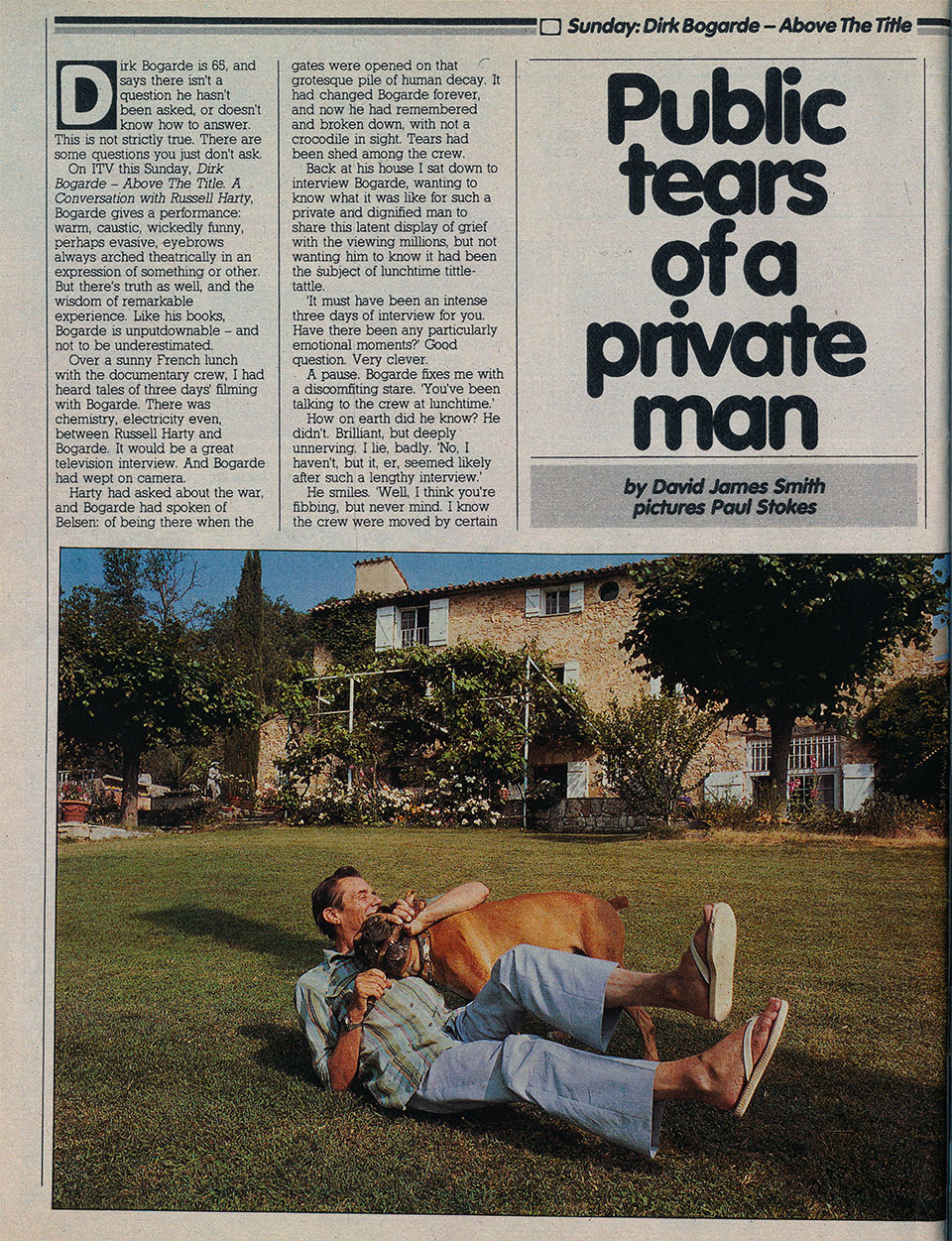
Padding around in flip-flops on his vine-shrouded terrace. Bogarde emptied ashtrays, collected bottles and generally seemed unfazed by the intrusion.
Beyond the terrace lay 12 acres or Bogarde’s land, a glorious view down towards the Riviera coastline and an almost magical stillness. (‘Glenda Jackson sat out here one evening and said, “Well I suppose this must be paradise”, and I suppose it is. You don’t take that for granted.’)
Bogarde was in good health, ‘as far as I know’, and his friend Tony Forwood looked better too. In Nice he had presented a spectral figure; now he was frail, but a survivor of the serious illness Bogarde documents so painfully in Backcloth.
They have known each other for nearly 5O years, and when Bogarde moved to the South of France at the age of 49, Forwood went with him.
In this area lie the questions that are never asked. And why should they be? Just don’t jump to the most obvious conclusions. Bogarde says the clues to his private life are all there in his books.
‘If you’ve got your wits about you, you will know who I am: he says.
One eminent literary critic wrote of the gaps in Bogarde’s story. ‘I think he meant I hadn’t talked about the people I’d been in love with and all that kind of rubbish. Well that’s not my business, nor is it the business of the public. The only two people that I really much loved, and did want to marry, loved somebody else. So you leave that out. But the inferences are there, and anybody with half a head will know who and what I’m talking about.’
Asking Bogarde if he feels the lack of a normal family and children brings the retort that for a long time he had no room in his luggage for anyone else. It just had to be me. I wanted to be number one. I had no great pull towards having a family and I have no regrets. That takes care of it.’
‘But people who remain single can lead very lonely lives, and you seem to have avoided that?’ I ask.
‘Oh, I think I’ll end up alone.’
The idyllic phase of Bogarde’s life didn’t last too long. The war and a host of subsequent tragedies and traumas have left him with a powerful streak of fatalism. Like so much of his outlook, it is vividly described.
‘I don’t believe anything lasts forever. You take what you can and hang on to it. I’m telling you, not asking you, to agree with me. You’ll find out.’
Bogarde, who is by no means a rich man, can no longer afford the help required to maintain his home. He no longer has the energy to mow the lawn and keep everything as it should be kept.
‘If the crunch comes and I have to leave here, I’ve got enough nieces and nephews and godchildren, who I adore, and they’ll help me over the hurdles. At least, I hope so.
‘I’m not anticipating, but I know I can’t keep this. It’s too much work. From paradise it’s become an albatross.
‘It’s not forever; nothing’s forever. It’s sandcastles. The tide comes and down they go. You spend days, years, building the wretched things, covering them with shells, seaweed and making it all pretty, building moats and finding driftwood for little bridges. I remember very well as a child watching them and seeing them go in the evening when the tide came in. And that is what life is all about.’
He stops. ‘We’re getting very boring you know.’
Bogarde may be right, but time or tide will not erode the impressive body of work he has created. Four eloquent autobiographies, a couple of novels and a handful of great film performances: Victim (1961), The Damned (1961), The Servant (1963), Death in Venice (1971) and Despair (1979).
Hardly sand and driftwood.

