Woman’s Weekly – Oct 21st 1978


ABOUT TOWN
Introducing our first collection of extracts from the latest volume of Dirk Bogarde’s autobiography-pen pictures of an era in British cinema drawn with a perceptive and often humorous touch
SNAKES AND LADDERS
IT WAS a depressing time. Familiar faces slid away, in all departments, to fitful obscurity or television which, in those early Fifties, was scooping up all the leftovers from the film industry and starting to build up a force which would eventually bring us to the brink of ruin. But for the moment the [Rank] Organisation, having cleared out its dead-wood, found the land clear and open and with a little more money to spend bought the rights to a best seller called The Cruel Sea. Here I thought, wrongly, was a chance for me to break away from the raincoats and caps and play an Officer and a Gentleman, for there had to be one or both, in a film about the Navy. But there was not the slightest chance. I implored, I begged, I grovelled. I offered to test for any part, even if I didn’t get it, just so that I would have the chance to show them that I could speak “proper” and could therefore extend my range. I even offered to work for no money at all. Which didn’t move them in the least. They insisted that I was best in working class roles, no one would believe me as a Gentleman, but that there was a nice little cameo, if I was absolutely determined on being in their epic, of an Able Bodied Seaman who had a good little moment in a lifeboat.
I refused the Able Bodied Seaman in the lifeboat and went back to my uncertain role of Country Squire at Bendrose; but not for long. Ironically they cheerfully rented me out (they got half the salary) to a small company who offered me the part of a Wing Commander in a film about Bomber Command. He was an upper-class Wing Commander at that; never wore a raincoat and never saw a Copper. Appointment in London was the first time that I actually made any kind of impression for good on the screen. The Daily Mail suggested that I could act with my skin, The Graphic said it was my finest hour, The Telegraph welcomed me into the front rank of English screen actors, and Picturegoer threw all caution to the wind and hailed me as the foremost young actor on the British screen.
But no one from the Rank Organisation ever went to see it; nor did they make any comment whatsoever. As far as they were concerned I was still Working Class League. It was a crushing blow. It was made all the worse by the deep-seated knowledge, which I had always known but put aside in my usual way, that I had an enemy at court. Earl St. John, for all his charm, and he had a great deal, had never been able to overcome the overcoming of his first edict, that I had no future for the cinema, and that I was not cinema material, and he never saw reason to change his mind. A few years ago, shortly before he died, at a party in the South of France at which I was the host, he came across the bustling, noisy restaurant, greeted me warmly, one arm round my shoulder like a loving friend, and said, with the implacable smile and eyes of a baby shark caught in shallow waters, “I said you’d never make it, kid. And you won’t.”
Whether he was right or wrong is neither here nor there at this particular moment. But I did make it, albeit briefly, with Philip Leacock and Appointment in London. He, with Dearden, showed me that screen acting was more to do with the head than the left profile or the capped teeth. He made me more aware than any other director up till then that it was the thought which counted more than the looks.
THE BENDROSE days were the happiest; although there were to be grander houses, greater riches, finer views, it is always to Bendrose that I look with nostalgia and happiness. Perhaps it was because we were all so much younger then; because the calm of the countryside, after the depressed austerity of London, healed so well, or just perhaps it was because we we’re all content with so much less after the long strain of the war years so recently over, that even a shabby, still-rationed peace was better than anything which had gone before.
Bendrose House stood in 300 acres of corn and mangolds surrounded by a vast cherry orchard. The estate belonged to the Forwoods, and they allowed me to rent the house and gardens at a very modest rental.
Hardly to the delight and relief of the Studio Publicity Department who had already dubbed me as being unco-operative; along with the small head and the long legs and small trunk so despaired of by Earl St. John, I also refused to play the game by attending premieres, escorting resting actresses to night clubs, buying diamonds, fast cars, or fighting with waiters; I didn’t even try to crash Society (a popular pastime then) by hobnobbing with minor Royalty, playing polo at Cowdray or trying to dance with Princess Margaret at Charity Balls. All the Publicity Department could scrape together was a sorry list of trivia, assembled by a harassed lady in a feathered hat one day, which stated, among other things, that I made my own lampshades, bred tropical fish, and was descended on my father’s side from Anne of Cleves. Even I could see that this was hardly good news. Therefore the move from the shabby canyon of Chester Row to the Elysian fields of Amersham Common was pounced upon with alacrity. I could now be given a Country Background; rolling fields, sunsets, a man of the earth, brooding solitude in the sombre plough of the Home Counties. A kind of anaemic Heathcliff. They dubbed me the Lord of the Manor and only retracted a little when it was pointed out that Bendrose was not a manor nor mine, and substituted Country Squire, which anyway sounded better in a utilitarian, democratic, Socialist Britain. I was deeply relieved and brooded all over the place; anything so long as I was not forced into a black tie and the Orchid Room nightly, with a twenty pound bottle of champagne. I made the image stick.
“The one thing that you simply have to remember all the time that you are there,” said Olivia de Havilland just before I left, “is that Hollywood is an Oriental city. As long as you do that you might survive. If you try to equate it with anything else you’ll perish.”
THE ROLE OF FRANZ LISZT
I HAD DONE costume tests, make-up tests, acting tests with sundry people hoping to be cast as Countesses, George Sand, Chopin and my Mother. I had also been faced with the prospect of having to learn eighty-five minutes of piano music accurately enough for my hands to be examined by the giant Cinemascope camera, within five weeks. Since I couldn’t even play a Jew’s harp with any degree of confidence this was a severe challenge. My music coach, a gentle, gifted, Russian with rimless glasses and thirty years experience of music, called Victor Aller, sadly shook his head and pronounced it impossible.
An urgent meeting to request my immediate withdrawal from this debacle was demanded and resignedly agreed to. The cast was all assembled, Charles Vidor, the director, Victor Aller, Mr. Goetz, the producer, Forwood, and my extremely gentlemanly, calm, and pleasant American agent, Charles Feldman. And all the Top Brass. I was assured that it had never happened before in Columbia, and was I sure I knew what I was doing? I knew all right; I was going home as soon as possible. Before the meeting Vidor asked me to go to his office to have a “final little chat, just to see if we can’t come to some arrangement… this is a desperate step you’re taking.”
Rubber trees again, a small Renoir, a Manet with poppies, air-conditioning, Mr. Vidor, a symphony in grey and cream, cashmere and silk, alligator shoes winking like glass boats. His desk neat and tidy. A copy of the script, a telephone with fifty extension buttons, a photograph of Liszt aged twenty-five, a swatch of red and yellow suede, an onyx pen holder.
“This is a terrible state of affairs, kid… terrible.” He shook his spiky white, cropped head and pulled out a deep drawer on his right. There were four, chilling Martinis, each with a twist of lemon. He offered me one, and when I refused sipped his own with worried eyes fixed on Manet’s poppies.
“I hope you’ll be reasonable… just think of all the people who have been working so hard for you for months. Researchers, musicians, writers. The little people who work on the sets with such care and love. The costoom people, hours and hours they’ve spent designing just for you… 35,000 dollars worth of costooms we have, all authentic, all his stuff… so dedicated, .so devoted… all for you.” In my silence he took another Martini, dribbles of condensation puddled his grey leather desk-top. “You know we have five million dollars invested in you, kid?” The question was gentle, mild, there was no rebuke.
“Yes. I know.”
He was startled, but only showed it by the trembling of his glass. “You know?”
“They told me in New York. They said that five million dollars was on my shoulders.”
“They said five? Not three?” He was anxious.
“No. They said five.”
He finished his Martini, a hint of satisfaction.
“Just because of a little bit of music, you know, it doesn’t seem fair to throw all this away?” He waved the empty glass gently round the air-conditioned room and the grey leather desk.
“Everyone told me in London we’d use a double. I simply can’t do what you ask me to do. You must re-cast and let me go back to Europe.”
“Be reasonable, please. So many heads could fall … you want that?”
The Executive Office was on the top floor. The cast assembled, uneasily, all in dark suits, a convention of coroners. A Ficus Benjamina wept motionless in one corner, an iced-water machine bubbled occasionally. Papers were shuffled, seats creaked, Victor Aller stared dully at the deep pile carpet, his lips pursed, glasses winking. Someone behind a vast desk cleared his throat comfortably.
“What seems to be the trouble, Mr. Bogaarde?”
“I’m here under false pretences. You engaged me to play Liszt and presumably play a piano. I cannot do this. At the first meeting I had at the Connaught in London I explained this point carefully, and it was accepted, it was agreed then that a double would be used for the piano work and that I would merely do my job as an actor. Since it is now deemed necessary that I must do both, I must ask you to release me from the contract, and re-cast. There has not been very much publicity so far; at this stage I can simply announce that I was not able to perform my duties and so have withdrawn. It is very simple… “
❖ ❖ ❖ ❖ ❖ ❖
The man behind the desk took the top off his fountain pen, and snapped the clip nervously with his fingers. He swivelled suddenly like a bird of prey on the hunched figure of Victor Aller.
“You are the music coach on this production, right?”
“Right.”
“You coached Cornel Wilde to play Chopin, right?”
“Right. But Cornel Wilde could play tennis.”
An aching stillness.
“What the hell has tennis got to do with the piano?”
“A matter of co-ordination. Cornel Wilde could swim, ride horseback, play tennis and squash.”
“So?”
“So my pupil here can’t even play ‘Happy Families’.”
“He lacks, er, co-ordination, I take it?”
“Completely.”
“How long will it take you to teach him to play piano?”
Victor Aller sat upright; courage flooded his weary, stocky, frame. “If my pupil had just one degree of co-ordination, which he has not, if he had one iota of understanding for the piano, which he has not, I could probably get him to learn, and to play, the first eight bars of the Moonlight Sonata, the very simplest piece in the repertoire chosen for this motion picture – if you gave me one thousand years.”
I heard an ambulance bell far away on Hollywood Boulevard, the elevator rattle down to a lower floor; the man at the desk stared worriedly at Mr. Vidor.
“Charlie … say, can we compromise? We are too deep in. He can fake the long shots, you come in close over the keyboard for the rest, we use a double for the hand inserts. OK?”
It was agreed. My heart plummeted. We left in a draggle and stood in silence waiting for the elevator. I said I’d walk down, Victor Aller came with me. He mopped his brow with a handkerchief.
“That’s the first inquisition I ever attended in this town in over thirty years; I feel sick to my stomach.”
“You were very brave, thank you.”
“You shouldn’t bring your good British manners here; they don’t want ’em.”
“Anyway, thank you for speaking the truth.”
“They don’t like the truth here, that’s another thing, the truth’s dangerous.”
“I know … it could have meant your job, that’s why I said ‘thank you’.”
“Sometimes it’s nice to tell the truth once in a while.”
“You are a very good friend.”
He laughed mirthlessly, paused and removed his glasses, and wiped them carefully on his tie.
“Well, you got plenty of time to find out… plenty of time… ” he settled the glasses back on his nose and hurried on down the concrete steps, “… like one thousand years.”
❖ ❖ ❖ ❖ ❖ ❖
Victor Aller and I worked together in a dank brown sound-proofed room with a picture of Myrna Loy on one wall and a view of Naples on another for twelve to fourteen hours a day. Every day, with Sunday afternoons off for rest.
I invented a private code for the keys which only I could comprehend, leaving Aller mystified but pleasantly amazed as he corrected posture, wrists, thighs, back, feet, head and every form of musicianly behaviour. One piece of behaviour which vexed us considerably was the blood. After so many days, weeks and hours of practice, my fingers were inclined to split from time to time, leaving sensationally blood-splattered keys for the eager eye of the Cinemascope camera to delight in. During the Campanella there was a veritable cascade, which although quite inaccurate for a pianist, even one as passionate as Lovable Liszt, pleased the Studio Chiefs enormously since it proved that I had worked hard for my money and that audiences would be quite electrified by such intensity. I very much doubt that they were. However, I had done it; that is what mattered to me. Capucine and Aller both felt that God had leaned out of Heaven for a while, and although I seriously doubted that He had the time to spare, I was bound to agree, in private, that He might perhaps have sent a friend along. It was the nearest thing to a miracle that I have ever personally encountered.
❖ ❖ ❖ ❖ ❖ ❖
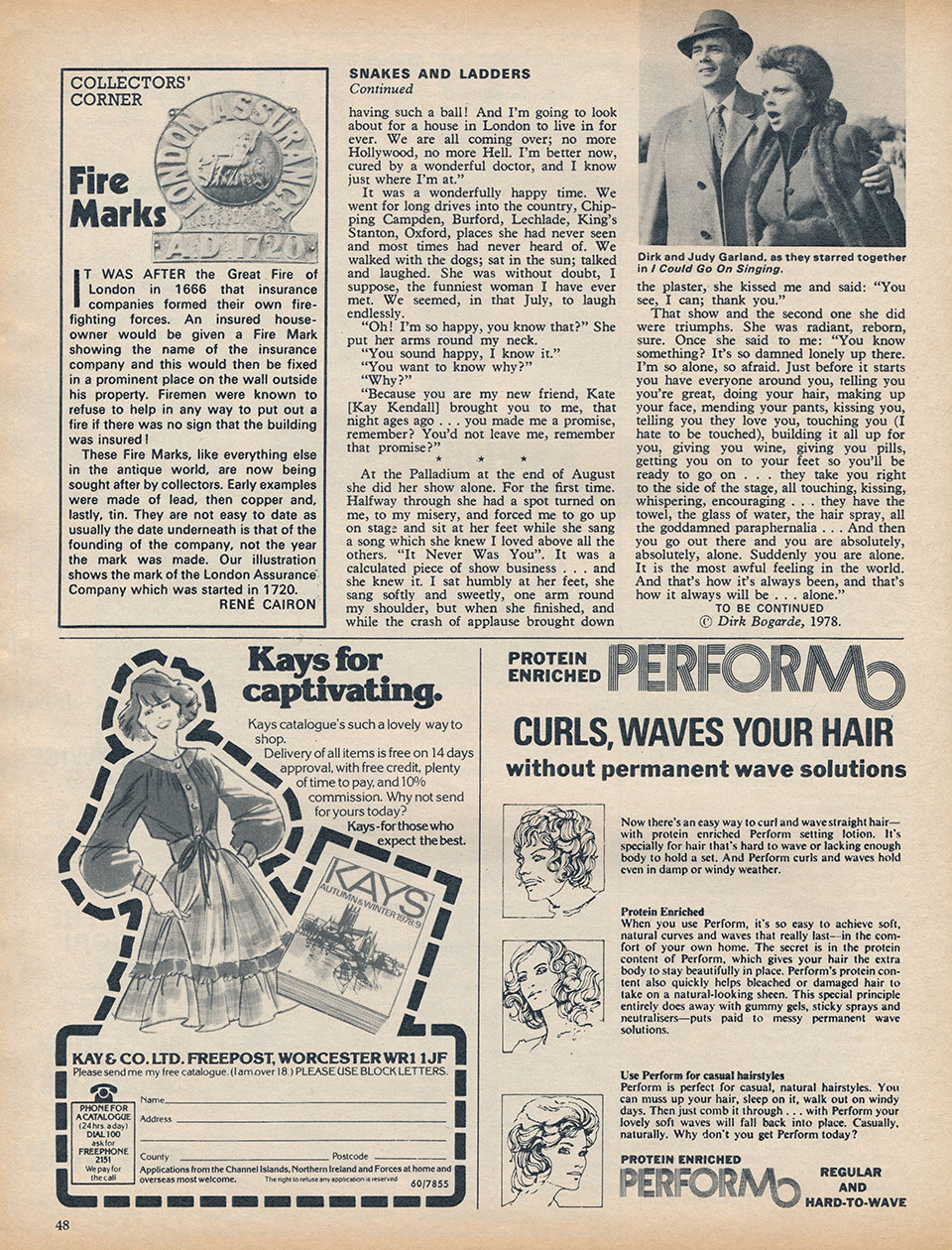
JUDY GARLAND arrived unexpectedly, slightly amazed herself at her own daring, since she had come from Los Angeles quite alone for the first time in her life, with, as she said, “a real purse with real money in it! I’m so excited.” The last time we had met was in my house in Hollywood; then she was fat, ill, moved in a trance, and those wide brown eyes were almost buried in a white puffy face. But now here she was eating a vast breakfast, laughing and giggling, pretty, plump I suppose, but no longer fat, and back on form and ready to go.
“I’m planning a concert, just two nights, at the Palladium, and you’d better be there, but first I’m going to Rome… can you imagine? All alone, no Sid, no family. I’m having such a ball! And I’m going to look about for a house in London to live in for ever. We are all coming over; no more Hollywood, no more Hell. I’m better now, cured by a wonderful doctor, and I know just where I’m at.”
It was a wonderfully happy time. We went for long drives into the country, Chipping Campden, Burford, Lechlade, King’s Stanton, Oxford, places she had never seen and most times had never heard of. We walked with the dogs; sat in the sun; talked and laughed. She was without doubt, I suppose, the funniest woman I have ever met. We seemed, in that July, to laugh endlessly.
“Oh! I’m so happy, you know that?” She put her arms round my neck.
“You sound happy, I know it.”
“You want to know why?”
“Why?”
“Because you are my new friend, Kate [Kay Kendall] brought you to me, that night ages ago … you made me a promise, remember? You’d not leave me, remember that promise?”
❖ ❖ ❖ ❖ ❖ ❖
At the Palladium at the end of August she did her show alone. For the first time. Halfway through she had a spot turned on me, to my misery, and forced me to go up on stage and sit at her feet while she sang a song which she knew I loved above all the others. “It Never Was You”. It was a calculated piece of show business … and she knew it. I sat humbly at her feet, she sang softly and sweetly, one arm round my shoulder, but when she finished, and while the crash of applause brought down the plaster, she kissed me and said: “You see, I can; thank you.”
That show and the second one she did were triumphs. She was radiant, reborn, sure. Once she said to me: “You know something? It’s so damned lonely up there. I’m so alone, so afraid. Just before it starts you have everyone around you, telling you you’re great, doing your hair, making up your face, mending your pants, kissing you, telling you they love you, touching you (I hate to be touched), building it all up for you, giving you wine, giving you pills, getting you on to your feet so you’ll be ready to go on . . . they take you right to the side of the stage, all touching, kissing, whispering, encouraging … they have the towel, the glass of water, the hair spray, all the goddamned paraphernalia … And then you go out there and you are absolutely, absolutely, alone. Suddenly you are alone. It is the most awful feeling in the world. And that’s how it’s always been, and that’s how it always will be … alone.”
TO BE CONTINUED
(c) Dirk Bogarde, 1978.

