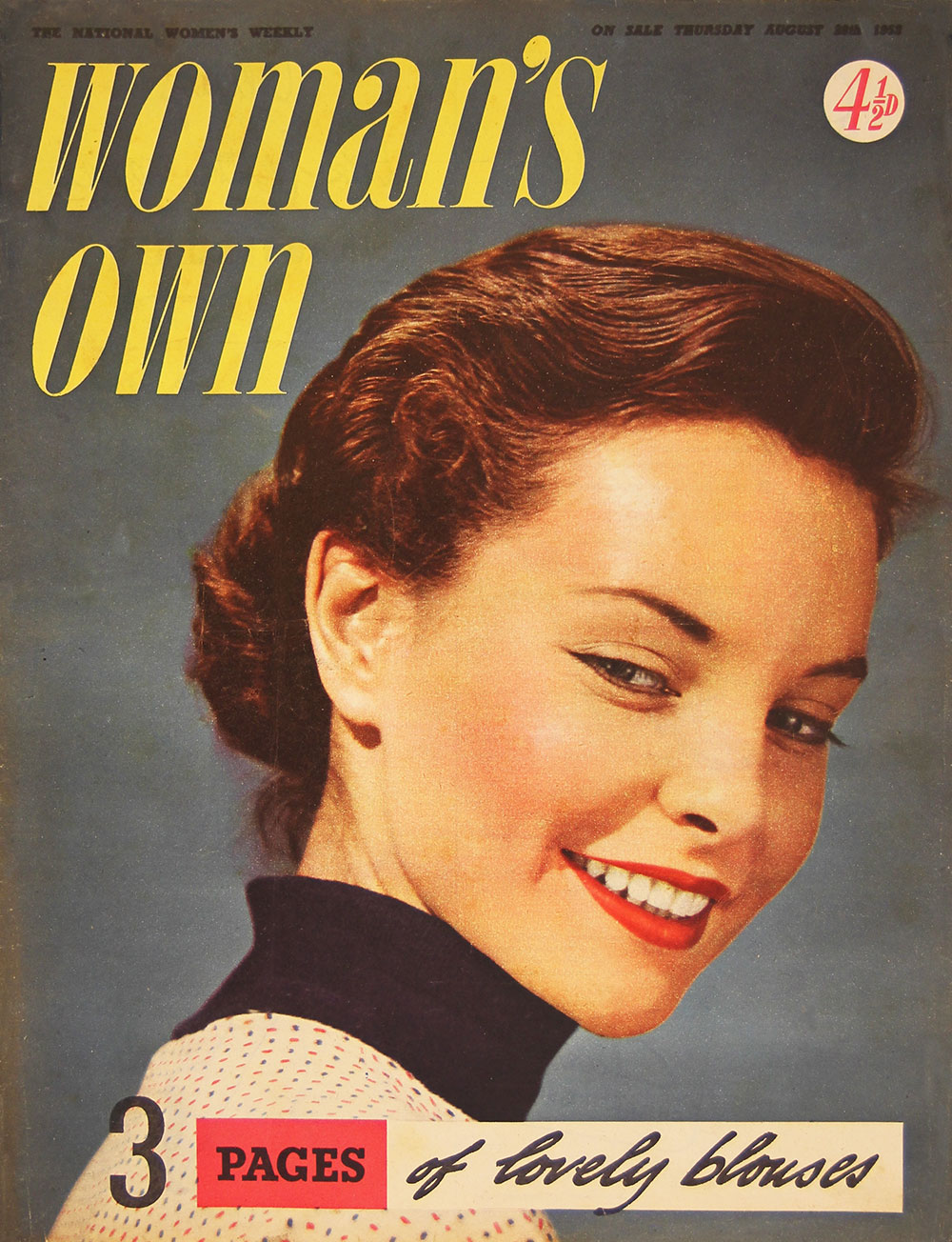
Women’s Own – Aug 29th 1952

Backstage
by Peter Daubeny
I shall always remember that electric night – The night I discovered Dirk Bogarde
From my earliest youth three names in the theatre had fascinated me: Lonsdale, Novello, and Coward. After the war a series of circumstances, part fortuitous, thrust me successively into close association with each of them.
In 1946 I was eogaged on the production of the Frederick Lonsdale play But For The Grace of God.
Freddie Lonsdale arrived from America, nominally to direct his play. I went down to Southampton to meet him; it was a great comfort to eocounter again the red face, the inevitable white socks and white muffler, and the Olympian contempt for the theatre. He is an outstanding example of a man who despises the very medium where be excels. He makes one feel that dramatic success is merely an affair of hocus-pocus; and in the weeks that foUowed while the production of But For The Grace of God took shape, I began to suspect that he was right. It was, as the critics were not slow to point out, in some ways an old-fashioned play, with a touch of melodrama which suggested the ‘eighties, rather than 1946, despite its smart modern jokes.
In incompetent hands the production might have seemed artificial, despite the wit of many of the lines and situations.
But all was transformed by the superlative cut. Nothiog but the very best would do for Freddie. The part of the wife, though admirably drawn, was a comparatively small one. I suggested Mary Jerrold for it.
She accepted, and her playing was to be one of our main delights.
Next, Freddie wanted a star for the part of the young husband, who only appeared for ten minutes towards the end of the last act. I was able to secure the services of Robert Douglas. He played the part admirably and earned himself a Hollywood contract.
In these days of meticulous young directon, I look back with awe and pleasure to the Lonsdale manner of conducting affairs. He would stroll into rehearsals at any unpredictable time, sit down beside A.E. Matthews, who had accepted the part of the Duke, and start gossiping about the Good Old Days at the Garrick Club, without apparently bothering to notice what wu happening on the stage. When he found time to, he directed by a fastidious process of elimination, rather like a connoisseur turning over and rejecting the trash in an antique shop and steadily moving towards the objects of real worth. Then suddenly he would pounce upon something he did not like; an admonitory finger would caress the fruity nose, and out would come a suggestion which, even if caustic, was always to the point.
However unconventional the method, the result was entirely satisfactory. But For The Grace of God opened at the St. James’s on September 3, 1946, after an encouraging provincial try-out. Though at times puzzled by Freddie Lonsdale’s old-fashioned mechanics, particularly by the Pinero-esque first act, the principal critics settled down to enjoy the polished sparkle of Matty. the supporting glow of Mary Jerrold, and above all the extraordinary performance of Michael Gough.
Michael Gough’s study in villainy and perversion, which made him into a star overnight, culminated at the end of the second act in a disastrous fight with the American lover, Hugh McDermott, and in a broken neck. I imported into the theatre that good-natured middle-weight champion Vince Hawkins, to teach and produce the combatants. Though Gough and McDermott were hurt several times during the run of the play, the result was acclaimed as one of the most realistic stage-fights seen on the London stage.
A VISIT TO A STRANDED COMPANY
Towards the end of this run, John Sutro rang me up one day to tell me of a company stranded at the New Lindsay Theatre in Notting Hill, with little to their name but a play called Power Without Glory. The backers who had leased this little playhouse – one of the best experimental laboratories for the theatre in London – had apparently disappeared. The modest enterprise was paralysed; saddest of all, the play, in Sutro’s estimation, was of unusual brilliance, by an unknown young playwright, Michael Clayton-Hutton.
I felt no desire to become involved in this and had no great wish to see tbe play. John Sutro was persistent, however, laying siege to my telephone till I weakly gave in. I would go and see the play “How much,” I asked, “would it cost to put on”? “Two hundred and fifty pounds.” Before setting forth, I made out a cheque for that amount. It was the line of least resistance I felt trapped, and too much of a coward to pass a death sentence upoo these young actors whose whole future might well depend on good· will from outside. Little did I suspect at the time how much it did.
AN ACTOR OF THE FIRST QUALITY
The tiny theatre seemed no bigger than a tool-shed. Immediately I entered, I sensed an atmosphere of acute tension. A few figures, lounging in the auditorium, leapt the few feet on to the stage and took up their positions: for all the world like members of an orchestra waiting, fiddles and trumpets raised, for the first flick of the conductor’s baton.
All at once the adventure, hitherto ridiculous, took on pathos and significance.
Just then, on to the stage rushed a breathless figure, half choking with emotion: a slight, dark youth, radiating a curious, almost hypnotic power; his every movement, every inflection of his voice uncannily suggested the poetry of the gutter, of a lost soul. Beyond any doubt, here was an actor of the first quality. His name, it turned out, was Dirk Bogarde. This performance with Michael Gough’s tour de force in But For The Grace of God and Richard Attenborough’s brilliant study of the G.I. in my production of the American play Home for the Brave were dramatic milestones in the careers of three of the best young actors in the post-war theatre. As I handed my cheque to the director, Chloe Gibson, I felt that in view of Bogarde alone, it was time well spent.
Power Without Glory was acclaimed by the Press as a minor masterpiece. But above all they praised the playing, particularly the performance given by Dirk Bogarde which was described as “brilliant.”
My visit to the New Lindsay Theatre on that bitterly cold winter’s evening had unearthed a new star, discovered the virtues of a young company unknown save for one player, and brought to light an author of exceptional talent. The productton, I felt, deserved a better showing than Notting Hill could give it. With the help of my good friends, A T. Smith and Frederick Starke, the owners of the New Lindsay, I accordingly moved it to the Fortune Theatre.
I invited Noël Coward to the dress rehearsal. He sat through it with tears in his eyes, like an excited schoolboy on his first visit to the theatre. He was profoundly moved.
“This,” he whispered, “is absolutely wonderful; we must make it into an enormous success.”
His enthusiasm touched me deeply; it is one of his most attractive qualities, a genuine and inspired love of the theatre, his belief that at any moment it can throw up its magic for him to catch.
He was most anxious to help the play in any practical way I could mention. I suggested therefore that he gave us an appreciation which we could use for poster advertising all over London. He immediately agreed.
However, despite powerful support from many quarters and the renewed enthusiasm of the critics. Power Without Glory persistently lost money; we were nevertheless able to keep it on for a limited run of eight weeks.
I was obliged therefore to write the venture off as an “artistic” flutter, a gesture which, I hoped, had brought pleasure to the public.
Happily, at the conclusion of the play’s three months’ run, Noël Coward popped into his new productioo Peace In Our Time the whole of my cast, with the exception of Dirk Bogarde who was signed up for a successful career by Rank.
I WAS DISMAYED AT IVOR’S SURPRISE FOR ME
Meanwhile, friendship had landed me in a predicament – a flattering one, perhaps, but a predicament for all that. One day, a few weeks before I became embroiled in Power Without Glory. Ivor Novello rang up and commanded me to come down forthwith to “Redroofs,” his house near Maidenhead. “I have,” he added, “a great surprise for you.”
I had some inkling of the reason for my summons. Three years before, on my first night back in London from fighting abroad, I was sitting in my grim, cheerless hotel bedroom; an air-raid was in progress. Suddenly, amid the bangs, the whines and the whistles, I thought how pleasant it would be to see him again, and to draw vigour from his enthusiasm for living. I hurried round to the Savoy Grill, where be so often dined My luck was in.
He was the first person I set eyet on, as I entered the restaurant In a few minutes I had told him of my intention to go into theatrical management, and on the back of a menu he had assessed the hazards of the enterprise, going into every specific facet of it. When I had been adequately blooded in the theatrical jungle, he would, he promised, write a play especially for me and about my struggles. “As a reward for sticking the course,” he added. No doubt it was this reward which the telephone call had now presaged.
I went to “Redroofs,” and received from Ivor, as he lay in his vast bed, just what I had expected – the play he had written for me. It was not until I was in the train, on my way back to London, that I got a chance to look at it.
Ivor Novello at that moment was at the height of his success.
I was naturally flattered that now I should be the subject, however distorted, of a new play from his hand.
THE PLAY WAS POOR IN COMPARISON TO NOEL’S
As I began to read We Proudly Present, enthusiasm and pleasure drained from me. The play dealt with the varied and ludicrous fortunes of two stage-struck amateurs, fresh out of the army, who go into theatrical management.
Here and there were most amusmg moments, and plenty of good fun, if of a somewhat narrow parochial kind. But the writtng lacked style and wit. Inevitably one was forced to compare it to that brilliant coup de théâtre, Coward’s Present Laughter. Beside it, Ivor’s effort seemed poor and flat.
There could, however, be no question of not putttng it on. Not only had Ivor written it specially for me; but it purported to be based on my own expenences. Moreover, being delighted with it, he was convinced that be was doing me a good turn by slipping into my hands a really big potential money-maker. Perhaps, 1 told myself, fighting back dismay, it might get by, if carefully and cleverly cast.
Here, at least, the Gods were with us. The vital part of the fallen star turned secretary had been specially written by Ivor for Phyllis Monkman
There was but one actress, I felt, for the part of the leading lady – Ena Burrill. We were lucky enough to engage her.
[Continued overleaf]

