Women’s Own – Jan 29th 1958


Bright wallpapers, fresh paint and antique furniture can make the most of any house says film star Dirk Bogarde
What do you want from a house? Some people seem to want their houses to be museums, complete in every detail, but with no room for ordinary living; others want a functional workshop where it does not matter what anything looks like, so long as it works.
For Dirk Bogarde, home must be a place where there is room for everything he likes, from his tropical birds to his collection of American records.
His Queen Anne house in Buckinghamshire is 250 years old; it has to take pictures painted 100 years later, chairs made 50 ears before. But it must also fit all the requirements of Dirk’s extremely busy life.
There is nothing in his house that he did not choose himself – except, of course, the presents, like the painting that actress Glynis Johns gave him as a house-warming gift. He seldom goes to the big shops for his furniture; he likes to dig about in junk yards and small antique shops.
Often, he finds things which seem at first sight to be worthless.He has them repaired and cleaned up, perhaps re-covered, and the result is something that any valuable but beautiful, too.
He has a Georgian bookcase that cost £12 pounds when he bought it and is now worth five times as much: a spinet that cost and £9. And he has the largest Staffordshire china hen in existence, or at least in captivity!
Another fascinating touch is provided by Dirk’s various collections: he has a set of military prints in his bedroom, and the company of tiny, tin soldiers that he began to collect on the set of his first film.
Interested in history, Dirk finds the eighteenth and nineteenth centuries the most fascinating And would have preferred to have lived then.
That’s why he especially enjoyed making his new film, A Tale Of Two Cities, which is set in the eighteenth century. It has its London premiére on February 6.
But he does not try to live in the past. He has a modern kitchen, central heating and a TV set – though he keeps that in a Georgian cupboard.
As well as two corgis and four cats, Dirk has a hamster, a hedgehog, a rook, a squirrel and a baby alligator. There are 34 tropical birds in a Specially constructed aviary and in a heated pond there are over seven dozen varieties of fish.
Each room has a definite purpose – the morning-room really is the place where Dirk reads his mail and drinks his coffee in the mornings; he really does paint in the studio. Not one of his 15 rooms is wasted.
He has managed to make a beautiful home that is easy to live in.
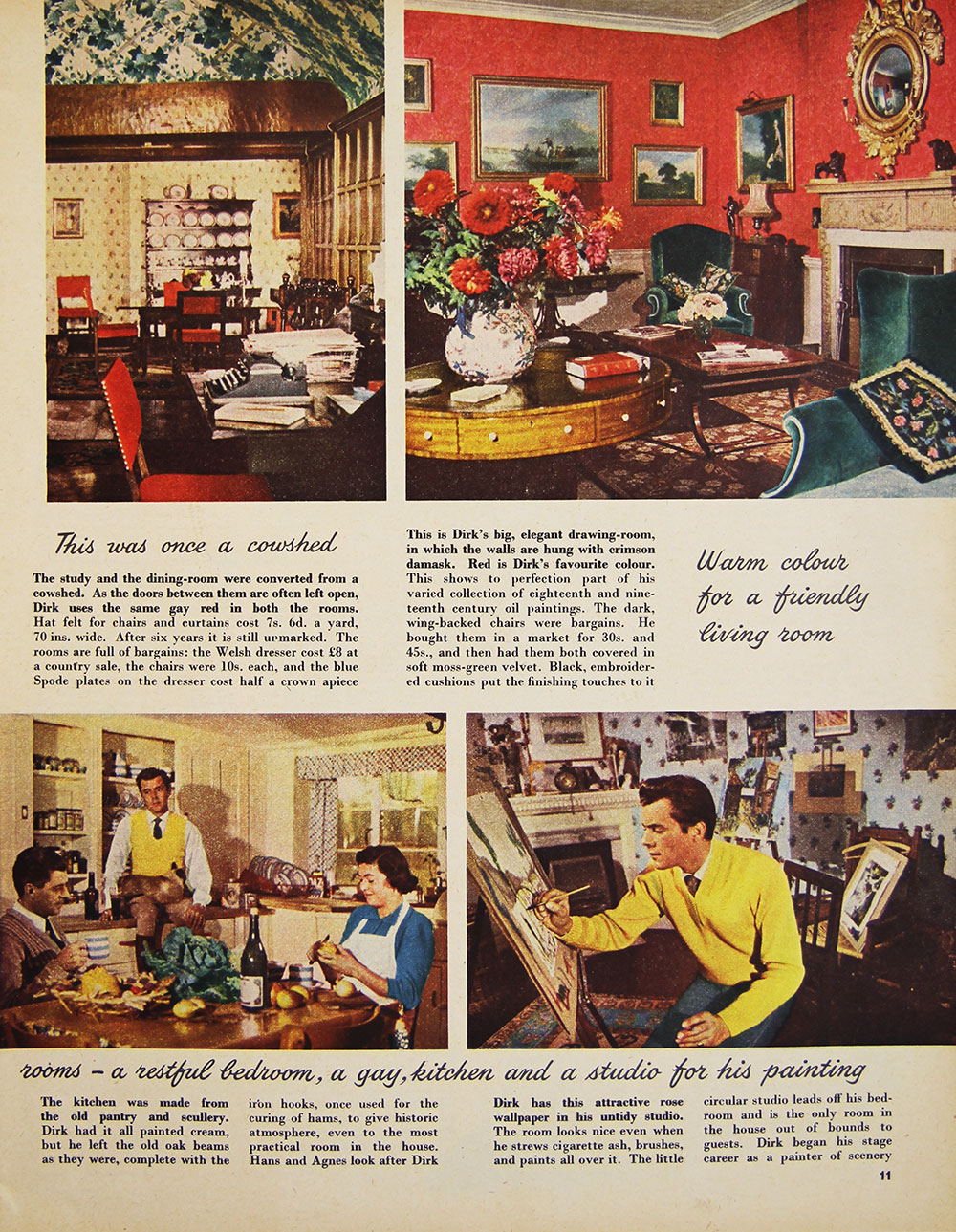
Dirk’s most important rooms – a restful bedroom, a gay kitchen and a studio for his painting
A strong bedside light is essential for Dirk, who reads a lot in bed. The French Empire wardrobes are possibly his most prized possessions; his patchwork quilt is 150 years old.
The kitchen was made from the old pantry and scullery. Dirk had it all painted cream, but be left the old oak beams as they were, complete with the iron hooks, once used for the curing of hams, to give historic atmosphere, even to the most practical room in the house. Hans and Agnes look after Dirk.
Dark has this attractive rose wallpaper in his untidy studio. The room looks nice even when he’s strews cigarette ash, brushes, and paint all over it. This little circular studio leads off his bedroom and is the only room in the house out of bounds to guests. Dirk began his stage career as a painter of scenery
10 tips from Dirk on Decoration
• Put something read in every room in the house.
• Try a gay, patterned paper on the ceiling.
• A mirror over the fire gives the room extra size.
• If furniture doesn’t match, one bold colour will give a room that unity.
• Do not be afraid to have the same wallpaper into different rooms.
• Cover the TV set when you’re not watching it.
• Always have plenty of books in all your rooms.
• China on one or two of the bookshelves.
• Search the junk shops for interesting oddments, and display them boldly.
• Use plain curtains to offset patterned chair covers and wallpapers.
This was once a cowshed
The study and the dining-room were converted from a cowshed. As the doors between them are often left open, Dirk uses the same gay red in both the rooms. Hat felt for chairs and curtains cost 7s. 6d. a yard, 70 ins. wide. After six years it is still unmarked. The rooms are full of bargains: the Welsh dresser cost £8 at a country sale, the chairs were 1Os. each, and the blue Spode plates on the dresser cost half a crown apiece.
Warm colour for a friendly living room
This is Dirk’s big, elegant drawing-room, in which the walls are hung with crimson damask. Red is Dirk’s favourite colour. This shows to perfection part of his varied collection of eighteenth and nineteenth century oil paintings. The dark, wing-backed chairs were bargains. He bought them in a market for 30s. and 45s., and then had them both covered in soft moss-green velvet. Black, embroidered cushions put the finishing touches to it.

